A subrogation demand letter template needs eleven elements: the letterhead and date, the responding carrier's details, your own claim details, the facts of loss, the basis of liability, the amounts paid, the insured's deductible, the enclosures, the ask and the reply date, what happens if the other carrier disputes it, and a signature. The template below annotates each with where its facts come from in the claim file and which rule, if any, governs it. The hard part is not the wording but the sourcing: every amount must match a payment, every liability fact must point to a document, and in California the insured's deductible must be in every demand. Botminds' Subrogation Demand & Arbitration fills the template from the claim file itself, citing each fact to its page, tying each amount to a payment and checking the result before a subrogation specialist sends it.
Examples come from a fictional sample recovery unit, Harborline Mutual, and its files; the people, carriers and amounts are invented. Rules and statutes are quoted from their own texts and linked where they appear.
The subrogation demand letter template, annotated
1[Your company] · Subrogation demand · [date]
Letterhead and date
The date starts your own follow-up clock.
2To: [Responding carrier], [handler name], [address] · Your claim [number] · Your insured [name]
Who you are writing to
The forum’s minimum: the other side’s insured, claim or policy number and handler’s address.
3Re: Our insured [name] · Our claim [number] · Date of loss [date] · [place]
What the demand is about
Claim file: first notice and policy.
4On [date] at [time], your insured [what they did] [exhibit, page]. Our insured [what they did] [exhibit, page].
Facts of loss, each cited
Crash report narrative, statements, photographs, recorder data.
5Your insured was cited under [statute] for [conduct] [exhibit, page]. [The rule of the road] required [duty].
Why they are liable
Police citation; the loss state’s code, e.g. Ohio § 4511.42 on left turns.
6We paid: repairs $[ ] · rental [days] × $[ ] · towing $[ ] · storage $[ ] · less salvage $[ ] = $[company-paid] [payment exhibits]
What you paid, line by line
Payments on the claim, invoices, salvage sale.
7Our insured’s deductible: $[ ]. Total demand: $[company-paid + deductible].
The deductible, stated
Policy declarations; California and Washington require it in every demand.
8Enclosed: D-1 [document] · D-2 [document] · … · proof of payment
Every enclosure listed
Anything cited is enclosed; anything enclosed is cited.
9Please pay $[total] to [your company], or reply with your position, by [date].
The ask and the deadline
Your setting; no rule we found fixes it between insurers.
10If liability or damages are disputed, we will file in inter-company arbitration, [forum].
What happens next
Only if both carriers signed that forum’s agreement.
11[Name], [title], [phone, email]
Who stands behind it
The specialist who checked and sent it.
What should a subrogation demand letter include?
Enough for the other adjuster to pay without asking for anything, and enough for an arbitrator to decide if they do not. No statute prescribes the letter for insurer-to-insurer demands, but the arbitration rules behind most of them set a floor and a direction. The floor is identification: the rules of Arbitration Forums, the not-for-profit run by its insurer members, require at minimum that the filing company name the insured, give a claim or policy number, and, if asked, a correct current address for whoever handles the claim for the other side (AF Rules). A demand that gets those right carries them into any filing; one that gets them wrong risks a closed filing or a voided decision, as the subrogation demand package guide sets out.
The direction is proof. The same rules tell members to try to settle before filing, and the forum's FAQ explains what helps a payer accept a number: proof of payment, which arbitrators use to check the damages arithmetic, such as a deductible counted twice or a salvage return left in (AF FAQ). A template that leaves room for the enclosures and their citations is doing half the work of the eventual filing.
Do you include the deductible in a subrogation demand?
Yes, and in some states it is mandatory. California's regulation: “Every insurer that makes a subrogation demand shall include in every demand the first party claimant's deductible.” Washington, under its rule as amended from 18 October 2026: “The insurer must include the insured's deductible, if any, in its subrogation demands.” The NAIC's model regulation requires it on the claimant's request. Both California and Washington also bar deducting expenses from the deductible recovery unless an outside attorney (or, in California, a collection agency) is retained, and then only a pro rata share of the allocated loss adjustment expense.
California adds a duty to the insured: written notice telling the first-party claimant whether it will pursue subrogation, and if it will not, a statement that any recovery is the insured's own responsibility. In the template, the deductible sits on its own line (element 7), below the company-paid total and never inside it. That matters if the demand becomes an arbitration filing, because the forum's rules keep the deductible out of the company-paid total (AF Rules; the rule is quoted in intercompany arbitration rules). On the sample unit's Delgado file, a draft that entered the $500 deductible inside $16,333.40 of damages was corrected to $15,833.40 company-paid, with the deductible claimed as the insured's interest.
What documents go with a subrogation demand?
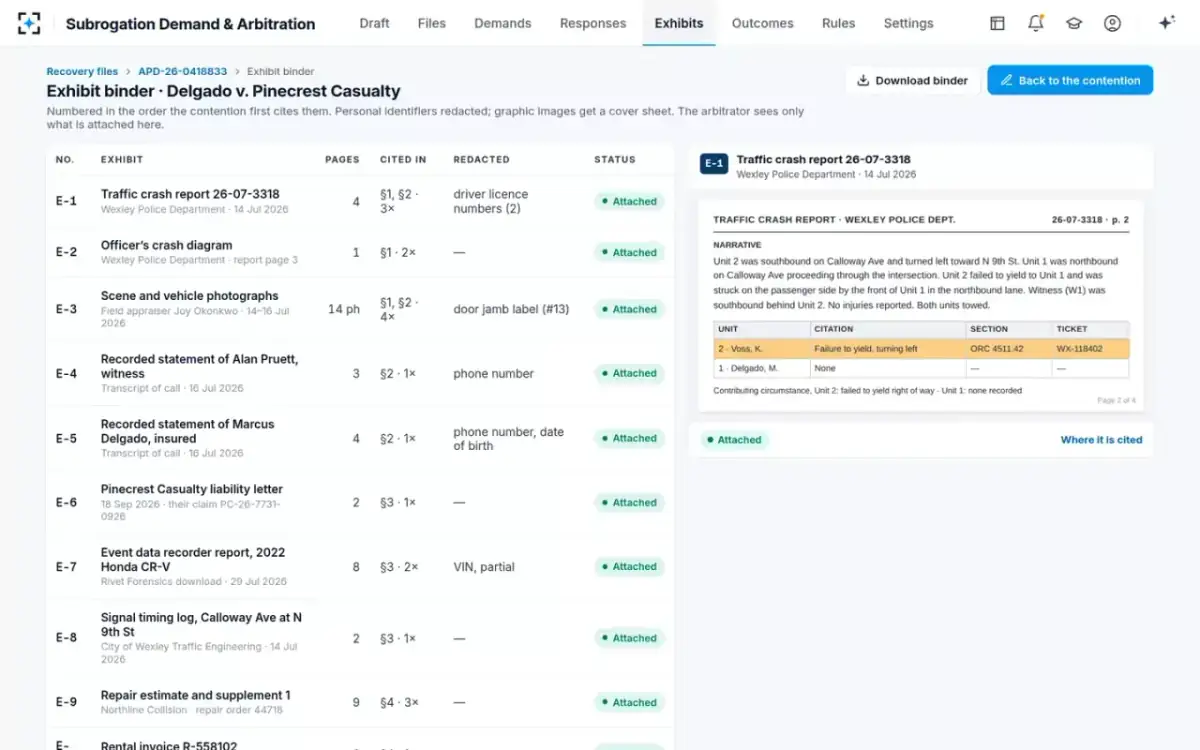
Whatever proves liability, and whatever proves each amount. The table lists the documents a property or auto demand usually carries, what each proves and where it lives in the claim file.
The enclosures, what each proves, and where to find it
| Document | Proves | Where in the file |
|---|---|---|
| Police crash report and diagram | What happened, who was cited, under which section | First notice; police portal or request |
| Scene and damage photographs | Points of impact, damage pattern, debris field | Field appraiser or insured |
| Recorded statements, as written transcripts | Each driver’s and witness’s account | Adjuster’s statements; the forum wants transcripts, not audio |
| Event data recorder report or video | Speed, braking, signal phase, sequence | Download vendor; dash cam or security footage |
| Estimate and supplements | Scope and cost of repair | Appraisal system |
| Rental, towing and storage invoices | Each extra cost, with dates | Vendor invoices on the claim |
| Proof of payment | That each amount was paid, and to whom | Payments on the claim |
| Salvage sale, for a total loss | The amount to deduct from the paid value | Salvage auction statement |
| Expert or forensic report, for property | Cause: failed part, faulty installation | Engineer; with chain of custody for the part |
Two items deserve care. Recorded statements: the forum's Reference Guide wants the written transcript, not the audio, declared and filed as evidence (AF Reference Guide). Sending the transcript with the demand saves converting it later. And amounts the forum will never award: the guide says damages “cannot include an insurer’s or self-insured’s operating expenses”, and the FAQ adds that gap insurance payments are not recoverable in the Auto forum because they are not damages from the loss. A demand that asks for them invites a dispute it cannot win.
The enclosures as an exhibit binder: numbered, cited, redacted
How long should a subrogation demand letter be?
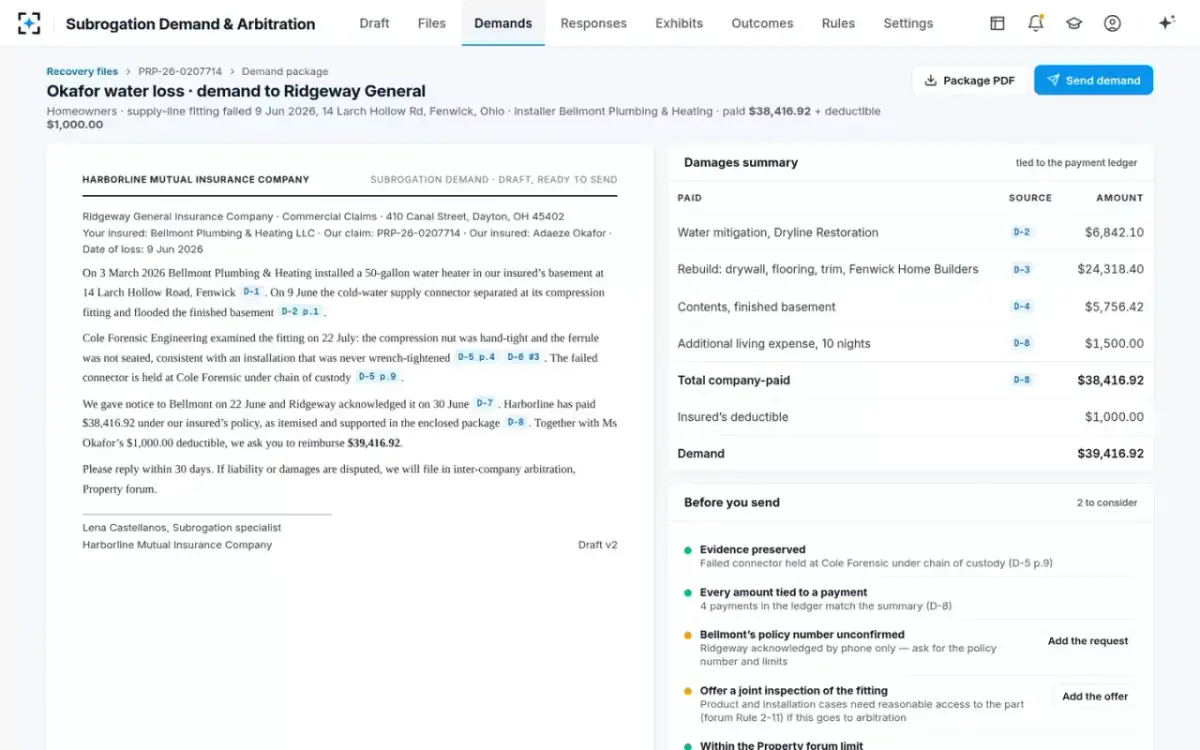
One to two pages for most property and auto demands; the enclosures carry the length. The sample unit's water-loss demand is four short paragraphs: what was installed, when and how it failed; what the forensic engineer found; the notice, the amount paid, the deductible and the ask; and the reply date with what follows if it is disputed. Everything else is in the damages summary and the cited documents. A long letter is usually a letter repeating its enclosures, and every repeated figure is one more place for two numbers to disagree.
The liability paragraph is where brevity pays most. One sentence of fact, one of rule and one citation each beats a page of argument. In the Delgado file the liability case is that the other driver turned left across the insured's lane and was cited for it, and Ohio's rule requires a driver turning left to “yield the right of way to any vehicle, streetcar, or trackless trolley approaching from the opposite direction” that is close enough to be an immediate hazard. Element 5 of the template is that, and nothing more.
What is a reasonable deadline in a demand letter?
For an insurer-to-insurer property or auto demand, the deadline is the demanding carrier's choice; we found no rule that fixes it. The sample unit asks for a reply within 30 days and follows up if none comes. The deadline matters less for its length than for what follows it: once arbitration is filed, the forum's own clocks take over, and the responding carrier is notified 30 days before its response is due. How long the whole process runs is priced in how long inter company arbitration takes.
Injury claims are different. A claimant's time-limited demand to a liability insurer is governed in several states by statute, and missing it can expose the insurer to an excess judgment; that is a casualty claims subject, covered in time limit demands by state. Nothing in a subrogation template should borrow that language.
Auto and property demands are built differently
The same eleven elements serve both, but what fills them changes. An auto demand turns on a few minutes at an intersection and a repair bill; a property demand turns on cause, often a failed part or a contractor's work, and on a larger, mixed bill.
The same template, filled for an auto loss and a property loss
Auto: the Delgado left turn: Crash report citation, witness transcript, recorder data, signal timing log.
Property: the Okafor water loss: Forensic engineer’s finding on the fitting, notice and acknowledgement letters.
Auto: the Delgado left turn: The other driver’s auto liability carrier.
Property: the Okafor water loss: The plumber’s general liability carrier.
Auto: the Delgado left turn: Repair, supplement, rental days tied to repair dates, towing, storage.
Property: the Okafor water loss: Mitigation, rebuild, contents, ten nights of additional living expense.
Auto: the Delgado left turn: $500, on its own line.
Property: the Okafor water loss: $1,000, on its own line; demand $39,416.92 on $38,416.92 paid.
Auto: the Delgado left turn: Automobile forum.
Property: the Okafor water loss: Property forum; claims based on a product defect are excluded unless consented, installation claims are not.
Auto: the Delgado left turn: The other side’s speed claim; answer it with the recorder.
Property: the Okafor water loss: The failed part: preserved, and a joint inspection offered.
The property template, filled: a water-loss demand with its damages summary
Who signs a subrogation demand letter?
The subrogation specialist who checked it, under the carrier's name, with a direct phone and email. The signature is a promise that each line can be defended, so the signer should be the person who opened the sources, not the person who typed the template. Some demands need more than one signature by policy: on the sample unit, anything that would become a filing over $25,000, or that offers to accept less than full liability, goes to the recovery supervisor first, and claims involving legal fees or pleadings go to claims counsel.
How Subrogation Demand & Arbitration fills the template before a person signs
Agent
Claim file readerFinds each fact the template asks for, with its page: parties, claim numbers, time, place, what each driver did.
Never: Never fills a field it could not source
Agent
Damages reconcilerBuilds elements 6 and 7 from the payments: each line tied to an invoice, salvage deducted, deductible apart.
Never: Never claims an amount that was not paid
Agent
Contention writerWrites elements 4 and 5 plainly, one cited sentence per fact, and the rule of the road by section.
Agent
Exhibit assemblerNumbers the enclosures in citation order and redacts licence and plate numbers, dates of birth and phone numbers.
Never: Never alters a document’s content
Agent
Forum rules checkerChecks the letter against the loss state’s deductible rule and the forum’s evidence rules; lists weak points.
Never: Never sends
A person decides
Subrogation specialistOpens the sources, fixes or accepts each finding, signs and sends.
Mistakes a template will not catch, and Subrogation Demand & Arbitration checks
A template guarantees the headings; it guarantees nothing underneath them. The errors that cost recoveries are all in the fields, and each needs a check against something outside the letter. The order below follows how often the sample unit's rules check found them in drafts.
Five errors that slip through a filled-in template
- A cited document that is not enclosed
The commonest finding on the sample unit’s drafts. In arbitration, the arbitrator may only consider evidence listed and attached.
- The deductible inside the company-paid total
Ask for it, but on its own line; an arbitration filing must keep it out of company-paid damages.
- A quoted witness with no transcript
Quote only what you enclose; the forum takes the written transcript, not the recording.
- A total that matches the estimate, not the payments
Paid amounts, less salvage and prior payments, are what the other carrier owes.
- The wrong responding carrier or handler
The rules let a filing be closed or a decision voided for wrong details.
Each of these is cheap to fix in a demand and expensive in a filing. The full case for keeping the person who fills the template apart from the check that reads it is in the subrogation demand package.
Questions people ask
Is there a standard subrogation demand letter format?
No statute or forum prescribes one for insurer-to-insurer demands; carriers use their own templates, and members of Arbitration Forums can exchange demands through its E-Subro Hub. What the forum does require, if the demand becomes a filing, is the other side's insured name, claim or policy number and handler's address.
How do you write a subrogation demand letter that gets paid?
State the liability in two or three cited sentences, list each amount paid with its invoice and payment, put the deductible on its own line, enclose everything you cite, and give a reply date. The other adjuster pays faster when nothing needs to be requested.
Can a subrogation demand include rental, towing and storage?
Yes, if the insurer paid them under the policy; Arbitration Forums' Reference Guide lists towing, storage, rental reimbursement and salvage expenses as part of an Auto claim when paid out of the insured's policy. Rental days are often disputed against the repair dates, so enclose both.
Should a subrogation demand mention arbitration?
If both carriers are signatories to the relevant forum, saying so tells the other adjuster where a dispute will go and that the file is built for it. If either is not, arbitration is voluntary and needs written consent, so the letter should not promise it.
What happens if the deductible is left out of a subrogation demand in California?
The demand breaches California's fair claims regulation, which requires the first-party claimant's deductible in every subrogation demand and proportionate sharing of recoveries. It also leaves the insured's money unclaimed, which is the part customers notice.