Yes, intercompany arbitration is binding, but only on the insurers. Arbitration Forums, Inc., the not-for-profit whose insurer members run it, tells them that “All decisions regarding liability and/or damages are final and binding.” There is no appeal in the Automobile, PIP and Medical Payment forums, and in Property and Special only above set amounts; New York's mandatory loss-transfer arbitration says the same by regulation. The insured is a different matter. The same forum answers its members that “The insured is not a party to the agreement.” The decision does not decide the insured's own claims, cannot be shown to them, and does not stop their insurer refunding a deductible whatever the arbitrator found. Botminds' Subrogation Demand & Arbitration, software that drafts recovery demands and arbitration contentions from the claim file with every fact cited, keeps the insured's deductible apart from the company's damages from the first draft, because that is where the two halves of this answer meet.
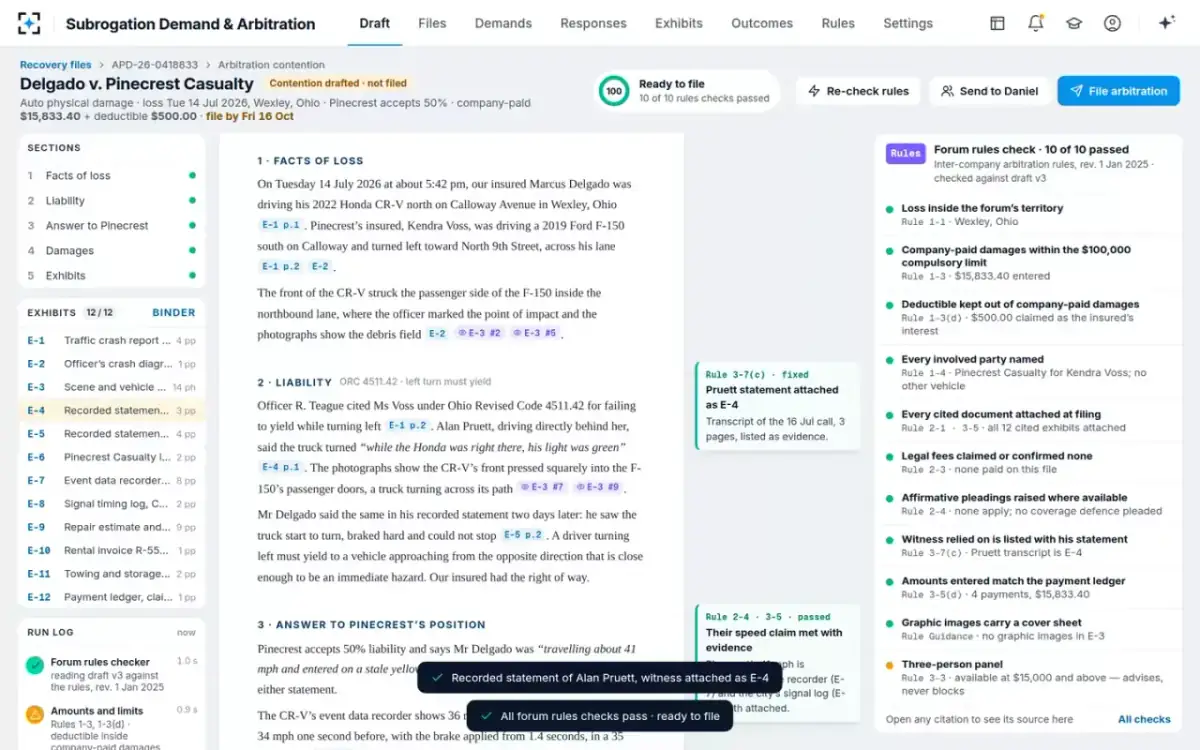
Worked figures use a fictional sample file, Delgado v. Pinecrest Casualty, as it runs through the solution: $15,833.40 paid by the sample carrier and a $500 deductible. The people, carriers and amounts are invented. This page explains how the process works; it is not advice on any person's claim.
Bound, told, paid: the insurer and the insured side by side
The signatory insurer: Yes: it filed or was filed against under an agreement it signed.
The insured: No. The agreement binds only the signatory companies.
The signatory insurer: Yes, on liability and damages, between the companies in the case.
The insured: No. The decision is conclusive only as to the parties.
The signatory insurer: Yes, on the forum’s website when it is published.
The insured: No. The forum says decisions may not be shared with insureds.
The signatory insurer: Only in Property ($10,000+) and Special ($100,000+), within 30 days; errors can be flagged within 30 days.
The insured: No. There is no route for an insured into the case.
The signatory insurer: Pays, or receives, the award within 30 days.
The insured: Recovers a deductible through its insurer, under its state’s rules.
The signatory insurer: Not on what was decided; yes on a matter closed for lack of jurisdiction.
The insured: Its own claims are untouched by the decision.
Is intercompany arbitration binding on the insurers?
Yes, and deliberately so: speed and finality are what the members signed up for. The Reference Guide explains that under the agreements “decisions are final and binding without the right of rehearing or appeal”, except for clerical or jurisdictional errors and the appeals Rule 2-12 allows in the Property and Special forums. It also explains why the smaller forums have none: the members want quick, binding resolution, “This is why decisions cannot be appealed in the Automobile, PIP and Medical Payments forums.”
The narrow exits are worth knowing exactly. Within 30 days of publication either side can claim a clerical error (a miscalculation, the parties switched, evidence called missing that was in fact submitted) or a jurisdictional one (an exclusion ignored, or raised by the arbitrator on their own); the forum decides, and its decision is final. A dissatisfied party cannot reargue the facts: the Reference Guide is explicit that an arbitrator finding that a statement does not support an allegation is interpretation, not a correctable error. And for 60 days a responding carrier may still raise no policy, a denial of coverage, policy limits or a liability deductible, which can void or limit the award.
Where the law makes arbitration mandatory, it says the same. New York's regulation for loss-transfer disputes: “The decision of a majority of an arbitration panel shall be final and binding upon the insurers to the controversy. There shall be no right of rehearing or appeal.” Minnesota sends certain no-fault indemnity claims to binding arbitration that the parties must enter in good faith (Minn. Stat. § 65B.53). And when a binding award goes unpaid, courts enforce it: in New York, for example, “The court shall confirm an award upon application of a party made within one year after its delivery to them”, while an application to vacate must come within 90 days under CPLR 7511.
Can an insured appeal an intercompany arbitration decision?
No, because an insured is never in the case to begin with. The agreements are open only to insurers, self-insureds and commercial insureds with large retentions; the forum's FAQ says individuals cannot take part “even if they should wish to participate.” An insured or witness may join a hearing call only to clarify a statement already in evidence, beside a company representative, and Rule 3-7(c) adds that what a witness says on the call is not evidence (AF Rules).
The flip side is that the decision does not bind the insured either. The forum quotes its own agreements to members: a decision is “conclusive only of the issues in the matter submitted to the panel and only as to the parties to the arbitration.” The Reference Guide adds that decisions are neither res judicata nor collateral estoppel to other claims or suits from the same accident, other than a later filing for supplemental damages between the same companies. Minnesota goes further for its no-fault indemnity arbitrations: “No evidence nor the decision in such an arbitration proceeding shall be admissible in any action by any party.”
Does an arbitration decision affect my deductible?
In practice, often yes, though not because it binds the insured: the deductible usually comes back out of the same money. The forum's rules require the paying carrier to include it: payments must carry any deductible interest, as goodwill between companies (AF Rules, quoted in intercompany arbitration rules), and the Reference Guide treats the deductible as a courtesy calculation rather than part of the award (AF Reference Guide). What the insured then receives from their own insurer is set by state rules, not by the forum.
One $500 deductible, three possible decisions
DecisionPinecrest found 100% liable
Paid by the other carrier$15,833.40 + $500.00 deductible interest
Back to the insured$500.00
WhyThe whole deductible comes back.
DecisionLiability split 50/50
Paid by the other carrier$7,916.70 + $250.00 deductible interest
Back to the insured$250.00
WhyWashington: deductible less comparative fault. California: a proportionate share of the recovery. Both give $250 here.
DecisionOur insured found 100% liable
Paid by the other carrierNothing
Back to the insured$0 from the award
WhyThe carrier may still refund the deductible; the forum says signatories are free to.
Washington's rule, as amended from 18 October 2026, is the clearest statement of the insured's priority: “Any recoveries must be allocated first to the insured for any deductible(s) incurred in the loss, less applicable comparable fault.” California requires every insurer to “share subrogation recoveries on a proportionate basis with the first party claimant” unless the insured has recovered the whole deductible otherwise. Both bar taking collection expenses out of the deductible unless outside counsel (or, in California, a collection agency) was retained, and then only a pro rata share.
In Subrogation Demand & Arbitration, the deductible is claimed as the insured's interest
Can I see the arbitration decision on my claim?
Not from the forum, and usually not from the insurer either. Rule 2-13 makes every filing, decision and award confidential, and the FAQ answers the members' question directly: “Decisions may not be shared with insureds.” The Reference Guide gives the reasoning: since the decision is neither res judicata nor collateral estoppel, “there should be no reason to disclose the decision to any other party.”
What an insured is owed is information from their own insurer, and some states set it out. California requires written notice telling the first-party claimant whether it will pursue subrogation, and, if the insurer will not, a statement that any recovery is the insured's own responsibility. Washington requires the insurer to contact the insured within 60 days of starting subrogation and at least every 180 days until the insured's interest is resolved. Neither requires the arbitration decision itself to be shown.
What happens if my insurer loses arbitration?
The insurer does not recover from the other carrier, and the insured's deductible does not come back through that award. That is not necessarily the end for the insured. The forum tells its members plainly that the result does not tie their hands with their own customers:
“Signatories are free to handle their insured's claims as they deem appropriate, i.e., refund deductible, assess no liability, regardless of the arbitration decision.”
Arbitration Forums, Frequently Asked Questions (answer to its insurer members)
So a loss in arbitration is a decision between companies about who pays whom. Whether the insured's own record or premium is affected is a question for their policy and their state's rating rules, not for the forum; and because the insured was not a party, the decision does not settle any claim the insured may have against the other driver. An insured with questions about their own situation can ask their insurer or their state's insurance department.
Is intercompany arbitration the same as going to court?
No. It is a private, paper-based process between companies. Hearings are informal and confidential, with no recording; formal rules of evidence do not apply; the arbitrators are claims professionals at member companies, not judges; the standard is a preponderance of the evidence; and there are no default judgments, so even an unanswered filing must be proved. Courts come in at the edges: to enforce an award that is not paid, or to hear a claim that the forum closed for lack of jurisdiction. The forum says an exclusion upheld leaves the right to recover elsewhere untouched and is not a finding that nobody was liable (AF FAQ).
What happens to the insured's interest from filing to refund, in Subrogation Demand & Arbitration
Agent
Damages reconcilerKeeps the deductible out of company-paid damages and shows it as the insured’s interest on every draft.
Never: Never counts the deductible as company money
A person decides
Arbitration specialistFiles the contention with the deductible on its own line.
A person decides
ArbitratorDecides liability and damages between the companies; the deductible appears as a courtesy calculation.
A person decides
Responding carrierPays the award within 30 days, including any deductible interest.
A person decides
Recovery deskAllocates the recovery to the insured’s deductible as the loss state requires and tells the insured.
Can I sue the other driver after arbitration?
The arbitration decides nothing about the insured's own rights; whether and how an insured can pursue the other driver for losses the insurer did not pay is a question of state law and deadlines, and of the share of the claim that passed to their insurer when it paid. The forum's position is only that its decision is not res judicata or collateral estoppel to other claims or suits from the same accident. Statutes of limitations by state are set out in the Subrogation Identification guide to the statute of limitations on subrogation claims; how the insured's deductible is shared after an award is set out in subrogation deductible reimbursement rules; anything specific to a person's claim is for a lawyer or the state insurance department.
What customer-facing staff can tell an insured
The rules leave carriers to explain a process their customers cannot see, and the safest explanation comes from the deductible rules, not the award. The list below is what each statement rests on.
Statements about arbitration a claims representative can make, and their basis
- ‘We are pursuing recovery from the other insurer, and your deductible is part of what we ask for.’
California and Washington require the deductible in subrogation demands.
- ‘The dispute is between the two insurance companies; you are not a party and do not need to appear.’
The forum’s agreements bind only signatory companies.
- ‘We cannot share the decision itself.’
The forum’s rules make decisions confidential and its FAQ says they may not be shared with insureds.
- ‘Here is what we recovered for your deductible, and how it was calculated.’
In Washington, recoveries go first to the deductible less comparative fault; in California, they are shared proportionately.
- ‘The decision does not settle any claim you may have against the other driver.’
The forum says decisions bind only the parties and are not res judicata to other claims.
The decision and its paperwork are where these statements start. On the sample unit's outcomes page, three awards totalling $41,018.32 are owed to the carrier, each on its 30-day clock; each will carry deductible interest that has to reach an insured. The life of a disputed file before that point, and who waits on whom along the way, is drawn in intercompany arbitration: who waits on whom, and the rules themselves are summarised in intercompany arbitration rules in plain words.
Questions people ask
Is intercompany arbitration binding on insurers that did not sign the agreement?
No, unless they consent in writing or answer a filing without objecting to jurisdiction; Arbitration Forums treats such an answer as implied consent and its decision as final and binding on the consenting party. Some states, such as New York for no-fault loss transfer and the District of Columbia for auto physical damage, make arbitration between insurers mandatory by law.
Does arbitration decide who was at fault for my insurance record?
It decides only how the two insurers share the cost. Whether an accident counts against a driver for rating purposes is governed by the policy and the state's rules; Massachusetts, for example, has its own standards for when a driver is presumed more than 50% at fault.
Can my insurer refund my deductible if it loses arbitration?
Yes. Arbitration Forums tells its members they are free to handle their insureds' claims as they see fit, including refunding a deductible, regardless of the arbitration decision.
How long after an arbitration decision do insurers pay?
The responding company must pay within 30 calendar days of publication, including any deductible interest. If it does not, the recovering company sends two payment requests 30 days apart and may then sue to collect, with statutory interest and collection costs.
Can an arbitration decision be changed after it is published?
Only for a clerical or jurisdictional error raised within 30 days, a coverage defence the responding company raises within 60 days, or an appeal in the Property and Special forums above their thresholds. Disagreement with how the arbitrator weighed the evidence is not grounds.