The intercompany arbitration rules that signatory U.S. insurers follow in their subrogation disputes are the Arbitration Forums, Inc. Rules, written and administered by a not-for-profit whose members are insurers and self-insureds; the current edition took effect on 21 October 2024 and was revised on 1 January 2025. In plain words: try to settle first; the forum hears auto, property, medical payment and uninsured motorist disputes up to $100,000 of company-paid damages, and Special Arbitration contribution disputes up to $250,000; the insured's deductible does not count towards the limit; evidence must be attached when you file and nothing can be amended later; any point not raised in its own section is waived; the arbitrator decides only on what is listed and attached; and the loser pays within 30 days. A handful of states make insurer-to-insurer arbitration mandatory by statute. Botminds' Subrogation Demand & Arbitration drafts demands and contentions from the claim file, every fact cited, and checks each draft against the edition of these rules it will be filed under before a specialist files.
Every rule below is quoted or summarised from the forum's own rules, Reference Guide (revised 9 June 2026) and FAQ, which are written for its insurer members; statutes are quoted from their official texts. Examples come from a fictional sample recovery unit, Harborline Mutual, whose people and figures are invented.
The intercompany arbitration rules on one page
Before filing
PreambleTry to settle first. Name the other side’s insured, claim number and handler correctly.
1-1Losses in the United States, Puerto Rico and the U.S. Virgin Islands.
1-3$100,000 company-paid cap ($250,000 in Special); deductible and legal fees not counted.
1-4Name every involved member; let an unnamed party’s fault be heard and you waive the balance.
Filing and answering
2-1File online with evidence attached; no amendments, no reschedules.
2-2Answer by the due date; a counterclaim must come with the answer.
2-3 · 2-4Legal fees, pleadings and exclusions: raise them where provided or lose them.
2-5Dispute damages on the Feature Response step or not at all.
Time
2-9One response extension, 15 days, for a fee.
2-10Any party may defer a year; the first is free.
3-1The responder is notified 30 days before its response is due.
2-1Special Arbitration within 180 days of paying the claimant.
The hearing
3-3One arbitrator; three may be requested at $15,000 and above.
3-5Only listed and attached evidence counts.
3-6Informal and confidential; formal rules of evidence do not apply.
3-7Witnesses may only clarify a statement already in evidence.
The decision
4-1No default judgments; decided on the evidence.
4-230 days to flag a clerical or jurisdictional error.
3-960 days for certain coverage defences.
2-12Appeal only in Property ($10,000+) and Special ($100,000+).
The money
5-1Pay within 30 days, to the recovering company, with any deductible interest.
5-2Unpaid: request, second request, then court.
5-3Supplemental damages later; liability is res judicata.
6-1The recovering company pays the filing fee.
What is the compulsory limit in Arbitration Forums?
$100,000 of total company-paid damages in the Automobile, Medical Payment, Property and Uninsured Motorists forums; $250,000 of contribution sought in Special Arbitration; and in PIP, whatever limit the statute or endorsement creating the recovery right sets. Rule 1-3 then excludes two things from the count: “(c) The legal fees are not considered part of the program limit unless the policy limit includes legal fees.” and “(d) The deductible is not included as part of the total company-paid damages.” The Reference Guide's example: a filing with $99,000 of company-paid damages and a $5,000 deductible is heard, although the total is $104,000.
The limit applies per feature, meaning per damaged vehicle, injured person or property, not per accident. Above it, arbitration is voluntary. A recovering company that wants the forum anyway can cap its claim at the limit and waive the rest, but the cap changes the arithmetic: the guide's example is $110,000 paid, $100,000 filed, liability found at 50%, and an award of $50,000, “not $55,000, exclusive of the deductible amount.”
What evidence is allowed in intercompany arbitration?
Almost anything, as long as it is listed and attached. Rule 3-6 says “Formal rules of evidence do not apply.”, and the forum's FAQ lists expert reports, briefs of law, photographs and statements among what parties submit. The constraint is the other half of the sentence: under Rule 3-5 the arbitrator may consider only “(c) Evidence listed and attached.” A document mentioned in a contention but not attached does not exist for the hearing.
“Neither amendments nor reschedules are allowed”
Arbitration Forums, Rule 2-1 (rules written by its insurer members)
Format rules follow. Video such as dash cam or security footage can be uploaded up to 40MB; links to outside sites are not accepted; and for audio, the Reference Guide says “AF requires the written transcript of the recording be declared and provided as evidence for the arbitrator to view.” Witnesses do not testify in the usual sense: an insured or witness may join a hearing call only if their statement is already listed as evidence, and Rule 3-7(c) is explicit that “Specifically, witness testimony is not evidential.” In the Auto forum, evidence supporting the damages must sit on the Feature Damages step, where the other side can see it. The standard of proof is a preponderance of the evidence: more likely than not.
Raise it or waive it: pleadings, legal fees and disputed damages
Three rules turn placement into substance, and they catch experienced specialists as often as new ones. Legal fees, under Rule 2-3: “If seeking legal fees, a company must include these amounts, or they are waived.” Pleadings and exclusions, under Rule 2-4: they must be raised and supported where provided, or they are waived. Damages, under Rule 2-5: “Damages must be disputed on the Feature Response workflow step, if applicable.” The rule names what it covers: “This includes, but is not limited to, issues such as repair and/or rental amounts, causation, and partial exclusions.”
The responding side has one more: if it paid its own insured and wants that money back, it must include its damages when it responds, and they are heard with the original case or barred, with narrow exceptions for later payments and pending total losses. The other carrier's defenses, and what each needs, are set out in Arbitration Forums affirmative defenses.
When must an arbitration award be paid?
Within 30 calendar days of the decision's publication, under Rule 5-1, and only to the recovering company. The rule adds that payments “must include any deductible interest, if applicable, in the interest of good will between the companies.” Payment may be held while the payer raises a clerical or jurisdictional error (30 days), a post-decision coverage defence (60 days) or, in Property and Special, an appeal.
When payment does not come, Rule 5-2 sets the steps: a request for payment, a second request 30 days later, and after 30 more days the recovering company may go to court, where it is entitled to statutory interest and the legal fees and costs of collection. New York's mandatory loss-transfer arbitration has no equivalent rule; the forum's FAQ says a recovering company there may complain to the Department of Financial Services or move in court to enforce the award.
What is special arbitration?
Special Arbitration is the forum for disputes between liability carriers after a third party has been paid: how to share a settlement between two insurers whose insureds both caused an injury, which policy is primary when two cover the same person, and workers' compensation subrogation against a negligent third party. It runs on the same rules with different numbers, and the table sets the forums side by side.
The forums compared: limit, appeal, time limits, legal fees
| Forum | Compulsory limit | Appeal | Filing time limit | Legal fees |
|---|---|---|---|---|
| Automobile | $100,000 company-paid | None | The loss state’s statute of limitations | Only after an improper jurisdiction objection (Rule 2-8) |
| Property | $100,000 company-paid | At $10,000 and above, within 30 days | Statute of limitations; file 120 days before it when possible | As Automobile |
| Special | $250,000 contribution sought | At $100,000 settlement and above, within 30 days | 180 days from payment to the claimant, if delay prejudices | Recoverable with the damages sought |
| Medical Payment | $100,000 company-paid | None | Statute of limitations; only where med-pay subrogation is allowed | As Automobile |
| PIP | Set by the statute or endorsement | None | Per the state’s recovery statute | As Automobile; not in New York loss transfer |
Special is also where a recovering company most often needs a lawyer's eye. Settlement of the underlying claim is a precondition (workers' compensation subrogation needs none, and uninsured motorist settlements need not release every party), legal fees can be part of the award, and appeals exist for larger cases. On the sample unit, every Special Arbitration filing goes to claims counsel before it is filed.
Can an insured see the arbitration decision?
No, under the forum's own practice. Rule 2-13 makes everything confidential: “All matters related to arbitration proceedings, including filings, communications, hearings, decisions and awards are confidential.” The FAQ answers the question directly: members may not share decisions with insureds (AF FAQ). The insured is not a party, and the decision binds only the companies. What that means for an insured's deductible, and for what they are entitled to be told, is the subject of is intercompany arbitration binding.
Which states require intercompany arbitration?
For signatories, the agreements themselves make arbitration compulsory within each forum's scope. Some states go further and write it into law. The table lists the five statutes we read; Arbitration Forums' own list also names Kentucky and Virginia, and says the list may change.
Statutes that make insurer-to-insurer arbitration mandatory
| Jurisdiction | Law | What it covers, in its words or close to them |
|---|---|---|
| New York | Insurance Law § 5105(b); 11 NYCRR 65-4.11 | Loss-transfer recoveries of no-fault benefits: arbitration is “the sole remedy”; decisions final and binding upon the insurers, no rehearing or appeal. |
| District of Columbia | D.C. Code § 31-2405(i) | All disputed automobile physical damage claims between insurers, under the nationwide intercompany agreement; limited to liability and damages. |
| Maryland | Insurance § 19-514 | All motor vehicle physical damage claims between authorized insurers, through the program of the arbitration organization the requesting insurer chooses. |
| Delaware | 21 Del. C. § 2118(g)(3) | Disputes among insurers over liability or amounts paid under the state’s required motor vehicle coverages, arbitrated by the Wilmington committee or its successors. |
| Minnesota | Minn. Stat. § 65B.53, subd. 4 | Indemnity for no-fault benefits from the insurer of a commercial vehicle over 5,500 pounds: only through binding arbitration, using comparative negligence. |
New York's regulation shows how a mandatory scheme differs from a contractual one. Its panels are drawn from insurers' own salaried staff, an insurer may ask for three arbitrators, and the regulation says plainly that “This section is applicable only to controversies involving insurers.” Where an insurer is signatory to another program as well, New York's mandatory jurisdiction comes first.
Which edition of the rules applies?
The one in force when the case was filed. The FAQ: “Cases are administered in adherence to the rules in effect on the date of filing.” That matters because the rules, the Reference Guide and the fees move separately: the rules carry an effective date of 21 October 2024 and a revision of 1 January 2025; the Reference Guide was revised on 9 June 2026; and the Auto member filing fee went from $42 to $50 per feature on 1 July 2026 and rises to $60 on 1 January 2027, according to the forum's fee schedule. A recovery desk's templates and checks should name the edition they were built on.
Twelve Subrogation Demand & Arbitration checks, each tied to the rule it comes from
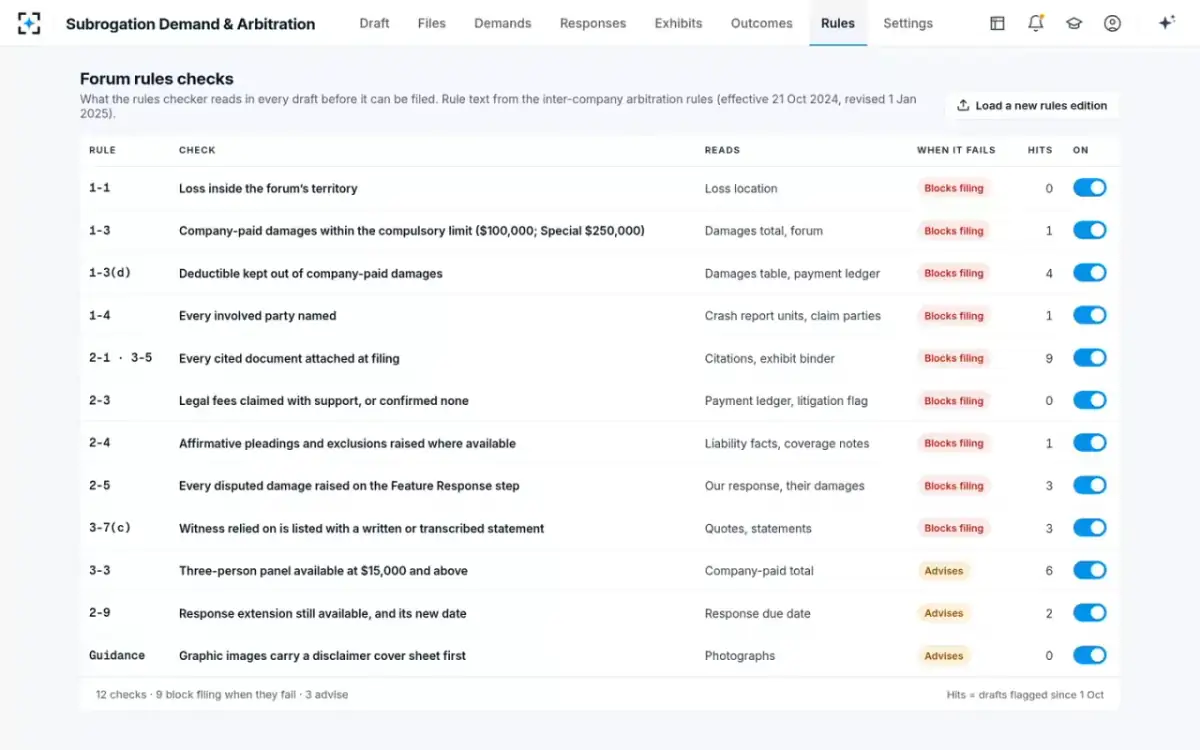
How Subrogation Demand & Arbitration applies the rules before filing
Rules that waive what is not raised are best applied by a check that reads every draft, every time, the same way. In the solution, the forum rules checker runs the checks that apply to each draft, pins each finding beside the paragraph it concerns with its fix, and leaves the decision to the specialist. Nine checks block filing until cleared; three advise. On the sample unit's Delgado contention the check found a rental invoice cited but not attached, the $500 deductible counted inside company-paid damages, and a quoted witness whose statement was not in evidence; after the specialist's three fixes, ten of ten checks passed.
The ten rules a new arbitration specialist should know by number
- 1-3 and 1-3(d)
The $100,000 and $250,000 limits, and the deductible outside them.
- 1-4
Name every involved member, or risk waiving the balance against an unnamed party.
- 2-1
Evidence attached when filed; no amendments.
- 2-3
Claim legal fees with support, or lose them.
- 2-4
Raise pleadings and exclusions where provided, or lose them.
- 2-5
Dispute damages on the Feature Response step.
- 2-9 and 2-10
One 15-day extension; one-year deferments.
- 3-3
A three-person panel at $15,000 and above, for a fee.
- 3-5
Only listed and attached evidence counts.
- 5-1 and 5-2
Pay in 30 days; then requests, then court.
The rules do not tell anyone how long a case will take or what a waiting month costs; that is worked through in how long inter company arbitration takes. Nor do they say who on a desk should hold which step; that map is in who waits on whom.
Questions people ask
What is the Arbitration Forums statute of limitations rule?
The loss state's statute of limitations applies, and an expired statute is an exclusion the responding company must raise; the arbitrator may not raise it alone. Rule 1-2 adds that a suit filed in the wrong place tolls the statute for 60 days after it is dismissed, and Special Arbitration has its own 180-day administrative limit from payment to the claimant.
Who are the arbitrators in intercompany arbitration?
Claims professionals employed by member companies, plus forum staff in some forums. The Reference Guide requires at least three years of claims experience and a supervisor's approval, asks each member to hear as many cases as it files, and forbids anyone to hear a case in which their company has an interest.
How many arbitrators hear a case?
One, unless a party asks for three, which Rule 3-3 allows when total company-paid damages or the contribution sought reach $15,000. The party asking pays a panel fee; on the sample unit, the solution suggests one at $15,000 and above.
What happens if the responding company does not answer?
The case is heard anyway, under Rule 3-2, but on the evidence filed: Rule 4-1 forbids default judgments, so the recovering company must still prove liability and damages by a preponderance of the evidence.
Are intercompany arbitration rules the same in every forum?
The procedure is shared, but the numbers differ: the compulsory limit, whether appeals exist, legal fees and filing deadlines all vary between Automobile, Property, Special, Medical Payment and PIP, and New York's mandatory PIP loss-transfer cases follow New York's own procedures.