How long inter company arbitration takes depends on which of the forum's clocks the parties use, because no published source reports an average case length. The rules of Arbitration Forums, the not-for-profit whose insurer members arbitrate their subrogation disputes there, set the pieces: the responding carrier is notified 30 days before its response is due, may extend once by 15 days, may defer a hearing for a year, and must pay an award within 30 days of the decision being published, with another 60 days of payment requests before a recovering company may sue. Add those up and a contested auto filing runs about two months from filing to money at the fastest the rules allow, plus however long the case waits to be heard, and over 18 months on the slowest ordinary path. Botminds' Subrogation Demand & Arbitration is software for the recovery desk that drafts demands and contentions from the claim file with every fact cited and checks them against the forum's rules; it cannot move the forum's clocks, but it removes the days a desk loses on its own side. This guide prices both.
Worked examples use a fictional sample recovery unit, Harborline Mutual, and its Delgado file: $15,833.40 of company-paid damages on an auto claim in Ohio. The people, carriers and amounts are invented; the rules, rates and wages are published, and linked where they appear.
The rules' clocks after filing, in days, priced on one $15,833.40 recovery
- Response window30 d · $58
- Award payment30 d · $58
- Response window30 d
- Extension15 d
- Coverage window, award held60 d · $116
- Payment30 d
- Two payment requests60 d · $116
How long does inter company arbitration take, stage by stage?
Five stages, of which the rules time three. Before filing, the demand and the negotiation take as long as the carriers let them; the rules only ask the parties to try to settle first. From filing, the responding carrier gets its notice “30 calendar days prior to the response due date for the initial filing.” It may take “one extension of its response due date”, which the Reference Guide says “Currently, an extension adds 15 days to the response due date.” Any party may also add a one-year deferment, which an adverse party can challenge.
Then comes the wait for a hearing, which no rule fixes. Once both sides have submitted, or the response date has passed, the case is ready to hear and an arbitrator takes it. For the Property forum, the forum's FAQ tells members that “The majority of filings are heard within 30 days of being submitted should you wish to set a diary.” We found no equivalent published figure for the Auto forum. After the hearing the decision is posted on the forum's website, and the payment clock starts at publication.
The last stage is money. Rule 5-1: “A responding company shall pay an award within thirty (30) calendar days of the decision publication date.” The award may lawfully be held longer while the payer raises a post-decision coverage defence (up to 60 days) or a clerical error (30 days), or appeals in the two forums that allow it. Only after a first and second payment request, 30 days apart, and another 30 days unpaid, may the recovering company go to court.
How long do insurers take to respond to subrogation demands?
Before arbitration, as long as they choose: we found no statute or forum rule that sets a reply time for an insurer-to-insurer property or auto demand. The deadline in the letter is the demanding carrier's own, and so is the follow-up. The sample unit asks for a reply within 30 days and brings an unanswered demand back for follow-up after 30, a setting it could make 21 or 45. Arbitration Forums' Reference Guide puts the expectation on both sides: the condition to settle first “is a bilateral obligation.”
Once a filing exists, the response window is the rules', not the carriers'. That is the real reason to file a demand that the other carrier is sitting on: arbitration converts an open-ended wait into a dated one. A carrier that never answers still has the case heard, because “A case will be heard even if a responding company fails to answer.” The trade-off is the filing fee and the discipline of a filing that cannot be amended, which is the subject of the ways a filing fails.
Four numbers to price a waiting recovery
$1.93a day
interest forgone on a $15,833.40 recovery at 4.45% a year
our arithmetic
$37.50an hour
a claims adjuster’s median pay, from $78,000 a year over 2,080 hours
wages only
60days
the fastest path from filing to money the rules allow, before the hearing wait
560days
the slowest ordinary path, with an extension, a deferment and a slow payer
How long does it take to get an arbitration decision?
The rules set the response clocks, not the hearing date; a decision comes when an arbitrator has heard a case that is ready. What a recovering company controls is whether its case is ready the first time. Three things push a hearing back. A revisit: if the responding carrier raises limits, an exclusion, a damage dispute or a new party, the recovering company can answer, and the case waits for it. An adjournment: the arbitrator may stop for up to 30 days to ask for a brief of law or a missing breakdown, and the Reference Guide gives the common example, an estimate that does not split front and rear damages. And a deferment, of up to a year.
Two things never delay it. A missing response does not, because the case is heard anyway. And a missing exhibit does not, because the rules forbid amendments: the arbitrator simply decides without it. That is the cruel economy of the forum. Speed is guaranteed; completeness is not. On the sample unit's outcomes page, two of five split or lost decisions in 90 days cut the rental because the invoice was not attached.
How long does the other insurer have to pay an award?
Thirty calendar days from publication, then a ladder. Rule 5-2 says that when an award goes unpaid, the recovering company sends a request for payment; if still unpaid 30 days later, a second request; and “(c) If the award remains unpaid for an additional thirty (30) calendar days, the recovering company may seek legal recourse in pursuit of collection”, with statutory interest and collection costs. In days: 30 to pay, 30 to the second request, 30 more, so court is possible from day 90 after publication.
Three awards owed, each on its own 30-day clock
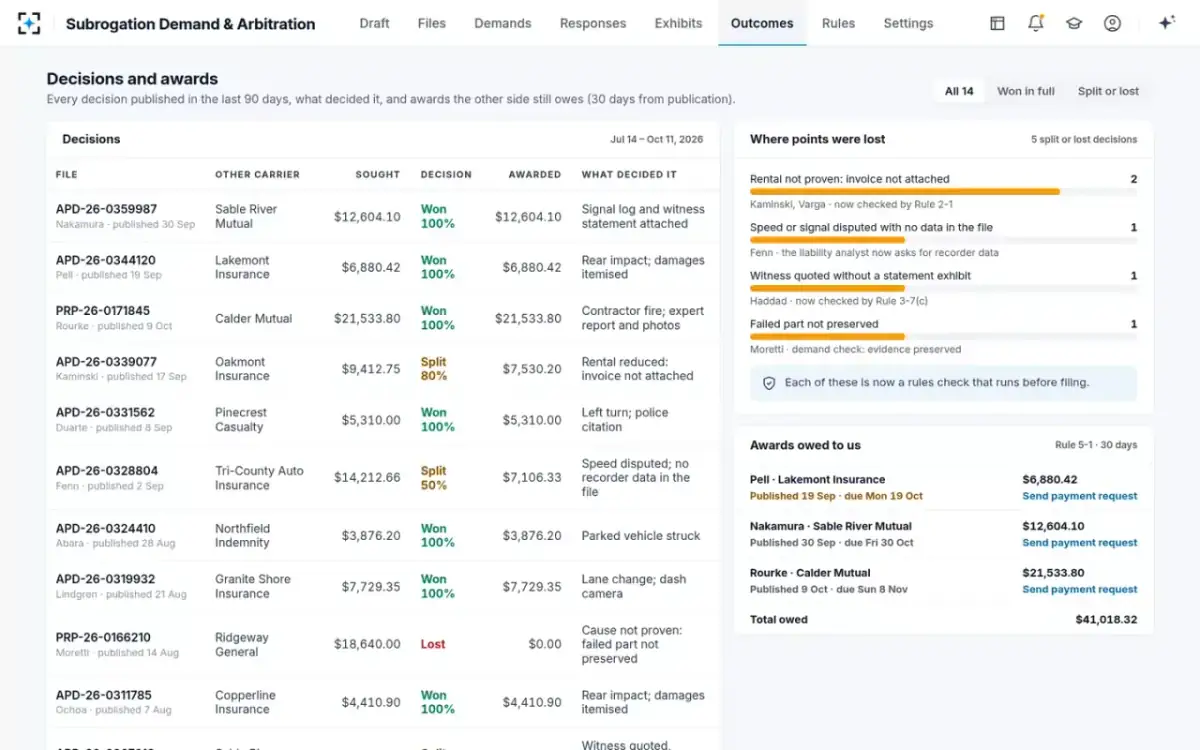
Three awards totalling $41,018.32 sit on the sample unit's page. At 4.45% a year, the interest forgone on all three is about $152 a month (our arithmetic). That number is the point: if interest were the only cost of waiting, nobody would chase. The costs that justify chasing are the ones below.
What a month of waiting costs, line by line
A month's delay on a recovery has four costs, and interest is usually the smallest. The others are the people who touch the file while it waits, the customer whose deductible is waiting with it, and the risk that the wait turns a collectable recovery into a lost one.
The monthly cost of a waiting recovery, as a sum
Interest forgone
amount × annual rate ÷ 12
$15,833.40 × 4.45% ÷ 12 ≈ $58.72 a month on the sample file.
Claims finance
Handling
touches a month × minutes ÷ 60 × hourly cost
Two 15-minute follow-ups at $37.50 an hour ≈ $18.75 in wages alone, before overhead.
Recovery supervisor
The insured’s deductible
deductible outstanding × contacts owed
In Washington, contact within 60 days, then at least every 180 days, until the insured’s interest is resolved.
Subrogation specialist
Risk of loss
amount × chance the wait loses it
A statute that runs, a deferment left to expire, a limit eaten by a companion claim, an award unpaid.
Claims counsel
The risk term is the one to dwell on. The Reference Guide warns that a filing made only to stop the statute running and then deferred will be closed for good if nobody acts within 90 days after the deferment expires. A responding carrier can raise policy limits for 60 days after the decision, so a recovery against a policy also exposed to a bodily injury claim is not safe on publication day. And a desk that misses the other side's response due date on a filing against its own insured concedes points it could have disputed. None of these costs accrue a little each month; each arrives all at once, on a date, which is why dates matter more than days.
What slows down subrogation recovery?
Liability itself. Recoveries on liability lines arrive far more slowly than on physical damage: a 2023 study in the NAIC's peer-reviewed Journal of Insurance Regulation found that more than half of auto physical damage salvage and subrogation is recovered in the year of the loss, against roughly a third or less on auto liability (about 35% for commercial and 28% for personal), and that about three-quarters of liability recoveries are in by the end of the third year. The authors attribute the gap to the mix: physical damage recovery is largely salvage, with standard processes, while liability recovery is largely subrogation. Subrogation takes negotiation and, when that fails, arbitration or suit.
Inside a case, the slow events are predictable. Policy limits and companion injury claims produce deferments. Disputed damages produce revisits. Coverage questions produce exclusions and, sometimes, litigation and a return to arbitration under Rule 2-8. Each can be seen coming from the file: a bodily injury claim on the other side, a responding carrier's letter that disputes rental days, a policy number nobody has confirmed. A desk that reads its files for those signals can file the clean ones fast and prepare the slow ones early. How the parties hand the file to each other at every stage is drawn in who waits on whom in intercompany arbitration.
Can you speed up subrogation arbitration?
Not the forum's clocks, which bind everyone, but the days on your own side, which are often the larger share before filing. The sample unit's estimate of where one contested auto contention's hours go is a fair picture of that side: about five hours by hand, mostly reading the file, answering the other carrier's liability letter and writing, against about 0.8 hours when the solution has drafted and checked it. The design target is under an hour per contention.
Where one contested contention's hours go, by hand and drafted by Subrogation Demand & Arbitration
By hand · about 5.0 hours
- Reading the file · 25%
- Answering their letter · 20%
- Tying damages · 10%
- Writing · 30%
- Exhibits · 10%
- Rules check · 5%
With the solution · about 0.8 hours
- Reading · 12.5%
- Their letter · 25%
- Damages · 6.25%
- Writing · 37.5%
- Exhibits · 12.5%
- Rules · 6.25%
Time saved on drafting matters most when it changes the order of work. A specialist carrying 46 open matters, as the sample unit's arbitration specialist does, files the cases she has time to finish. When a contention arrives drafted, cited and checked, the queue is ordered by date instead of by effort, and the response a carrier owes on a filing against its own insured goes out before its due date rather than on it. The checklist below is what speeds a case up from the recovering side.
Days a recovery desk can take back without touching the forum's clocks
- Send the demand with its proof the first time
Every exchange of ‘send me the invoice’ is a week. A package tied to the payments ends that loop.
- Set your own follow-up date and keep it
Nothing obliges the other carrier to answer; a filing does. Decide when silence becomes a filing.
- File complete, so there is nothing to revisit
Every party named, every exhibit attached, damages on the right step.
- Confirm limits and companion claims before filing
They are where deferments come from; a policy-limits answer can be planned for.
- Answer filings against you before the due date
An unanswered filing is heard on the other side’s papers; disputed damages must be raised on the Feature Response step.
- Diarise every deferment’s expiry
A deferred tolling filing closes 90 days after expiry if nobody acts.
- Send the payment request on day 31
The 90 days to court start only when you start them.
Price your own queue in an afternoon
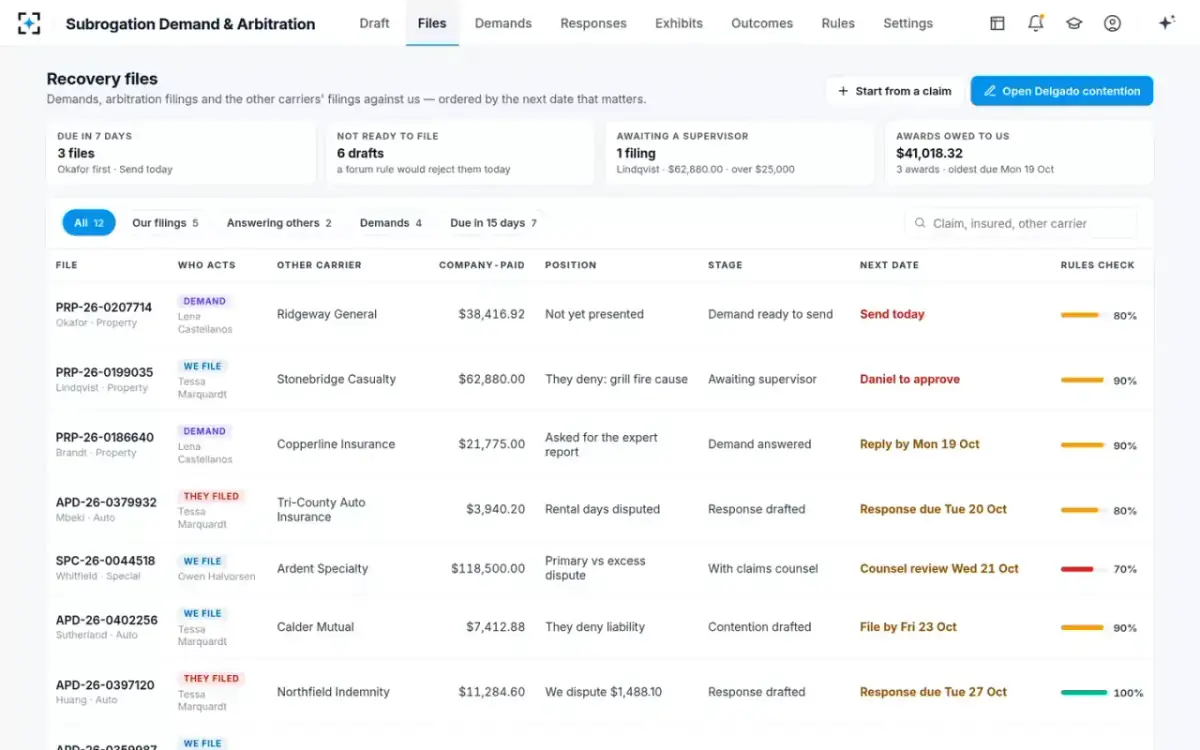
The sum above works on a whole desk as well as one file. List open demands, filings and awards with three columns: amount, days since the last action, and the next date the rules or your own settings give it. Interest on the list is a single multiplication and will be small. The files with no next date are the expensive ones, because they are where a statute, a deferment expiry or an unpaid award can arrive unnoticed. On the sample unit's recovery files list, every row carries its next date and who acts, and six drafts are flagged as not ready to file because a forum rule would reject them today.
Every file with its next date: the queue the sum is priced on
Where Subrogation Demand & Arbitration shortens the clock, and where it cannot
The solution shortens the stages that belong to the recovering desk: the drafting of each demand and contention from the file, the check against the forum's rules before filing, the answer to the other carrier's filings before their due date, and the payment request on the day an award goes late. It cannot shorten the response window, a deferment the other side is entitled to, or the forum's queue for hearings, and it does not chase cash beyond the award; that belongs to Subrogation Recovery Management. The limits and clocks it checks against are summarised in intercompany arbitration rules in plain words.
Questions people ask
How long does a subrogation demand take before arbitration?
No rule sets it for insurer-to-insurer property and auto demands, so it lasts until the other carrier pays, refuses or goes silent. The demanding carrier decides when silence becomes a filing; the sample unit follows up after 30 days, and once a filing exists the forum's response clock takes over.
How long does intercompany arbitration take for property claims?
The same response and payment clocks apply, and Arbitration Forums tells its Property forum members that most filings are heard within 30 days of being submitted. Property decisions of $10,000 or more can also be appealed within 30 days, which adds at least another 30 days for the other side's reply.
How long can a deferment delay an intercompany arbitration?
One year from the deferment request, and another deferment can follow, for a fee. An adverse party can challenge a deferment, and an arbitrator decides whether it stands on the justification and evidence attached to it.
What happens if the other insurer does not pay an arbitration award?
After 30 days the recovering company sends a request for payment, then a second request 30 days later; 30 days after that it may sue to collect, and the rule entitles it to statutory interest and the legal fees and costs of collection. The award can be held, though, while a coverage defence, an error claim or an appeal is pending.
Does the insured's deductible wait for the arbitration too?
Usually, because the deductible is recovered with the award. The responding carrier's payment must include any deductible interest, and in Washington the insurer must contact the insured within 60 days of starting subrogation and at least every 180 days until the insured's interest is resolved.