Arbitration contentions are how two insurers argue a liability dispute over a car accident: a disagreement over who caused the crash and in what share, which, when both drivers are insured, is usually settled between the carriers, not in court. If the at-fault driver's insurer denies or only partly accepts liability, the insurer that paid its own customer files in intercompany arbitration, and an arbitrator who is a claims professional decides on the written file which version is more likely, applying the rules of the road and the comparative fault rule of the state where the crash happened. The document that wins it is the contention: a short statement in which every fact points to an exhibit and every argument names a rule. Botminds' Subrogation Demand & Arbitration drafts that contention from the claim file, every fact cited to its page, answers the other insurer's argument point by point, and checks the filing against the forum's rules before an arbitration specialist files it.
The worked file is fictional sample data in the solution: Delgado v. Pinecrest Casualty, a left-turn collision in Ohio, in which Pinecrest accepted only 50% liability. The people, carriers and amounts are invented. Laws and research are linked where they appear.
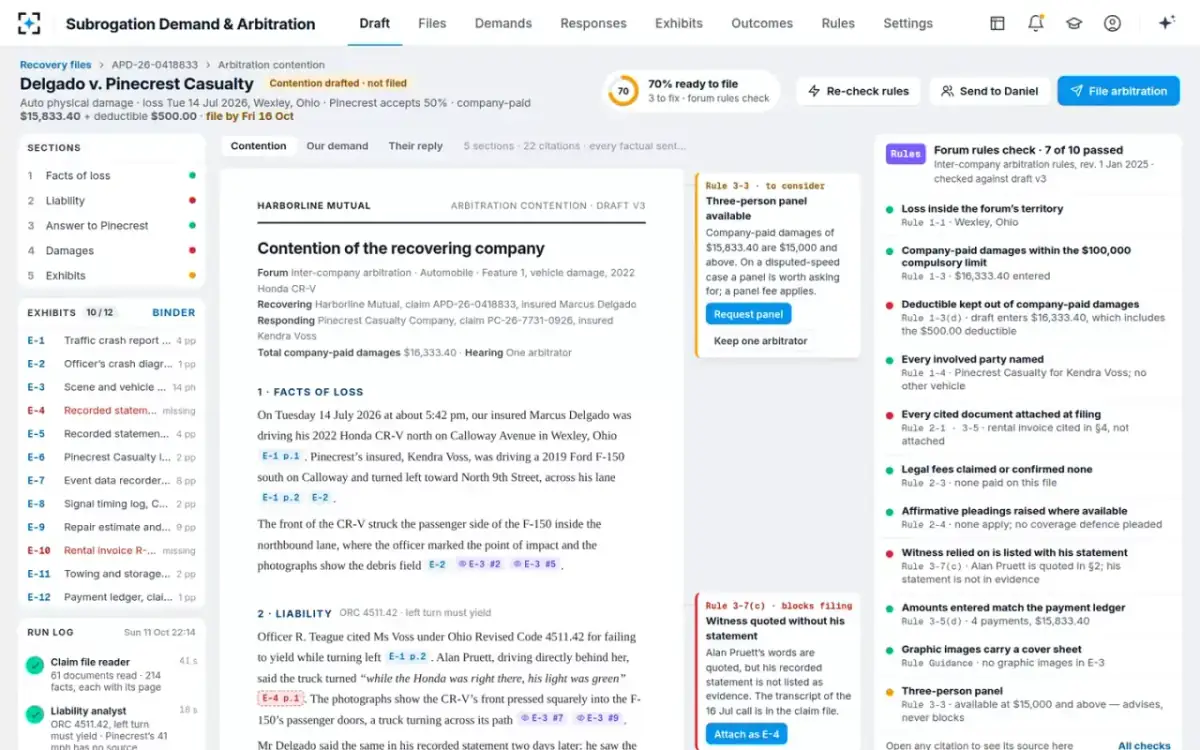
A Subrogation Demand & Arbitration contention, built in three columns: fact, document, rule
FactMs Voss turned left across the CR-V’s lane at Calloway Avenue and North 9th Street.
DocumentCrash report narrative, E-1 p.2; officer’s diagram, E-2
Rule or reasonOhio § 4511.42: a driver turning left yields to an oncoming vehicle close enough to be an immediate hazard.
FactThe officer cited her for failure to yield while turning left.
DocumentCitation WX-118402 on the crash report, E-1 p.2
Rule or reasonArbitrators weigh any listed evidence; formal rules of evidence do not apply.
FactThe CR-V was at 36 mph five seconds before impact and 34 mph one second before, in a 35 mph zone, braking before impact.
DocumentEvent data recorder report, E-7 p.3; posted limit, E-1 p.1
Rule or reasonAnswers their “about 41 mph”, which their letter does not source.
FactThe northbound signal was green from 5:41:38 to 5:42:21 pm; impact was at 5:42:04 pm.
DocumentCity signal timing log, E-8; crash notification, E-7 p.2
Rule or reasonAnswers their “stale yellow”.
FactA driver behind the F-150 says “his light was green”.
DocumentTranscript of Alan Pruett’s recorded call, E-4
Rule or reasonA quoted witness needs the written transcript listed and attached.
FactThe CR-V’s front struck the F-150’s passenger doors.
DocumentPhotographs E-3 #7 and #9
Rule or reasonThe damage pattern fits a vehicle turning across the CR-V’s path.
What is a liability dispute in a car accident?
Between insurers, it is a disagreement about the share of fault, as distinct from a dispute about the amount of damage. The two often travel together but are argued separately: in Arbitration Forums, the not-for-profit run by its insurer members that hears auto subrogation disputes between signatory insurers, liability goes in the contention and damages are disputed on their own workflow step. The forum's Reference Guide gives the textbook liability case: “The driver of a vehicle traveling at an excessive rate of speed collides with another vehicle that changed lanes without signaling. Insurers cannot agree on the respective liability of the two drivers.”
Left turns are the classic. In NHTSA's on-scene study of crashes, “In the case of 22.2 percent of crashes, the critical event was turning left”, and among the patterns it found for left turns at signals were “turned with obstructed view” or “misjudgment of gap or other’s speed”. That second phrase is exactly the ground a turning driver's insurer fights on: the oncoming car was going too fast to judge. Pinecrest's letter on the Delgado file makes that argument, claiming the CR-V was travelling about 41 mph and entered on a stale yellow, and gives no source for either.
How is fault decided between insurers?
By an arbitrator, on the evidence filed, more likely than not, under the loss state's law. Each element of that sentence comes from the forum's own documents. The standard: the Reference Guide says “The standard of proof used is “preponderance of evidence””, and the FAQ explains that the recovering company must show “that its factual explanation is more likely true than any other alternative explanations.” The law: arbitrators must apply the rules and statutes of the jurisdiction, and the Reference Guide counts an arbitrator applying, on their own, a statute from a state other than the loss state as a correctable error.
The responding carrier frames the question. It enters the share of liability it admits, and the FAQ is precise about the effect: “The arbitrator can find the responding company more liable than it admitted but not less.” Pinecrest's 50% admission is a floor. The contention's job is to move the arbitrator from that floor to 100%.
And the arbitrator can only work with what was filed. When the versions conflict and nothing corroborates either, the forum's FAQ warns that “determining liability will most likely be impossible.” A contention made only of the insured's account against the other driver's account is the weakest kind there is. The cure is independent evidence.
What evidence wins a liability dispute?
Evidence that neither driver wrote: the police report and citation, physical damage, independent witnesses, vehicle data and signal or video records. The table lists what each proves and the rule that governs how it gets in front of the arbitrator.
The evidence that decides car accident liability, and how to get it in
| Evidence | What it proves | Watch for |
|---|---|---|
| Police crash report and citation | The officer’s account of positions, narrative and any charge | A citation is evidence to weigh, not a verdict; formal rules of evidence do not apply |
| Diagram and photographs | Points of impact, angle, rest positions, debris | Number and cite the photographs you rely on |
| Independent witness | An account from someone with no stake | Only as a listed statement; audio must be transcribed |
| Event data recorder | Speed, accelerator and brake in the seconds before the crash | Access needs the owner’s consent or a court’s authority |
| Signal timing log | Which phase each direction had at the time of impact | Match the clock to the crash time from another source |
| Dash cam or security video | The sequence itself | Upload the file, up to 40MB; links to outside sites are not accepted |
| The other side’s own letter | What they claim, and whether they cite anything | An unsourced claim is the easiest to answer |
Vehicle data deserves its own paragraph, because it is what turns a speed argument from opinion into measurement. Federal rules define an event data recorder as “a device or function in a vehicle that records the vehicle's dynamic time-series data during the time period just prior to a crash event”, and require one, where fitted to a light vehicle, to capture indicated speed and service brake status; for vehicles built before September 2031, subject to a phase-in, the required window is “−5.0 to 0 sec relative to time zero”. The data belongs to the vehicle's owner: the Driver Privacy Act says it “is the property of the owner, or, in the case of a leased vehicle, the lessee of the motor vehicle in which the event data recorder is installed.” An insurer can download its own insured's recorder with consent; the other car's needs that owner's consent or a court's authority. So the time to ask for it is before either car is repaired or sold.
The contention as drafted: numbered sections, citation chips, the rules check beside it
How does comparative fault affect a car accident claim?
It sets what a shared-fault file is worth, and the rule changes from state to state. Under pure comparative fault, a party's recovery is reduced by its own share however large; under modified comparative fault, recovery stops once the party's share passes a threshold. The table shows three common designs and what they mean for a recovering insurer whose own insured shares the blame. The state-by-state list is in the guide to comparative negligence states.
What a recovering insurer gets back, by fault rule and its own insured's share
| Rule | Example state | Own insured 30% at fault | 50% at fault | 60% at fault |
|---|---|---|---|---|
| Pure comparative fault | New York, CPLR § 1411 | 70% | 50% | 40% |
| Barred above 50% | Florida, § 768.81(6), since 2023 | 70% | 50% | Nothing |
| Barred if greater than the others combined | Ohio, § 2315.33 | 70% | 50% | Nothing |
The table shows why a 50/50 offer is so common, and why it is often worth fighting. In all three designs a recovering insurer at 50% gets half; at 60% it gets something only under pure comparative fault. On the Delgado file, accepting Pinecrest's 50% means $7,916.70 of the $15,833.40 paid, plus half the $500 deductible interest (our arithmetic); proving 100% means all of it. That difference is what the recorder data and signal log are for.
Regulators also write presumptions of fault for their own purposes, and they show how routine certain patterns are. Massachusetts' standards of fault, used to decide whether a driver was more than 50% at fault, list “(15) Collision While Making a Left Turn or U-turn Across the Travel Path of a Vehicle Traveling in the Same or Opposite Direction” and “(03) Rear End Collision” among them, each applying “unless a showing to the contrary is demonstrated by the evidence”. A presumption is a starting point; the evidence decides.
What is a contention in arbitration?
It is the written argument a party files with its evidence: in the forum's terms, the recovering company's liability arguments and the responding company's answer to them. Because hearings are on paper and the file must speak for itself, the contention does the work a lawyer's opening and a witness's testimony would do in court. A good one is short and ordered: the facts of loss, the liability rule, the answer to the other side's position, the damages, the exhibits. Every factual sentence cites an exhibit and page; every argument names its rule; nothing argues past the evidence.
The answer section is where most disputed files are won. Pinecrest's 41 mph and stale yellow are not answered by saying the insured was careful. They are answered by the recorder's 36 and 34 mph in a 35 mph zone, by a signal log that has the light green until 17 seconds after impact, and by a witness who says the light was green, each cited. The contention then asks for what the evidence supports: 100%.
What happens if both insurers deny liability?
Each files for its own damages, and the arbitrator apportions fault between them in one case. The forum's rules require a responding carrier that paid its own insured and wants that money back to include its damages when it responds; Rule 2-2 says “It must be heard with the original arbitration case or recovery is barred.” The FAQ also covers the innocent party: where a parked or lawfully stopped vehicle is struck as a result of a crash between two others and nothing establishes their shares, the recovering company has still proved its damages came from the accident, and an award may be apportioned equally between the responding carriers.
Fourteen decisions on the sample desk, and what cost the five not won in full
14 published decisions, 90 days
- Won in full · 64.3%
- Rental cut: invoice not attached · 14.3%
- Speed disputed, no recorder data · 7.1%
- Witness quoted, no statement · 7.1%
- Failed part not preserved · 7.1%
Answering the other carrier's contention in Subrogation Demand & Arbitration
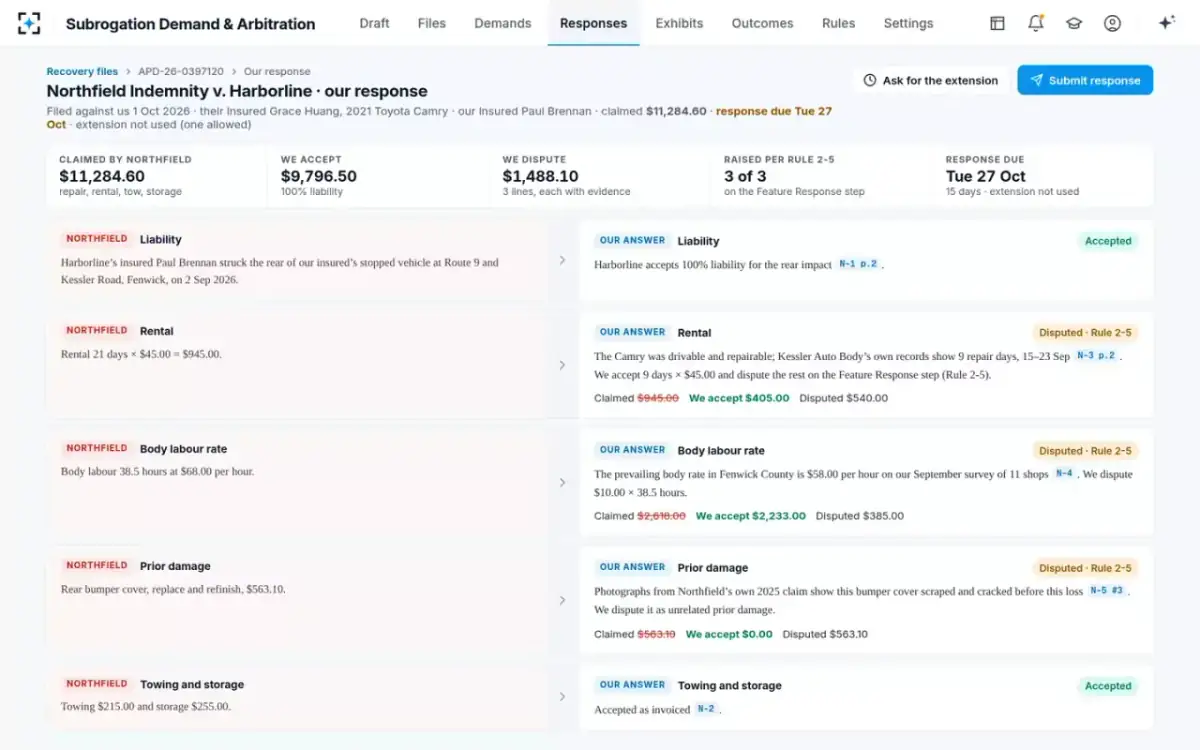
Sometimes the right answer is to accept liability and fight the bill. When the sample unit's insured rear-ended Northfield Indemnity's insured, the drafted response accepted 100% liability and disputed $1,488.10 of the $11,284.60 claimed: rental for 21 days against the body shop's own 9 repair days, a $68 labour rate against a surveyed $58, and a bumper cover photographed damaged on Northfield's own earlier claim. The forum's FAQ supports the approach: asked whether a responding company should admit 100% liability, it answers “Yes, especially when liability is accepted, and the only disputed issue is damages.”
Their claim and our answer, line by line, on a rear-end filing against us
Northfield’s filing: Our insured struck the rear of their stopped car.
Our drafted response: Accepted at 100%, citing their own crash report page.
Northfield’s filing: 21 days × $45 = $945.
Our drafted response: 9 days accepted from the body shop’s repair dates; $540 disputed.
Northfield’s filing: 38.5 hours at $68.
Our drafted response: $58 prevailing rate from a survey of 11 shops; $385 disputed.
Northfield’s filing: Rear bumper cover, $563.10.
Our drafted response: Photographed damaged on their own 2025 claim; disputed in full.
Northfield’s filing: $215 and $255.
Our drafted response: Accepted as invoiced.
The discipline is the rule's, not the software's. Rule 2-5 makes the responding carrier dispute damages on the forum's Feature Response step (AF Rules; see intercompany arbitration rules), and arguments raised anywhere else are not considered. How labour rates are surveyed and set is a property and auto claims subject in its own right, covered in the guide to California's auto body labor rate survey.
Our response: their claims on the left, our answer on the right
Who decides fault in an intercompany dispute, and can it be challenged?
One arbitrator, or three if a party asks and pays once company-paid damages reach $15,000, drawn from claims professionals at member companies who have no interest in the case. On the Delgado file, with speed and signal both disputed, the specialist requested a three-person panel. Once published, a liability decision in the Auto forum is final between the companies: there is no appeal, and only a clerical or jurisdictional error, flagged within 30 days, can change it. The challenge, in other words, has to be in the contention. The forum's full rulebook is summarised in intercompany arbitration rules in plain words, and the ways a filing fails before liability is even argued in Arbitration Forums affirmative defenses.
Before filing a disputed-liability contention
- Is there one piece of evidence neither driver wrote?
Without it, conflicting accounts may leave liability undecidable.
- Does every factual sentence cite an exhibit and page?
The arbitrator reads only what is listed and attached.
- Is each of their arguments answered with a document?
An unsourced speed or signal claim is answered by data, not by denial.
- Is the loss state’s rule of the road named by section?
And its fault rule applied to the share you ask for.
- Was the recorder downloaded with the owner’s consent?
The data belongs to the vehicle’s owner or lessee.
- Is a three-person panel worth its fee?
Available at $15,000 and above; most useful when facts are disputed.
In Subrogation Demand & Arbitration the liability analyst applies the loss state's rules of the road and fault rule to the facts and maps the other side's argument against the evidence, saying so when they cite none; it proposes and never concedes or sets liability. The specialist decides what to ask for and files.
Questions people ask
What does disputed liability mean in a car accident claim?
It means the at-fault driver's insurer does not accept that its driver caused the crash, or accepts only part of the blame. Between insurers that have both signed the forum's agreement, the dispute goes to intercompany arbitration if they cannot settle it.
Can a police report decide liability between insurers?
No single document decides it. A citation and narrative are strong evidence, and formal rules of evidence do not bar them, but the arbitrator weighs them with everything else filed and decides what is more likely, under the loss state's law.
What if there are no witnesses and the two drivers disagree?
Then physical and electronic evidence carries the case: damage pattern, rest positions, recorder data, signal logs, video. Arbitration Forums warns that where conflicting versions are uncorroborated, determining liability will most likely be impossible.
Why do insurers offer 50/50 on disputed accidents?
Because when the evidence is balanced, half is what each side expects an arbitrator to find, and the forum allows a 50% decision where the evidence supports equal fault. A 50/50 offer is worth refusing when independent evidence points one way.
How long does an insurer have to decide liability on a car accident?
That depends on each state's fair claims rules for the claim in question and is a property and auto claims subject. Between insurers, once arbitration is filed, the responding carrier's clock is the forum's: notice 30 days before its response is due, and one 15-day extension.