Arbitration Forums affirmative defenses are objections to the forum's power to hear a case, not arguments about the crash. The rules of Arbitration Forums, Inc., the not-for-profit whose insurer members write them, define an affirmative defense as “A complete defense that does not address the allegations, but instead asserts that the filing is excluded from compulsory arbitration.” The members' Reference Guide lists the main ones: the other company is not a signatory, the action does not exist in law (subrogation prohibited, no right of recovery, a prior release), no liability policy was in effect, coverage was denied, or the policy limits are too low. A responding carrier must raise and support them or lose them. Yet the filings a recovery desk loses most often never meet a defense at all: they fail on paper, because an invoice was not attached or a point was not raised in the right box. Botminds' Subrogation Demand & Arbitration drafts each contention from the claim file with every fact cited and runs the forum's rules against it before a specialist files, so both kinds of failure are visible while they can still be fixed.
The counts and screens below come from a fictional sample recovery unit, Harborline Mutual, as its files run through the solution; the carriers, people and amounts are invented. The rules quoted are the edition effective 21 October 2024, revised 1 January 2025, with the Reference Guide revised 9 June 2026.
What the Subrogation Demand & Arbitration rules check stopped on the sample unit's drafts
What are affirmative defenses in Arbitration Forums?
They are the forum's version of a jurisdiction challenge: arguments that the dispute is excluded from compulsory arbitration, whatever the facts of the loss. The rules use "affirmative defense", "exclusion" and "jurisdictional exclusion" for the same thing, and set them apart from two other kinds of point a party can raise.
Three kinds of point, three different boxes
Affirmative defense, or jurisdictional exclusion
Raised byUsually the responding company
What it doesSays the case does not belong in compulsory arbitration at all. It argues neither liability nor damages.
What proves itEvidence of the ground: a denial letter, a declarations page, a statute.
If it succeedsThe filing is closed for that party. Not a finding of no liability.
Affirmative pleading
Raised byEither side, often the recovering company
What it doesRaises a legal doctrine that changes how damages are awarded, such as bailment or joint and several liability.
What proves itThe statute or case law of the loss state.
If it succeedsThe award is calculated under the doctrine.
Damage dispute
Raised byThe responding company
What it doesContests specific amounts: rental days, labour rate, causation, prior damage, a partial exclusion.
What proves itEvidence attached to the Feature Response step, with the proposed amount.
If it succeedsOnly the disputed line is reduced.
The distinction matters because each lives in a different place, and the rules treat placement as substance. Rule 2-4: “The parties must raise and support affirmative pleadings or jurisdictional exclusions where provided or they are waived.” Rule 2-5 does the same for damages, and adds “Arguments not properly raised will not be considered by the arbitrator.” An arbitrator cannot rescue a party by raising a defense it forgot. The Reference Guide counts that as a jurisdictional error: if the responding carrier does not plead an expired statute of limitations and the arbitrator raises it anyway, the decision is voided and the file goes back for a decision on the issues actually disputed.
What is a jurisdictional exclusion in subrogation arbitration?
It is a ground on which a company is not required to arbitrate without its written consent. The agreements list them in Article Second, and the Reference Guide groups the ones raised in practice. The table puts each with the evidence the rules expect and what happens if it holds.
The exclusions a responding carrier can raise, and what each needs
| Exclusion | What it means | Evidence expected | If upheld |
|---|---|---|---|
| Non-signatory | The responding company has not signed the agreement for this forum and has not consented. | Its signatory status; a non-member can still consent in writing or by answering. | Closed for that party; pursue it elsewhere. |
| Liability deductible or self-insured retention | The claim falls within the other insured’s own retention, so no insurer money is at stake. | Proof of the deductible or retention. | Only the amount above it can be awarded; file against the commercial insured if it consents. |
| Action does not exist in law or equity | Subrogation prohibited, no right of recovery, or a prior release. | The statute, case law or release. | Closed; the recovering company must cite law showing the cause of action exists. |
| No liability policy in effect | The listed insured had no liability cover on the loss date. | The coverage answer in the response; wrong answers carry Rule 2-8 costs. | Out of jurisdiction for that party. |
| Denial of coverage | Cover was denied to the person seeking it for this event. | A copy of the denial letter addressed to that person. | Out of jurisdiction; without the letter, the arbitrator rules on it. |
| Policy limits | An award could exceed the responding policy’s limit. | Declarations page or claim screen, plus proof of other exposures. | No award unless the recovering company accepts the limit. |
| Retrospective or experience-rated policy | The award would move the insured’s own premium. | Evidence of the rating plan. | Excluded; no post-decision relief if not raised before the hearing. |
| Over the compulsory limit | Company-paid damages above $100,000, or $250,000 sought in Special. | The amounts on the filing. | Not compulsory; consent, or reduce the claim and waive the rest. |
| Suit pending before signing | Litigation was filed before the company signed the agreement. | The court filing. | Excluded. |
| Product liability (Property forum) | A claim based on an alleged defective product. | The theory of the claim; installation or repair claims stay in. | Excluded unless consented. |
| Statute of limitations | The recovery right expired under the loss state’s law. | The statute and the dates. | Closed; must be pleaded, never raised by the arbitrator. |
One exclusion dominates. The Reference Guide says “Policy limits is the most common exclusion asserted by a responding company.” It is also the one that most needs a decision from the recovering side, because a carrier can keep the case in arbitration by agreeing to accept an award up to the limit and giving up the balance against the other carrier's insured. The guide's own example: a $6,000 claim, a $5,000 limit raised and supported, liability at 100%, and no award at all, because the recovering company had not agreed to accept the limit. It may still agree within 60 days of publication.
A denial of coverage is not a denial of liability
The two sound alike and work in opposite directions. A denial of liability says our insured was not at fault; it is an argument for the hearing. A denial of coverage says our policy does not protect the person who caused this; supported properly, it ends arbitration for that carrier. The Reference Guide is blunt: “Simply, a denial of liability is not a denial of coverage.”
Two letters a responding carrier may attach, and what each does to the case
Denial of liability: Our insured was not negligent, or less negligent than you say.
Denial of coverage: Our policy does not cover the person or entity seeking cover for this event, or no policy was in force.
Denial of liability: Often the recovering company or its insured.
Denial of coverage: The person seeking cover: the named insured or the driver. A copy to anyone else does not count.
Denial of liability: None on jurisdiction; it goes to hearing.
Denial of coverage: Out of jurisdiction for that carrier, if the letter is attached.
Denial of liability: —
Denial of coverage: Not enough: coverage has not been affirmatively denied.
Denial of liability: The arbitrator decides liability.
Denial of coverage: Rule 2-8: the carrier repays legal costs and the new filing fee when the case comes back.
The reservation-of-rights point catches responders out. The guide says “A Reservation of Rights letter is not sufficient to support a Denial of Coverage exclusion since coverage is not affirmatively denied.” If a coverage decision is still pending, the right move is a deferment, not an exclusion. How a reservation of rights letter is built on the coverage side is explained in the property claims guide on reservation of rights letters, line by line.
What is subrogation prohibited?
It is the exclusion a responding carrier raises when it says no subrogation right exists at all, because the law of the loss state does not give one. The Reference Guide files it under "action does not exist in law or equity", next to no right of recovery and a prior release. Its examples of a legal bar to recovery include medical payment subrogation where a statute or court decision bars it, a bodily injury claim that never met a no-fault threshold, and a leasing company seeking diminution in value where the state does not recognise that right.
It is also the one time proof of payment becomes mandatory. Normally the forum presumes the recovering insurer paid its insured. The Reference Guide says proof of payment is required only when a responding company asserts subrogation prohibited, arguing that no subrogatable claim exists, and that it cannot rely solely on the absence of proof of payment to make the argument. The recovering company answers with the controlling statute or case law in its revisit, because the guide says “Failure to establish the existence of the cause of action is grounds to place the case out of jurisdiction.”
What happens if evidence is missing in arbitration?
The point it supported is lost, and it cannot be patched. Under Rule 3-5 the arbitrator “may only consider:” pleadings properly raised, deferments properly supported, “(c) Evidence listed and attached.”, the amounts entered, and damages disputed in the right step. Rule 2-1 then closes the door: a filing can be neither amended nor rescheduled. The only way back in is a revisit, which the rules open only when the responding company raises limits, an exclusion, a damage dispute or a new party.
The Auto forum adds a trap of its own. Evidence for the damages sought must be attached to the Feature Damages step, where the other side can see it. The Reference Guide says that when it is not, and the responding company says so in its damage dispute, “the evidence will not be considered by the arbitrator and the damages will not be awarded.” A rental invoice sitting in the general evidence list, rather than on the damages step, can lose the rental.
The amount entered is equally unforgiving. The guide's example: if the itemized damages add up to $2,000 but the evidence supports $20,000, “the arbitrator’s award will be controlled by the $2,000 amount.” And the deductible must stay out of company-paid damages under Rule 1-3(d). On the sample unit's Delgado draft it had crept in, so $16,333.40 was entered where $15,833.40 was right.
Where points were lost: five split or lost decisions in 90 days
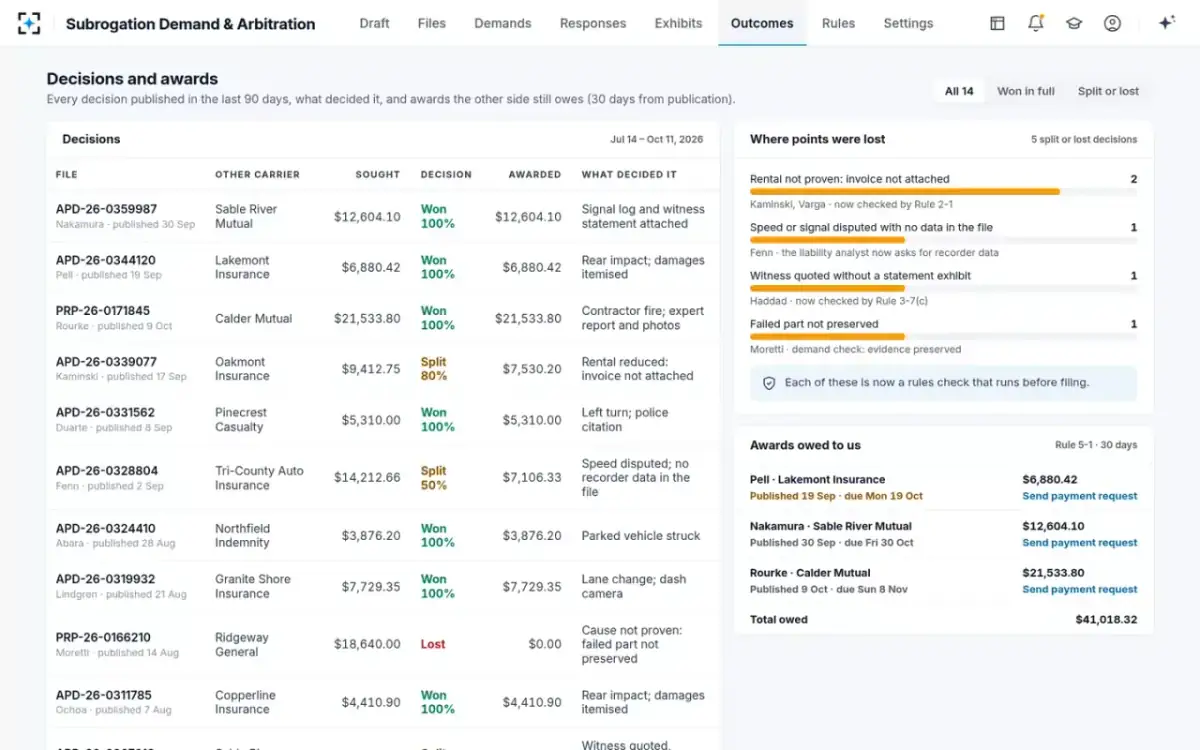
The sample outcomes make the argument better than any statistic. Two decisions cut the rental because the invoice was not attached. One split liability 50/50 because speed was disputed and the file had no recorder data. One quoted a witness without his statement in evidence. One property claim was lost because the failed part had not been preserved. Each loss became a check that now runs before filing.
Can a subrogation arbitration be dismissed, and can you refile?
A case can be closed for lack of jurisdiction, and that is not a loss on the merits. Arbitration Forums tells members that an exclusion “has no bearing on the right of recovery in any other venue and is NOT a finding of no liability.” The recovering company can sue, or refile once the obstacle is gone: the Reference Guide's example is a defective-part case closed because the part was not offered for inspection, which can be refiled once reasonable inspection is arranged. If a responding company wins an exclusion and later turns out to have been wrong, Rule 2-8 lets the case come back and makes the responding company reimburse “all legal expenses and court costs resulting from the improper objection to jurisdiction, as well as the additional arbitration filing fee.”
What cannot be refiled is a decision on liability or damages. Those are final for the parties, with appeal only in the Property and Special forums above set amounts, and Rule 5-3 makes the original liability decision res judicata for any later filing for supplemental damages. The limits of that finality, and why it does not reach the insured, are set out in is intercompany arbitration binding.
What is the Arbitration Forums statute of limitations rule?
There is no separate arbitration deadline for most forums: the loss state's statute applies, and it is an exclusion like any other, so it must be pleaded. Ohio, for example, gives two years for an action for injury to personal property under Ohio Rev. Code § 2305.10; other states differ, and the clock state by state is set out in the guide to the statute of limitations on subrogation claims. The forum's rules add four timing points around it.
First, a suit filed in the wrong place tolls the statute for 60 days after it is dismissed: “If the applicable statute of limitations has expired, the filing of suit will toll the statute of limitation for 60 calendar days from the suit dismissal/discontinuance.” Second, a filing made only to stop the clock and then deferred closes for good if nothing is done within 90 days after the deferment expires. Third, the 60-day post-decision window for coverage defenses only applies if raised at least 60 days before the statute runs. Fourth, for Property, the FAQ advises: “It is a good idea to file at least 120 days before the statute of limitations when possible.” That leaves time to go to court if a valid exclusion is raised. Special Arbitration has its own administrative clock: file within 180 days of paying the claimant, or the delay can be raised if it caused prejudice.
How do you respond to an affirmative defense?
In the revisit, with evidence, and nowhere else. The Reference Guide says “Only rebuttals entered in jurisdictional exclusion revisit will be considered by the arbitrator.” What the rebuttal contains depends on the defense. Against subrogation prohibited, cite the statute or case law that creates the right. Against policy limits, the filing system lets the recovering company accept the limit, make a note, or dispute the stated amount, and nothing more. Against a denial of coverage, the system allows no rebuttal: the recovering company pursues the uninsured party outside arbitration and, if coverage is later accepted, brings the case back under Rule 2-8.
It also helps to remember that asserting is not proving. The guide warns responders that “Asserting a jurisdictional exclusion does not mean that such defense is necessarily valid.” The party must explain the ground and submit evidence, and should complete the rest of its response in case the arbitrator denies the exclusion and hears the case.
The twelve forum rules checks, each with the rule behind it
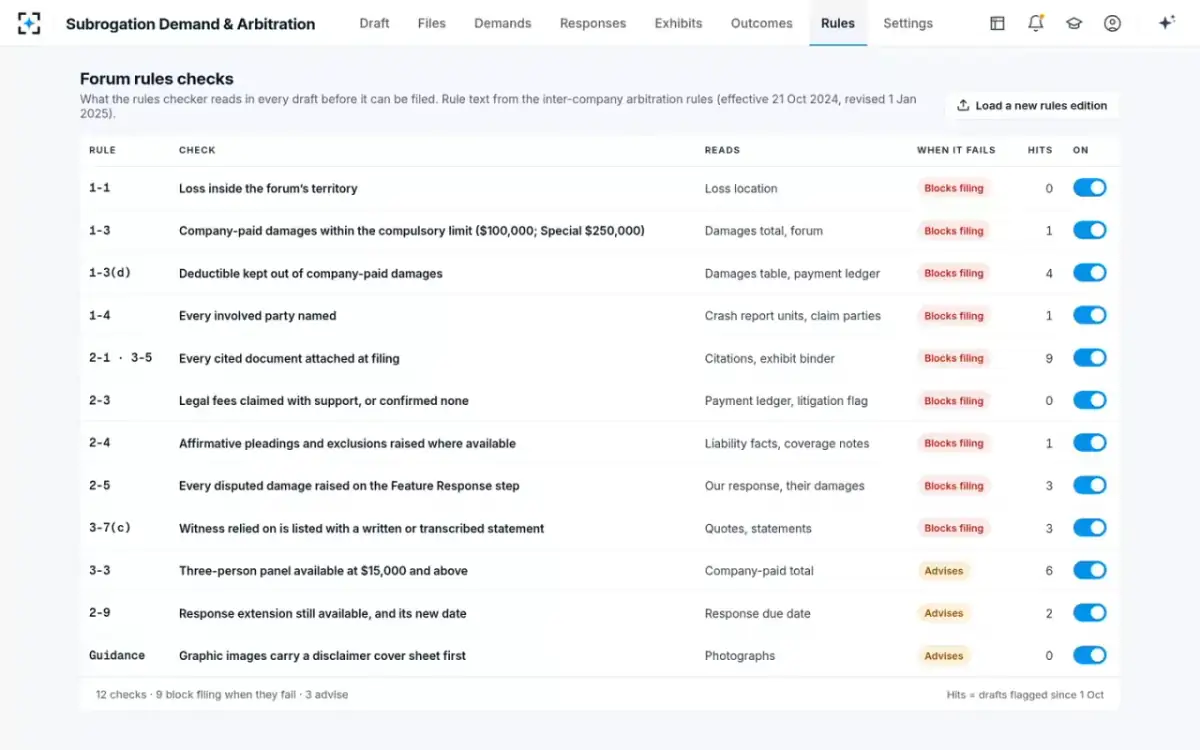
Pre-filing checks in Subrogation Demand & Arbitration, failure by failure
Every failure on this page has a check that can run before filing, and most need no judgment at all. The forum rules checker in the solution reads each draft against the rules edition it will be filed under and pins each finding beside the paragraph it concerns; the specialist clears it or overrides it with a reason. The checks that matter most, by how often they bite on the sample unit's drafts, are below.
Before filing: the defense-proof and error-proof checks
- Is every party named, and did each sign this forum’s agreement?
An unnamed party argued by the other side can cost the balance of the claim if the case is heard (Rule 1-4).
- Is the claim inside the compulsory limit, deductible excluded?
$100,000 company-paid in Auto, Property, Medical Payment and Uninsured Motorists; $250,000 in Special; the deductible never counts.
- Is every cited document attached, and in the right step?
In Auto, damages evidence belongs on the Feature Damages step; elsewhere it is simply not considered.
- Does the amount entered match the payments?
The amount entered caps the award, even when the evidence proves more.
- Is every quoted witness backed by a written statement or transcript?
Audio is not accepted; the transcript is.
- Have the pleadings that help us been raised in their section?
Bailment or joint and several liability change the award only if pleaded.
- Has the loss state’s statute been checked against the filing date?
And is there room for court if an exclusion is upheld? The Property FAQ suggests 120 days.
- For product or installation claims, was the part preserved and offered for inspection?
Rule 2-11 lets a responder close the case if inspection was critical and refused.
The responding side has its own version. When the other carrier files against us, the solution drafts our answer point by point, puts each disputed damage on the Feature Response step, and checks that available pleadings and exclusions have been raised where Rule 2-4 provides, with affirmative pleadings going to claims counsel. A defense not pleaded in time is waived just as surely as a recovering company's missing invoice. For the full rules behind these checks, see intercompany arbitration rules in plain words.
Questions people ask
Is an affirmative defense the same as an affirmative pleading in Arbitration Forums?
No. An affirmative defense, or exclusion, says the case is outside compulsory arbitration; an affirmative pleading is a legal doctrine, such as bailment or joint and several liability, that changes how damages are awarded if liability is found. Both must be raised in their own sections or they are waived.
What is the Arbitration Forums compulsory limit?
$100,000 of total company-paid damages in the Automobile, Medical Payment, Property and Uninsured Motorists forums, and $250,000 of contribution sought in Special Arbitration. The deductible and, unless the policy limit includes them, legal fees do not count towards it, and the limit applies per feature.
Can a reservation of rights letter take a case out of arbitration?
No. Arbitration Forums' Reference Guide says a reservation of rights is not enough to support a denial-of-coverage exclusion, because coverage has not been affirmatively denied. A carrier still deciding coverage should ask for a deferment instead.
Can an arbitrator raise the statute of limitations on their own?
No. An exclusion not raised by a party is waived, and the Reference Guide treats an arbitrator who raises one as committing a jurisdictional error; the decision is voided and returned for a decision on the disputed issues.
What happens after a jurisdictional exclusion is upheld?
The filing is closed for that party without any finding on liability, and the recovering company may pursue the claim in court or refile once the obstacle is removed. If the exclusion later proves improper, Rule 2-8 lets the case be refiled and makes the responding company repay legal costs and the extra filing fee.
Does the responding company have to prove a policy limits defense?
Yes. It must assert the limit in its response with a declarations page, claim system screen or other written proof, and show any other exposures to the same limit. It can also raise limits after the decision, within 60 days of publication and at least 60 days before the statute runs.