Arbitration case management software, for an insurer's recovery desk, is the layer that keeps every subrogation demand, arbitration filing and response to the other carrier's filings in one list, tracks each against the forum's clocks, assembles the evidence and checks a filing before it goes. It is not the forum and not the claims system. The intercompany forum, Arbitration Forums, Inc., a not-for-profit run by its insurer members, already has its own filing system, and the claims system already holds the file and the payments. Good software reads both and replaces neither. Botminds' Subrogation Demand & Arbitration is built that way: six agents read the claim file and draft the demand or the contention, every fact cited to its page, attach the exhibits in order and check the forum's rules, while a specialist decides and files. This guide is for the people choosing such software: what it must connect to, which deadlines it must know, and what to ask.
Screens and settings below come from a fictional sample recovery unit, Harborline Mutual; its people, carriers and amounts are invented. Forum rules are quoted from Arbitration Forums' own documents and laws from their official texts.
Three systems hold the work; the software sits between them
The claims system
Holds the claim file
- Crash report, statements, photos
- Estimates, supplements, invoices
- Payments made, deductible, salvage
- Adjuster notes and letters
Read by the agents. Written back to only with what a person approves.
The recovery layer
Drafts, checks, tracks
- Demand packages and contentions, every fact cited
- Answers to the other carrier’s filings
- Exhibit binder, redacted, in citation order
- Rules check against the edition in force
- Every next date, and who acts
Agents prepare; specialists, supervisors and counsel decide.
The forum
Holds the case
- Demands exchanged between members
- Filings, responses, extensions, deferments
- Decisions and their publication dates
- Awards, appeals, post-decision inquiries
Receives only what a specialist files.
What is arbitration case management software for subrogation?
The phrase covers two different markets. In commercial and international arbitration, case management software serves arbitral institutions and law firms: parties, hearings, procedural orders, document exchange. A recovery desk's problem is different. Its cases are many, small and fast, decided on paper by arbitrators who are claims professionals, under rules that forbid amendments and waive any point not raised in the right place. The forum's own Reference Guide describes the intent: “Intercompany arbitration is designed to be expeditious, easy, and cost-effective.” Software for it is less about managing hearings and more about getting each file right once.
Arbitration Forums already gives its members the case side. It describes its Total Recovery Solution simply: “TRS is the tool for filing and responding to arbitration cases online.” Its E-Subro Hub moves demands between members and can turn a demand into an arbitration filing. What neither does is read a carrier's claim file, decide what the evidence proves, tie damages to the payments, or tell a specialist which of tomorrow's filings would fail a rule. That is the gap the recovery layer fills.
Can arbitration software connect to the forum?
It should be able to work with what the forum holds, but the act of filing should stay with a person. The rules make filing final: the evidence goes in with the filing, not after it, and once filed a case can be neither amended nor rescheduled (AF Rules). A tool that can file on its own can file a mistake that cannot be taken back. In Subrogation Demand & Arbitration, File now is the specialist's button; the agents never file, never concede liability and never claim an amount that was not paid.
What the software must know about the forum is narrower and more practical than a live connection. It must know which edition of the rules applies, because a case runs under the rules in force on the day it was filed (AF FAQ; editions are compared in intercompany arbitration rules). It must know the evidence formats the forum accepts: the FAQ says “The file size cannot exceed 40MB.” for video and “Links to external websites like YouTube as evidence are not permitted.”, and recorded statements must go in as written transcripts. And it must know the dates the forum sets, which is the next question.
How do you track arbitration deadlines?
From the rules, by event, not by a generic reminder schedule. Each clock starts from a different trigger, and the riskiest ones are the ones that end a case without a decision. The table is the minimum set a recovery desk's software should carry, with the trigger each counts from.
The deadlines a recovery desk's software must carry, and what starts each
| Clock | Starts from | Length | If missed |
|---|---|---|---|
| Response to a filing against us | The forum’s notice, sent 30 days before the due date | To the due date | The case is heard on the other side’s papers |
| Response extension | Request made before the due date | 15 days, once, for a fee | No further extensions |
| Deferment | The deferment request | One year | A tolling filing closes 90 days after expiry if nobody acts |
| Special Arbitration filing | Payment to the third-party claimant | 180 days | Delay can be raised if it caused prejudice |
| Suit dismissed in favour of arbitration | Dismissal or discontinuance | 60 days to file | An expired statute can then be raised |
| Clerical or jurisdictional error | Decision publication | 30 days | Decision stands |
| Post-decision coverage defence (responder) | Decision publication | 60 days, and 60 before the statute runs | No action taken |
| Appeal, Property and Special only | Decision publication | 30 days | Decision final |
| Award payment | Decision publication | 30 days | Request for payment, then a second, then court |
Two of these clocks are easy to miss because they run on someone else's action. A deferment the recovering company added only to stop the statute running is dormant for a year, then dangerous for 90 days. And the response to a filing against our own insured starts when the forum's notice arrives, which is why the sample unit warns ten days before each response is due and shows whether its one extension is still unused. How the clocks add up over a whole case is covered in how long inter company arbitration takes.
What features should arbitration software have?
The features that matter are the ones that prevent unrecoverable mistakes. A deadline calendar helps, but the forum's rules are harsher on content than on time: an exhibit cited and not attached, a deductible counted in company-paid damages, a disputed damage argued in the liability section, are each lost for good once filed. The checklist puts the features in the order they protect money.
Questions to put to any arbitration case management vendor
- Does it read the whole claim file, and can I open the source of every fact it uses?
A draft with a citation on each sentence can be checked in minutes; one without has to be re-read from the file.
- Does it tie every amount to a payment, and keep the deductible apart?
Rule 1-3(d) keeps the deductible out of company-paid damages; several states require it in every demand.
- Does it check a draft against the rules edition in force on the filing date?
And can a new edition be loaded and dated when the forum revises its rules?
- Does it put disputed damages on the right step when answering their filing?
Damages argued anywhere but the Feature Response step are not considered.
- Does it build the exhibit binder in citation order, with redaction?
Licence and plate numbers, dates of birth and phone numbers out; transcripts in place of audio.
- Who can file, concede liability or accept a compromise?
Named people only, with the carrier’s approval limits as settings.
- Does every agent step, approval and filing leave a dated trail?
Proceedings are confidential; the carrier still has to show its own regulators how it works.
- Does it learn from decisions?
Each point lost at hearing should become a check that runs before the next filing.
The last question is the one that compounds. The sample unit's outcomes page lists the 14 decisions of the last 90 days and what decided each; of five split or lost, two cut the rental because the invoice was not attached, one split liability because speed was disputed and the file had no recorder data, one quoted a witness without his statement, and one property claim failed because the part was not preserved. Each became a check that runs before filing. Software that only tracks dates would have recorded those losses and repeated them. The rules behind each check are explained in the ways a filing fails.
Does arbitration software replace the claims system?
It should not, and a vendor that proposes it is selling a migration, not a recovery tool. The claims system is where payments are made and reserves are held; the recovery desk needs it as the single source of what was paid. The forum's system is where the case lives; nobody else's copy is authoritative. A layer that reads both and keeps its own drafts, checks and dates can be added without moving either.
Replacing a system or working with it: what changes for the desk
A tool that replaces: Copied into the tool; two versions drift apart.
A layer that works with both: Read where it is; every fact cites its page there.
A tool that replaces: Re-keyed for the demand; totals can differ from what was paid.
A layer that works with both: Read from the claim; the damages summary ties to each payment.
A tool that replaces: Mirrored; dates must be kept in step by hand.
A layer that works with both: The forum stays the record of the case; the layer carries the next date.
A tool that replaces: Data migration, retraining, cut-over.
A layer that works with both: Run on past files first, then on new ones alongside the desk.
A tool that replaces: History is in the tool.
A layer that works with both: History stays in the claims system and the forum.
Who approves an arbitration filing?
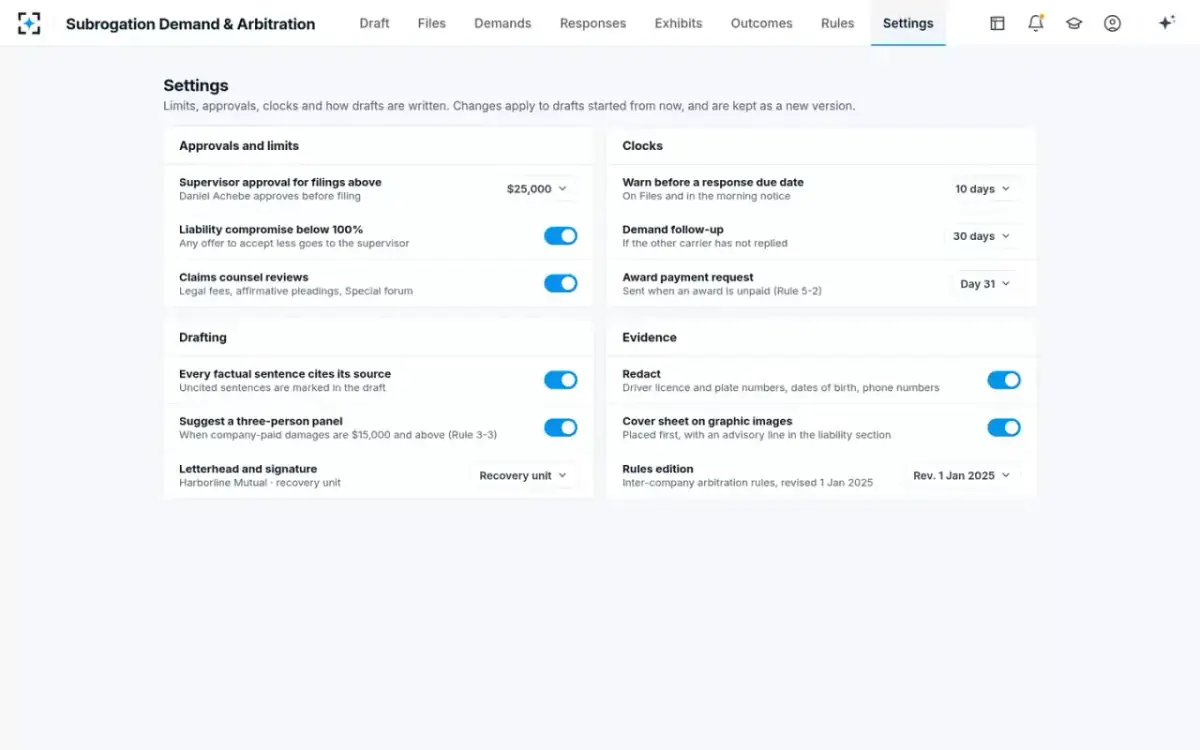
Whoever the carrier says, and the software should enforce it rather than suggest it. On the sample unit, the specialist files anything under $25,000 that asks for full liability; filings above $25,000 and any offer to accept less than full liability go to the recovery supervisor; legal fees, affirmative pleadings and Special Arbitration filings go to claims counsel. Those are settings, alongside the clocks: a warning ten days before a response is due, a follow-up 30 days after an unanswered demand, a payment request on day 31 after an unpaid award, and the rules edition drafts are checked against.
Limits, approvals and clocks are the carrier's settings
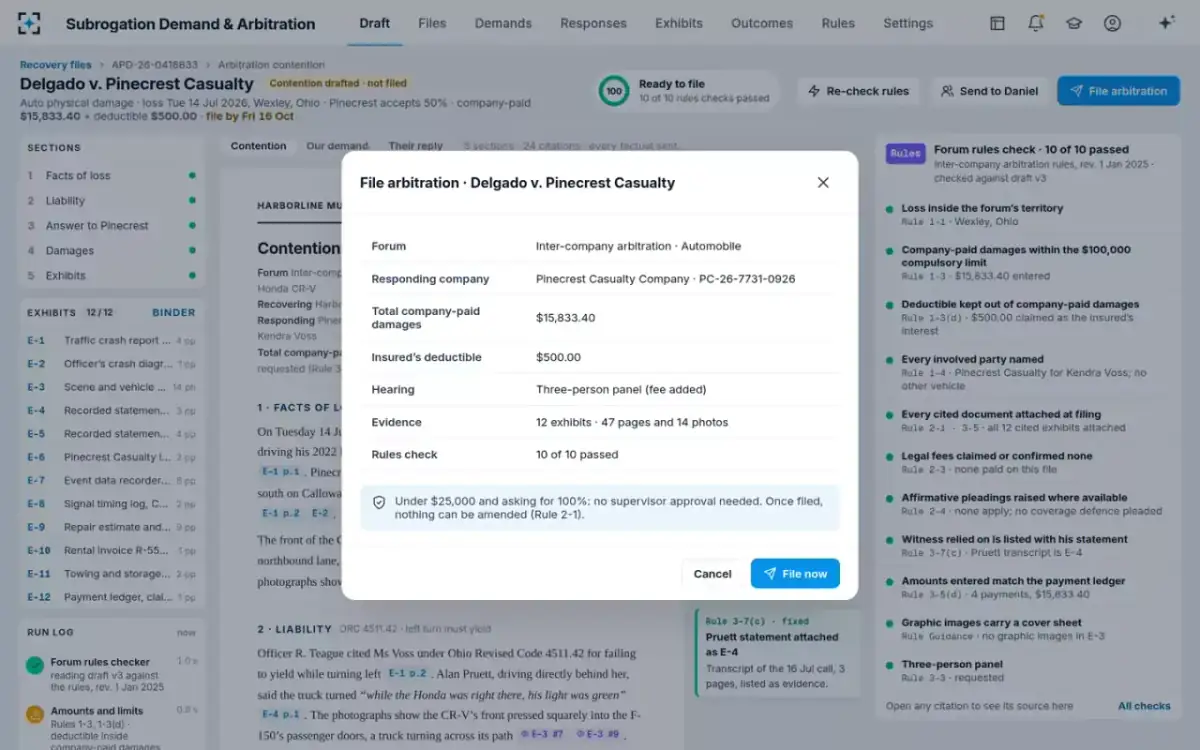
The filing screen is where those settings meet a real case. On the sample unit's Delgado contention it shows the forum, the responding company, company-paid damages of $15,833.40 with the $500 deductible apart, a requested three-person panel, twelve exhibits, and ten of ten rules checks passed, with the reminder that nothing can be amended once filed. Under $25,000 and asking for full liability, no supervisor approval is needed.
One screen before File now: forum, amounts, panel, evidence, checks
Vendor security: what insurance regulators expect
Recovery files carry personal information, and a carrier that hands them to software takes on duties for the vendor. In states that have adopted the NAIC's Insurance Data Security Model Law, an insurer must choose such vendors with due care and require them to protect the information they hold (NAIC Model #668). New York's cybersecurity regulation requires each covered entity to keep written policies that secure the systems and nonpublic information its third-party service providers can reach or hold (23 NYCRR 500.11).
The crash report is a special case. Driver details drawn from state motor vehicle records are protected by the federal Driver's Privacy Protection Act, which lets insurers, self-insured entities and those working for them use the details for claims investigation (18 U.S.C. § 2721(b)(6)). Permission to use is not a reason to spread them: the sample unit's exhibits redact driver licence and plate numbers, dates of birth and phone numbers before anything leaves the file, and the forum's rules make the whole proceeding confidential.
How long does arbitration software take to set up?
The honest answer is that it depends on access, not on the software. The part that needs other people is connecting to the claims system and agreeing what the tool may read; the rules, the letter templates and the approval limits are configuration. The sensible order is to prove the software on files whose outcome is already known before trusting it with new ones.
A sensible order for putting Subrogation Demand & Arbitration on a desk
A person decides
Recovery operations and claims ITAgree read access to the claim file and payments, and the letterhead, templates and approval limits.
Agent
Claim file reader and contention writerDraft contentions on a sample of decided files, every fact cited, with the decision kept out of the file they read.
Agent
Forum rules checkerChecks each replayed draft against the edition in force on its filing date.
A person decides
Arbitration specialistsCompare the drafts and findings with what was filed and what the arbitrator decided, point by point.
A person decides
Recovery supervisorDecides which checks block filing and which advise, then turns the desk on for new files.
Where Subrogation Demand & Arbitration fits, and where it does not
It fits a property and auto recovery desk that files and answers intercompany arbitration and sends demands to other carriers: it drafts, cites, binds, checks and tracks, and leaves every decision and every filing to a named person. It does not replace the forum's filing system, the claims system or a law firm's matter management, and it is not built for commercial or international arbitration. It does not find the subrogation opportunity in the first place; that is Subrogation Identification, whose buyers’ guide to insurance subrogation software covers that side. The other buying question people ask is whether a general AI writing tool would do; that comparison is in AI demand letter generator or a cited demand.
Questions people ask
What is TRS in intercompany arbitration?
TRS, Total Recovery Solution, is Arbitration Forums' online system for filing and responding to arbitration cases. Filings, responses, extensions, deferments, decisions and payment requests run through it; recovery software works alongside it rather than replacing it.
What is E-Subro Hub?
It is Arbitration Forums' system for sending and receiving subrogation demands between members, with supporting documents, and for moving a demand into arbitration when it cannot be settled. Members that join agree to issue and receive demands through it, and the forum offers it to members at no cost.
Can arbitration software file cases automatically?
It can prepare everything, but filing should stay a person's act, because the rules allow no amendments once a filing is submitted. In Subrogation Demand & Arbitration only the specialist can file, and filings above the carrier's limits need the supervisor first.
Does recovery software handle filings against our insureds?
It should. In the solution, filings by other carriers are picked up with their response due date, the answer is drafted point by point, disputed damages go on the Feature Response step, and a warning comes before the due date with the extension's status.
What data does arbitration software need from the claims system?
The documents in the claim file, the payments made with their dates and payees, the deductible and any salvage or prior recovery, and the other carrier's letters. Read access is enough to draft; anything written back should be what a person approved.