An AI demand letter generator is a tool that turns a few typed facts into a formal letter asking someone to pay: a deposit back from a landlord, an unpaid invoice, compensation for damaged property. For an insurer's subrogation demand, fluent text is the easy part. The demand must state what the insurer actually paid, include the insured's deductible (in every demand, in California), tie each liability fact to the document that proves it, and arrive with evidence the other carrier, and later an arbitrator, can check. A generator that works from what it is told cannot know any of that unless someone supplies it, and research on language models shows they will fill gaps with confident inventions. Botminds' Subrogation Demand & Arbitration takes the other route: six agents read the claim file and draft the demand or arbitration contention, every factual sentence cited to its page, then check it against the forum's rules before a specialist sends or files it.
Screens and examples come from a fictional sample recovery unit, Harborline Mutual, and its files; people, carriers and amounts are invented. The research and rules are linked where they appear.
A generic AI demand letter and a cited subrogation demand, line by line
Generic AI demand letter generator: Whatever the user types or pastes into the prompt.
Cited demand drafted from the claim file: The claim file itself: crash report, statements, photos, recorder data, estimate, invoices, payments.
Generic AI demand letter generator: The figures given, or figures the model supplies to complete the letter.
Cited demand drafted from the claim file: Each amount tied to a payment made on the claim and an invoice; nothing claimed that was not paid.
Generic AI demand letter generator: Included if someone remembers to mention it.
Cited demand drafted from the claim file: Shown as the insured’s interest, as the loss state requires; kept out of company-paid damages for arbitration.
Generic AI demand letter generator: A persuasive paragraph.
Cited demand drafted from the claim file: Each sentence cited to an exhibit and page; the rule of the road named with its section.
Generic AI demand letter generator: Can be confabulated: a section that does not exist or says something else.
Cited demand drafted from the claim file: Only rules held in the solution by edition, applied by a separate check.
Generic AI demand letter generator: Not part of the output.
Cited demand drafted from the claim file: An exhibit binder in citation order, personal identifiers redacted.
Generic AI demand letter generator: The user reads the letter.
Cited demand drafted from the claim file: A separate agent checks it against the rules; a named person sends or files.
What is an AI demand letter generator?
It is a writing tool with a template: the user fills in who owes what and why, and a language model writes the letter in a firm, formal register. Most are built for individuals and small businesses chasing money, which is why the searches around them are about deposits, invoices and property damage. They do that job well enough, because in those cases the person typing the facts is the person who knows them, and the letter's main work is tone.
A subrogation demand reverses those conditions. The person writing it did not see the crash; the facts sit across dozens of documents in a claim file; the amounts are fixed by payments already made; and the reader is a professional adjuster who will check every number against the attached proof, with arbitration behind the letter if they disagree. In that setting, a generator's strength, producing confident text from little input, is the risk.
Are AI demand letters accurate?
Only as accurate as their sources, and general-purpose models are measurably unreliable on legal facts. A study published in the Journal of Legal Analysis in 2024 found that, asked specific and checkable questions about randomly chosen federal court cases, general-purpose models invented the law between 58% of the time (ChatGPT 4) and 88% (Llama 2). Tools built specifically for legal research, which retrieve documents before answering, did better but not well: a preregistered evaluation posted as a preprint in May 2024 found that each of the commercial tools it tested still gave false answers on 17% to 33% of queries (Magesh et al.).
What the research measured, and what one sample contention read
58–88%
of answers about specific federal cases were wrong, depending on the general-purpose model
Journal of Legal Analysis, 2024
17–33%
hallucination rate of retrieval-based legal research tools in a preregistered test
preprint, not peer reviewed
61
documents read for one sample contention before a word was written
214
facts extracted from them, each with its page
Federal standards now name the failure. NIST's generative AI profile lists it among the risks of these systems: “Confabulation: The production of confidently stated but erroneous or false content (known colloquially as “hallucinations” or “fabrications”) by which users may be misled or deceived.” For a demand letter the danger is specific. A confabulated statute section, a rental total that matches no invoice, or a fact about the crash that no document supports will not look different from a true one. The other adjuster will find it, and in arbitration a point that cannot be supported is a point lost.
Can ChatGPT write a demand letter for a subrogation claim?
It can write one, if someone gives it every fact and figure and then checks the result line by line; it cannot read the claim file, and it should not be given one carelessly. Three practical problems follow. First, the drafting time saved is spent again on verification, because nothing in the output says where each statement came from. Second, the law: a model asked to cite the rule of the road may produce a plausible section number, and a demand to an Ohio carrier that cites the wrong section undermines the right point. The real rule for a left turn in Ohio, Ohio Rev. Code § 4511.42, requires the turning driver to give way to oncoming traffic (the wording is quoted in the demand letter template) when it is close enough to be an immediate hazard, and that last condition is exactly what the other carrier's speed argument attacks.
Third, the data. A crash report carries driver details from state motor vehicle records, which federal law lets insurers use “in connection with claims investigation activities, antifraud activities, rating or underwriting”. Pasting them into a consumer AI service is a different matter: in states that have adopted the NAIC's data security model law, an insurer must take due care in choosing any outside provider that will hold its data (NAIC Model #668). Whatever tool drafts a demand, the carrier answers for where its claim files go.
A cited sentence, opened
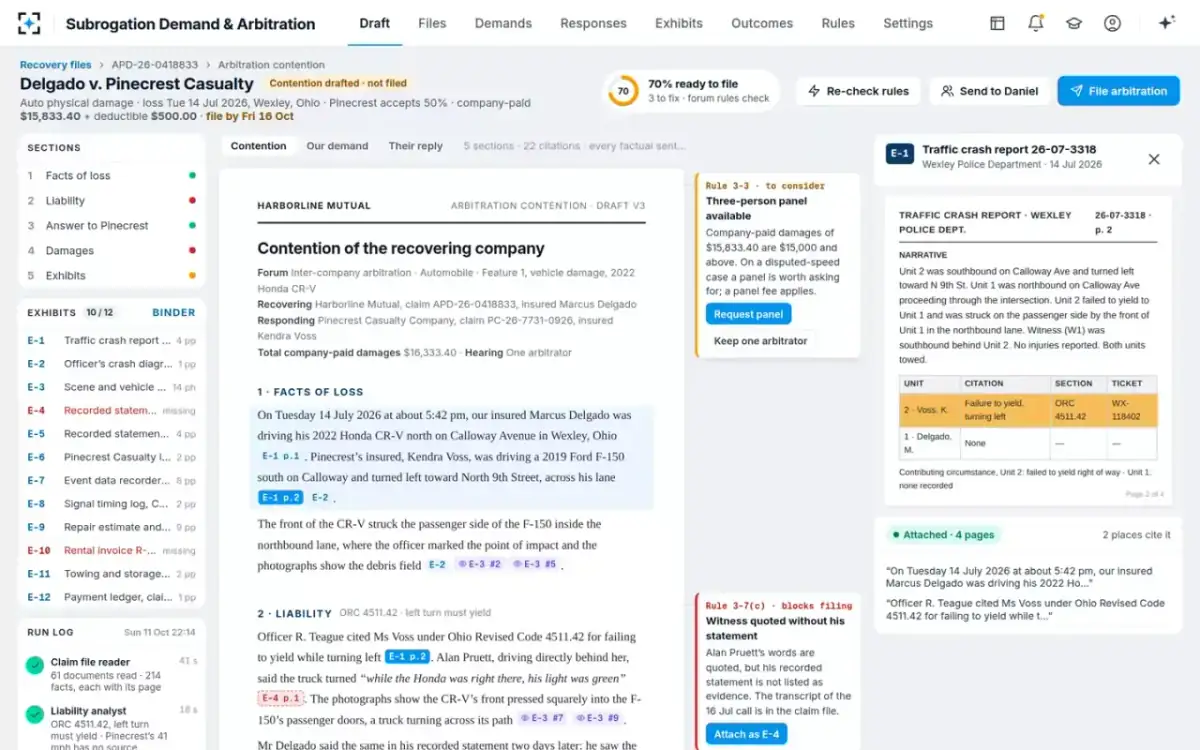
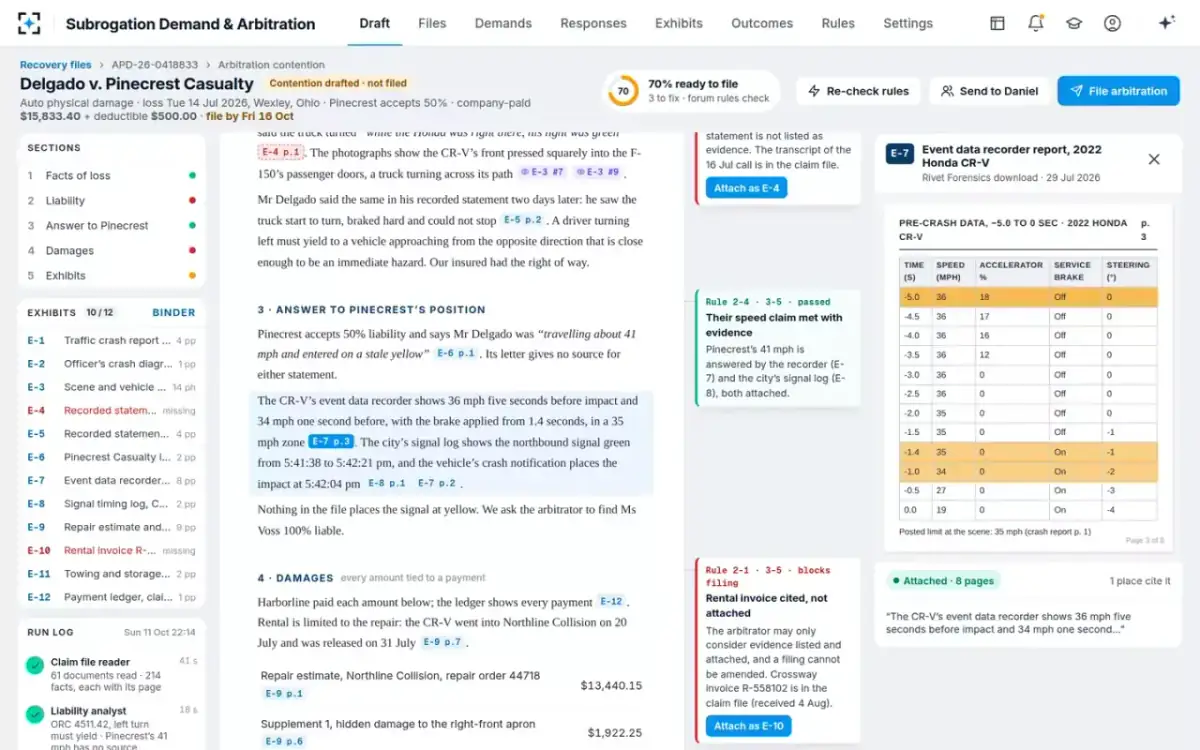
The alternative is a draft in which every factual sentence carries a chip that opens its source. On the sample unit's Delgado file, Pinecrest Casualty accepted only 50% liability, saying the insured was doing about 41 mph on a stale yellow. Its letter gives no source for its speed or its yellow. The answer section of the contention gives four.
One sentence of a Subrogation Demand & Arbitration answer, and what each citation opens
Pinecrest accepts 50% liability and says Mr Delgado was travelling about 41 mph and entered on a stale yellow E-6 p.1. The CR-V’s event data recorder shows 36 mph five seconds before impact and 34 mph one second before E-7 p.3. The city’s signal log shows the northbound signal green from 5:41:38 to 5:42:21 pm E-8 p.1, and the vehicle’s crash notification places the impact at 5:42:04 pm E-7 p.2.
E-6 p.1
Pinecrest Casualty’s liability letter
Their claim: about 41 mph on a stale yellow, with no source given.
E-7 p.3
Event data recorder report, 2022 Honda CR-V
36 mph five seconds before impact, 34 mph one second before, brake on before impact.
E-8 p.1
City signal timing log
Northbound green from 5:41:38 to 5:42:21 pm.
E-7 p.2
The CR-V’s crash notification
Impact at 5:42:04 pm, inside the green.
Every claim in that sentence can be checked in one click, which changes what review means. The specialist is not asked to trust the draft; she is asked to open what it cites. The recorder data matters in its own right: federal rules require a vehicle's event data recorder to capture speed and service brake status before a crash, and for vehicles built before September 2031, subject to a phase-in from 2028, the required window is the five seconds before the crash (49 CFR Part 563; how to read one in a liability argument is in liability disputes in car accidents). A generator has no way to know such a download exists in the file; a reader of the file does.
A citation chip opens the crash report at the cited line
Their 41 mph, answered by the recorder and the signal log
How do you check an AI demand letter?
Against things outside it, never by re-reading it. A letter that reads well has passed the only test its author could apply. The checks that matter compare the letter with the payments, the law, the file and the reader's rules.
Before an AI-drafted demand goes out
- Every amount matches a payment actually made
And the total matches the sum of the lines; prior payments and salvage are deducted.
- The deductible is handled as the loss state requires
In every demand in California and Washington; shown as the insured’s interest, not company-paid damages.
- Every liability fact can be pointed to
If no document in the file says it, it comes out of the letter.
- Every statute and rule cited exists and says that
Open the official text; check the section number and the edition.
- Everything cited is enclosed, everything enclosed is cited
In arbitration, the arbitrator may only consider evidence listed and attached.
- No personal identifiers that do not need to travel
Licence and plate numbers, dates of birth and phone numbers can be redacted from exhibits.
- A named person signs, and could explain each line
The letter is the insurer’s statement, whoever drafted it.
“I want to see the weak points before we pay the filing fee, not after the decision.”
Daniel Achebe, recovery supervisor in the fictional sample unit
Is an AI demand letter legally valid?
Validity does not depend on who drafted the words; it depends on whether they are true and whether the sender stands behind them. We found no rule that forbids an insurer to draft a subrogation demand with software, and none that excuses an error because a machine made it. What regulators do expect is governance of how AI is used in claims, which the NAIC's model bulletin on insurers' use of AI addresses and which our compliance guides cover under AI governance and model inventory.
The practical test is simpler: could the person who signs the letter defend each sentence to the other adjuster, and each amount to an arbitrator? In Subrogation Demand & Arbitration the governance is built into the draft. Uncited sentences are marked; agents never file, concede liability or claim an amount that was not paid; filings above the unit's limit and any offer below full liability go to the supervisor; and every agent step, attachment, approval and filing is kept on the file's activity trail with who and when.
Demand letter or demand package: what is the difference?
A demand letter is the request; a demand package is the letter with its damages summary and the documents that prove both. A generator produces, at best, the first. In subrogation the second does the work: the forum's FAQ tells its insurer members that proof of payment, while not required, helps arbitrators catch a deductible counted twice or a salvage return left in (AF FAQ). What belongs in a package, and why its writer should never be its checker, is set out in the subrogation demand package; an annotated letter, element by element, is in the subrogation demand letter template.
When a generic generator is enough, and where Subrogation Demand & Arbitration fits
For a one-off letter from a person who knows every fact and figure, a generic generator is a reasonable start, with the checklist above. For a recovery desk sending 30 or 40 demands a week, as the sample unit's subrogation specialist does, and answering other carriers' filings against a due date, the costs run the other way: the time a generator saves on typing is spent on verifying, and the errors it can introduce are the kind arbitration does not forgive.
Subrogation Demand & Arbitration is built for that desk. It drafts from the claim file rather than from a prompt, cites every fact, ties every amount to a payment, assembles the exhibits, checks the forum's rules, and leaves every send and filing to a person. It does not write consumer or injury demand letters, and it is not a legal research tool: the rules it checks against are the forum's edition in force and the carrier's own settings.
Questions people ask
Can AI write a subrogation demand letter?
Yes, as a draft, if it works from the claim file and cites each fact; a general chatbot working from a prompt can only restate what it is told and may invent what it is not. Either way, a person should check the amounts, the deductible and the law against their sources and sign it.
Are free AI demand letter generators safe to use for insurance claims?
For an insurer, the question is less the letter than the data: a crash report and claim file carry protected personal information, and states that have adopted the NAIC's data security model law expect due diligence on any third-party service provider that holds it. Any tool that receives claim files has to pass the same vendor review as every other service that holds them.
What should a subrogation demand letter include?
The parties and claim numbers, the date and place of loss, the liability facts with the documents behind them, the amounts paid, the insured's deductible, the enclosures and a reply date. California requires the first-party claimant's deductible in every subrogation demand.
How often do AI tools make up legal facts?
In a 2024 study in the Journal of Legal Analysis, general-purpose models answered specific questions about federal cases wrongly 58% to 88% of the time; a 2024 preprint found purpose-built legal research tools hallucinated 17% to 33% of the time. Neither measured demand letters, but both measured the kind of fact a demand cites.
Does an AI-drafted demand change anything in arbitration?
No. The forum judges the filing, not its author: the arbitrator may consider only evidence listed and attached, and nothing can be amended after filing. A cited, checked draft simply makes those rules easier to meet.