The NAIC error tolerance chart most examiners work from comes from the Market Regulation Handbook's sampling chapter: 7 percent for claims practices and 10 percent for other trade practices such as underwriting, rating, marketing and complaint handling. In the 2017 edition, which the Indiana Department of Insurance publishes in full, the handbook says error rates above those benchmarks are presumed to indicate a general business practice contrary to the unfair trade and claims practices laws. The same numbers do a second job as the tolerance in a two-stage sample, and that is where most misreadings start: a first sample with only two or three errors, far below 7 percent, can still fail to rule out a problem and send the examiners to a larger second sample. Botminds' Market Conduct Exam Management applies each standard's tolerance as a setting when it pre-checks sampled files, so a company sees the count that matters before the examiner does.
The numbers and quotations on this page are from the NAIC's 2017 handbook, the NAIC model acts, a state coordinator's handbook and a 2025 Florida examination report, linked where they appear. Where the solution appears, the data is from a fictional sample exam.
The four numbers behind the tolerance chart (2017 edition)
7%
benchmark error rate for claims practices
10%
benchmark for other trade practices
95%
minimum confidence for the first-stage acceptance sample
90%
the floor for a second-stage sample’s confidence
What is the NAIC error tolerance chart?
The NAIC error tolerance chart is two numbers and a rule. The handbook's sampling chapter (2017 edition, published in full by the Indiana Department of Insurance) says: "Historically, a benchmark error rate of 7 percent has been established for auditing claim practices and 10 percent for other trade practices. Error rates exceeding these benchmarks are presumed to indicate a general business practice contrary to these laws." It strongly encourages states with a general business practice standard, absent case law that sets another, to use 7 and 10 percent both as sampling tolerances and as benchmarks for deciding when a violation has occurred.
The phrase "general business practice" comes from the NAIC model acts. Under the Unfair Claims Settlement Practices Act, an act listed in the statute is an improper claims practice if it is committed flagrantly and in conscious disregard of the Act, or often enough to indicate a general business practice of that conduct. The Unfair Trade Practices Act uses a similar frequency test for some practices. The tolerance chart is the handbook's answer to how often is often enough.
States can and do set their own levels. North Carolina's coordinator's handbook, for example, says the department cites companies when sample errors are at or above 0 percent for consumer complaints, sales and advertising, unappointed or unlicensed producers and unfiled forms or rates; 7 percent for claims; and 10 percent for everything else. Below the threshold, it sends the company a reminder rather than a citation.
The NAIC error tolerance list, with how one state applies it
| Practice | Tolerance (NAIC handbook, 2017 edition) | What exceeding it means | One state’s practice (North Carolina) |
|---|---|---|---|
| Claims handling | 7% | Presumed general business practice under the unfair claims practices law | 7% |
| Other trade practices: underwriting, rating, policy service, marketing | 10% | Presumed general business practice under the unfair trade practices law | 10% |
| Complaint handling | 10% (other trade practices) | Presumed general business practice under the unfair trade practices law | 0% |
| Sales and advertising | 10% (other trade practices) | Presumed general business practice under the unfair trade practices law | 0% |
| Unlicensed or unappointed producers; unfiled forms or rates | Often no frequency test: each act can be a violation | Each instance may be cited | 0% |
Two meanings of 7 percent: the tolerance and the benchmark
The same 7 and 10 percent play two roles, and the handbook warns readers not to confuse them. As a tolerance, 7 percent is a statistical setting for the first sample: the examiners ask whether the sample lets them rule out, with 95 percent confidence, that the true error rate is 7 percent or more. As a benchmark, 7 percent is a legal presumption: an error rate above it is presumed to be a general business practice.
The handbook's footnote spells out why the first role cannot do the second's work: "the first stage sample cannot be used to establish with confidence that the true rate of noncompliance exceeds 7 percent or 10 percent." A small first sample can only clear a process. If it cannot clear it, the examiners take a larger second sample to estimate the actual rate, and only that estimate can support a finding that the rate exceeds the benchmark.
The handbook adds a caution in plain words: the tolerance level used in sampling "has little to do with the real tolerance that a jurisdiction may have for error." A company that reads 7 percent as permission to get 6 percent of its files wrong has misread both meanings.
What is the market conduct exam error tolerance test? Errors found against sample size
The market conduct exam error tolerance test asks one question of the first sample: if the true error rate were exactly the tolerance, how likely is a sample with this few errors? The handbook's Acceptance Samples Table answers it for common population sizes, using the hypergeometric distribution. "A second sample is triggered when the p-value exceeds 5 percent." In plain terms, once errors are frequent enough that a process at the tolerance could plausibly have produced them, the first sample has not cleared the process.
Errors you can find in a first sample before the examiners draw a second, by population (2017 Acceptance Samples Table)
200
Claims sample76 files
Claims errors allowed2
Other sample79 files
Other errors allowed4
400
Claims sample82 files
Claims errors allowed2
Other sample84 files
Other errors allowed4
500
Claims sample83 files
Claims errors allowed2
Other sample86 files
Other errors allowed4
1,000
Claims sample105 files
Claims errors allowed2
Other sample113 files
Other errors allowed6
2,000
Claims sample107 files
Claims errors allowed3
Other sample114 files
Other errors allowed6
3,500
Claims sample108 files
Claims errors allowed2
Other sample115 files
Other errors allowed6
5,000
Claims sample108 files
Claims errors allowed2
Other sample115 files
Other errors allowed6
10,000 to 50,000
Claims sample109 files
Claims errors allowed3
Other sample116 files
Other errors allowed6
Read the claims column against the benchmark and the gap is obvious. In a 105-file claims sample, three errors (2.9 percent) are enough to trigger a second sample; in a 76-file sample, three errors (3.9 percent) do the same. The handbook's own example: in a sample of 76 from a population of 200, "the probability of finding two or fewer errors is 4.8 percent if the sample were taken from a population with an error rate of 7 percent." Two errors clear the process; a third does not.
How likely is a 108-file claims sample with this few errors, if the true rate were 7%?
That last detail is worth knowing before an exit conference. The text says a second sample follows when the probability exceeds 5 percent, but the table's own column marks three errors as needing one at 5,000 claims (4.9 percent) and at 3,500 (4.8 percent), while marking the same three errors as clear at 2,000 claims (4.9 percent). At three errors, the outcome is a judgement call for the state; a company should not count on the lenient reading. The guide to the market conduct exam sample size calculator lets you compute the probability for your own population.
How many violations is a general business practice violation?
There is no fixed number of violations that makes a general business practice; it is a rate, estimated from a random sample, measured against the benchmark. Under the handbook's method, an error rate shown by an adequate second sample to exceed 7 percent for claims, or 10 percent for other practices, is presumed to be a general business practice where the state uses that standard. A presumption can be answered: the company's response can set out the cause and the fix, and the department decides what follows.
Two other routes do not depend on frequency at all. The model act also reaches a practice committed flagrantly and in conscious disregard of the law, and some laws make each act a separate violation. The handbook gives the example of doing business without a licence, which may be a violation every time it occurs, and adds that in states without the general business practice standard, the sample error rate "represents the probable number of violations within the total population rather than a benchmark for evaluating whether or not a violation has occurred."
The stakes are set in the penalty section. The NAIC's Unfair Claims Settlement Practices Act allows a monetary penalty of not more than $1,000 for each violation, up to $100,000 in aggregate, and up to $25,000 per violation and $250,000 in aggregate when the violation was flagrant and in conscious disregard of the Act. States set their own amounts, and some add remedies. Florida's statute lets the Office, after a market conduct exam finds a pattern or practice of willful claims-handling violations that harmed policyholders, order the insurer to file its claims-handling practices and procedures for that line, to be held for 36 months as public records.
Where the tolerance chart does not apply
The chart applies to rates estimated from random samples, and some reviews are not sampled at all. The handbook says random sampling is unnecessary where each discrete violation is the target of the review rather than a rate across a population. Its example is advertising: an examiner may have no complete list of every advertisement used in a period, but "if 7 violations are identified among the advertising materials that are available, the examinee is noncompliant in seven known instances", even though nothing is learned about the overall rate.
The same logic covers forms used without filing, producers without a licence or appointment, and any law that makes each act a violation. North Carolina's zero thresholds for those areas follow from it. For a company, the practical point is that the tolerance protects nothing in those areas: one unfiled endorsement is one finding. Self-audits of advertising, forms and licensing should aim for a complete review rather than a sample.
Market conduct exam error tolerance rate in practice: a 2025 report
Published reports show the tolerance at work, because they give the sample, the count and the rate for each finding. A 2025 Florida report on one insurer's Hurricane Ian claims drew random samples from three claim populations and stated each finding as a count out of the 295 claims reviewed. Its findings ranged from 2.4 percent (interest not paid on late payments) to 12.2 percent (claim communications not acknowledged within 14 calendar days), with others at 3.4, 4.1, 5.1, 6.4, 7.1 and 9.8 percent.
Most of those rates are below 7 percent, and they are findings anyway. The report states that its sampling followed the NAIC handbook and its Acceptance Samples Table and that "Examination results with a 95% confidence level permit those results to be extrapolated to the population identified in each of the areas examined." A finding below the benchmark can still be a violation where the law counts each instance, and it is evidence of a pattern either way. The guide to a market conduct examination report example reads another 2025 Florida report line by line.
How to read an error tolerance finding in an exam report
Read every finding for six things before deciding whether to agree, explain or dispute it. Most disputes that succeed turn on one of them: the population, the randomness of the sample, or which rule applied when the file was handled.
Six checks for any finding stated against an error tolerance
- What population was sampled, and for what period?
An inference applies only to the population the sample was drawn from; the handbook rules out extrapolating beyond it.
- Was the sample random, and drawn from a complete list?
The handbook treats non-random findings as discrete errors only, never as a rate for the population.
- Is this the first-stage sample or the second?
A first sample can only fail to rule out a problem; a rate above the benchmark needs the larger sample.
- Which tolerance applies: 7%, 10% or none?
Claims, other practices, or a law where each act is a violation. The report’s scope should state the tolerance used.
- Which rule was in force on the file’s dates?
Clocks change; Florida cut its 14-day acknowledgement to 7 days in 2023.
- Is the count stated in the report the count in your files?
Recount from the files and the examiner’s sample list before you answer.
How Market Conduct Exam Management applies the tolerance chart
In the solution, each standard the pre-checker tests carries its clock, what starts the clock, and its tolerance, as settings a company maps to its own state: 7 percent for the claims standards by default, 10 percent for answering the department on complaints, and other levels where a state uses them. The pre-checker shows the count and rate for each standard as files are tested and flags repeats of prior findings. It does not decide that a rate is a violation; that is the examiners' finding to make and counsel's to answer.
Each standard's tolerance as a setting in Market Conduct Exam Management
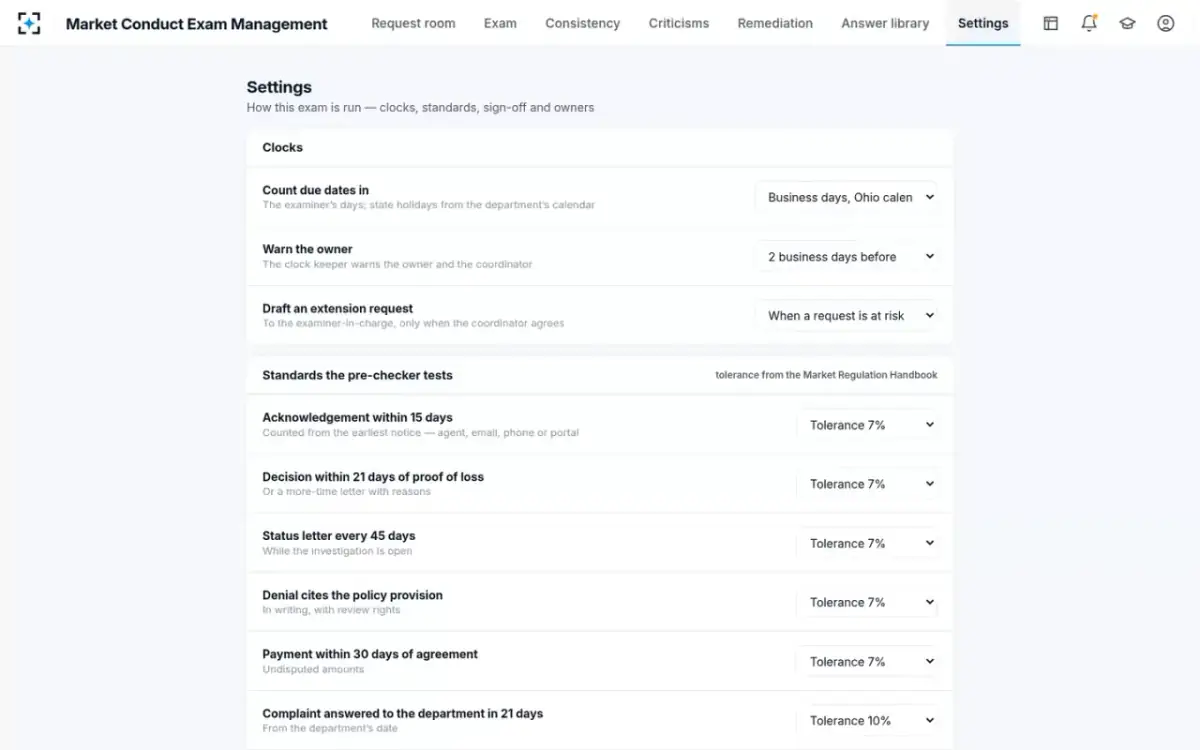
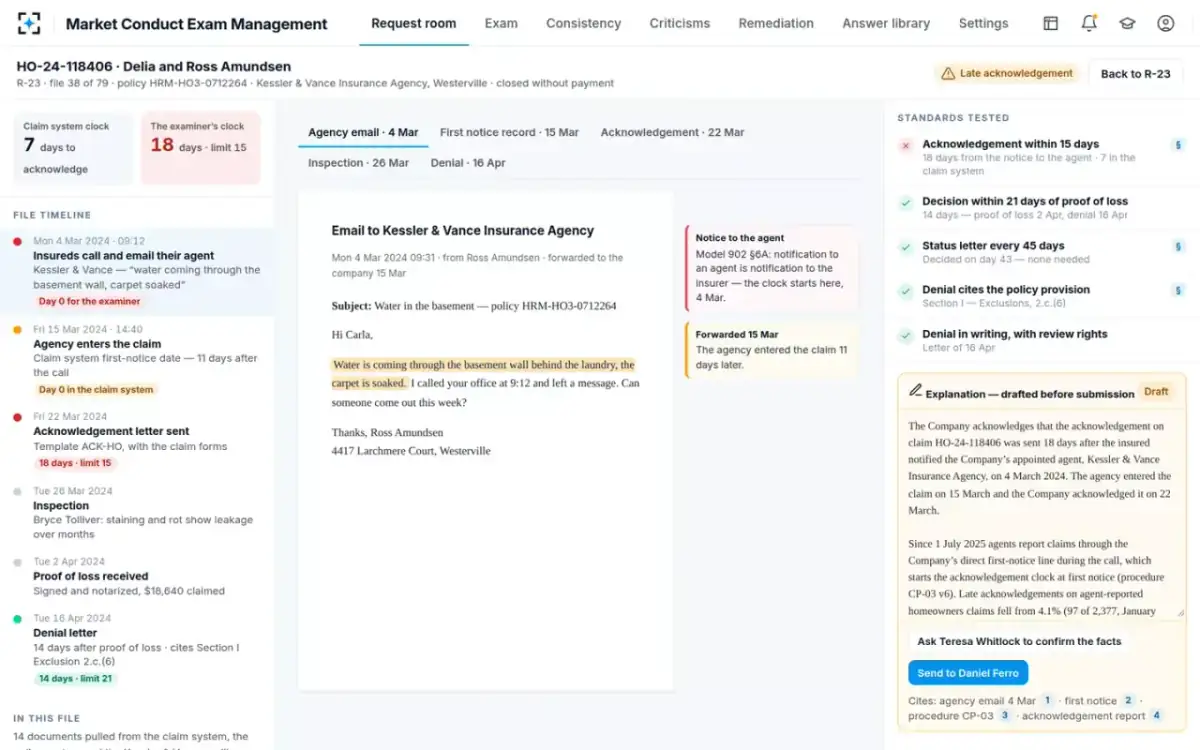
The count matters more than the rate. In the solution's sample exam, a replay of 79 homeowners files found three late acknowledgements and two denials that did not cite the policy provision. Against the handbook's method, either count is enough that a first sample of that size would not clear the standard, which is why each exception came with its cause found and its explanation drafted before submission. The self-audit guide works through that reading in market conduct exam self audit questions; for underwriting files, the Commercial Lines guide to an underwriting audit checklist applies the same standards to commercial accounts.
One exception, explained before the examiner sees it
Questions people ask
What is the NAIC error tolerance for claims?
Seven percent in the NAIC Market Regulation Handbook's 2017 edition, which says error rates above that benchmark are presumed to indicate a general business practice contrary to the unfair claims practices law. Other trade practices use 10 percent.
Does an error rate under 7 percent pass a market conduct exam?
Not necessarily. A small first sample can trigger a second sample with only two or three errors, and a finding below the benchmark can still be cited where a law counts each instance as a violation. Florida's 2025 reports list findings as low as 2.4 percent.
Where is the NAIC error tolerance table published?
In the sampling chapter of the NAIC Market Regulation Handbook, with the Acceptance Samples Table. The 2017 edition is published in full by the Indiana Department of Insurance; the NAIC updates the handbook each year.
Are general business practice standards the same in every state?
No. The NAIC model acts use the frequency test, and the handbook encourages the 7 and 10 percent benchmarks where states adopted it, but states set their own law. North Carolina, for instance, cites at 0 percent for complaints, sales and advertising, licensing and unfiled forms or rates.
What happens after a second sample?
The examiners estimate the actual error rate with a confidence interval, using at least 90 percent confidence, and compare it with the benchmark. The handbook says the report should describe the sampling method and the confidence limits for any estimate.