Who pays for market conduct exams? In the states we checked, the insurer being examined does. Florida's statute says "The reasonable cost of the examination shall be paid by the person examined", and when Florida uses an independent examiner under contract, the insurer pays that firm directly at rates the state agreed. Texas, which enacted the NAIC's Market Conduct Surveillance Model Law, lets the department assess the reasonable and necessary cost against the insurer, but requires itemized monthly bills and caps examiner fees at the rates in the NAIC handbook. Because the bill runs by examiner time, the cost of an exam depends less on its scope than on how many days the examiners spend waiting, re-asking and resampling. Botminds' Market Conduct Exam Management is built around that: its agents pull, test and reconcile each requested file before the company submits, so a request is answered once.
Where this page uses examples from the solution, they come from a fictional sample exam of an Ohio mutual insurer, with invented figures. The cost estimates are ours and say how they were made.
How a market conduct exam bill is built
Monthly
itemized bills, for the insurer’s review before payment, in Texas and the NAIC model law
Tex. Ins. Code §751.208(a)
6
states the NAIC lists as having adopted that model, as of its Fall 2021 state page
400miles
of driving counts as one day of examiner travel time in the 2017 handbook’s compensation guide
$96,400
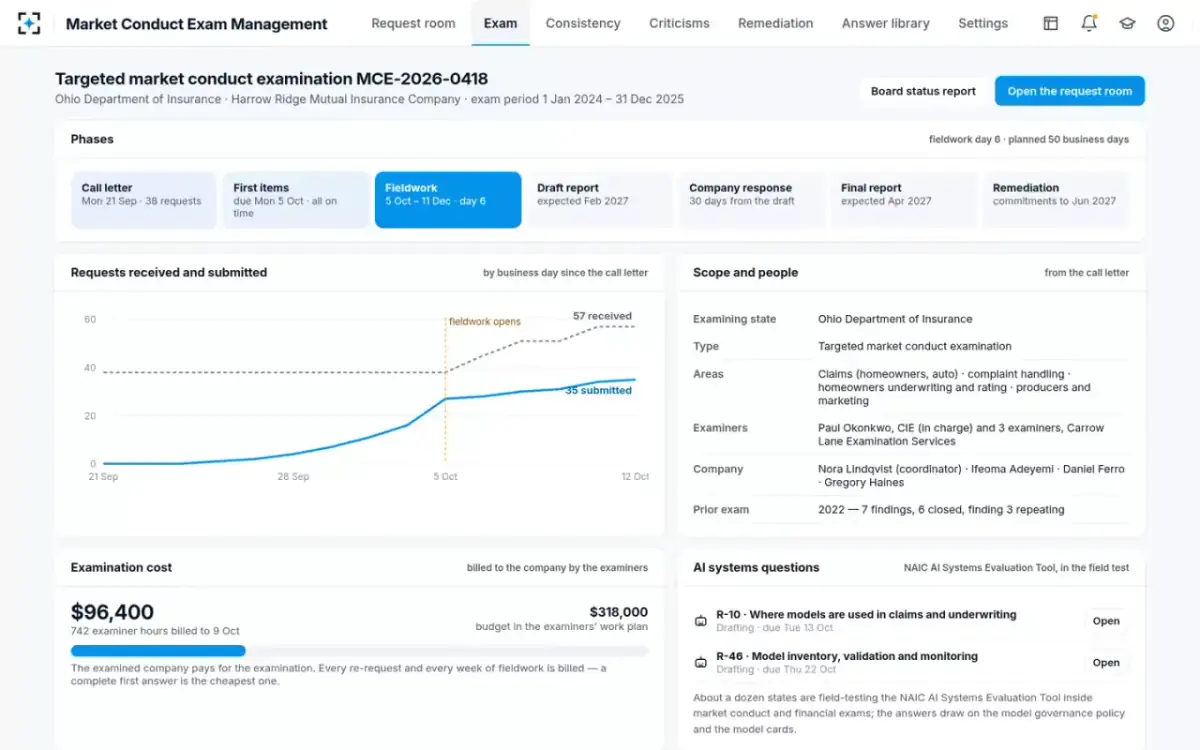
for 742 examiner hours, billed to 9 October in the solution’s sample exam
Fictional sample data
Who pays for market conduct examination costs? The examined insurer, in the statutes we checked
The examined insurer pays, under a statute that also limits what can be charged. The pattern is the same in the sources we read, though the wording differs. Florida makes the insurer liable for the reasonable cost and, for contract examiners, says "payment shall be made directly to the contracted examiner by the insurer examined in accordance with the rates and terms agreed to by the office and the examiner." Both of Florida's 2025 hurricane-claims reports we reviewed were performed by contracted examination firms.
The NAIC model law and the Texas statute that follows it go further on control. They require a budget in the work plan whenever the insurer is billed, itemized monthly bills, written protocols for outsourced work including "a dispute resolution or arbitration mechanism to resolve conflicts with insurers regarding examination fees", and the commissioner's endorsement of a contract examiner's detailed bill before it reaches the insurer. Texas adds a ceiling: an insurer need not reimburse examiner fees above those prescribed in the market conduct examiners handbook, unless the commissioner shows the handbook's fees are inadequate for the exam.
Who pays for market conduct exams, and the controls on the bill, by source
| Source | Who pays | Controls on the bill |
|---|---|---|
| Florida, Fla. Stat. §624.3161 | The person examined pays the reasonable cost; a contract examiner is paid directly by the insurer. | Rates and terms agreed between the Office and the examiner. |
| Texas, Tex. Ins. Code §751.208 | The insurer, where the reasonable and necessary cost is assessed against it. | Itemized monthly bills; fee disputes by a dispute mechanism; commissioner endorses contract bills; fees capped at the handbook’s. |
| NAIC Model Law #693, §6 | The insurer, where costs are assessed. | Budget in the work plan; itemized monthly bills; written outsourcing protocols, including disclosure of contractors’ fees or hourly rates. |
| NAIC Market Regulation Handbook, 2017 edition | Assumes the company reimburses; the notice states cost and billing procedures. | Suggested examiner rates published by the NAIC; per diem on federal GSA rates; no salary for absent days. |
That is why the call letter matters to finance as much as to compliance. The 2017 handbook lists "The legal basis for examination and cost and billing procedures;" among the things a notification letter should state, and the model law requires the work plan to identify the factors that will be billed. The time to ask what is in the bill is before the first invoice.
What a market conduct exam bill contains: examiner days, travel and the waiting
A market conduct exam bill is mostly examiner time, charged by the day or the hour, plus travel and subsistence. The 2017 handbook's compensation chapter, which states use as a guide, says "The daily rate is to be computed beginning at the time the examination is initiated and terminating upon completion of the examination or the examiner’s active participation therein and to include actual travel time." Expenses follow federal per diem rates published by the General Services Administration, with travel home every other weekend.
Two rules in that chapter show where a company's own conduct moves the bill. No salary is charged for days examiners are absent while the company is open, but if the company closes and the examiner is assigned and available, the handbook recommends that salary be allowed for that day. In other words, the daily rate runs while an examiner is assigned, whether or not the company has the next files ready. The handbook's model post-examination questionnaire even asks the coordinator, "Were sufficient documents requested and retained at one time so as to remain busy at all times?"
The examination plan the handbook describes names the risk directly. Alongside budgeted examiner time, travel and incidental costs, it should list "factors that could potentially contribute to increased examination costs, such as delays in responding to examiners or unforeseen compliance matters;". A late file, an incomplete package and an answer that contradicts the annual statement are each a delay in responding to examiners.
The examination cost panel: examiner hours billed against the work plan
What do market conduct exams cost? Price the request, not the exam
No regulator we found publishes typical market conduct exam costs, and totals would mislead anyway: an exam of one line for one year and a comprehensive multi-line exam differ by an order of magnitude. What a company can price is the unit that drives the bill, one examiner request. Each request costs the examiner time to read the response and test the files, and costs more each time it has to be asked again.
The examiner cost of one sample request, as an estimate a company can run on its own exam
Review of the package
files × examiner hours per file × hourly rate
The unavoidable part: the examiner tests each sampled file once.
Rate from the work plan; hours from the last exam
Re-request
extra hours to re-ask, wait and re-review × rate
A missing document, a wrong file or a count that does not tie.
Coordinator’s log of follow-ups
Second sample
additional files × hours per file × rate
Triggered when the first sample cannot rule out an error rate above tolerance.
Standard-by-standard pre-check
Criticism round
hours to write, answer and resolve each criticism × rate
Each exception the company did not explain first becomes one.
Counsel and the coordinator
Run with illustrative numbers, the method shows why first-time completeness is the lever. Take the sample exam's implied rate of about $130 an hour and assume, for illustration only, half an hour of examiner time per sampled file. A 79-file sample answered completely costs roughly $5,100 of examiner time to review. If the same request is re-asked once, at an assumed six extra hours of chasing and re-review, it costs about $780 more. If the first sample cannot clear the tolerance and a second sample of 100 files follows, the review time more than doubles.
Estimated examiner cost of one 79-file sample request, three ways it can go
Those numbers are assumptions, but the shape holds whatever the inputs: a second sample is the most expensive thing that can happen to a request, and it is triggered by a handful of exceptions, not by a high error rate. Under the 2017 handbook's Acceptance Samples Table, three exceptions in a sample of 105 drawn from a population of 1,000 claims are enough to require a second sample against a 7 percent tolerance. The guide to the NAIC error tolerance chart explains why.
Why the budget moves: the work plan follows the company's cooperation
The budget in the work plan is an estimate, and the handbook expects it to change with what examiners find on site, including how the company behaves. The 2017 edition tells the examiner-in-charge to make final adjustments within the first two weeks and says "The examination plan needs to reflect actual field discoveries as to the quality and availability of data, the level of the company’s cooperation, the location of the data, etc." The company should be told of any change and the reason for it.
Data quality is the first item on that list for good reason. Examiners validate the lists a company sends before they sample from them, reconciling to control totals and, where they can, to the annual statement and MCAS. A list that fails those checks has to be rebuilt, and the sampling waits. In the fictional sample exam, the examiner corrected a sample list five days after sending it because four of the claims had actually been closed with payment; the due date did not move, and the company absorbed the rework.
The most expensive bill is the next exam: repeat findings and re-examinations
The largest cost an exam can create is another exam. Among the dispositions the 2017 handbook lists after a report is a re-examination referencing issues noted in the previous report, and among the reasons a state calls an exam is the result of the last one. A re-examination is billed like any other, and its scope is already written: the findings the company said it would fix.
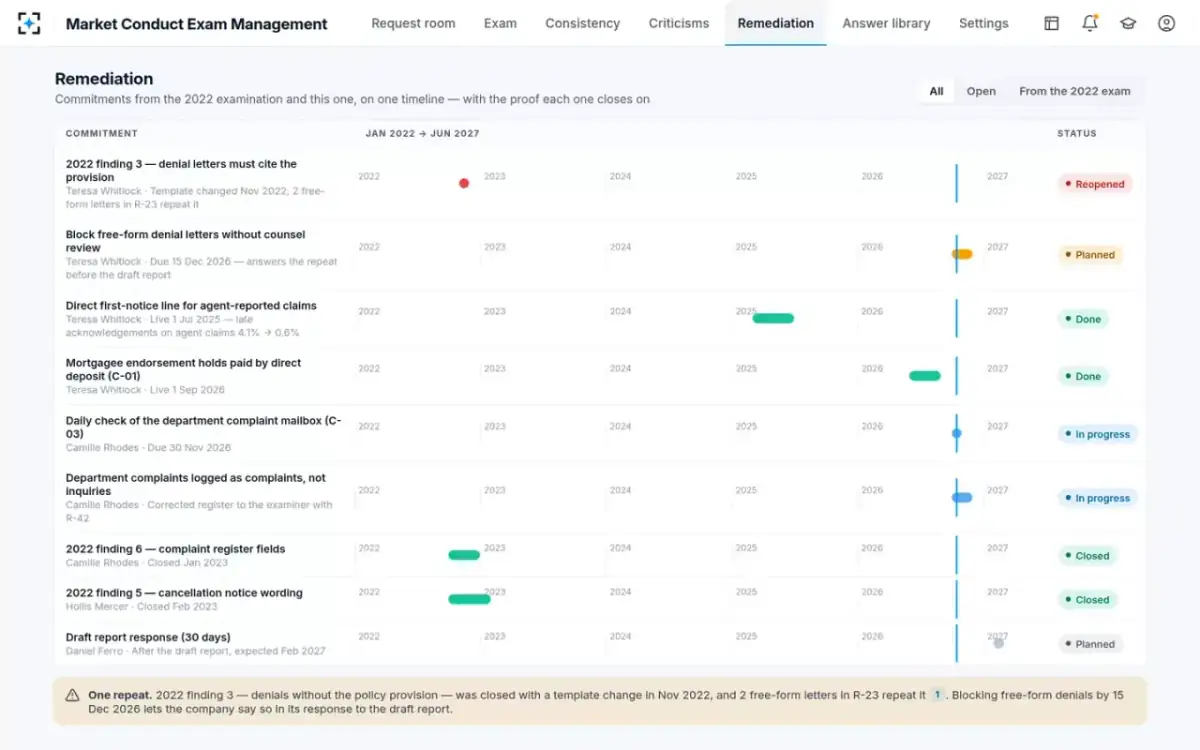
That turns remediation into a cost question. A commitment made in a response letter needs an owner, a date and proof that it worked, kept where the next coordinator can find it. In the sample exam, a 2022 finding about denial letters that did not cite the policy provision had been closed with a template change, yet two free-form denials in a 2026 sample repeated it; the solution reopened the commitment and dated a fix before the draft report.
Remediation commitments from two exams on one timeline
Who pays for market conduct inspections and multistate exams?
Inspections, targeted reviews and multistate exams are paid the same way, by the examined company, but the statutes try to stop it paying twice. Florida may accept another state's report "In lieu of any such examination". Texas makes it a violation for a contract examiner to take compensation from several states for the same examination where that duplicates the insurer's costs, while allowing a coordinated exam for several states to share the cost.
Lighter actions cost less because they use fewer examiner days. Texas requires the commissioner to consider correspondence, interviews, information gathering, policy and procedure reviews, interrogatories and reviews of self-evaluation programs before calling a targeted exam, and to select actions that are efficient and cost-effective for the department and the insurer. A company that answers an interrogatory completely may never see the bill for an on-site visit.
How to read a market conduct exam invoice before you pay it
Read an invoice against the work plan, not against intuition. The model law gives the insurer a monthly review before payment, and that review is only useful if someone compares each line to what was budgeted and what happened that month.
Questions to ask of each monthly market conduct exam invoice
- Does it match the budget and billing factors in the work plan?
The model law requires both whenever the insurer is billed.
- Are hours itemized by examiner and by day?
Texas requires itemized bills; the handbook calls detailed documentation a best practice for the insurer’s own audit.
- Are travel and subsistence at the published per diem?
The 2017 handbook points to federal GSA rates and travel home every other weekend.
- Were examiners billed for days they were idle on site?
If so, find the request that kept them waiting; it is the cheapest saving next month.
- Do contract examiners’ rates match the agreed terms?
Florida pays them directly at rates the Office agreed; Texas caps fees at the handbook’s.
- Has the scope grown?
In Texas an expanded exam needs a written notice and a revised work plan before it starts.
What is a market conduct examination in insurance, and why does the company fund it?
A market conduct examination is a state insurance department's review of how a licensed insurer treats consumers in sales, underwriting, policy service, complaints and claims, tested on a sample of the company's own files. Funding follows the old logic of insurance examinations: the department examines on behalf of policyholders, and the regulated company bears the cost of being examined, within limits set by statute. Florida's report language describes the purpose as evaluating business practices, protecting consumers and holding insurers accountable when issues or violations are identified.
A company cannot opt out of the cost, but it controls much of the size. The handbook expects the company to be cooperative and timely, and among the NAIC's general examination standards is that the company cooperates on a timely basis with examiners. The days the examiners spend because files arrived late, incomplete or inconsistent are days the company asked to pay for.
Where Market Conduct Exam Management reduces the bill, and where it cannot
The solution reduces the billable time that comes from the company's side of a request. Its file puller collects every document for a sampled file before submission, its standards pre-checker finds the exceptions the examiner would, and its response drafter prepares an explanation with the fix and its proof, so counsel can decide whether to volunteer it. The consistency checker compares each count with the MCAS filing and earlier answers before the examiner can. The clock keeper warns the owner two business days before a due date and drafts an extension request only when the coordinator agrees.
It cannot change the scope, the examiners' rates, or the department's decision to draw a second sample when the first sample shows too many exceptions. What it changes is when the company learns about those exceptions: during fieldwork with an explanation drafted, rather than from a criticism. The guide to market conduct exam management systems sets out what to automate and what to keep, and the guide to self-audit questions shows how to find the exceptions before the exam begins.
Questions people ask
Do insurers pay for market conduct exams?
Yes, in the states we checked. Florida requires the person examined to pay the reasonable cost of the examination, and Texas allows the reasonable and necessary cost to be assessed against the insurer with itemized monthly bills.
How are market conduct examiners paid?
State examiners are paid as department staff and their time is billed to the examined company; contract examiners bill at rates the department agrees. The 2017 NAIC handbook's guide computes a daily rate from the start to the end of the examiner's participation, including travel time, with expenses on federal per diem rates.
Can an insurer dispute a market conduct exam bill?
In states that follow the NAIC model law, yes. Texas requires written protocols that establish a dispute resolution or arbitration mechanism for conflicts with insurers over examination fees, and it caps reimbursable examiner fees at the handbook's unless the commissioner shows they are inadequate.
Does a second sample cost the company more?
Usually, because examiner time is billed and a second sample means more files to review. The 2017 handbook draws a second sample when the first cannot rule out an error rate above the 7 or 10 percent tolerance with 95 percent confidence, which can happen with only a few exceptions.
Who pays when several states examine one company?
The company, but statutes try to avoid duplication. Florida can accept another state's examination report instead of its own, and Texas bars a contract examiner from taking compensation from several states for the same exam where that duplicates the insurer's costs.