Market conduct exam self audit questions should be the examiners' own: was the first contact with the claimant within the required time, was the claim resolved on time, is the file documented, does every denial cite the policy provision, are complaints on the register and answered on time, and did the company follow its own manual. Asked of a random sample of closed files, using the same population, sample size and error tolerance an examiner would, they predict what an exam will find while there is still time to fix it. Botminds' Market Conduct Exam Management does that replay with agents: it pulls each sampled file, tests it against the configured standards counted from the earliest notice, and explains every exception, so a compliance team can run a self-audit as a dry run of the exam rather than a questionnaire.
The worked example below uses the solution's fictional sample exam: an Ohio mutual insurer's homeowners claims closed without payment, with invented people and files. The standards and the Florida findings come from the NAIC and the Florida Office of Insurance Regulation, linked where they appear.
What a self-audit is up against
11
general claims standards in the NAIC’s 2024 summary
Plus 3 more for property and casualty
4
complaint handling standards, from the register to response times
12.2%
of 295 sampled Hurricane Ian claims had claim communications acknowledged late, in one 2025 Florida exam
7.7%
of 272 claims in another missed a contact rule the insurer wrote itself
What are the NAIC market conduct examination standards?
The NAIC market conduct examination standards are the tests a state examiner applies in each business area, published in the Market Regulation Handbook and summarised in the NAIC's 2024 Examination Standards Summary. The summary describes itself as a compilation of the standards in the 2024 handbook that does not cover every standard or method a department may use. Each standard is one sentence; the handbook adds the documents to review and the model law behind it.
The claims standards read like a self-audit already. The first is "The initial contact by the regulated entity with the claimant is within the required time frame." Others ask whether investigations are timely, claims are resolved and correspondence answered on time, files are documented, and whether "Denied and closed without payment claims are handled in accordance with policy provisions and state law." The words "required time frame" point to the state rule: under the NAIC's Model Regulation 902, fifteen days to acknowledge a claim, twenty-one to answer the department, a decision within twenty-one days of proof of loss, and a letter every forty-five days while more time is needed. States vary; Florida cut several of its property clocks in 2023.
The operations standards add two that matter for any self-audit program. Standard 1 asks whether the company "has an up-to-date, valid internal or external audit program." Standard 7 asks whether records are adequate, accessible, consistent and orderly. An examiner who finds a working self-audit program has a reason to look elsewhere; one who finds none has a reason to look harder.
What questions belong on a market conduct self audit form?
A market conduct self audit form should turn each standard into a question with a yes or no answer per file, because the examiner's method needs a binary result: the handbook's sampling chapter tells examiners to record conclusions about each file "in binary form, such as “pass/fail” or “deviates from statute/complies with statute.”" A question that asks whether handling was reasonable cannot be counted; one that asks whether the denial letter quotes the provision can.
Market conduct exam self audit questions, one per standard, asked of each sampled file
- Was the claim acknowledged within the state’s time limit, counted from the earliest notice?
Claims standard 1. Notice to an agent counts as notice to the insurer under Model 902 §6A; the claim-system date may be later.
- Was the investigation started and pursued without unexplained gaps?
Claims standard 2. Look at the activity log, not the closing note.
- Was the claim accepted or denied within the limit after proof of loss, or was a timely letter sent explaining why more time was needed?
Claims standard 3, and the status-letter rule where your state has one.
- Was every claimant communication that expected a reply answered on time?
Claims standard 4.
- Does the file show what happened and when, without relying on memory?
Claims standard 5: adequately documented.
- Does the denial letter cite the specific policy provision, condition or exclusion relied on?
Claims standard 9, and Model 902 §7.
- Was payment made within the limit after the amount was agreed?
Claims standard 6 and your state’s payment rule.
- Did the handling follow the company’s own claims manual in force at the time?
Examiners test written guidelines as well as statutes; Florida’s 2025 reports cite them as the standard.
- Is every complaint, including those forwarded by the department, on the complaint register in the required format?
Complaint handling standard 1. Reconcile to the department’s count.
- Was each complaint answered within the statutory time?
Complaint handling standard 4.
- Do the counts you would give an examiner match what you filed?
Operations standard 18: data reported to departments is complete and accurate.
One question on that list carries more weight than it looks: the company's own manual. Florida's purpose statement for market conduct examinations includes reviewing whether an insurer's practices comply with "procedures adopted by the Company", and one 2025 Florida report found that in 21 of 272 claims, 7.7%, the insurer did not ensure that a field adjuster contacted the insured within one working day of assignment, as its own 2021 field guidelines required. A self-audit that tests only statutes misses the rules the company wrote for itself. The guide to a market conduct examination report example reads that report finding by finding.
Which self audit questions first? Start where examiners find errors
Start with the standards that have a clock, because clocks fail in volume and are easy to count. The Florida Office of Insurance Regulation's July 2025 report on one insurer's Hurricane Ian claims shows the pattern. Examiners drew random samples of 107, 83 and 105 claims from three populations (closed with payment, closed without payment, and reopened) and reported eight findings across the 295 files.
The largest was acknowledgement: in "36 instances out of 295 claims reviewed, an error rate of 12.2%", the insurer did not acknowledge claim communications within the 14 calendar days the statute then required. Next came the adjuster's name and license number missing from later communications (9.8%), claims not paid or denied within 90 days (7.1%), a missing disclosure with preliminary estimates (6.4%) and adjusters who were not properly appointed (5.1%). Every one of those is a yes-or-no question a self-audit can ask of a closed file. The same report notes that the insurer paid $46,320.09 in restitution after auditing the sampled claims for one finding, which is the cost of learning the answer from the examiners.
Two lessons carry beyond Florida. The statute changed during the period, so a self-audit has to apply the clock in force on each claim's date. And appointment and licensing errors sit beside timing errors in the same report, so a claims self-audit that ignores who handled the file misses a whole class of finding.
How to run market conduct exam self audits on closed files the way an examiner would
Run a self-audit on closed files by copying the examiner's method, not just the examiner's questions. That means defining the population the way the examiners will (for example, homeowners claims closed without payment in the exam period), drawing a random sample from all of it, testing each file against the standard in force when it was handled, and counting failures per standard.
Randomness is the step teams skip, and it decides what the result can be used for. The 2017 handbook is blunt about non-random samples: "If 10 violations are identified in 20 files that are non-randomly selected, the examinee can only be meaningfully cited for 10 discrete violations, not for 50 percent of the entire population of files." The same logic applies to a company's own review. Files chosen because a supervisor remembers them tell you about those files; a random sample tells you about the practice.
Two more choices matter. Count from the earliest notice, not from the claim-system date, because that is how the examiner counts. And use the version of each procedure in force during the period: a 2024 claim handled under a 2024 rule is judged by that rule, whatever the manual says now. In the solution, the answer library keeps each procedure with its effective dates for exactly this reason.
A sampled file replayed: the claim system's clock and the examiner's clock
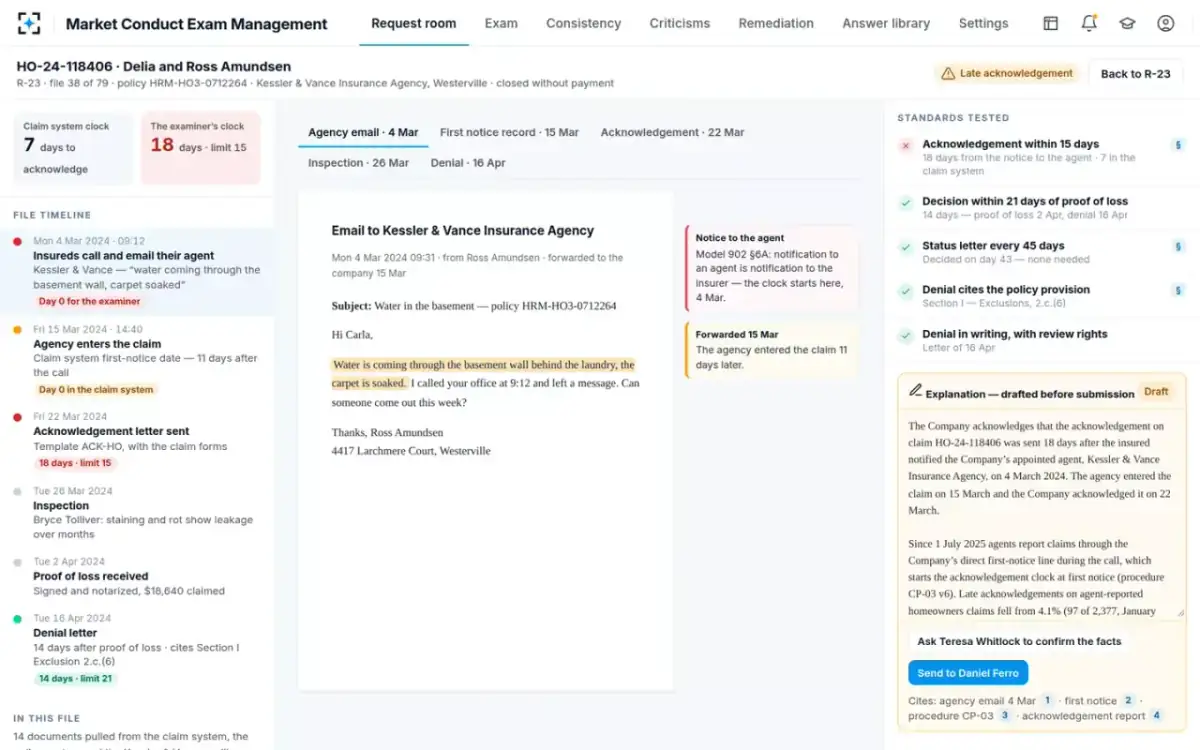
Market conduct exam self audit results: one replayed sample, standard by standard
A replay produces a count of failures per standard, and the count is the finding, not the percentage. In the solution's sample exam, the examiner asked for 79 homeowners claims closed without payment in 2024, drawn from a population of 1,391. The agents pulled 782 documents and tested each file before the company submitted anything. Six files had an exception against four standards.
Exceptions found by standard when 79 closed files were replayed in Market Conduct Exam Management
The three late acknowledgements share a cause, which is the point of finding them early. Each claim was reported to an agent, who entered it days later; the acknowledgement letter went out within the company's own count but late on the examiner's. The two denials without a cited provision were free-form letters, a repeat of the company's 2022 exam finding. That repeat is the worst kind of exception: examiners review prior reports before they arrive, and a finding the company said it had fixed is one they look for.
What a count means: why 2 of 79 is not a pass
A self-audit result should be read against the examiner's decision rule, not against the tolerance alone. The 2017 handbook sets benchmark error rates of 7 percent for claims and 10 percent for other practices, but it uses a small first sample only to rule out a problem. If the first sample cannot rule out an error rate above the tolerance with 95 percent confidence, a second, larger sample follows. That happens at counts well below 7 percent.
How many exceptions a sample of 79 can carry before a second sample, against a 7% tolerance
| Exceptions in 79 files | Rate in the sample | Chance of so few if the true rate were 7% | Second sample? |
|---|---|---|---|
| 0 exceptions | 0.0% | 0.3% | No |
| 1 exception | 1.3% | 2.0% | No |
| 2 exceptions | 2.5% | 7.4% | Yes |
| 3 exceptions | 3.8% | 18.2% | Yes |
Read that way, the replay says two standards would not clear an examiner's first stage: acknowledgements and denial wording. The status-letter standard, with one exception, would. That is the use of a self-audit: not a score, but a list of the standards that will draw a larger sample, ranked, with the cause of each exception already found. The guide to the NAIC error tolerance chart explains the two meanings of 7 percent, and the sample size calculator lets you check any count.
Market conduct exam checklist PDF or template: where a checklist stops working
A market conduct exam checklist template is a good start for the questions and a poor tool for the answers. A checklist PDF records that someone looked; it does not say which files were looked at, whether they were random, which clock was used, or which manual version applied. Those are the things an examiner will ask about the moment a self-audit is offered as evidence.
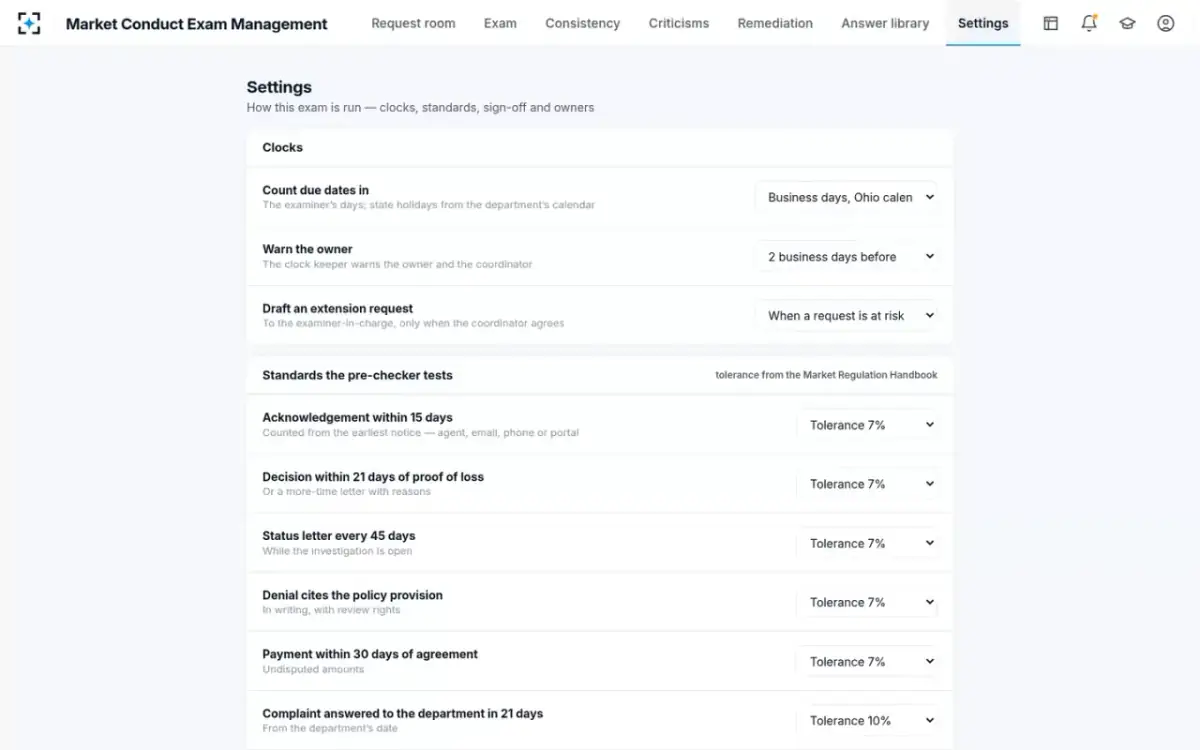
The settings behind a replay should be visible instead. For each standard: the limit, what starts the clock, and the tolerance it is measured against. In the solution those are settings a company maps to its state, and each test result cites the passage it relied on, so a reviewer can disagree with a result by pointing at its source.
The rules a replay uses: each standard's clock, start and tolerance
Can a self audit be used against you? Privilege, disclosure and credit
It depends on the state, and the handbook says so plainly: use of self-audits "will vary by state; if uncertain, regulators should consult their insurance department’s legal counsel." Some states protect self-audit documents by statute. Texas, which enacted the NAIC's market conduct surveillance model, says an insurer "may not be compelled to disclose a self-audit document or waive any statutory or common law privilege", while allowing voluntary disclosure.
The incentives run toward auditing. The 2017 handbook suggests regulators learn the scope and structure of a company's self-audit program rather than review the reports themselves, and says it "would seldom be prudent to penalize a regulated entity that voluntarily communicated about a problem discovered by way of self-audit, if the regulated entity also took steps to rectify the problem and provided remediation as needed." Texas makes the same point in its sanctions section, telling the commissioner to weigh an insurer's programs to self-assess, self-report and remediate. A self-audit that found a problem and fixed it is a mitigating circumstance; one that found it and did nothing is not.
"regulators may request that the insurer conduct a targeted market conduct self-audit."
NAIC Market Regulation Handbook, 2017 edition, on what regulators may ask after finding a systematic error
That request often comes after an exam, and a company that already replays closed files can answer it in days. The remediation side, tracking each fix to its proof so the next replay finds nothing, is covered in how to prepare for a market conduct examination.
Questions people ask
What is a market conduct self assessment?
A company's own review of its practices against the standards examiners use, usually by testing a sample of files and reviewing procedures. The NAIC's operations standards ask whether the company has an up-to-date, valid internal or external audit program, so a working self-assessment is itself something examiners look for.
How many files should a market conduct self audit test?
Enough to read the result the way an examiner would. The 2017 NAIC handbook's Acceptance Samples Table recommends 76 claims files for a population of 200, 105 for 1,000 and 108 for 5,000, drawn at random from the whole population.
Should a self audit count from the claim-system date?
No, from the earliest notice the examiner will accept. NAIC Model Regulation 902 says notification given to an agent of an insurer is notification to the insurer, so a claim reported to an agent starts the acknowledgement clock on that day.
Do examiners test a company against its own claims manual?
Yes. Florida's 2025 examination reports state that exams review compliance with procedures adopted by the company, and one cited findings against the insurer's 2021 field guidelines alongside the statute.
Is a market conduct self audit confidential?
It depends on the state. Texas says an insurer may not be compelled to disclose a self-audit document, though it may disclose one voluntarily; other states differ, and the NAIC handbook tells regulators to consult their department's counsel when uncertain.