A market conduct examination report example from Florida shows the standard shape: an executive summary naming the statute, the purpose and scope, the procedures and sampling, a profile of the company, numbered findings, a review of the claims-handling manual, and a conclusion. Each finding reads the same way: the examiners determined that in so many instances out of so many claims reviewed, an error rate of so much, the company did not do what a requirement demanded. In the April 2025 report read below, six findings cite Florida statutes and three cite the insurer's own guidelines, including a 47.8 percent error rate against a 72-hour inspection rule the company wrote for itself. The lesson for any insurer is that its manual is a standard it will be examined against. Botminds' Market Conduct Exam Management keeps every procedure and manual with the version in force on each date, so an answer about a 2023 file quotes the 2023 rule.
Each report is described from the regulator's own text and linked; no individual is named. Where the solution appears, the data is from a fictional sample exam.
"The purpose of a market conduct examination is to review an insurer’s operating practices to determine if they comply with the Florida Insurance Code, rules related to the business of insurance, procedures adopted by the Company, the provisions contained within a contract of insurance issued by the Company or orders issued by OIR."
Florida Office of Insurance Regulation, purpose statement in its 2025 market conduct examination reports
What does a market conduct exam report contain?
A market conduct exam report contains a title page, the scope and authority, the method, a profile of the company, the findings by business area with sample sizes and error counts, a summary, and usually the company's response. The 2017 NAIC handbook sets the standard format: title page, table of contents, salutation, foreword, scope, executive summary, results of previous examinations, the facts of the current examination, summarization and appendices.
Two choices in that format change how a report reads. The first is whether it reports by exception or by test. A report by exception lists only errors, so it is short but does not show which tests the company passed; a report by test states every test and its result. The second is the scope statement, which the handbook says should cite the statutory authority, the period, the purpose and the error tolerance used, and state that failing to criticise a practice does not mean accepting it.
What a market conduct exam report should contain, and what to read first
- Title page
Type of exam, company and NAIC codes, the NAIC tracking number, an “as of” date and participating states.
- Foreword
Whether it is a report by exception or by test.
- Scope
Authority, period, purpose, the error tolerance used, and the areas covered.
- Executive summary
The principal concerns, usually no longer than 10 to 20 percent of the report.
- Previous examination findings
Earlier results and responses as they relate to this exam; repeats show here.
- Findings by area
Sample size and files in error for each area, the error ratio, and the rule.
- Summarization and recommendations
Examiners’ comments, recommendations and the report submission page.
- Company response
Included in the final report as an appendix or in the text, where the state follows the NAIC model.
A market conduct examination report example, annotated
The example below is a targeted examination of a Florida residential property insurer's Hurricane Ian claims, issued by the Florida Office of Insurance Regulation on 22 April 2025. It follows the state's standard structure, and each section answers a question a company should ask of its own draft report.
One market conduct exam report, section by section: what it says and what to check
Executive summary
A targeted market conduct examination under Section 624.3161, F.S.
The statute tells you the department’s powers, including who pays and what can follow.
Purpose and scope
Purpose includes compliance with “procedures adopted by the Company”; scope: Hurricane Ian claims, 28 Sep 2022 to 31 Dec 2023; performed by a contracted firm; the company’s first market conduct exam.
The period fixes which statute and which version of the manual apply to each file.
Examination procedures
NAIC handbook procedures; sample sizes consistent with the Acceptance Samples Table; results at 95% confidence extrapolated to each population.
Whether the samples were random and sized by the table, and what the results are said to represent.
Populations and samples
Closed with payment 2,238 → 107; closed without payment 459 → 82; reopened 592 → 83.
Recount each population from your own data; a different definition changes the denominator.
Findings 1–6
Each states instances out of 272 claims, an error rate and a statute: unappointed adjusters, missing license numbers, missing disclosures, 90-day pay-or-deny, interest.
The rule in force on the claim’s dates; Florida shortened several clocks in 2023.
Findings 7–9
The same form, but the requirement is the company’s own 2021 field guidelines and a 2024 practices guide.
Every time and duty your manual promises is a standard you can be cited against.
Claims-handling manual
Manual reviewed for the contents Florida law requires; attestations checked. No exceptions noted.
Having the right manual is necessary and not sufficient: findings 7–9 are about following it.
Conclusion
The report does not document what regulatory or administrative action may be taken.
Penalties and orders come separately; the report is the evidence for them.
The procedures section is worth reading slowly. It says the samples were random and consistent with the handbook's Acceptance Samples Table, and that results at 95 percent confidence "permit those results to be extrapolated to the population identified in each of the areas examined." That sentence is why a finding of 47.8 percent in a sample is read as the rate across thousands of claims. A company that doubts a finding should test the sample first: was the population defined correctly, was the list complete, and were the files drawn at random.
Your manual is the yardstick: findings against the company's own guidelines
Three of the nine findings in the April 2025 report cite no statute at all. They cite the insurer's own documents. In 21 of 272 claims, 7.7 percent, a field adjuster did not contact the insured within one working day of assignment, as the company's 2021 field guidelines required. In 2 of 272, 0.7 percent, an acknowledgement letter was not sent within one day of reopening, as a 2024 company guide required. And the largest:
"an error rate of 47.8%, Centauri did not ensure that the field adjuster inspected the loss within 72 hours of the assignment when an independent adjuster was assigned to the claim, as required by Centauri’s 2021 Field Claim Handling Process/Guidelines."
Florida OIR, targeted market conduct examination report issued 22 April 2025, finding 8
Findings in one 2025 Florida report, by the rule broken: statute or the insurer's own guidelines
This is not a Florida quirk. The 2017 NAIC handbook's guidance for reports by exception says the error count should include inconsistencies with the company's own manuals and filings, and an Illinois report from 2024 describes reviewing new policies for, among other things, "compliance with company underwriting guidelines". Florida has also made claims manuals a matter of statute for residential property insurers: its reports check that each insurer has a manual with the contents the law requires and has filed the required attestations. Both Florida reports found no exceptions there. The findings came from not following the manual.
The practical consequence is uncomfortable. A manual that promises an inspection within 72 hours turns every slower inspection into a countable error, even where the law sets no such clock. A company should write the times it can keep, date every version, and test itself against them, as the guide to self-audit questions sets out.
Market conduct exam findings: how each one is written
Market conduct exam findings follow a fixed sentence: the number of instances, the number of files reviewed, the error rate, what the company did not do, and the requirement. The Florida form is "The examiners determined that in 36 instances out of 295 claims reviewed, an error rate of 12.2%", followed by the failure and the statute. Illinois puts its findings in a summary table first: a criticism number, the statute or rule, the survey, files reviewed, errors and error percentage.
Reading one finding: the five parts and the question each raises
| Part | In the Florida form | What to check in your files |
|---|---|---|
| Count | “in 36 instances” | Recount from the criticism sheets you answered during fieldwork. |
| Denominator | “out of 295 claims reviewed” | Three samples combined; the rate is not the rate in any one population. |
| Rate | “an error rate of 12.2%” | Against the 7% or 10% benchmark, and whether a second sample was drawn. |
| Failure | did not acknowledge receipt of claims communications within 14 calendar days | From which date the clock was counted, and whether notice to an agent was used. |
| Requirement | Section 627.70131(1)(a), F.S. (2022) | The version in force on the file’s dates; a later amendment cut the 14 days to 7. |
Note the year in that citation. The report cites the statute as it stood in 2022 and footnotes that the 2023 version reduced 14-day timeframes to 7 days, 45-day timeframes to 30 days, and 90-day timeframes to 60 days. Illinois says the same in its foreword: "Statutory citations were as of the examination period unless otherwise noted." The yardstick is the rule on the day, for statutes and manuals alike.
Florida OIR market conduct exam reports: what the 2025 hurricane exams found
Florida OIR's 2025 market conduct exam reports on Hurricane Ian claims show the shape of a modern targeted exam: three claim populations, random samples sized by the NAIC table, findings stated against all the files reviewed, and a separate review of the claims-handling manual. The April report's insurer was examined for the first time; the July report's insurer had last been examined in 2021, over its Hurricane Michael claims.
The July report's findings ran from 2.4 percent (interest not paid on late payments) to 12.2 percent (claim communications not acknowledged within 14 days), with unappointed adjusters, missing adjuster names and license numbers, missing disclosure statements and late pay-or-deny decisions between. It also recorded that the insurer issued $46,320.09 in restitution to Florida policyholders after auditing the sampled claims for one finding. Both reports close the same way: the report does not document what regulatory or administrative action may be taken. Florida's statute adds a consequence specific to claims handling: after an exam finds a pattern of willful claims-handling violations that harmed policyholders, the Office may order the insurer to file its claims-handling procedures for review, held for 36 months as public records.
Illinois market conduct examination reports, and why some states do not publish
Illinois publishes market conduct examination reports with a closing letter once the company has shown compliance. The Department's October 2024 closing letter says it intends to make the report and the stipulation and consent order available for public inspection under 215 ILCS 5/132, and that "specific content of the report may be subject to redaction for private, personal, or trade secret information prior to making the report public." That report's sample sizes, 105 to 108 files for most claims populations and every file where a population was small, match the NAIC table.
Publication is a matter of state law. The 2017 handbook says states shall publish examination reports as public documents where allowed by law, and the NAIC model law holds an adopted report confidential for 30 days and then opens it for public inspection unless a court stays it. Texas went the other way: a final or preliminary market conduct examination report "is confidential and is not subject to disclosure under Chapter 552, Government Code." A company looking for comparable reports should start with the departments that publish them, such as Florida OIR's market regulation library, the Illinois Department of Insurance and the North Carolina Department of Insurance.
Report by test or report by exception: why it matters to the company
A report by exception tells readers what went wrong and nothing about what was tested and passed; a report by test tells both. The 2017 handbook calls the report by exception the accepted method since market conduct examinations began, and notes the concern that readers cannot tell which tests were applied. The Illinois report above says it is "generally a report by exception" and adds that failing to criticise a practice does not constitute approval.
For a company, the difference matters when it uses the report. A clean area in a report by exception is silence, not approval, and should not be cited as proof of compliance. A report by test gives the company a public account of the tests it passed, which the handbook says some fear could be used in advertising; departments can forbid that in the report itself.
Responding to the draft report
The draft report is the company's last chance to correct what the report says, and the timeline is short. Under the NAIC model law as Texas enacted it, the department delivers the draft within 60 days of the exit conference, the company has 30 days to comment in writing, and the department has 30 days to resolve issues and prepare the final report unless both agree to extend. The response is included in the final report, and individuals involved in the examination are not named in either, except to acknowledge their involvement.
A good response follows each finding's five parts: it recounts, checks the denominator and the rule in force, and states the fix with its date and proof. A repeat finding from a previous exam needs special care, because the report's previous-findings section will set the two side by side. The guide to the insurance market conduct examiner explains how examiners expect criticisms to be answered.
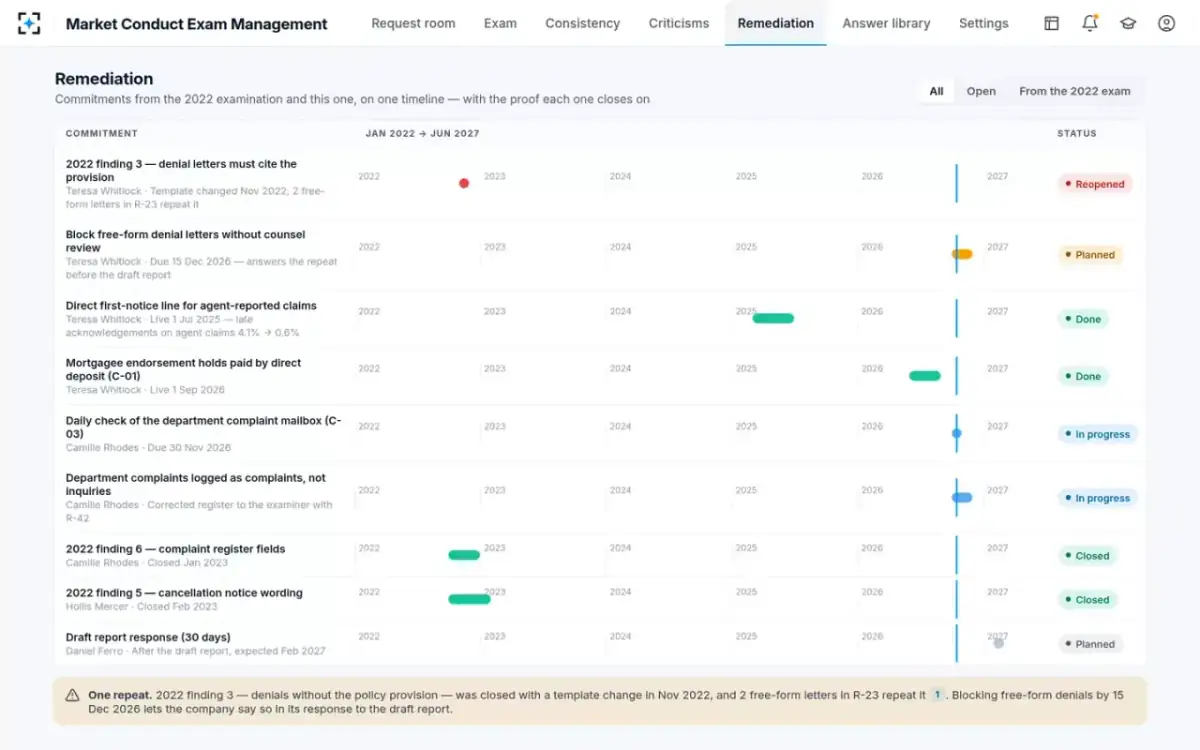
Remediation commitments from the last exam and this one, with the repeat reopened
How Market Conduct Exam Management keeps the yardstick in view
The solution's answer library holds past exam reports and responses, procedures, manuals and filings, each with the version in force and the answers that quote it. When the answer drafter writes about a 2024 claim, it uses the procedure in force in 2024 and says when it changed. The standards pre-checker can test files against the company's own guidelines as well as statutes, because each standard is a setting with its own clock. And the remediation timeline carries each commitment from one report to the next, so a finding the company promised to fix is tested again before an examiner tests it.
The answer library: every procedure with the version in force
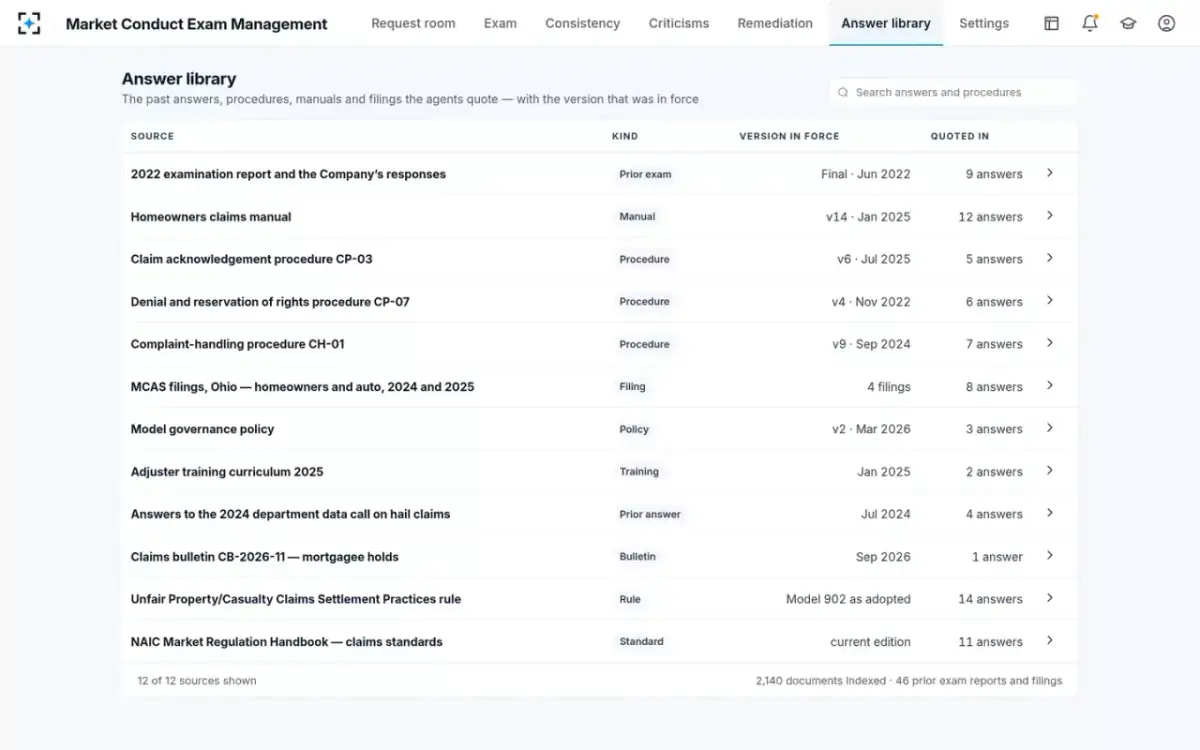
It does not write the company's manual or decide whether a finding should be contested. Those calls stay with the claims leadership and counsel. What it removes is the most avoidable kind of finding: the one where the company did not know which version of its own rule applied. For what to have ready before an exam begins, see how to prepare for a market conduct examination.
Questions people ask
Where can I find market conduct exam reports?
On the websites of departments that publish them. Florida OIR posts reports in its market regulation library, and Illinois makes reports and consent orders available for public inspection under 215 ILCS 5/132, with redactions. Some states keep them confidential: Texas law says market conduct examination reports are not subject to disclosure under its public information act.
Do market conduct exam reports name the company?
Yes, published reports identify the examined company and its NAIC codes. Under the NAIC model law and Texas law, individuals involved in the examination are not named in the report or the response, except to acknowledge their involvement.
Can an insurer be cited for breaking its own claims manual?
Yes. A Florida report issued in April 2025 cited an insurer in 130 of 272 claims, 47.8 percent, for field inspections later than the 72 hours its own 2021 guidelines required, and the NAIC handbook counts inconsistencies with a company's manuals as errors.
What happens after a market conduct exam report?
The department decides on any action, which can range from none to a re-examination, a consent order or a monetary penalty. Florida's 2025 reports state that they do not document what regulatory or administrative action may be taken.
How long does a company have to respond to a draft report?
Thirty days in states following the NAIC model law, such as Texas, after the department delivers the draft within 60 days of the exit conference. The department then has 30 days to resolve issues and issue the final report, unless both sides agree to extend.