A market conduct exam call letter is the state insurance department's notice that it will examine an insurer's treatment of consumers: it states the legal authority, the business areas and lines in scope, the period under review, the examiner-in-charge, how the examination will be billed, and the first data and documents the company must produce, and it asks the company to name an examination coordinator. A good market conduct exam call letter example is therefore less a template than a map of dependencies. Every paragraph in it becomes a request that waits on a different person: claims for files, IT for data lists, underwriting for manuals, counsel for the legal reading, finance for the bill. Botminds' Market Conduct Exam Management exists for the weeks that follow that letter. Its agents turn each request into a dated, owned item, pull the sampled files, and test them before the examiner does, while named people decide what the company says.
The sample exam used for illustration on this page is fictional: an Ohio targeted examination of a mutual insurer called Harrow Ridge, with invented people and claims, as it runs through the solution. The rules and quotations come from state regulators, state statutes and the NAIC, linked where they appear.
The clocks a call letter starts
60days
minimum notice before on-site work in the NAIC model law and Texas law
Model 693 §6E; Tex. Ins. Code §751.203
30days
before the exam starts, the pre-examination conference in Texas
Tex. Ins. Code §751.204
9
things the 2017 NAIC handbook says a notification letter should cover
Handbook ch. 12, section G
3years
the default examination period in North Carolina’s coordinator’s handbook
Unless agreed otherwise
What is a market conduct exam in insurance?
A market conduct exam is a state insurance department's review of how an insurer treats policyholders and claimants, tested against the state's statutes and regulations by sampling the company's own files. It is separate from the financial examination, which looks at solvency. The NAIC's Market Regulation Handbook says these examinations are conducted "to ensure (1) equitable treatment of policyholders; and (2) compliance with applicable statutes and regulations."
The handbook (2017 edition, the copy published by the Indiana Department of Insurance) sorts examinations by reason, scope and method. A comprehensive examination covers the whole company. A target examination looks at a line of business or one practice, such as claims or underwriting, and the handbook says it "may be called by any jurisdiction at any time, with or without notice to the insurer as circumstances dictate." Exams run on-site or as desk examinations at the department's offices, and many now begin with data requests before anyone visits. Texas writes that order into law: "To the extent feasible, the department shall conduct a market conduct examination through desk examinations and data requests before conducting an on-site examination."
The examined areas are the same seven in almost every state: operations and management, complaint handling, marketing and sales, producer licensing, policyholder service, underwriting and rating, and claims. The NAIC's 2024 Examination Standards Summary lists the tests within each. A call letter tells the company which of the seven it will face.
What goes in a market conduct exam call letter? A sample, annotated
A market conduct exam call letter contains the authority, scope, period, team, billing terms, first requests and a request to name a coordinator. That list is not invented by each state: the 2017 handbook names nine things a notification letter should cover, and the NAIC's Market Conduct Surveillance Model Law, as enacted in Texas, requires a work plan with the reasons for the exam, its scope, a time estimate and, where the insurer pays, "a budget for the examination" and the factors that will be billed.
States wrap this in their own forms. North Carolina's coordinator's handbook opens by thanking the company "for responding to our examination call letter" and then sets out what it needs and when. The example below is assembled from those sources for the fictional sample insurer, paragraph by paragraph. The right-hand column is what matters to a coordinator: the duty each sentence creates, and the person who owes it.
A market conduct exam call letter example, and the work each line creates
1
Re: Targeted market conduct examination of Harrow Ridge Mutual Insurance Company, under [state examination statute].
Handbook notice item 2: the legal basis
Counsel confirms the authority and whether the exam is targeted or comprehensive.
2
Scope: claims handling (homeowners, private passenger auto) and complaint handling. Examination period: 1 January 2024 to 31 December 2025.
Item 1: scope, intent and period
The coordinator maps every later request to an area and a line; claims and complaints leaders learn they are in.
3
The examiner-in-charge is named below, with three examiners from a contracted firm. Fieldwork begins on 5 October and is expected to run ten weeks.
Item 1 dates; Texas work plan items 2 and 6
Facilities and IT arrange access; the coordinator becomes the examiners’ one door.
4
The examination will be billed to the company at the rates and on the terms attached. A budget for examiner time and expenses is enclosed.
Item 2: cost and billing; Texas item 8
Finance sets up invoice review; the compliance head owns the budget.
5
Provide claims and complaint data lists in the attached layouts by the date shown, with procedures and manuals in force during the period and the complaint register.
Items 3 and 4: materials and lead-time data
IT builds the lists; claims and complaints owners collect manuals by version.
6
Name your examination coordinator in reply to this letter.
Item 6
Management names one person with authority to answer criticisms.
7
Examiner conduct, confidentiality of documents and how to raise a concern about the examination are set out in the enclosed coordinator’s handbook.
Items 7 and 9
Counsel reads the confidentiality terms before the first document leaves.
Two lines in any real letter deserve a second reading. The first is the period under review: it fixes which versions of every manual and procedure the company must produce, because the examiners test files against the rules in force when each claim was handled. The second is the coordinator request. The handbook says the company must name people with "the authority and responsibility to respond to the criticisms of the examiners", which is a decision about authority, not about who has time.
Market conduct exam call letter template or sample: why the letter is only the first batch
Searchers looking for a market conduct exam call letter template or sample usually want to know how many requests will follow, and the honest answer is: more than the letter shows. North Carolina splits its requirements into two phases. Phase I items, the complaint register, policy and claims lists and company history, "must be forwarded in good order to this office no later than 60 days prior to the commencement of the examination." Phase II items, the procedures and the sampled files themselves, must be ready on the day the examination starts.
Then the samples arrive. Examiners draw files from the lists the company sent, and each sample list is a new request with its own due date. Follow-ups come as fieldwork exposes questions. In the fictional sample exam, the call letter of 21 September carried 38 requests; by day six of fieldwork there were 57, and 34 had been answered. That growth is normal, which is why a tracker built from the letter alone falls behind in the first week.
The data lists are where most of the early time goes. North Carolina asks that IT staff who build the policy and claim files attend the pre-examination conference, and warns that "The timely receipt of complete and accurate policy and claim data is an integral part of the examination process." The 2017 handbook adds that data requests needing lead time, such as claims runs, policy runs and producer lists, belong in the notice itself. A coordinator who reads the letter on day one and sends the data layouts to IT on day one has bought back a week.
Who owes which answer: the dependency map behind the letter
Each request in a market conduct exam waits on one person, and the coordinator's real work is knowing who that is before the clock runs short. A claims sample waits on the adjusters who hold the files. A question about how acknowledgements are timed waits on the claims director who owns the procedure. A count that must match the annual statement waits on whoever filed it. And every explanation the company volunteers waits on counsel, because once it is in the examiners' papers it is the company's position.
From the call letter to a signed-off answer: who does each step in Market Conduct Exam Management
Agent
Call letter readerTurns the letter and every follow-up into requests with an exam area, an owner and a business-day due date taken from the examiner’s words.
Never: Never guesses a due date; ambiguous requests go to the coordinator.
A person decides
Exam coordinatorConfirms owners, answers what the reader could not resolve, and is the examiners’ single point of contact.
Agent
File pullerPulls each sampled claim, complaint or policy file, every document numbered with its source.
Never: Read-only on every source system.
Agent
Standards pre-checkerTests each file against the standard the examiners will use and flags exceptions with the passage behind them.
Never: Explains and routes; never concludes that an exception is a violation.
A person decides
Claims or underwriting expertConfirms what the file shows, and why.
A person decides
Regulatory counselApproves every explanation that admits or disputes an exception.
A person decides
Market conduct managerSigns off the package; the coordinator submits it through the department’s portal.
The map changes with the letter. A complaint-handling area adds the complaints manager and whoever reconciles the register to the department's own list. An underwriting area adds the rating team and its filed manuals. The point of drawing it early is that the bottlenecks are predictable: the same three or four experts are named on most requests, and their ordinary jobs do not stop for the exam.
The people a call letter puts to work, and what changes for each
Today
Rebuilds the request list in a spreadsheet each time a follow-up lands, and chases owners by email.
With agents
Works from a request list that updates itself, with each owner and due date already set.
Still theirs: Every judgement call on scope, and the single line to the examiner-in-charge.
Today
Pulls adjusters off live claims to gather dozens of closed files for one sample.
With agents
Reviews files already pulled and tested, starting with the exceptions.
Still theirs: Confirming what happened on a file, and why.
Today
Builds data lists to a layout read once, then rebuilds them when counts do not tie.
With agents
Sees each list compared with the filed annual numbers before it leaves.
Still theirs: The extract logic and its controls.
Today
Reads explanations late, under the deadline, without the earlier answers beside them.
With agents
Approves cited drafts, with any conflict with a prior answer flagged first.
Still theirs: Every admission or dispute.
Today
Checks each package by hand to keep one rule: nothing goes out that cannot be explained.
With agents
Signs off packages that show each exception, its explanation and its source.
Still theirs: The sign-off.
How much notice does a market conduct exam call letter give? The clocks that follow
For a scheduled examination, expect at least 60 days' notice; for a target examination, possibly much less. The NAIC model law and Texas both require the announcement, with the work plan, "as soon as possible but in no case later than sixty (60) days before the estimated commencement of the on-site examination", except in extraordinary circumstances. The 2017 handbook recommends the same 60 days for a notification letter and notes that routine examinations usually allow a minimum of 30 days for the company to prepare materials. A target examination, as above, can come without notice.
After fieldwork, the clocks run the other way. Texas, following the model law, gives the department 60 days from the exit conference to deliver a draft report, the insurer 30 days to comment, and the department 30 days to resolve issues and prepare the final report, unless both sides agree otherwise. The model law then gives the insurer 30 days to accept the final report or ask for a hearing.
The standard market conduct exam calendar, in days
- Notice to conference30 d
- Conference to fieldwork30 d
- Draft report due60 d
- Company comments30 d
- Final report30 d
- Accept or request a hearing30 d
Inside fieldwork, the deadlines are set request by request. The fictional sample exam shows a typical pattern: a sample list sent on a Wednesday, files due within five business days, with a state holiday that does not count. The solution counts each due date in business days on the department's holiday calendar, warns the owner and coordinator two business days out, and drafts an extension request to the examiner-in-charge only when the coordinator agrees. Missing a date is not only awkward: among the NAIC's general standards is that the company "cooperates on a timely basis with examiners performing the examinations."
Is a market conduct data call the same as a call letter?
No. A market conduct data call asks many insurers for the same data at once, while an exam call letter opens an examination of one company. The best-known data call is the Market Conduct Annual Statement: each December the NAIC sends call letters to companies for the year's MCAS filing, which for 2026 data is due on 30 April 2027 for most lines. States also issue ad hoc data calls, for example after a catastrophe, and the answers become part of the department's file on each company.
The two meet in the exam. Texas law tells the commissioner to take steps to eliminate requests that duplicate an insurer's annual market conduct statement or other regular filings, unless the information is state-specific. And examiners use those filings to check the exam data: if the claims list for a sample does not tie to what the company reported, the difference becomes a question. How the MCAS counts and the exam lists diverge, and how to reconcile them before the examiners do, is the subject of the guide to MCAS filing requirements.
Between a data call and a full examination sit lighter tools. Texas lists them as correspondence, interviews, information gathering, policy and procedure reviews, interrogatories and reviews of self-evaluation programs, and requires the commissioner to consider them before calling a targeted examination. An interrogatory, as the handbook describes it, is a compilation of written questions on one subject, procedure or product. A company that answers these well can sometimes avoid the letter altogether.
What a call letter does not say: criticisms come later, and they have a format
The call letter sets up the exam; the criticisms decide its outcome. When an examiner sees what looks like a violation, the company receives a written criticism, often called a crit sheet, asking it to agree, explain or acknowledge the error within a set time. The 2017 handbook's uniform outline says any such communication should include the record numbers, "The examiner’s statement of the problem or error and, if relevant, the applicable law and/or standard" and a request for the company's signature and comment.
That format is the reason the dependency map matters on day one. The person who answers a criticism needs the file, the rule in force at the time, any procedure the company wrote, and every earlier answer on the same subject, including those from the last exam. If the call letter named the 2022 findings as part of the scope, the examiners will look for repeats. The guide to the insurance market conduct examiner follows a criticism from the examiner's side.
How Market Conduct Exam Management runs a call letter as a request room
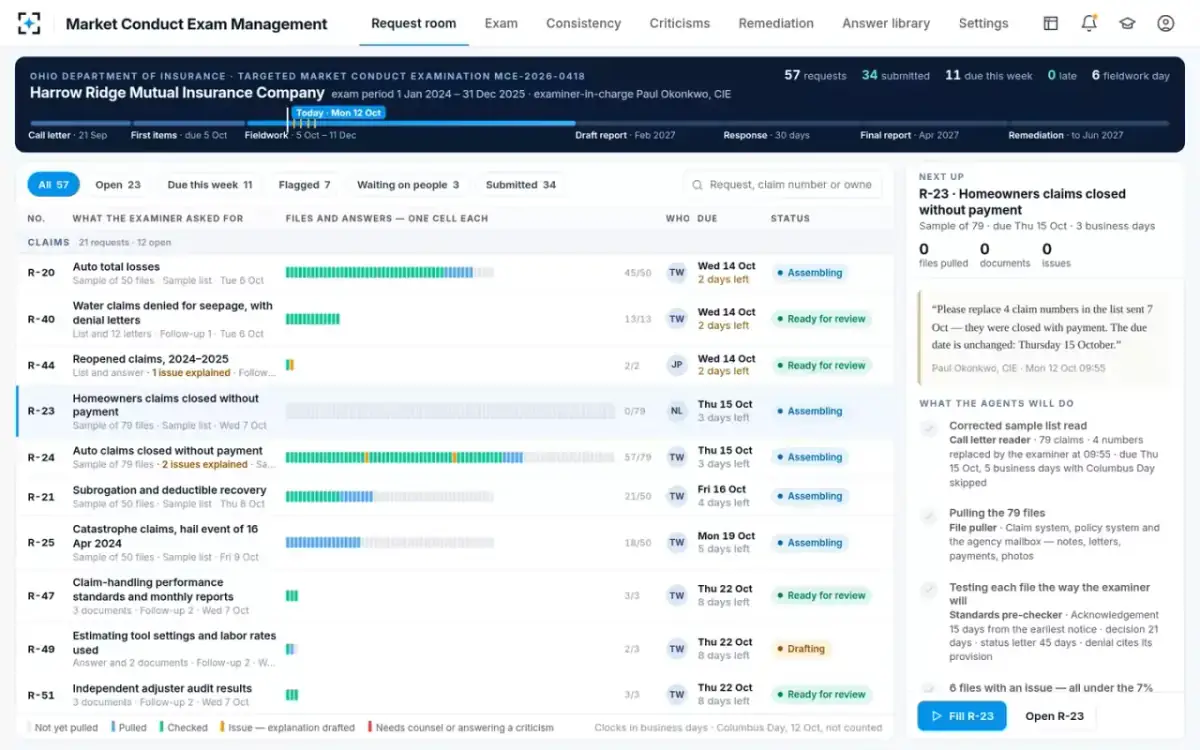
Market Conduct Exam Management treats the call letter and every follow-up as one list, not a series of emails. Each request carries its exam area, owner, business-day due date, and one cell for every file or answer it needs, so the coordinator sees at a glance which requests are filling, which are waiting on a person, and which have an exception that needs an explanation before submission.
The request room: every examiner request, with its owner and business-day clock
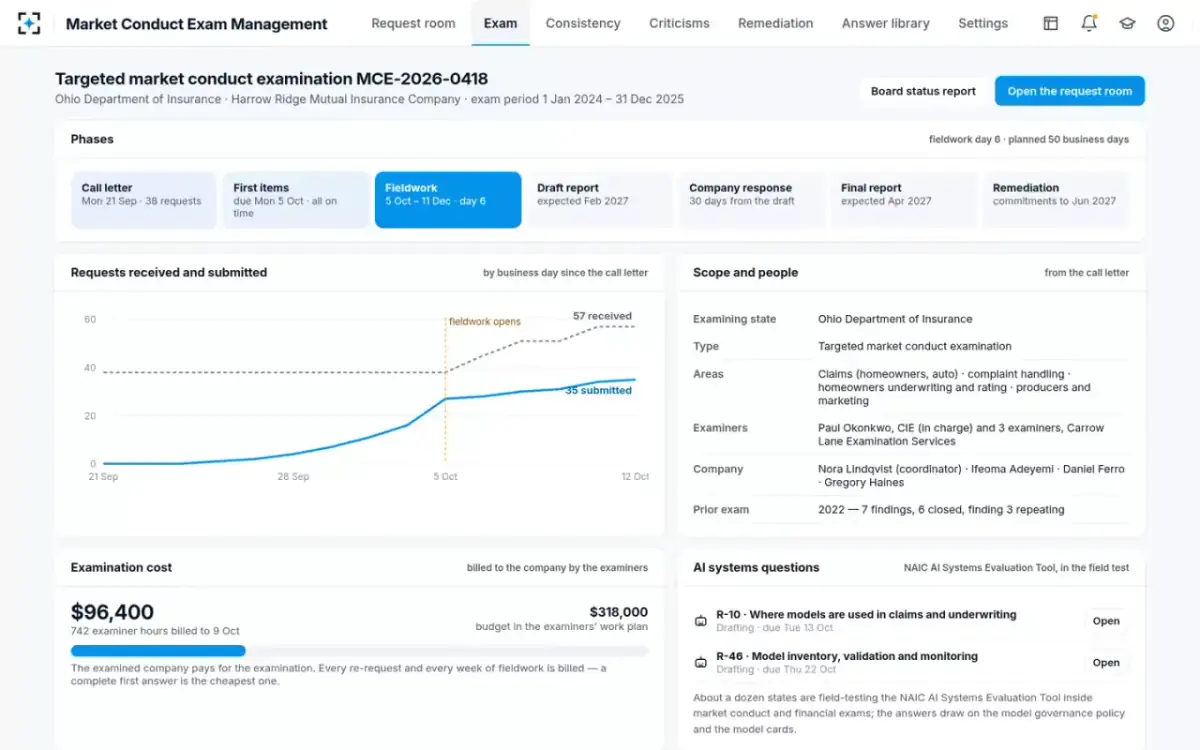
The exam overview carries what the call letter set: phases, scope and people, the examiner hours billed against the budget in the work plan, and the questions the examiners have asked about AI systems. In the sample exam, two requests ask where models are used in claims and underwriting and how they are governed; the NAIC's pilot of its AI Systems Evaluation Tool ran in 12 states from March to September 2026, in work that included market conduct exams, and the updated tool is to be considered for adoption at the NAIC's Fall National Meeting in November (what its four exhibits ask is set out in the NAIC AI Systems Evaluation Tool).
The exam at a glance in Market Conduct Exam Management
What the solution does not do matters as much. Its agents read, pull, test and draft; they never submit, never approve, and never decide that an exception is a violation. Counsel approves every admission or dispute and the market conduct manager signs off each package before the coordinator sends it. For the inventory a company can build before any letter arrives, see how to prepare for a market conduct examination.
Questions people ask
Is there a standard market conduct exam call letter template?
There is no single national template, but the contents are standardised. The 2017 NAIC handbook lists nine things a notification letter should cover, from scope and period to billing and the coordinator request, and states that enacted the NAIC model law, such as Texas, require a work plan with a budget when the insurer pays. Many departments add a coordinator's handbook with data layouts.
How long does a company have to respond to a call letter?
The first reply is usually the name of the examination coordinator, by the date the letter sets. Data due before fieldwork can be due well ahead of it: North Carolina asks for its Phase I items no later than 60 days before the exam starts. Each later request carries its own date, often counted in business days.
Who should be the examination coordinator?
Someone with authority, not just availability. The handbook asks companies to name people with the authority and responsibility to respond to examiners' criticisms, and it tells the examiner-in-charge to deal directly with the coordinator without letting that arrangement shield key staff the examiners need to reach.
What period does a market conduct exam cover?
Whatever the letter states, usually one to three years of closed business. North Carolina's default is the three full calendar years before the exam begins, unless agreed otherwise at the pre-examination conference. The period also decides which version of each manual and procedure is the yardstick.
Can the scope grow after the call letter?
Yes, but in Texas the department must say so in writing. If a targeted examination is expanded beyond the reasons in the notice, the commissioner must explain the extent of and reasons for the expansion and provide a revised work plan before a significantly expanded exam begins.