An insurance market conduct examiner is a state regulator, or a contractor working for one, who examines how an insurance company treats consumers: they define populations of claims, policies or complaints, draw random samples, test each file against the examination standards and the state's law, and record each apparent violation on a written criticism the company must answer. The examiner-in-charge runs the team on site and writes the report; the department, not the examiner, decides what action follows. Seen from that desk, an exam is a sequence of standards, samples and criticisms, and the company that answers in the same order (standard, file, rule) answers once. Botminds' Market Conduct Exam Management is built to put each answer in that order, with the sampled file, the rule in force and the company's explanation side by side.
The examiner's work described here comes from the NAIC's Market Regulation Handbook (2017 edition), state statutes and federal occupational data, linked where they appear. Where the solution appears, the data is from a fictional sample exam.
"The primary role of examiners is to be fact-finders when determining compliance, which can then be used by the insurance department to determine sanctions or fines."
NAIC Market Regulation Handbook, 2017 edition, chapter 12, on the examiner's role in enforcement
What does an insurance market conduct examiner do?
An insurance market conduct examiner tests whether a company's practices comply with the law, file by file. The 2017 handbook says these examinations are conducted to ensure equitable treatment of policyholders and compliance with statutes and regulations, and can cover insurers of every kind as well as HMOs, third-party administrators, title insurers, producers and other licensees.
The job runs in a set order. Before fieldwork, the examiner-in-charge reviews prior exam reports and the company's responses, complaint data and the complaint index, producer licensing records and rate and form filings. On site, the team validates the company's data, draws samples, reviews files, and documents exceptions; the handbook notes that most jurisdictions "document exceptions with the use of critique forms and photocopies of appropriate files and materials." At the end, the team summarises findings, offers an exit conference and drafts the report. The letter that starts all this is annotated in the guide to a market conduct exam call letter example.
The standards are the examiner's checklist. The NAIC publishes them by business area: operations and management, complaint handling, marketing and sales, producer licensing, policyholder service, underwriting and rating, and claims, in the 2024 Examination Standards Summary. Each standard has its documents to review and its model-law basis, and each exam tests the subset its scope names.
The exam from the examiner's desk: what each side sees
The examiner sees a population, a sample and a rule; the company usually sees a request, a deadline and a scramble. Most friction in an exam comes from the gap between the two views, and most of it can be closed by the company adopting the examiner's frame for every answer.
A market conduct exam from the examiner's side and the company's
The examiner's view: A defined population and period, a random sample, and the standard each file will be tested against.
The company's usual view: A list of claim numbers due in five business days.
The examiner's view: Everything that shows when notice arrived, what was done, what was said, and under which rule.
The company's usual view: Whatever the claim system shows, gathered by an adjuster between other work.
The examiner's view: Starts at the earliest notice the law recognises, including notice to an agent.
The company's usual view: Starts when the claim was entered in the system.
The examiner's view: The statute, the regulation, and the company’s own manual in force on the file’s dates.
The company's usual view: The current procedure.
The examiner's view: A criticism with the file number, the problem, the law or standard, and a request for comment.
The company's usual view: A surprise, answered under a deadline.
The examiner's view: Errors against the tolerance, and whether the first sample clears the process.
The company's usual view: A percentage that looks small.
The examiner's view: Checked against the annual statement, MCAS and the department’s own complaint count.
The company's usual view: Produced fresh for each request.
Two rows decide most outcomes. The clock row is where companies lose acknowledgement findings they did not know they had: the NAIC's claims settlement model regulation says notice to an agent is notice to the insurer, and an examiner counts from it. The yardstick row is where they lose findings to their own manuals: the handbook's report guidance counts departures from the company's manuals and filings as errors, and Florida's 2025 reports cite insurers' own guidelines as the requirement breached.
Insurance market conduct examiner trainee to examiner-in-charge: the classifications
The 2017 handbook recommends five classifications, from an entry-level associate to an administrative examiner who oversees several teams. Each step is tied to training and certification by the Insurance Regulatory Examiners Society (IRES), the examiners' professional society. An insurance market conduct examiner trainee typically starts as what the handbook calls an Associate Examiner, an entry-level examiner who has not yet met the qualifications for Insurance Examiner.
The market conduct examiner classifications the NAIC handbook recommends
| Classification | Qualification the handbook recommends | Typical work on an exam |
|---|---|---|
| Associate Examiner | Entry level; has not yet met the qualifications for Insurance Examiner. No certification set. | Reviews sampled files under supervision and drafts exceptions. |
| Insurance Examiner | At least two of the eight courses IRES requires for the AIE designation, or its other conditions. | Tests files against standards and writes criticisms. |
| Senior Examiner | Certified by IRES as eligible for the AIE or CIE designation, or meets all its conditions. | Leads a functional area; eligible to become examiner-in-charge. |
| Examiner-in-Charge | A Senior Examiner certified as eligible for the CIE designation. | Supervises the team on site, deals with the coordinator, guards against pre-selection, writes the report. |
| Administrative Examiner | The qualifications of an examiner-in-charge. | Oversees more than one team; may schedule exams, review reports and handle rebuttals. |
The handbook allows three employment routes: an insurance department employee, a self-employed examiner under contract with a department, or an employee of a firm that examines under contract with one or more departments. Both 2025 Florida hurricane-claims reports we reviewed were performed by contracted examination firms, which Florida's statute allows, with the insurer paying the contractor directly at rates the Office agreed.
How do you become a certified market conduct examiner? The AIE and CIE designations
Certified market conduct examiners hold designations from the Insurance Regulatory Examiners Society. The Accredited Insurance Examiner designation, in O*NET's description, is "awarded to insurance regulatory professionals who have been extensively trained" in property and casualty or life and health regulation, after completing the coursework on one education path and meeting employment and experience requirements. The Certified Insurance Examiner designation requires the AIE in one field and cross-training in the other.
The two examiner designations in the NAIC handbook's qualifications
| Designation | What it requires | Exam? | Renewal | Where the handbook uses it |
|---|---|---|---|---|
| Accredited Insurance Examiner (AIE) | Coursework on one path (property and casualty, or life and health) plus employment and experience | No written or oral exam listed | Every year, through continuing education | Senior Examiner; multistate examiners preferably |
| Certified Insurance Examiner (CIE) | The AIE in one field, plus the coursework of the other path and experience | No written or oral exam listed | Every year, through continuing education | Examiner-in-Charge |
For multistate examinations the handbook sets a floor: an examiner should be employed by or contracted with a regulator, have at least two years of insurance regulatory examination experience, and preferably hold the AIE or CIE. Texas puts the principle in statute, saying market conduct surveillance personnel "must be qualified by education and experience and, if applicable, must hold appropriate professional designations."
Market conduct examiner jobs and salary: who employs examiners, and who pays them
Market conduct examiner jobs sit in two places: state insurance departments, which employ examiners on their own pay scales, and firms that examine under contract with departments. Salaries in departments follow each state's civil service scale. The handbook does not publish pay; it says suggested examiner compensation rates are posted on an NAIC page for regulators, subject to each jurisdiction's own rules on examiner salaries and expenses.
Federal statistics do not separate market conduct examiners. The nearest federal occupation, financial examiners, is defined in O*NET as people who "Enforce or ensure compliance with laws and regulations governing financial and securities institutions", and its sample job titles are bank and credit-union examiners and compliance roles, so its wage data describe a neighbouring field. What is fixed is who funds the work: the examined insurer reimburses the cost, and in Texas reimbursable examiner fees are capped at those prescribed in the handbook unless the commissioner shows they are inadequate.
Conflict-of-interest rules travel with the job. The handbook says no examiner may be affiliated with the management of, or own a pecuniary interest in, a company subject to examination, while allowing an examiner to be a policyholder or claimant, and Texas has enacted the same rule. The guide to who pays for market conduct exams covers how examiner time is billed.
Market conduct examiners handbook: what examiners work from
The market conduct examiners handbook is the NAIC's Market Regulation Handbook, updated each year; state statutes still refer to it by older names such as the market conduct examiners handbook. It is a guide, not a rule: the 2017 edition says its text becomes a jurisdiction's procedure only after that agency adopts it, and that deviations to fit a state's law should not be read as inadequate procedure. States that enacted the NAIC's Market Conduct Surveillance Model Law, such as Texas, require examinations to follow the handbook and the uniform examination procedures.
The handbook also governs how examiners write. Its report chapter asks for objectivity and says "The report must be a factual recording of the findings." Words such as some, many, several and few are to be minimised; reports should give sample sizes and the number of files in error. A company reading a draft report can hold the examiners to that standard, and often should; a finished report is read finding by finding in the guide to a market conduct examination report example.
Market conduct exam vs financial examination: two exams, two questions
A market conduct exam asks whether the company treats consumers lawfully; a financial examination asks whether it is solvent and its statements are right. They use different handbooks (the Market Regulation Handbook and the Financial Condition Examiners Handbook), and often different teams and statutes. The 2017 handbook notes that the NAIC's tracking system for market conduct actions holds history on combined exams, while financial examinations are followed in a separate system of their own.
They touch at the edges. The 2017 handbook lists a financial examination as one reason to call a market conduct exam, says the two may run at the same time, and notes that financial examiners may fold market conduct findings into their report. Their sampling philosophies differ too: the market conduct handbook describes the financial handbook's small zero-error samples and does not recommend them for general market conduct use. An insurer preparing for both should expect different requests from different people, about different years.
Answering in the examiner's order: how a company makes one answer enough
The company that answers once is the one whose response mirrors the criticism. The handbook's format for a criticism gives the order: the record number, the examiner's statement of the problem with the law or standard, and a request for signature and comment. An answer that follows it states the file, quotes the rule in force on that date, shows what the file contains, and says whether the company agrees, disagrees or explains, with the fix if there is one.
Five things an examiner looks for in a company's response to a criticism
- The same file and the same rule the criticism names
An answer about a different version of the procedure, or a different date, invites a second criticism.
- A clear position: agree, disagree or explain
The handbook asks for signature and comment; a vague reply is read as agreement.
- Evidence from the file, not a description of policy
The agency email that proves the notice date beats a paragraph about how notices are handled.
- Consistency with earlier answers
Including the last exam’s responses, which the examiner read before arriving.
- The fix, with a date and an owner
If the company agrees, what changed, from when, and how it will show the change worked.
Each criticism with its draft response, sources and files in Market Conduct Exam Management
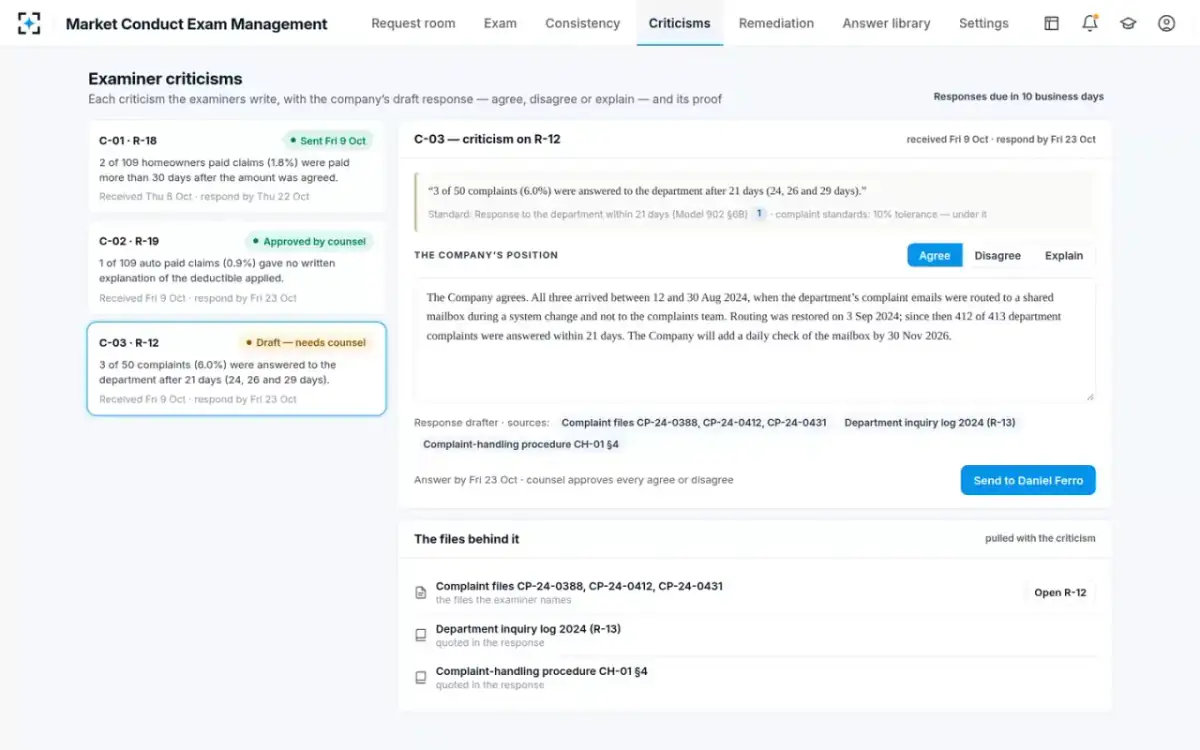
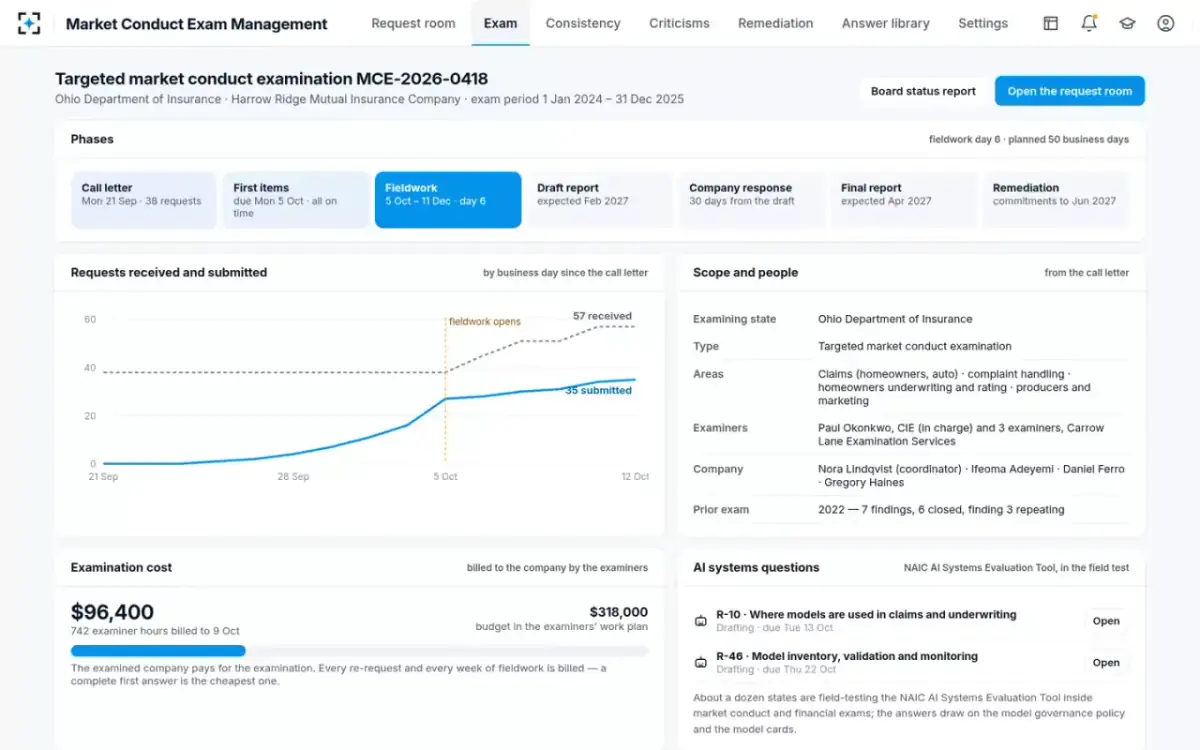
In the solution, each criticism arrives with that structure already drafted by the response drafter from the files, the procedure in force and the remediation made, and with any contradiction of an earlier answer flagged for counsel. Nothing is sent by an agent. The coordinator can see the whole exam as the examiner does, by request, standard and deadline, in the exam overview.
The exam as the examiner-in-charge would see it
Questions people ask
What qualifications does a market conduct examiner need?
The NAIC handbook recommends training and certification through the Insurance Regulatory Examiners Society that rises with each classification: two of the eight AIE courses for an Insurance Examiner, AIE or CIE eligibility for a Senior Examiner, and CIE eligibility for an examiner-in-charge. States set their own requirements.
Are market conduct examiners state employees?
Many are, but the handbook also allows self-employed examiners and firms under contract with insurance departments. Florida's statute lets its Office use an independent professional examiner under contract, paid directly by the examined insurer.
Do market conduct examiners decide penalties?
No. The handbook describes examiners as fact-finders whose findings the department uses to decide sanctions or fines, and says final regulatory disposition is determined by the insurance department, not the examiner.
Can a company complain about an examiner?
Yes. The 2017 handbook says the notification letter should set out the parameters of examiner conduct and how companies can report complaints against examiners, and its model post-examination questionnaire asks the coordinator to rate the team's conduct and efficiency.
How is a market conduct exam different from a financial exam?
A market conduct exam tests how consumers are treated, on samples of claims, policies and complaints; a financial exam tests solvency and the accuracy of financial statements. They follow different NAIC handbooks, though a financial exam can be a reason to call a market conduct exam.