A market conduct exam management system is software that runs an insurer's side of a state market conduct examination: it keeps every examiner request with its owner and due date, gathers the files and answers each one needs, and holds the company's responses, criticisms and remediation commitments in one place. The useful question for a buyer is which of the exam's recurring tasks the system should take over. Retrieval, date-counting, file testing and reconciling counts are mechanical and can move to software agents; deciding what the company admits, disputes or promises cannot. Botminds' Market Conduct Exam Management is built on that split. Seven agents read the call letter, pull sampled files, pre-check them against the standards examiners use, and check every number against the company's MCAS filing, while the coordinator, counsel and the market conduct manager approve and submit.
Where the page shows the solution at work, it uses a fictional sample exam: an Ohio targeted examination of a mutual insurer, with invented people, claims and figures. The rules come from the NAIC, state statutes and regulators, linked where they appear.
"the extent to which the insurer maintains regulatory compliance programs to self-assess, self-report, and remediate problems detected by the insurer."
Texas Insurance Code §751.351(b), factors the commissioner must consider in setting a sanction after a market conduct action
What does a market conduct exam management system have to manage?
It has to manage four streams that arrive at different speeds: requests, files, findings and money. Requests start with the call letter and keep coming through fieldwork. Files arrive as sample lists the examiners draw from the company's own data. Findings arrive as written criticisms the company must answer within a set time. Money arrives monthly where the state bills the insurer: the NAIC model law, as Texas enacted it, says examination fees "must be itemized and bills for the fees must be provided to the insurer on a monthly basis for review prior to submission for payment."
The standards the system must track are public. The NAIC's 2024 Examination Standards Summary lists the tests examiners apply in each of seven business areas, from complaint handling to claims, and two general standards apply to the exam itself: the company "cooperates on a timely basis with examiners performing the examinations", and that every figure reported to a department is complete and accurate, the standard behind the MCAS filing requirements. A late answer and a count that does not tie are findings in their own right.
Most of that work happens on deadlines measured in days, while the people who hold the answers have other jobs. That mismatch is what software has to fix, and it explains why a request tracker on its own does not: knowing that a sample is due Thursday does not pull its files or tell anyone that file 38 was acknowledged late.
The exam's tasks, re-divided: what moves to agents and what stays with people
The tasks that move to agents are the ones where a wrong answer is visible and checkable: a date, a document, a count, a test against a written standard. The tasks that stay with people are the ones that commit the company. In between sit drafting tasks, where an agent can do the first ninety percent of the writing but a named person owns every word that goes to the examiner.
Ten recurring tasks in a market conduct exam, and who owns each in Market Conduct Exam Management
Turn the call letter and follow-ups into dated requests
Agent
Mechanical reading; the due date is taken from the examiner’s words, never inferred.
Count due dates in business days on the state’s calendar
Agent
Arithmetic that people get wrong around holidays.
Decide who owns each request
Shared
The agent proposes from the exam area; the coordinator confirms.
Pull every sampled file and its documents
Agent
Hours of retrieval across claim, policy and mail systems, read-only.
Test each file against the standard the examiners will use
Shared
The agent tests and cites; a claims expert confirms what the file shows.
Tie every count to MCAS, other requests and prior answers
Agent
Comparison, not judgement; a contradiction goes to counsel unresolved.
Explain an exception before the examiner finds it
Shared
The agent drafts from the file and the fix; the expert and counsel own the words.
Agree, disagree or explain a criticism
Person
An admission or dispute is the company’s legal position.
Sign off and submit a response package
Person
The manager signs; the coordinator submits through the department’s portal.
Check examiner invoices against the work plan
Shared
The hours are tracked automatically; finance and compliance approve.
Three of the ten carry a hard limit in the solution's configuration. The standards pre-checker tests files the way an examiner would but never concludes that an exception is a violation; it explains and routes. The consistency checker never edits a figure to make it agree with the annual statement; it finds the reason or sends the contradiction to counsel. And no agent submits anything to the examiners. These are not modesty: an examiner reads a response as the company's word, and a system that could change numbers or send answers would turn its errors into the company's positions.
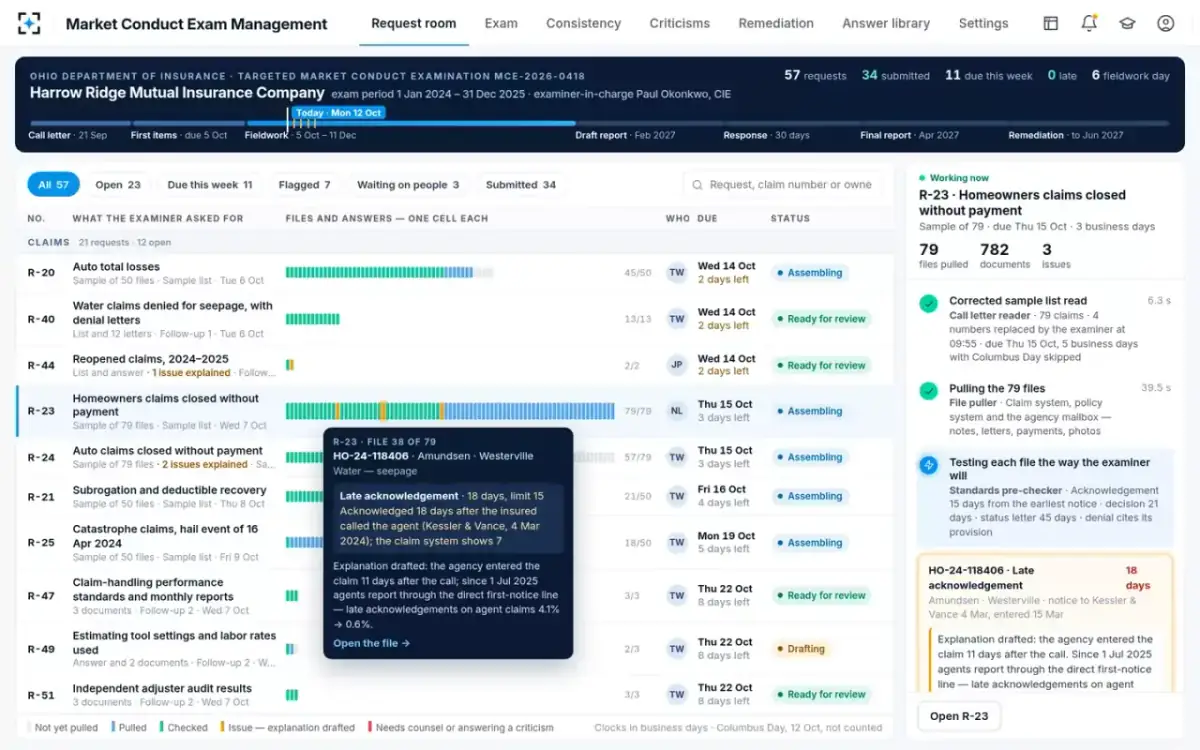
The allocation also changes who waits for whom. Before, a claims director spends days gathering files for a sample and the coordinator waits. After, the files arrive already pulled and tested, and the director's time goes to the handful with exceptions. In the fictional sample exam, a 79-file sample of homeowners claims closed without payment came back as 782 documents, with six files flagged for a human to read.
A sample request filling in, file by file
Is there free market conduct exam tracking software? What a spreadsheet does and does not do
The free market conduct exam tracking tool most teams use is a spreadsheet, and for a small desk examination it can be enough. It lists requests, owners and dates, and it costs nothing. Its limits show up in a larger exam, where requests multiply during fieldwork and each answer depends on documents and numbers held elsewhere.
A spreadsheet tracker against a market conduct exam management system
Spreadsheet and shared drive: Rebuilt by hand from each letter and email; drifts from what the examiner actually sent.
Market Conduct Exam Management: Read from the letter and every follow-up; ambiguous items go to the coordinator.
Spreadsheet and shared drive: Typed in; holidays and business days counted by whoever enters them.
Market Conduct Exam Management: Counted in business days on the department’s calendar, with warnings two days out.
Spreadsheet and shared drive: Requested from adjusters one by one; completeness checked by eye.
Market Conduct Exam Management: Pulled read-only from source systems, each document numbered with where it came from.
Spreadsheet and shared drive: Usually none; the company learns of an exception from the criticism.
Market Conduct Exam Management: Each file tested against the configured standard, with the passage cited.
Spreadsheet and shared drive: Whatever is on the drive today.
Market Conduct Exam Management: The version in force during the exam period, and when it changed.
Spreadsheet and shared drive: Compared when someone remembers to.
Market Conduct Exam Management: Every count compared and marked agrees, explained or contradicts.
Spreadsheet and shared drive: Email threads.
Market Conduct Exam Management: An activity trail of who pulled, drafted, approved and submitted, and when.
The weakest cell in the spreadsheet column is the version of a procedure. Examiners test each claim against the rules in force when it was handled, and the 2017 NAIC handbook says a report should count "inconsistencies with the company’s manuals and filings" among errors. A tracker that links to today's manual invites the company to defend a 2024 file with a 2026 rule. The guide to a market conduct examination report example shows how examiners cite a company's own guidelines.
Where a sample request's business days go, by hand and with agents
Most of a sample request's time goes on retrieval, not on judgement. Botminds estimates that a 79-file claims sample takes about seven business days by hand, three of them spent pulling files and documents from claim, policy and mail systems. The solution's design target is two business days from the examiner's request to a checked package, with most of the saving in retrieval and testing.
One sample request’s business days, by hand and with Market Conduct Exam Management
By hand · about 7 business days (estimate)
- Reading the request, setting its clock · 7%
- Pulling files and documents · 43%
- Testing files and checking counts against MCAS · 29%
- Writing explanations and the cover letter · 14%
- Counsel review, sign-off, submission · 7%
With the solution · 2 business days (target)
- Reading the request, setting its clock · 5%
- Pulling files and documents · 20%
- Testing files and checking counts against MCAS · 30%
- Writing explanations and the cover letter · 25%
- Counsel review, sign-off, submission · 20%
The second bar's largest share is writing, and its counsel share grows. That is the intended shape: when files arrive tested, the time left over goes to the sentences that matter, and counsel reviews a smaller number of explanations with their sources attached. In the sample exam, the package for the 79-file request went out three business days early, after counsel approved three explanations and the manager signed off.
What should exam management software for insurance companies do? Twelve questions to ask
Exam management software for insurance companies should be judged on evidence it can show on your own files, not on a feature list. These are the questions we would ask any vendor, including ourselves, with the answer that should satisfy a market conduct manager.
Twelve questions for a market conduct exam management system, and what a good answer shows
- Can it read our last call letter and produce the request list we actually worked from?
Run it on a closed exam. Missing or merged requests show up immediately.
- Where does each due date come from?
It should cite the examiner’s words and count business days on the state’s holiday calendar.
- Does it touch our claim or policy systems?
Read-only access, limited to files in the sample and the exam period.
- Can every pulled document be traced to its source?
Numbered documents with system and location, so an examiner’s question about one page has an answer.
- Which standards does it test, and can we change them?
Each standard, its clock and its tolerance as a setting, mapped to your state’s rule.
- Does it count from the earliest notice?
A notice to an agent starts the insurer’s clock under NAIC Model 902 §6A; the claim system often starts later.
- Will it ever call an exception a violation?
It should not. That conclusion belongs to the examiners and, inside the company, to counsel.
- How does it reconcile with MCAS?
Every count compared with the filing, with the reason for each difference, and nothing changed to make it agree.
- Does it know which version of a procedure applied?
Versions with effective dates, quoted as in force during the exam period.
- Who approves what, and can we prove it?
Named approvers for explanations and criticism responses, and an activity trail.
- Does it track examiner billing against the work plan?
Hours and amounts by month against the budget in the work plan.
- What happens after the exam?
Commitments with owners and proof, so the next exam does not find a repeat.
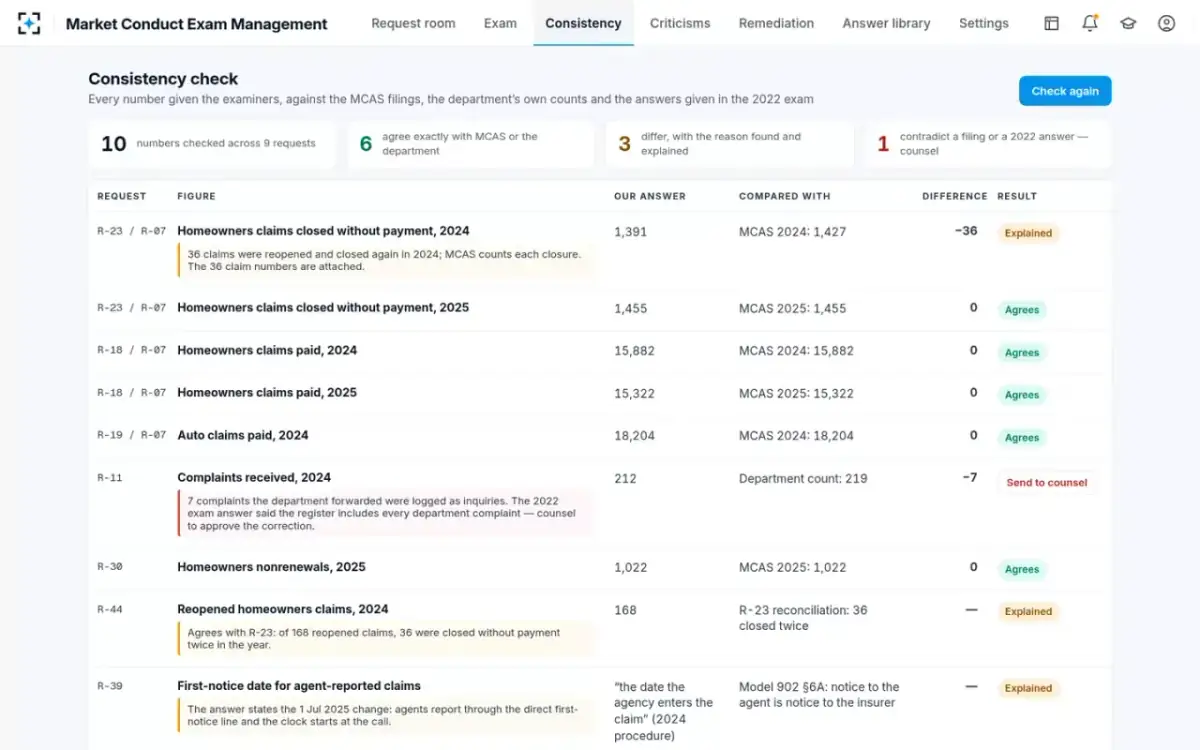
Two of these questions catch most weak systems. The first is the earliest-notice question. Under Model 902, notice given to the insurer's agent counts as notice to the insurer (NAIC Model 902), so the clock can start before the claim reaches the claim system. A system that tests acknowledgement time from the claim-system date will pass files the examiner fails. The second is reconciliation: if the system cannot explain why a claims list differs from the annual statement, the examiner will ask, and the MCAS homeowners instructions require the filing's attestors to affirm that the company "is able to accurately trace the data as reported to its source within the company".
Consistency check: every number given the examiners, against MCAS and past answers
Market conduct exam management consulting, certification and software: who does which part
Software, consultants and people with credentials solve different parts of the problem. Consultants who have worked as examiners can run a mock exam, read a state's appetite and coach a coordinator. A system can do the retrieval and checking at a scale a consultant cannot, every exam, on every file. Neither replaces the company's own counsel and manager, who own its positions.
Credentials in this field belong to the examiners. The 2017 handbook recommends that an examiner-in-charge be certified by the Insurance Regulatory Examiners Society as a Certified Insurance Examiner, and the O*NET listing describes the CIE as awarded to regulatory professionals who have attained the society's Accredited Insurance Examiner designation in one field. Company staff who understand how examiners are trained answer in the examiners' order: standard, file, rule. The guide to the insurance market conduct examiner describes that order.
From criticism to response: the part of the system that belongs to counsel
A criticism is where an exam turns into findings, and it is the one stream a system should slow down rather than speed up. The 2017 handbook's uniform outline says each written criticism should give the record numbers, the examiner's statement of the problem with the law or standard where relevant, and "A request for signature and comment from the company." Whatever the company writes back can travel: under the model law as Texas enacted it, the department includes the insurer's responses in the final examination report, as an appendix or in the text.
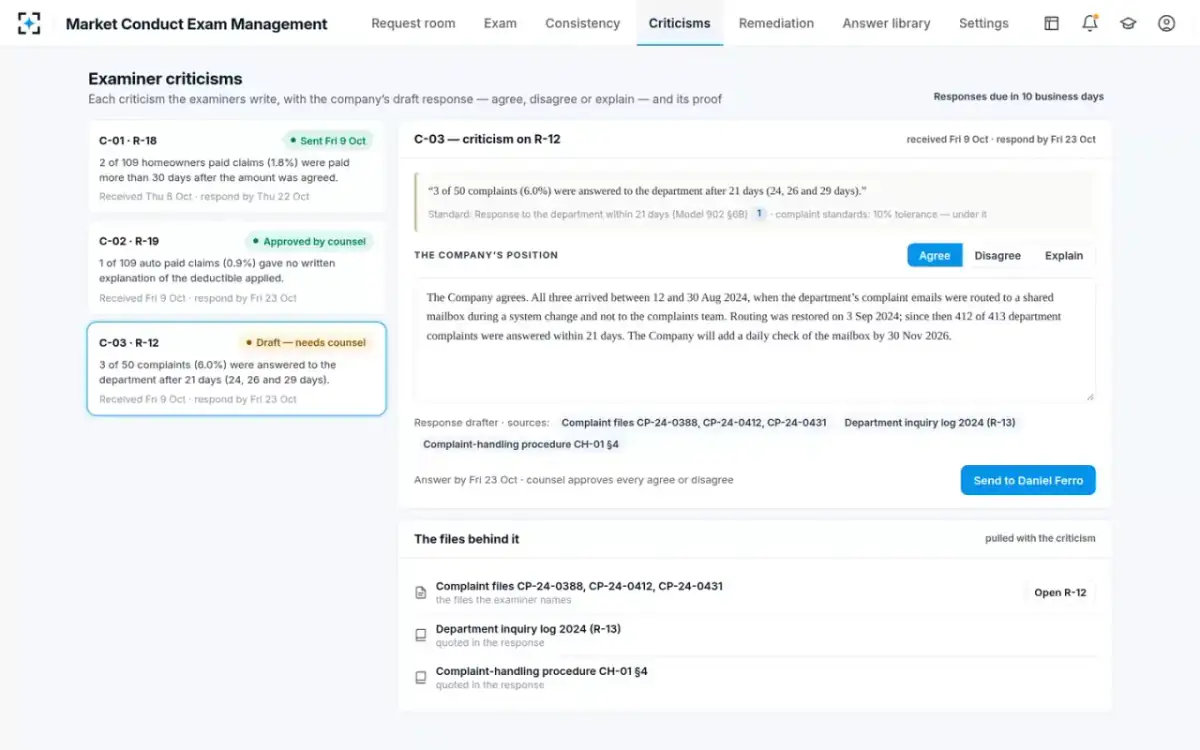
So the system's job here is preparation, not speed. It should put the file, the rule in force, the company's own procedure and every earlier answer on the subject beside the draft, flag any conflict with what the company said in a prior exam, and then stop until counsel decides whether to agree, disagree or explain.
Examiner criticisms with their draft responses and sources
Where Market Conduct Exam Management fits, and where it does not
It fits an insurer that faces market conduct exams, targeted or comprehensive, on claims, complaints, underwriting and producer areas, and that holds the answers in several systems. It is built for the company side of the exam and for the work between the call letter and the final report, plus the remediation that follows. It does not decide anything for the company, and it does not submit.
It is not the tool for a financial-condition examination, which tests solvency and reserves rather than consumer treatment. It does not repair source data: if the claim system records the wrong notice date, the solution can find the earlier date in the agency mail and explain the gap, but the fix belongs in the claims process. And it is not a substitute for state-specific legal advice. The standards it tests are settings that a company maps to its own state's rules, with the clock, the counting start and the tolerance for each.
A sensible pilot uses a closed exam: the last call letter, its sample lists and the company's answers. Run the solution on it, compare the request list, the files pulled and the exceptions found with what the examiners wrote, and judge it on that. The guide to market conduct exam sample sizes explains how to tell whether a pre-check result would have triggered a second sample.
Questions people ask
What is market conduct exam management software?
Software for an insurer's side of a state market conduct examination: it tracks every examiner request with its owner and due date, gathers the files and answers, and keeps criticism responses and remediation in one place. Newer systems add agents that pull sampled files and test them against the standards the examiners use before the company submits.
Is there free market conduct exam tracking software?
A spreadsheet and a shared drive are the free option, and they work for a short desk exam with few requests. They do not count business days, pull files, test them, or tie counts to the MCAS filing, which is where larger exams lose time.
Should an exam management system decide whether an exception is a violation?
No. Whether a pattern is a violation is the examiners' and the department's call, and inside the company it is counsel's. A system should explain each exception with its source and route it to the person who answers for it.
How does exam management software handle MCAS?
It should compare every count given to the examiners with the company's MCAS filing and earlier answers, and mark each one as agreeing, explained or contradicting. The NAIC's MCAS instructions require attestors to affirm that the filed data can be traced to its source and recreated.
How long does it take to pilot an exam management system?
A pilot on a closed exam is the fastest honest test: run the last call letter and its samples through the system and compare its output with the examiners' requests and findings. It needs read access to the files in that exam's samples and the procedures in force at the time.