How to prepare for a market conduct examination comes down to having, before any letter arrives, what the examiners will ask for in its first weeks: the procedures and manuals in force during the period with their effective dates, claims and policy lists that tie to the company's MCAS and annual statement figures, a complaint register reconciled to the department's own count, the last exam report with proof that each finding was fixed, and a named owner for each of those. A target exam can be called with little or no notice, and North Carolina, for one, wants its first batch of data 60 days before fieldwork begins, so a company that starts collecting on the day the letter arrives is already late. Botminds' Market Conduct Exam Management is built for the weeks after the letter, but most of what makes it work, a library of procedures by version, data that ties out and a remediation history, is the same inventory good preparation builds.
Examples from the solution on this page come from a fictional sample exam of an Ohio mutual insurer, with invented people and files. The requirements come from the NAIC, state statutes and a state department's published coordinator's handbook, linked where they appear.
"Only through open communication between the examination team and company personnel will both parties be on the same page, thus leading to a “no surprises” wrap-up or exit conference."
NAIC Market Regulation Handbook, 2017 edition, chapter 12, on communication during an examination
What is a market conduct exam, and what makes a department call one?
A market conduct exam is a state insurance department's review of how a company treats consumers, from advertising and sales to underwriting, policy service, complaints and claims, tested on samples of the company's own files. Departments choose whom to examine from data they already hold, so preparation starts with knowing what that data says about you.
The 2017 NAIC handbook lists nineteen reasons a state may call an exam. They include the company's complaint index, a rise in recent complaints, market share, findings from a financial exam or another state, a shift in business practices, a new law, MCAS results, the result of the last exam, and the simple passage of time. Florida writes its own triggers into statute: its selection method must prioritise, among others, insurers with a disproportionate number of claims-handling complaints, including complaints of "Failure to adhere to the company’s claims-handling manual.", and insurers that MCAS shows to be a "negative outlier with regard to particular metrics."
Those triggers are visible from inside the company. A rising complaint ratio, an MCAS ratio far from the industry's, a product change, or a commitment from the last exam still open are the early warnings. Preparing for a market conduct exam is partly preparing the evidence that each of them has an explanation.
Market conduct exam requirements: what the company must be able to produce
The requirements are broad and mostly predictable. The 2017 handbook says a notification letter should arrange for "copies of relevant company procedural guidelines, manuals, policy forms with notice of approval, advertising materials, producers’ records, renewal material, methods used to solicit business, any required consumer complaint register and any other pertinent data", and for data that needs lead time, such as claims runs and policy runs. Before arriving, the examiner-in-charge reviews prior exam reports and the company's responses, the NAIC's complaint data and the company's complaint index, producer licensing records, and rate and form filings.
North Carolina's coordinator's handbook shows how that becomes a calendar. Its Phase I items, including the complaint register, privacy notices, form and filing histories, producer lists and electronic policy and claims lists, "must be forwarded in good order to this office no later than 60 days prior to the commencement of the examination." Its Phase II items, the claims, underwriting and termination files selected for review and the manuals in use, must be available on the first day. The examination period defaults to the three full calendar years before the exam.
Two general standards apply to all of it. The company must cooperate on a timely basis with examiners, and, in the NAIC's words, "Records are adequate, accessible, consistent and orderly, and comply with state record retention requirements." A file that exists but cannot be found within the exam's clock is, for the examiner's purposes, a file that does not exist.
Market conduct exam checklist: what to bring, and the standard each item serves
A market conduct exam checklist is most useful when each item names the standard it will be tested against, because that tells the owner what "ready" means. The list below covers the items examiners ask for most often in a property and casualty exam, built from the NAIC standards and North Carolina's published requirements.
A market conduct exam checklist: what to have ready, and the standard each item serves
- Claims procedures and manuals, every version in force during the period, with effective dates
Claims standards; examiners count inconsistencies with the company’s own manuals as errors.
- Closed-claim lists by category (paid, closed without payment, reopened, subrogated, total loss, litigated)
The populations examiners sample; North Carolina asks for these lists by date of loss.
- The complaint register, reconciled to the department’s count
Complaint handling standard 1: every complaint recorded in the required format.
- Evidence of complaint response times
Complaint handling standard 4: responses within the statutory time.
- Underwriting and rating manuals in use during the period, and filed forms with approval
Underwriting and rating standards 1 and 5: rates as filed, forms filed.
- Cancellation, nonrenewal and declination notices with proof of mailing
Underwriting and rating standard 8: notices comply with the policy, state law and guidelines.
- Producer appointment and termination lists that match the department’s
Producer licensing standard 1: records agree with insurance department records.
- Prior exam report, the company’s response and proof each finding was fixed
Examiners review prior reports before fieldwork and look for repeats.
- The internal audit or self-audit program, with its scope and last results
Operations/management standard 1: an up-to-date, valid audit program.
- MCAS filings for the period and the extracts behind them
Operations/management standard 18: data reported to departments is complete and accurate.
- Antifraud plan and privacy notices
Operations/management standards 3 and 13; both open North Carolina’s Phase I list.
- A named coordinator, and named owners for each area
The handbook asks for people with authority to answer examiners’ criticisms.
The first item is the one most companies underestimate. Examiners test each file against the rules in force when it was handled, and the 2017 handbook's guidance on writing reports counts a departure from the company's own manuals and filings as an error. If the manual changed during the period, both versions are evidence, and so is the date of the change. The guide to a market conduct examination report example shows a 2025 Florida report citing an insurer's own guidelines.
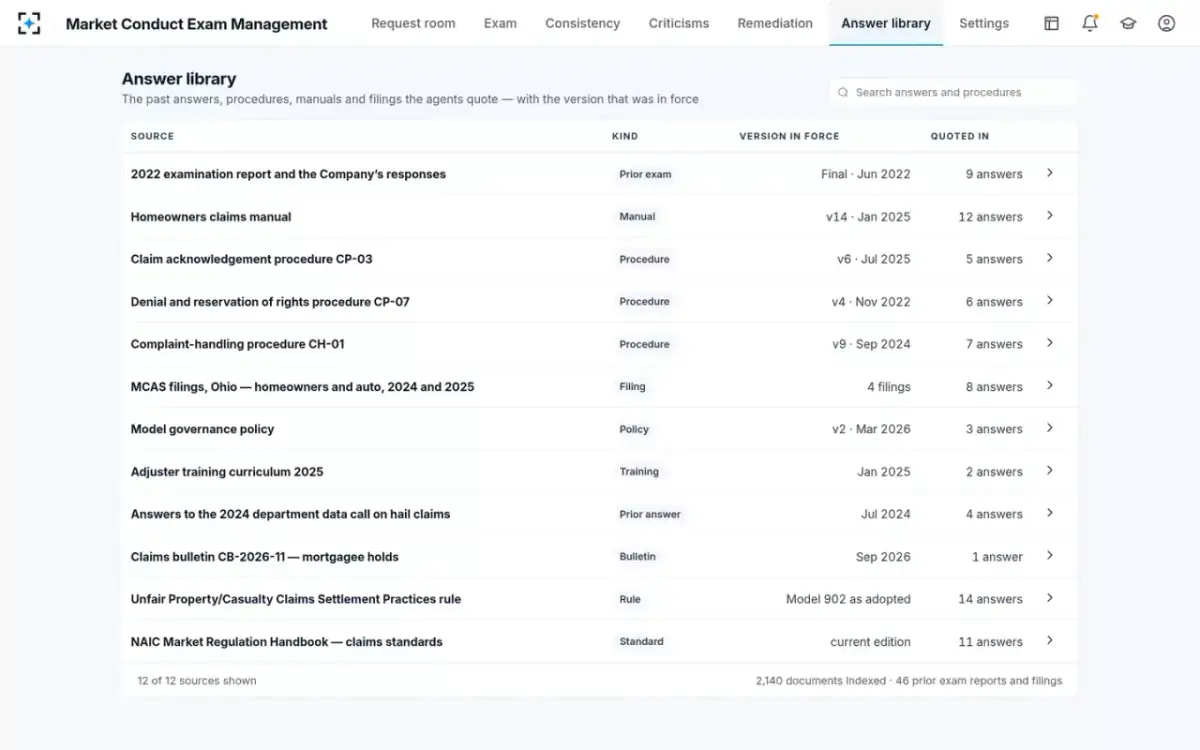
The answer library: procedures, manuals and filings with the version in force
What do targeted market conduct exam questions ask?
Targeted market conduct exam questions ask about one area in depth, usually through written interrogatories before the sample lists arrive. The 2017 handbook describes an interrogatory as a compilation of written questions on a subject, procedure or product, verified later in-house or on site, and recommends that a target examination also review "the company’s current complaints, as well as a review of its operations/management area". North Carolina's examination chronology lists completing interrogatories as one of the coordinator's first tasks, before the pre-examination conference.
The questions follow the trigger. A claims target asks how claims are reported and acknowledged, how the clock is started when an agent or a portal receives the notice, how status letters are generated, how denials are written and reviewed, who adjusts and whether they are appointed, and how the company audits itself. An exam called after an MCAS outlier will ask about the ratio that stood out. A target exam in 2026 may also ask how the company uses AI systems: the NAIC's evaluation tool for that purpose was piloted in twelve states from March to September 2026, in work that included market conduct exams.
Answering well means answering from documents. An interrogatory answer that describes what the procedure says, cites its version and date, and matches what the sampled files show will hold. One written from memory invites the examiner to test it on the files, where any gap becomes a finding.
A market conduct exam preparation guide by calendar: before the letter, the 60 days, fieldwork
Preparation runs on three clocks. Before any letter there is no deadline, which is why the work rarely gets done. Once the letter arrives, the model-law calendar applies to scheduled exams: at least 60 days' notice with a work plan, a pre-examination conference about 30 days before fieldwork in Texas, and, in North Carolina, the Phase I data due at the start of that 60-day window. During fieldwork, each request carries its own date.
When each part of the preparation is due, in a scheduled examination
- Manuals by version, lists that tie, register reconciled, remediation proofongoing
- Coordinator named; North Carolina wants Phase I data at the startfrom day 1
- Pre-exam conference about day 30; Phase II files ready by day 60to day 60
- Sample lists, follow-ups, criticisms, each on its own clockper request
The 60-day window is shorter than it looks. Data lists have to be built to the department's layout, validated and often rebuilt; North Carolina asks for fixed-length text files with no headers or totals and expects the IT staff who build them at the pre-examination conference. A company that can rebuild each list on demand, with totals that tie to its MCAS filing, turns that work into a run of an existing job.
Who owns which part of the inventory
Each part of the inventory needs one owner who can produce it on a day's notice and explain it. The coordinator should not hold the inventory; the coordinator should know who does. A useful test is to ask each owner for the version of their main procedure that was in force on a date eighteen months ago, and time the answer.
A preparation inventory by owner: what each keeps ready
Claims
Claims manuals and procedures by version; closed-claim lists by MCAS line; acknowledgement, status-letter and denial templates with their dates; adjuster appointment records.
Complaints
The complaint register in the required format, reconciled to the department’s list; response-time evidence; the procedure in force.
Underwriting and policy service
Rating and underwriting manuals in use during the period; filed forms with approval; cancellation, nonrenewal and declination notices with proof of mailing.
Producers and marketing
Appointment and termination lists that agree with the department’s; advertising and producer communications.
IT and data
Repeatable extracts for each list examiners request, tied to MCAS and annual statement totals; who can rebuild them.
Compliance and counsel
Prior exam reports, the company’s responses and every remediation commitment with its proof; the self-audit program and its results.
The IT and data owner is the one most often missing. Examiners validate data before they sample from it, checking control totals and, where they can, reconciling to the annual statement and MCAS. The NAIC's MCAS instructions already require the filing's attestors to affirm the company can trace the data to its source and, if necessary, recreate the reported results. A company that can do that for MCAS can usually do it for an examiner's list. The guide to MCAS filing requirements explains which counts examiners compare.
Run the exam on yourself first: the self-audit and the remediation file
The most useful preparation is a rehearsal on closed files: draw a random sample from each population the examiners will use, test it against the standards and your own manuals, and fix what you find. The 2017 handbook says it would seldom be prudent to penalise a company that found a problem through self-audit, fixed it and remediated, and Texas tells its commissioner to weigh a company's programs to self-assess, self-report and remediate when setting a sanction.
The remediation file is the second half. Every commitment from the last exam needs an owner, a date and proof that it worked, because examiners read the prior report before they arrive. A finding closed with a template change, then repeated in this year's files, is worse than the original. The guide to market conduct exam self audit questions sets out the questions and how to read the counts.
Where Market Conduct Exam Management fits in preparation, and where it does not
The solution is built for the exam itself, from the call letter to the closing report, but it uses the same inventory. Its answer library holds past exam answers, procedures, manuals and filings with the version in force; its consistency checker compares each count with the MCAS filing and prior answers; and its remediation timeline keeps commitments from one exam to the next. A company that loads its last exam into it has a rehearsal ready: replay the old sample lists and see what the standards pre-checker finds today.
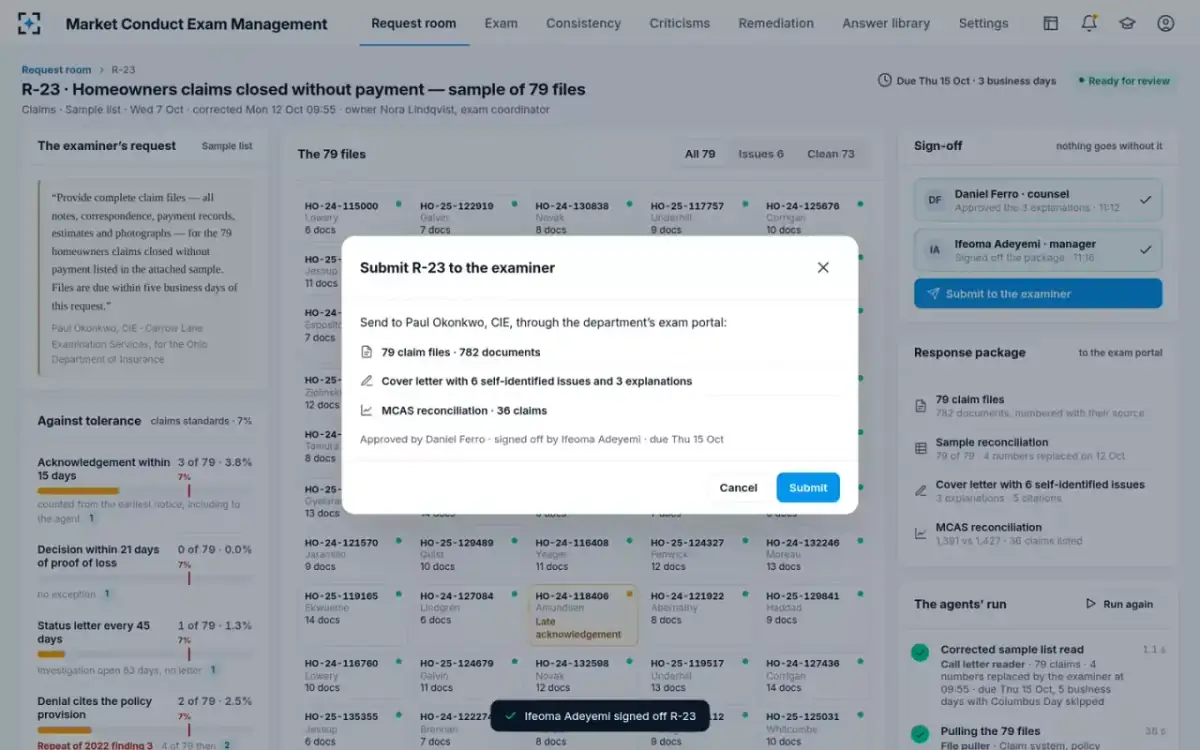
It does not write the company's procedures, set its legal positions, or fix a source system that records the wrong date. It does not decide whether an exception is a violation, and it does not submit to the examiners; the coordinator does, after counsel and the market conduct manager approve. Preparation remains a management job. The solution makes the evidence for it findable and checkable.
Sign-off before submission: nothing goes to the examiner without counsel and the manager
Questions people ask
How long does it take to prepare for a market conduct exam?
A scheduled exam gives at least 60 days' notice under the NAIC model law and Texas law, but the data and documents examiners want first may be due at the start of that window. In practice, preparation that has not started before the letter is compressed into a few weeks.
What documents do examiners ask for first?
Usually the complaint register, data lists of policies and claims for the period, procedures and manuals, filed forms, producer lists and the prior exam response. North Carolina's Phase I list also opens with the antifraud plan and privacy notices.
Should we run a mock market conduct exam?
A rehearsal on random samples of closed files, tested against the NAIC standards and your own manuals, is the most direct preparation. The 2017 NAIC handbook says it would seldom be prudent to penalise a company that found and fixed a problem through self-audit and remediated.
What triggers a market conduct exam?
Complaint trends, MCAS results, prior exam findings, market share, a change in business practices, a new law and the time since the last exam are among the nineteen reasons the 2017 NAIC handbook lists. Florida's statute also names a disproportionate number of claims-handling complaints and MCAS outliers.
What period does the exam cover, and which manual applies?
The period the call letter states, often the last three calendar years in North Carolina's default. Each file is judged against the statute and the company procedure in force when it was handled, so every version used during the period is relevant.