MCAS filing requirements apply to insurers licensed in participating jurisdictions: for each line of business covered by the Market Conduct Annual Statement in which a company has at least $50,000 of annual direct premium written in a state, it reports that state's claims, underwriting, complaint and lawsuit counts through the NAIC's online system. For the 2026 data year the NAIC collects 13 lines, and filings are due on 30 April 2027, except health, other health and short-term limited duration health, due on 31 May 2027. Two named attestors must affirm the filing is full and accurate and that the company can trace every number to its source and recreate it. That last requirement is why MCAS matters in a market conduct exam: examiners check the lists and answers a company gives them against what it filed. Botminds' Market Conduct Exam Management compares every count given to examiners with the MCAS filing, explains each difference, and sends contradictions to counsel.
The requirements and definitions on this page are the NAIC's, from its 2026 MCAS page, the homeowners data call and definitions, its ratio definitions and its own MCAS reports, linked where they appear. Where the solution appears, the data is from a fictional sample exam.
MCAS for the 2026 data year in four numbers
13
lines of business collected for the 2026 data year
$50,000
annual direct premium written in a state, the reporting threshold the NAIC states for homeowners
51
jurisdictions participating in MCAS as of the 2024 data year
2
named attestors required for each filing, homeowners data call
What are the MCAS filing requirements?
The MCAS filing requirements come from the participating states, collected centrally by the NAIC. The NAIC describes MCAS as a uniform system for state regulators to collect market information, developed in 2002, which began that year with eight states and two lines of business; its homeowners report says that through an NAIC portal, companies "report MCAS data to each jurisdiction in which they are licensed and have at least $50,000 in annual direct premium written." The NAIC's 2026 overview for its working groups adds that MCAS data is state-owned and confidential, generally collected under the states' examination authority, and that no filing fees are currently assessed for its collection.
The data is company-level, not group-level, and filed state by state. Each filing has schedules of interrogatories, claims activity by coverage, underwriting activity, complaints, lawsuits and an attestation. Unless the instructions say otherwise, the homeowners data call tells companies to follow the same methods and definitions used for the financial annual statement and its state pages, which is why the two filings are expected to agree.
MCAS filing requirements, item by item, for a homeowners filer
- Report each state where you are licensed and write at least $50,000 of homeowners premium
The threshold the NAIC states for MCAS homeowners reporting.
- Name an MCAS administrator, a contact and an attestor
The administrator assigns access; the contact knows the data; the attestor vouches for it.
- Answer the interrogatories
Coverages written, non-standard business, MGAs and TPAs used, digital claim settlement and its vendors.
- Report claims activity by coverage and by claimant
Opened, closed with and without payment, open at period end, closing-time bands, median days to final payment.
- Report underwriting activity
Policies in force by type, new business, premium, nonrenewals, cancellations by reason and timing, and complaints received directly.
- Report lawsuits
Opened, closed, and closed with consideration for the consumer, claim-related by coverage.
- Name two attestors who took part in validating the filing
The NAIC recommends one with operational responsibility for the source data and one from IT.
- Explain any premium difference of 20% or more from the financial annual statement
To avoid inquiries from the regulator receiving the filing.
MCAS lines of business for the 2026 data year
For the 2026 data year the NAIC collects MCAS for thirteen lines: disability income, health, homeowners, individual annuity, individual life, lender-placed auto and homeowners, long-term care, other health, pet, private flood, private passenger auto, short-term limited duration health, and travel. The list has grown in steps. The NAIC's July 2026 overview dates the additions: homeowners, individual annuity, individual life and private passenger auto from the start; long-term care in 2014; health in 2017; lender-placed in 2018; disability income in 2019; private flood in 2020; short-term limited duration and travel in 2022; other health in 2023; and pet insurance in 2025.
Each line has its own data call and definitions, and they change by version. The NAIC's process documents say changes adopted by the MCAS Blanks working group before 1 June, by its parent committee by 1 August and by the NAIC plenary by 31 December take effect for the following year's reporting. A filer should read the current version every year, not reuse last year's extract.
When is the market conduct annual statement due? The 2026 calendar
The market conduct annual statement for 2026 data is due on 30 April 2027 for all lines except health, other health and short-term limited duration health, which are due on 31 May 2027. The NAIC's calendar starts earlier: "Mid-December 2026 | Call letters to companies", the last day to submit corrections to 2025 data in late January, and the online filing tool open from mid-March.
The MCAS calendar for the 2026 data year, December 2026 to August 2027
- Call lettersmid-Dec
- 2025 correctionsto late Jan
- Filing open30 Apr
- Scorecards1 Jul
- Call lettersmid-Dec
- 2025 correctionsto late Jan
- Filing open31 May
- Scorecards1 Aug
The scorecards matter to the filer as well as the regulator. The NAIC's overview describes company-specific scorecards for each jurisdiction and line after submission, and public industry scorecards. A company that sees its own ratio far from the industry's has the summer to understand why, before a regulator asks.
Market conduct annual statement instructions: the definitions that change the count
The market conduct annual statement instructions decide what counts, and several definitions differ from how a claim system or an exam request might count. The most consequential, in the homeowners data call, are the claim unit, reopened claims, and the date a claim was reported.
A claim is counted per claimant and per coverage: one loss with a dwelling, a personal property and two liability claimants is four claims in different coverages. A reopened claim counts again: "If a claim is reopened for a subsequent supplemental payment, count the reopened claim as a new claim." And the clock for days to payment starts on "The date an insured or claimant first reported his or her loss to either the company or insurance agent." That definition matches how examiners count acknowledgements under the NAIC model claims regulation, where notice to an agent is notice to the insurer.
The instructions build in their own consistency checks. For each coverage, claims closed in each closing-time band must add up to the total closed, and the median days to final payment must fall inside the band that holds the middle claim. The NAIC's worked example uses 91 paid claims; the middle one, the 46th, falls in the 61 to 90 day band, so a reported median outside that band "will indicate a data error."
The NAIC's median check: 91 paid claims by closing-time band, and where the median must fall
91 claims closed with payment
- 0–30 days · 22 · 24.2%
- 31–60 days · 13 · 14.3%
- 61–90 days · 18 (the 46th claim is here) · 19.8%
- 91–180 days · 11 · 12.1%
- 181–365 days · 12 · 13.2%
- Beyond 365 days · 15 · 16.4%
What are the NAIC MCAS ratios?
The NAIC MCAS ratios turn each company's counts into comparable rates. The NAIC says the ratios were developed to provide more meaningful comparisons between companies than the raw data allowed, letting regulators identify concerns regarding claims and underwriting. For property and casualty lines (private passenger auto and homeowners), the NAIC's 2023 ratio definitions list seven.
The seven MCAS ratios for private passenger auto and homeowners
| Ratio | What it measures | Calculation |
|---|---|---|
| Ratio 1 | Claims closed without payment | Claims closed without payment ÷ (closed with payment + closed without payment) |
| Ratio 2 | Claims unprocessed at period end | (Open at start + opened − closed with payment − closed without payment) ÷ (open at start + opened) |
| Ratio 3 | Claims paid beyond 60 days | Claims settled beyond 60 days ÷ claims settled for all durations |
| Ratio 4 | Nonrenewals to policies in force | Company-initiated nonrenewals ÷ policies in force |
| Ratio 5 | Cancellations over 60 days to policies in force | Cancellations 60 days or more after the effective date ÷ policies in force |
| Ratio 6 | Cancellations under 60 days to new policies | Cancellations in the first 59 days ÷ new policies issued |
| Ratio 7 | Suits to claims closed without payment | Suits opened during the period ÷ claims closed without payment |
States act on outliers. Florida's statute requires its market conduct selection method to prioritise insurers whose MCAS results show them to be a "negative outlier with regard to particular metrics." The 2017 NAIC handbook lists MCAS among the statistics that may lead a state to call an exam. A ratio that sits far from the industry's is a reason to be examined; an explanation ready in advance is the cheapest answer. Aggregated, the same data also shows market trends: the Personal Lines guide on why insurers non-renew homeowners policies uses the NAIC's MCAS homeowners report.
Market conduct annual statement claim denials: what ratio 1 says, and what it does not
The MCAS measure people usually mean by claim denials is ratio 1, claims closed without payment as a share of all claims closed, and it measures closures, not wrongful denials. Under the homeowners definitions, a claim closed without payment includes one closed because the amount is below the deductible, and one where no policy was in force but a file was opened and investigated. A company with many small claims below a high deductible will show a high ratio for reasons that have nothing to do with how it adjusts.
That is exactly the kind of difference to explain before an examiner reads it. The ratio's numerator is also the population examiners most often sample: claims closed without payment. A company whose ratio is high should expect a sample from it, and should already know how many of those closures were below-deductible, no-coverage or withdrawn, and which were denials that needed a letter citing the policy provision. The guide to self-audit questions covers how to test those files.
The attestation: why MCAS and the exam are one dataset
The attestation makes MCAS a document the company stands behind file by file. In the homeowners data call, the attestors certify that the filing is a full and accurate statement, acknowledge that a department "may initiate regulatory action as authorized by law in a specific jurisdiction if the data submitted in the MCAS is inaccurate, incomplete, or found to be materially false, misleading or omissive.", and affirm that the company can trace the data to its source and recreate the results.
Examiners use that promise. The 2017 handbook tells them to test the completeness of an exam data file where they can, for example by checking that paid-claim amounts roughly reconcile with the annual statement and the MCAS filing. Among the NAIC's general examination standards is that "All data required to be reported to departments of insurance is complete and accurate." When a claims list sent for sampling does not match the MCAS count, the examiner's first question is which one is wrong.
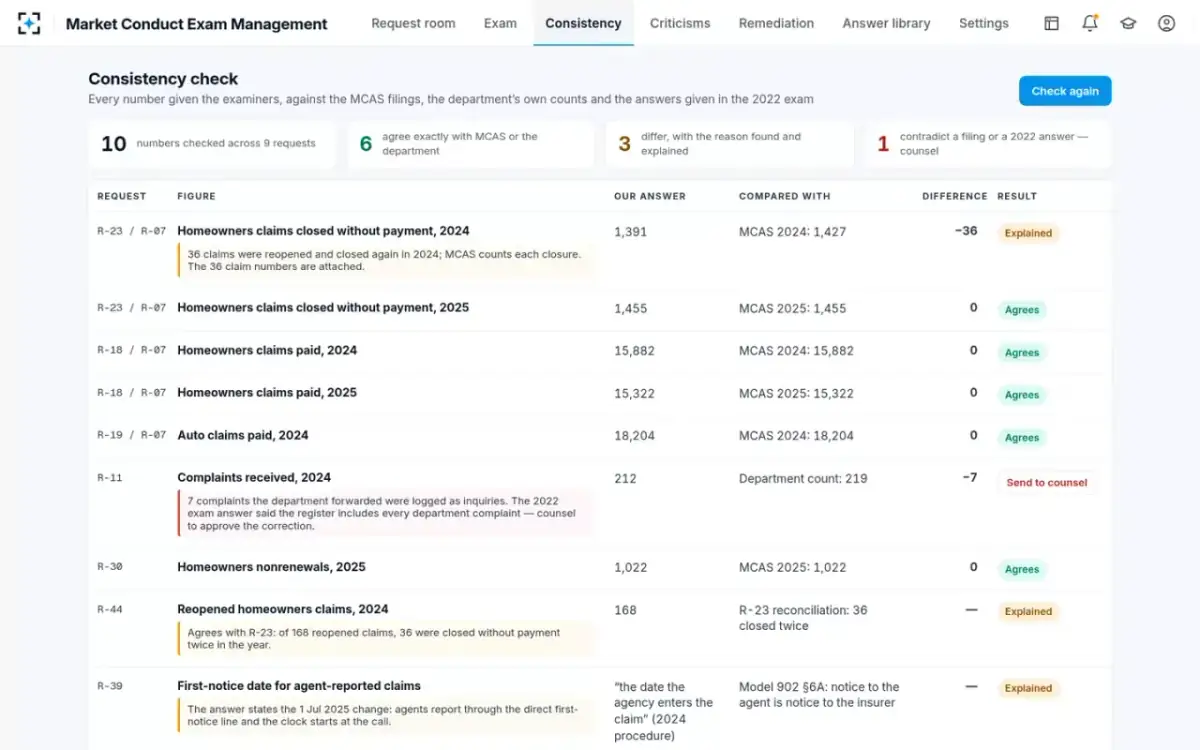
Often neither is. In the solution's sample exam, the company's list of homeowners claims closed without payment in 2024 held 1,391 claims; the MCAS filing said 1,427. The 36-claim difference was reopened claims closed again in the year, which MCAS counts each time. Explained with the claim numbers attached, it is a reconciliation; unexplained, it is a finding against data accuracy and a reason to doubt the sample.
Every number given the examiners, checked against MCAS before submission
MCAS filing with the NAIC: how the submission works, and what is changing
Today an insurer files MCAS through the NAIC's online application, uploading or keying data per state and line; the application checks it with data warnings and errors, and NAIC staff work with companies on filing questions and discrepancies. The NAIC's July 2026 overview says the MCAS data was first collected centrally at the NAIC for the 2010 data year, that regulators get filing status dashboards including extensions and waivers by state and line, and that ratios are calculated for regulator analysis.
The route is changing. Under the NAIC's financial data repository modernization project, the overview says the NAIC will keep sending call letters but its MCAS application will no longer be used; insurers will upload data through a third-party vendor into a new file-processing application, as they already do for financial filings, with completion scheduled for 2028 and data submitted to the NAIC in 2029. A company planning its MCAS process should expect the file format, not the definitions, to be what changes first.
How Market Conduct Exam Management ties exam answers to MCAS
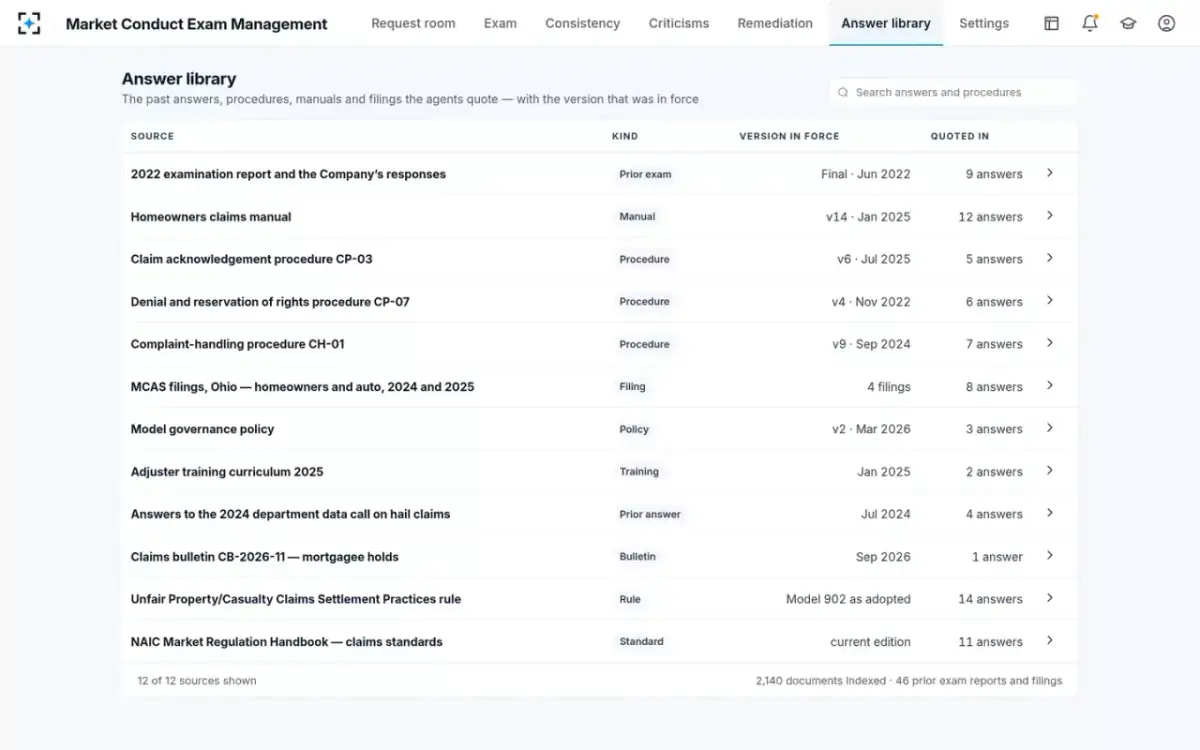
The solution treats the company's MCAS filings as a source the agents quote, with the version filed for each year. The consistency checker compares every count and ratio the company gives the examiners with the filing, other requests in the same exam and answers from prior exams, and marks each as agreeing, explained or contradicting. It never edits a figure to make it agree; contradictions go to counsel. The answer library lists the MCAS filings beside procedures and past exam answers, so the coordinator can see which answers depend on them.
MCAS filings in the answer library, beside the procedures and past answers that quote them
It is not an MCAS filing tool. It does not build or submit the statement, and it does not decide whether a number in a filing is wrong. Its job is to make sure that what the company tells the examiners and what it told the NAIC can be read together, with every difference explained. For the sampling side of that reconciliation, see the market conduct exam sample size calculator; for where MCAS sits among the triggers for an exam, see how to prepare for a market conduct examination.
Questions people ask
Who has to file MCAS?
Insurers licensed in participating jurisdictions that write the covered lines there, above the threshold for each line. For homeowners, the NAIC states the threshold as at least $50,000 of annual direct premium written in the state; 51 jurisdictions participated as of the 2024 data year.
When is MCAS due for 2026 data?
By 30 April 2027 for all lines except health, other health and short-term limited duration health, which are due by 31 May 2027. The NAIC sends call letters in mid-December 2026 and opens the online filing tool in mid-March 2027.
How does MCAS count a reopened claim?
As a new claim. The homeowners data call says a claim reopened for a subsequent supplemental payment is counted as a new claim, with days to final payment measured from the date the supplemental request was received.
Is there a fee to file MCAS?
The NAIC's July 2026 overview for its working groups says no filing fees are currently assessed for collecting MCAS data. Check each state's own requirements for any separate charges.
Can a company correct an MCAS filing?
Yes, within the NAIC's correction window: for the 2026 calendar, the last day to submit corrections to 2025 data is in late January 2027. A correction after examiners have used the data should come with an explanation of what changed and why.