An underwriting audit checklist is the list of tests an internal auditor or a state examiner applies to a sample of underwriting files: was each risk written within the carrier's guidelines and by someone with the authority to sign it, were credits and debits applied consistently and their reasons documented, were the forms filed, and does the file rest on information gathered at inception. For commercial lines, most of that checklist is already written down, in the NAIC's market-conduct standards and its financial examiners' handbook, and state examinations apply it to small random samples with fixed tolerances for error. Botminds' Underwriting Authority & Referral Management keeps one part of every file exam-ready: each check against the letter of authority and guides, with the versions in force and who signed.
Where the page uses an example account, it is fictional sample data from the solution. Exam figures come from published state examination reports, linked where they appear; we do not name the examined carriers.
The examiner's underwriting checklist for a commercial file
- Credits, debits and deviations applied consistently
NAIC standard 1: filed where required, applied alike to similar risks, and the reason for each documented.
- Schedule rating on objective criteria, inside the plan
NAIC standard 2: the worksheet in the file, the state’s limits respected, and no credit given for competitive pressure.
- Decisions based on information from inception
NAIC standard 8: underwriting built on what was known when the policy was written, not on what a claim revealed.
- Underwriting guidelines followed
NAIC standard 10: guidelines, bulletins and declination procedures reviewed, region by region.
- Forms listed and filed
NAIC standard 11: every form and endorsement on the declarations page, and filed where required.
- Application complete; the file supports the decision
NAIC standard 18: required signatures present, and adverse-decision notices sent where the policy differs from the application.
- The decision taken at the right authority level
NAIC financial examiners: final decisions, including deviations from guidelines, made by someone with the authority.
- Records kept, and producible on request
State record rules: in New York, a policy record for at least six years after the policy ends.
What is an underwriting audit? Three readers of the same file
An underwriting audit is a review of written files against the rules that were supposed to govern them, after the decision. Three different readers do it, and the same file has to satisfy all three: the carrier's own underwriting audit or quality team, the state's market-conduct examiners, and the state's financial examiners.
The internal audit asks whether underwriters followed the carrier's letters and guides. The market-conduct examiner asks whether the carrier treated policyholders lawfully, consistently and as filed. The financial examiner asks whether the carrier controls the risk it takes on. Their checklists overlap more than their titles suggest: all three end at the same question, whether the person who signed held the authority and could show why.
What is on an underwriting audit checklist? The NAIC standards, read closely
An underwriting audit checklist for commercial lines starts with the NAIC's underwriting and rating standards. Standard 10 is the broadest: examiners "Determine if the regulated entity is following its underwriting guidelines, and that the guidelines conform to state laws and are not unfairly discriminatory." The documents they list for it include the guidelines, "Underwriting bulletins", declination procedures, agency correspondence and the "Underwriter’s file or notes on a system log".
Two notes in the same standard matter for a commercial carrier with branches. Guidelines "may vary by geographic areas in the jurisdiction and, therefore, such guidelines should be reviewed for each regional office being examined." And "Inconsistent handling of rating or underwriting practices, even if not intentional, can result in unfair discrimination". Two branches reading the same bulletin differently is therefore not an internal quirk; it is an exam finding waiting for a sample.
The financial examiners add the authority test. Among the possible controls in their underwriting repository is "a process in place that requires deviations from pricing or acceptability guidelines to be pre-approved, reviewed, and/or spot-checked." A deviation that went through none of the three is the file an auditor should find before the examiner does.
How do examiners review commercial underwriting files? Samples, tolerances and controls
Examiners review commercial underwriting files by drawing a random sample per line of business, re-testing each file, and citing a violation only when the error rate exceeds a stated tolerance. The tolerance differs by type of error; the sample is usually small.
A 2020 North Carolina examination of a commercial carrier is typical: "A random selection of 150 policies was made from a population of 5,764." That was fifty files from each of three lines: general liability, workers' compensation and commercial auto. A 2022 North Carolina examination stated the tolerances: "0% tolerance level for producers who were not appointed and/or licensed, and the use of forms and rates/rules that were neither filed with nor approved by the Department; and 10% for all other areas reviewed." Below the line, the Department "issues a reminder to the company" rather than a citation. In the 2020 exam, four rating errors in fifty general liability files, an 8% error ratio, drew a reminder; one workers' compensation policy rated with the wrong schedule modification factor drew another.
Some exams start with the controls rather than the files. A 2008 Massachusetts examination, testing the schedule-rating standard, recorded that the carrier's controls "appear to be sufficiently reliable to be considered in determining the extent of transaction testing procedures", then compared credits and debits across a sample of 11 commercial policies. Strong controls do not exempt a carrier from file testing; they shape how much of it there is. The arithmetic of what a fifty-file sample can and cannot find is worked through in underwriting peer review.
What documentation supports a schedule rating credit?
A schedule rating credit is supported by evidence about the specific risk characteristic it rewards, kept in the underwriting file, plus a worksheet showing the plan's ranges and the underwriter's choices. Several states list the evidence they expect. Florida names "loss control reports, inspection reports, financial analyses, photographs, and safety plans" and requires the documentation to be kept for five years. Utah and New Mexico add agent observations, premises evaluations and narrative reports; New Mexico allows expense-based modifications, but "Expenses such as reduced commissions may be considered but must be documented in the underwriting file."
When the documentation is missing, the findings can be large. The 2022 North Carolina exam reviewed extra-heavy truck and livery policies and cited the carrier in every population for files that lacked documentation to justify the schedule debit or credit used to rate the policy.
Undocumented schedule debits and credits, by sampled population, in one state exam
The examiners' directive was short: "If schedule rating is employed to modify the premium, a properly completed Schedule Rating Worksheet must be maintained in each underwriting file." A carrier can meet that standard on every file only if the worksheet is produced as part of the decision, not reconstructed for the audit.
What is an IRPM worksheet? Ranges by characteristic, and a cap on the total
An IRPM worksheet, short for individual risk premium modification, records how an underwriter applied a filed schedule-rating plan to one risk: each characteristic the plan allows, its permitted range, the credit or debit chosen, the reason, and the total. The NAIC's schedule-rating standard lists "Underwriting files, including the Individual Risk Premium Modification (IRPM) worksheet" among the documents examiners review.
A state worksheet: seven characteristics, and a total capped below their sum
| Risk characteristic | Range of modification | What the file must show |
|---|---|---|
| Premises | 10% credit to 10% debit | Condition and housekeeping, from an inspection or photographs |
| Classification peculiarities | 10% credit to 10% debit | Why this risk differs from its class, in the underwriter’s words |
| Medical facilities | 5% credit to 5% debit | What is on site, and who is trained to use it |
| Safety devices | 5% credit to 5% debit | Which devices, where, and how they are maintained |
| Employees: selection, training, supervision | 10% credit to 10% debit | Hiring and training practices, with evidence |
| Management: cooperation with the insurer | 5% credit to 5% debit | Response to loss-control recommendations |
| Management: safety organisation | 5% credit to 5% debit | A safety programme or committee that exists in fact |
| Total | Maximum 25% | The sum of credits and debits, inside the cap |
The ranges add up to 50%, but the total stops at 25%: the cap, not the categories, is the binding limit. Utah writes the worksheet's contents into its rule: "a worksheet that describes the risk characteristics of the filed plan and the range of debits or credits allowed for each risk characteristic", the credits and debits chosen and their sum, and "a description of the underwriter's evaluation process". A carrier's letters often add a third limit inside the filed one: in the solution's sample branch, an Underwriter II may apply up to ±15% against a filed ±25%, which is why authority limits sit inside rate limits.
Which version of the guide applied? The question behind every bulletin
For every rule an auditor tests, the first question is which version was in force on the quote date. Bulletins change guides mid-year, letters change on renewal, and a file judged against today's rule rather than the rule of its day produces false findings in both directions.
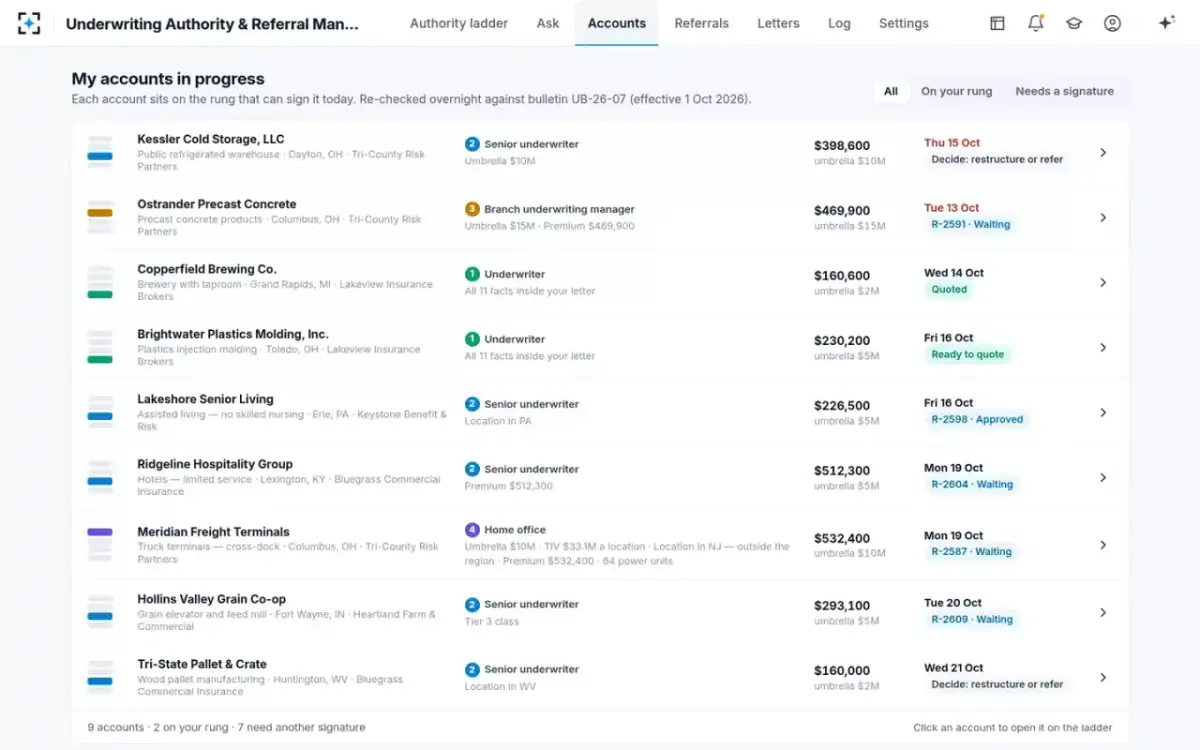
In the solution's sample branch, bulletin UB-26-07 took effect on 1 October 2026 and added a written ammonia mechanical-integrity inspection within 12 months as a condition for cold storage. That is the sample carrier's own rule, not a federal one. A cold-storage account quoted on 30 September and one quoted on 2 October must be audited against different rules, and the file for each must say which. The solution reads a bulletin before its effective date, shows it, and applies it only from that date; when it took effect, the nine accounts in progress were re-checked overnight and none changed rung.
Underwriting Authority & Referral Management re-checks every open account overnight
How long must underwriting files be kept?
Underwriting files must be kept for as long as the state's record rules require, and the longest rule usually wins for a multi-state book. New York's is specific. An insurer keeps "A policy record for each insurance contract or policy for six calendar years after the date the policy is no longer in force or until after the filing of the report on examination in which the record was subject to review, whichever is longer." An application that never became a policy is kept for six calendar years as well, which covers declined referrals.
Keeping is not enough; the record has to come back quickly. The same regulation provides that "Failure to produce and provide a record within a reasonable time frame shall be deemed a violation of Insurance Law, section 308", unless the insurer can show a reasonable justification. A retention period counted from the day a file was created can fall short of a rule counted from the day the policy ended, so retention belongs in settings per state, not in a single number.
One commercial file, scored against the checklist
Scored honestly, an agent-assisted file passes some tests by construction, leaves some to the underwriter, and leaves some to other systems. The sample account below, a fictional public refrigerated warehouse, shows which is which.
The Kessler Cold Storage file against the examiner's checklist
Signed by someone with authority
All 11 facts inside letter UA-2026-114 version 3; signed by its holder after a restructure.
Holds
Guidelines and bulletins in force
Line guides 2026.2, appetite table Q4 2026 and bulletin UB-26-07 recorded with the check.
Holds
Information from inception
Each fact read from the 34 submission pages, with the page it came from.
Holds
Credit inside the plan and the letter
General liability −12%, inside the letter’s ±15% and the filed ±25%.
Holds
Reasons for the credit documented
The range is checked by the solution; the reasons per characteristic are the underwriter’s to write on the worksheet.
Underwriter
Restructure allowed and recorded
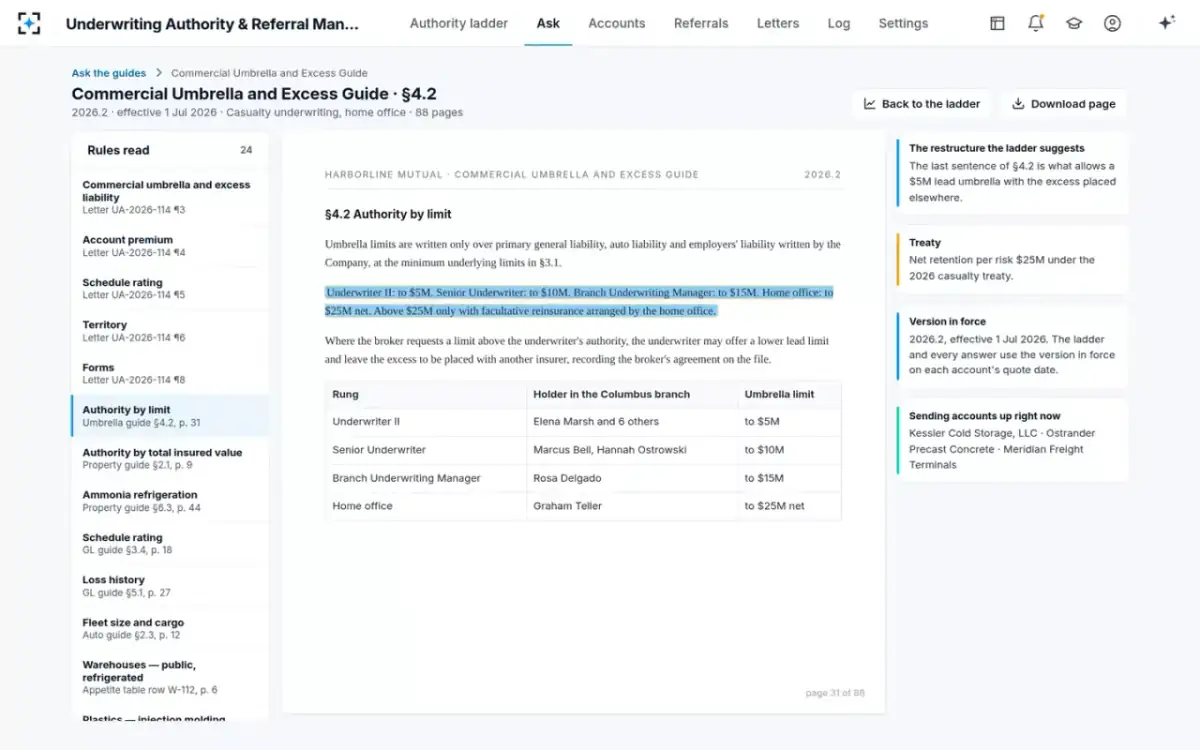
Lead umbrella cut to $5M under guide §4.2, which asks for the broker’s agreement on the file.
Underwriter
Forms filed
Filed forms only, inside the letter’s forms line.
Holds
Application complete and signed
Outside the solution: the signed ACORD application sits in the policy system.
Elsewhere
The two "Underwriter" rows are the kind of evidence the North Carolina findings above were about: documentation that exists only if a person writes it down at the moment of the decision. The solution can quote the guide sentence that allows a restructure and refuse to apply a credit outside the letter's range; it cannot know why this warehouse deserves a 12% credit. That sentence is the underwriter's, and the file is defensible only when it is there.
The guide page behind a decision in Underwriting Authority & Referral Management
How do you prepare underwriting files for an exam? Run the sample first
Prepare for an exam by running it on yourself: draw a random sample of fifty files per line from the exam period, test each against this checklist with the letter and guide versions of its date, and count errors by type against the state's tolerances. If the count is above 10% on any line, the examiner will likely find the same.
Three habits make that rehearsal cheap. Keep the authority check with the file, so re-performing it is a lookup, not a reconstruction. Keep every version of every rule with its effective date. And track findings by rule rather than by underwriter, because a rule that is broken often is usually a rule that is unclear. The sign-off fields that make a file re-performable are set out in underwriter sign off; the solution's own audit view is at Underwriting Authority & Referral Management.
Questions people ask
How many files does a market conduct exam sample?
Often fifty per line of business, drawn at random from the exam period, though small populations may be reviewed in full. A 2020 North Carolina exam drew 150 policies from 5,764 across three commercial lines; a 2022 exam reviewed all 27 files in one small population and 50 of 118 in another.
What is the error tolerance in a market conduct exam?
It is set by each state and stated in the report. North Carolina's 2022 report applied 0% for unappointed or unlicensed producers and for unfiled forms or rates, and 10% for all other areas. Errors below the tolerance drew a reminder rather than a violation.
What is the difference between an underwriting audit and a premium audit?
An underwriting audit tests whether the decision to write the risk, and its pricing, followed the carrier's rules. A premium audit, after the policy year, verifies the exposure the premium was based on, such as payroll or sales. Both feed the examiners' standards, but they test different documents.
Does a schedule credit need documentation at renewal?
If it changes, yes. Florida requires the modification to remain in effect for renewals and, if the insurer changes it, documentation that justifies the change, kept for five years. Utah lets an unchanged worksheet be reused only with a current date and signature.
What is an underwriting audit template?
It is a checklist like the one at the top of this page, arranged as columns an auditor fills per sampled file: the rule tested, the version in force, the evidence found, pass or fail, and the finding. The most useful templates score each rule separately, so findings can be traced back to unclear guides as well as to people.