Underwriting authority levels are the tiers of signing power a carrier grants its underwriters in writing, usually in a personal letter of authority: the largest limit, total insured value, account premium and schedule-rating range each person may sign, and the classes, states and hazards they may write at all. A commercial account that sits inside every line of an underwriter's letter can be quoted the same day; one that breaks a single line climbs to the next rung, typically a senior underwriter, then a branch underwriting manager, then the home office. The ladder is simple. Reading it is not, because a letter, several line guides and each quarter's bulletins together decide where an account lands. Botminds' Underwriting Authority & Referral Management reads the submission and the letters, places each account on the rung that can sign it, and leaves every signature with a person.
The examples on this page come from a fictional sample branch as it runs through the solution: the Columbus branch of an invented carrier, Harborline Mutual, with 23 signed letters and four rungs. Every name, account and figure describing that branch is sample data. The rules and research come from regulators and are linked where they appear.
One commercial account, five seats: what each signature attests
Today
Reads her own letter and four line guides by hand to learn whose signature a package account needs, then tells the broker.
With agents
Sees the account on its rung with the letter paragraph behind it, and the smallest change that keeps it on her own rung.
Still theirs: Her signature, and the attestation that every fact on the account sits inside her letter.
Today
Opens referrals that arrive as forwarded email, re-reads the submission, and finds some never needed his rung.
With agents
Gets only accounts that need his rung, each with the rule quoted and the facts as read from the submission.
Still theirs: Approving, declining or changing terms above the underwriter’s letter.
Today
Signs letters of authority without seeing how often each line is hit or ignored.
With agents
Sees every letter in force, who holds each rung today, the bulletins that changed a rule and the letters due for renewal.
Still theirs: Writing and signing the letters, and naming delegates with dates.
Today
Receives the largest and least familiar accounts last, often after the quote date.
With agents
Receives them with the trigger named, the other facts checked, and the date the quote is due.
Still theirs: The top of the ladder: limits above the branch, classes and states outside the region.
Today
Pulls a sample of files and reconstructs who approved each variance, under which version of the guide.
With agents
Reads each check with the letter and guide versions in force, and draws the sample from the full log.
Still theirs: Judging whether the file holds up, and reporting the findings.
What are underwriting authority levels? The rungs of one letter, line by line
Underwriting authority levels are a ladder of dimensions, not a single dollar figure. A commercial letter typically caps several things at once, and an account needs the rung whose letter covers its highest value on every one of them. A $4 million umbrella on a class outside an underwriter's appetite tiers needs whoever may write that tier, however small the limit.
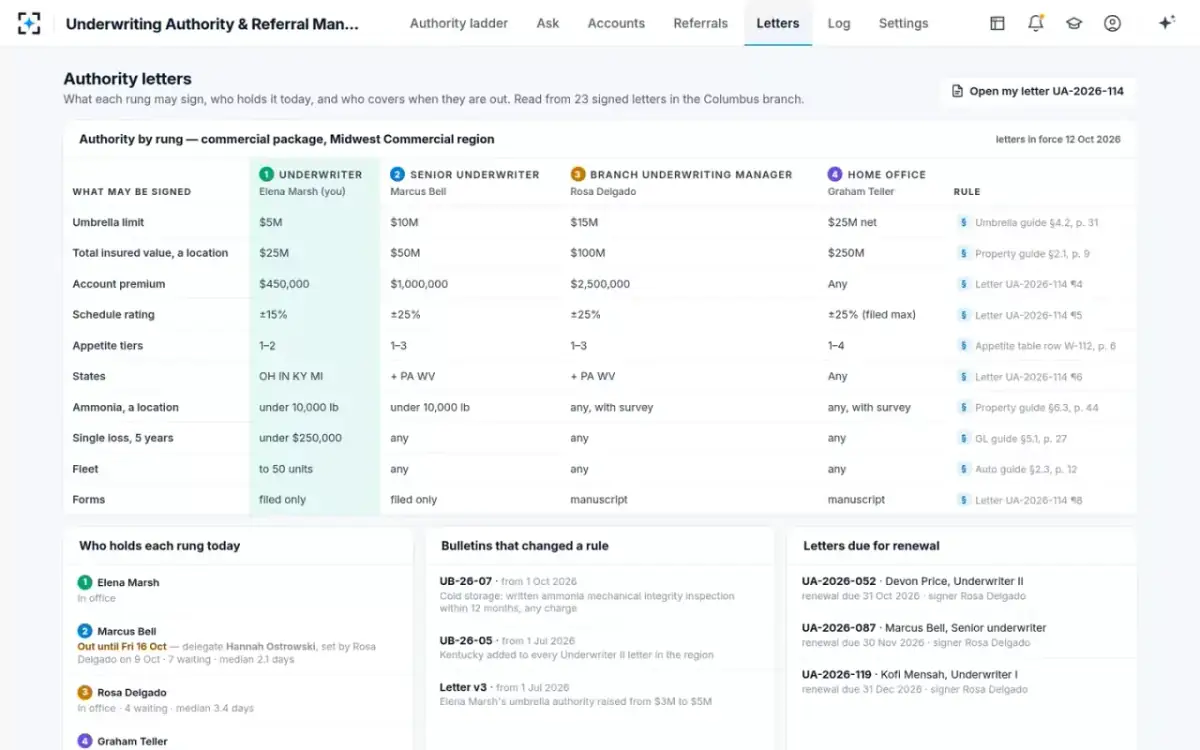
The sample branch's letters cap ten dimensions. Read across a row and the ladder widens; read down a column and you have one person's letter.
A four-rung commercial ladder: what each rung may sign
| What may be signed | Underwriter | Senior underwriter | Branch underwriting manager | Home office |
|---|---|---|---|---|
| Umbrella limit | $5M | $10M | $15M | $25M net |
| Total insured value, one location | $25M | $50M | $100M | $250M |
| Account premium | $450,000 | $1,000,000 | $2,500,000 | Any |
| Schedule rating | ±15% | ±25% | ±25% | ±25% (filed maximum) |
| Appetite tiers | 1–2 | 1–3 | 1–3 | 1–4 |
| States | OH, IN, KY, MI | adds PA, WV | adds PA, WV | Any |
| Anhydrous ammonia, one location | under 10,000 lb | under 10,000 lb | any, with a loss-control survey | any, with a survey |
| Largest single loss, five years | under $250,000 | any | any | any |
| Auto fleet | to 50 units | any | any | any |
| Forms | filed only | filed only | manuscript | manuscript |
Two things in that table are easy to miss. The underwriter's schedule-rating range, ±15%, is narrower than the ±25% the carrier filed, so a credit that is perfectly lawful can still be above her authority. And the ammonia row is a hazard trigger, not a size trigger: a small account with a large ammonia charge climbs as surely as a large one. Why letters cap these particular things is a question of its own, answered in why authority limits are established.
What does underwriting authority mean? A promise about who has read what
Underwriting authority means the written right to commit the carrier to a risk on stated terms. Each rung is also a promise: whoever signs at that level attests that the account's facts fall inside their letter, under the guides in force on the quote date. The signature is the evidence that a qualified person took the decision, which is why the rung matters more than the title on the email.
International supervisors write the expectation in general terms. The International Association of Insurance Supervisors says an effective internal control system typically includes "up-to-date policies regarding who can sign for or commit the insurer, and for what amounts", with controls to match. A commercial letter of authority is exactly that policy, written for one person.
What are the underwriting authorization levels?
NAIC Financial Condition Examiners Handbook 2026, Exhibit Y, sample interview questions for underwriting
That question sits in the risk section of the NAIC's sample interview questions for underwriting, which financial examiners put to a carrier's underwriters, next to questions on written guidelines and the underwriting committee. A head of underwriting should be able to answer it with a document, not a description.
What each rung signs, and what it never signs
Each rung signs the accounts its letter covers and refers the rest; none signs below another's trigger. In practice the chain has five links, and only four of them sign before the quote leaves.
The underwriter signs what is inside every line of her letter and attests that she checked each one. The senior underwriter signs what breaks the underwriter's letter but not his own, and attests to the one or two lines that sent the account up, as well as to the rest. The branch underwriting manager signs larger accounts and the hazards the letters reserve to her, and she also signs the letters themselves, which makes her the person who decides what the rungs below may do. The home office takes what the branch may not: the largest limits, the least familiar classes and states outside the region. The auditor signs nothing on the account; she tests afterwards whether the right person signed.
Two failure modes break the chain. A risk signed one rung too low is a decision taken without authority. A risk referred one rung too high is a decision that waits for nobody's benefit, and a queue that grows at the rungs with the fewest people.
Each rung up adds days: the sample branch's queues
0days
on the underwriter’s own rung: she signs it herself
2.1days
median answer at the senior underwriter’s rung, 7 waiting
3.4days
median answer from the branch underwriting manager, 4 waiting
6days
median answer from the home office, 11 waiting
What is the difference between Underwriter I and II? The title, and the letter
Underwriter I and II are job grades; the letter of authority is what decides what each may sign. Grades usually track experience, and higher grades usually carry wider letters, but the letter is the operative document. The federal occupational guide describes the path in one line: "Experienced underwriters may advance to become senior underwriters or underwriter managers."
The sample carrier ties grades to limits in its guides as well as its letters. Its umbrella guide, §4.2, reads: "Underwriter II: to $5M. Senior Underwriter: to $10M. Branch Underwriting Manager: to $15M. Home office: to $25M net." Seven Underwriter IIs in the branch hold that $5 million line. One of them, Elena Marsh, held $3 million until her letter's third version took effect on 1 July 2026. Her title did not change that day; her authority did. An auditor reading a file from June and one from August has to know which version applied, which is why the version number belongs on the file and not only in a drawer.
Underwriting Authority & Referral Management reads every letter into one matrix
What happens if an underwriter exceeds their authority?
If an underwriter exceeds their authority, the carrier holds a risk that nobody with the right to accept it accepted, and the first question is whether the rung holder will ratify the terms, change them at renewal or unwind them. The second question belongs to the examiner, who treats it as a control failure rather than a style choice.
The NAIC's 2026 Financial Condition Examiners Handbook lists the risk in plain words, "Policies are issued that do not comply with underwriting and pricing guidelines", and suggests a detail test: "Test a sample of new policies underwritten to determine whether the final underwriting decision (including any deviations from accepted guidelines) was made by someone at an appropriate authority level." On the market conduct side, the NAIC's file-review standards ask whether credits and deviations are applied consistently and "if the reasons for use of credits and deviations are documented."
A letter should say what happens next, because the cases are not alike. A schedule credit two points above the underwriter's range on a sound account is a ratification and a training note. A location in a state outside the region is a coverage and licensing question. A hazard the letter reserves to the branch manager may need a survey the account never had. The auditor's report will ask which of these it was; the file should already say. What examiners test in a commercial file walks through the full list.
Can underwriting authority be delegated when the holder is out?
Yes, if the letter's signer names the delegate in writing, with dates. A delegate set informally, by an out-of-office reply or a colleague's goodwill, leaves the file with a signature nobody authorised. The delegate signs under the absent holder's rung, not their own.
In the sample branch, the senior underwriter Marcus Bell is out until Friday 16 October. His delegate, Hannah Ostrowski, was set by the branch underwriting manager, Rosa Delgado, on 9 October, and referrals route to her automatically. She already has seven waiting and a median answer of 2.1 days. On the Kessler Cold Storage account, a public refrigerated warehouse quoted for Thursday 15 October, that queue means the answer would come the day after the quote is due. Knowing that on Monday morning, rather than on Thursday afternoon, is the difference between restructuring the account and missing it.
One account placed on its rung: who prepares, who decides
Agent
Submission readerReads the 34 pages of the Kessler submission and writes down the 11 facts the letters test, each with its page.
Never: guesses a fact the submission does not state; the account refers instead
Agent
Guide readerReads the letters, line guides and bulletins in force on 15 October into rules, each tied to its page and version.
Never: applies a bulletin before its effective date
Agent
Authority checkerTests each fact against the underwriter’s letter: ten sit on her rung; the $10M umbrella climbs to rung 2.
Never: approves anything, or places a risk below its highest trigger
A person decides
The underwriter decidesRefers the account as it stands, or offers a $5M lead umbrella with the excess placed elsewhere, as the guide allows, and signs it herself.
A person decides
The rung holder decidesIf referred, the senior underwriter or his named delegate approves, declines or changes terms.
How often is underwriting authority reviewed?
Authority should be reviewed on two clocks: the person's, when a letter is renewed or an underwriter's experience grows, and the rule's, whenever a bulletin changes what a rung may do. The first runs on the letter's renewal date; the second can fall in any week of the year. Both change who may sign tomorrow's account.
The sample branch shows both. Three letters are due for renewal before the year ends, the first on 31 October. Meanwhile bulletin UB-26-05, effective 1 July 2026, added Kentucky to every Underwriter II letter in the region without anyone re-signing a letter, and bulletin UB-26-07, effective 1 October, made a written ammonia mechanical-integrity inspection within 12 months a condition for cold storage at any charge. That twelve-month inspection condition is the sample carrier's own underwriting rule, not a federal one. When it took effect, every account in progress was re-checked overnight; none changed rung.
A letter that is renewed on time but read against last quarter's bulletins is as stale as one that has lapsed. That is why the solution keeps every version of every rule with its effective date, and why a sign-off should record the versions in force alongside the signature.
Underwriting authority levels and agents: where the solution fits on the ladder
Underwriting Authority & Referral Management does the reading the ladder depends on and none of the signing. Six agents read the submission and the letters, test every fact, place the account on the lowest rung that can sign it, suggest the smallest change the guides allow, draft the referral note and log the result with the versions in force. The underwriter signs within her letter; the rung holder or the delegate signs above it.
The design choice that matters most is the direction of error. If the submission does not state a fact the letters test, the account goes up a rung rather than staying on the underwriter's, so an unknown is never mistaken for a pass. The cost is an occasional referral that turns out to be unnecessary; the alternative is a file written outside authority that nobody noticed. Where an account is a single change away from the underwriter's own rung, the solution says so: on the Kessler account, a $5 million lead umbrella re-totalled the premium to $371,300 and brought every fact inside her letter.
The ladder in Underwriting Authority & Referral Management: 11 facts, one trigger
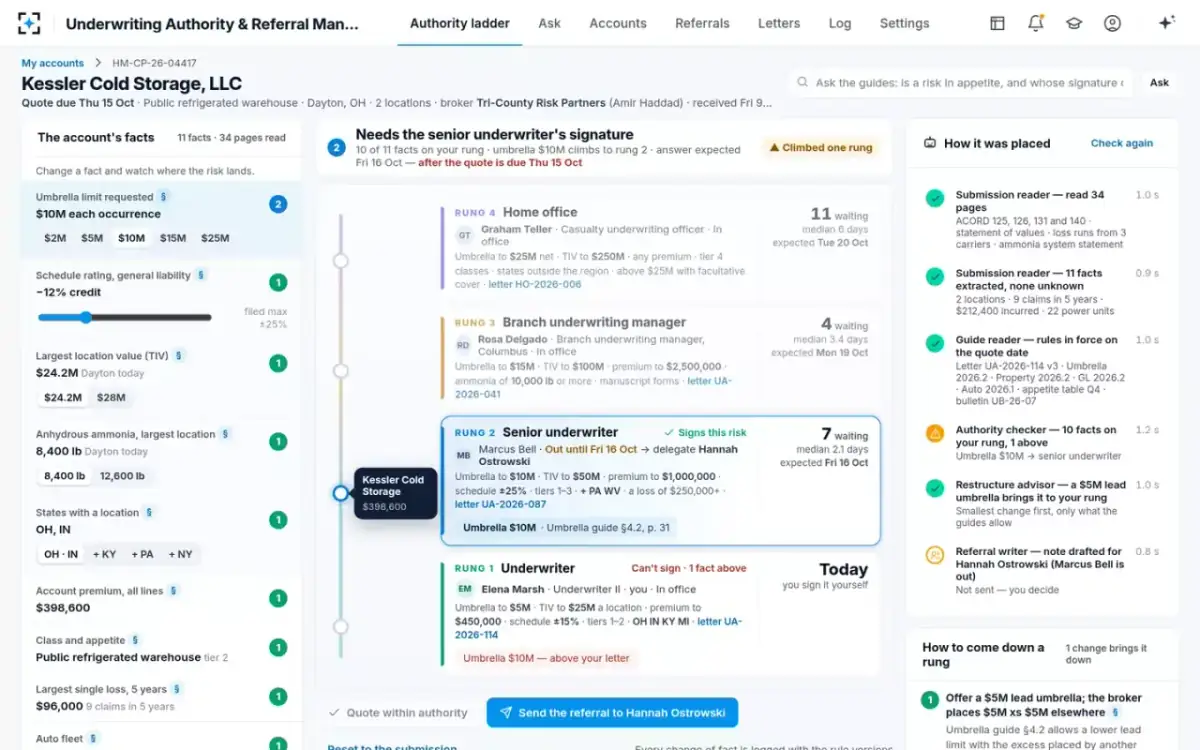
The ladder is only as good as the letters behind it. The page that follows a signature from preparation to the log is underwriter sign off; the solution itself, with every screen, is at Underwriting Authority & Referral Management.
Questions people ask
What is in an underwriting authority letter?
A commercial letter names the holder and its signer, the effective dates and version, and the caps for each dimension: limits, total insured value, account premium, schedule-rating range, appetite tiers, states, named hazards, loss history and forms. Good letters also say who covers when the holder is out and what happens to an account written outside the letter. The sample branch's letters cap ten dimensions across four rungs.
Who sets underwriting authority limits?
The person who signs the letter, usually the branch or regional underwriting manager for the rungs below, within limits the home office and the board have set for the line. Those upper limits rest on the carrier's underwriting policy and its reinsurance: the sample carrier's home-office umbrella authority stops at $25 million net, the same as its treaty retention per risk.
Do underwriting authority levels differ by line of business?
Yes. Each line guide carries its own triggers: the sample carrier's umbrella guide sets limits by rung, its property guide sets total insured value and ammonia thresholds, and its auto guide caps fleet size. A package account can therefore sit on different rungs for different lines, and it needs the highest of them.
Can a broker see an underwriter's authority level?
Usually not in detail. In the solution the broker view is a setting that is off by default; when it is on, brokers see only "in authority" or "referred", never the letter's limits. That keeps the conversation on the account rather than on the underwriter's personal caps.
Is a senior underwriter's approval enough for anything above the underwriter's letter?
Only for what the senior's own letter covers. A location in a state outside the region climbs past the senior to the home office in the sample branch, whatever the limit. That is why the solution places each account on the rung covering its highest trigger, not one rung above the underwriter by default.