Underwriting peer review is a second underwriter reading a sample of another underwriter's files after the decision, to check that each risk was written within the guidelines and the writer's authority and that the judgement behind it holds up. It sits between the underwriter's own sign off and the auditor's later test, and like both exams and audits it usually works from a sample, so most files are read once. That is reasonable when the reading is expensive. It is less so when the mechanical part, testing each file against the letter of authority and the guides in force, can be done on every file. Botminds' Underwriting Authority & Referral Management does that part for every account, so a peer reviewer can spend the second read on the files that carry a reason to be read and on the judgement no written rule captures.
The sampling figures below are our arithmetic, assuming files are drawn at random from a large book. Exam examples come from published state reports; sample-branch examples are fictional data from the solution.
Random second read, full first check, targeted second read: what each catches
An account signed one rung too low
Random peer reviewOnly if it falls in the sample
Every file checked by agentsEvery file, at the moment of the decision
Targeted peer reviewAlready caught; reviewer checks the fix
A credit outside the letter’s range
Random peer reviewOnly if it falls in the sample
Every file checked by agentsEvery file
Targeted peer reviewAlready caught
A credit inside the range with no reason written
Random peer reviewOften, if the reviewer reads the worksheet
Every file checked by agentsFlags a missing reason; cannot judge it
Targeted peer reviewAimed at credits near the edge of the range
A guide sentence misread the same way by many underwriters
Random peer reviewRarely: it looks normal in every file
Every file checked by agentsShows up as a pattern across the log
Targeted peer reviewAimed at the rule, not the person
A sound account priced too low, inside every rule
Random peer reviewYes, if the reviewer is experienced
Every file checked by agentsNo: it breaks no written rule
Targeted peer reviewYes, and with time to read closely
A rule applied in the wrong version
Random peer reviewRarely: the reviewer reads today’s guide
Every file checked by agentsEvery file, by quote date
Targeted peer reviewAlready caught
What is underwriting peer review? A second read, after the decision
Underwriting peer review is a quality check in which an experienced underwriter, not the one who wrote the file, reads it after it is written and records whether the risk selection, pricing, documentation and authority hold up. It differs from a referral, which happens before the decision and asks permission, and from an audit, which is independent of the underwriting line.
Financial examiners list it among the controls a carrier may have over underwriting. The NAIC's 2026 handbook describes a possible control in which "The insurer has established a QA process to review new policies underwritten for compliance with underwriting guidelines on a sample basis." The matching test is to "Re-perform, on a sample basis, testing of policies reviewed by the QA function for proper implementation of the insurer’s underwriting guidelines." Examiners, in other words, review the reviewers.
What is the difference between peer review and underwriting audit?
Peer review is done by underwriters for underwriters, close to the decision, and mostly about judgement; underwriting audit is done by an independent function, later, and mostly about compliance with written rules. Both sample, and both should feed what they find back into the guides.
Peer review and underwriting audit, side by side
Underwriting peer review: A senior underwriter or peer from the same line, not the writer.
Underwriting audit: An underwriting auditor or internal audit, independent of the line.
Underwriting peer review: Soon after the decision, often within the month.
Underwriting audit: Quarterly or annually, and before an exam.
Underwriting peer review: Was this a good decision, well documented?
Underwriting audit: Was the decision taken by the right person, under the right rule, and recorded?
Underwriting peer review: Coaching for the writer and notes on unclear guides.
Underwriting audit: Findings, error rates against tolerances, and remediation.
Underwriting peer review: Patterns across hundreds of files it never sees.
Underwriting audit: Judgement inside the rules, which no checklist captures.
Neither replaces the other, and neither replaces the check at the moment of the decision. What examiners test in an audit is set out in the underwriting audit checklist.
How many files should be peer reviewed? What a sample can and cannot find
Peer review enough files to find the problems you care about with a probability you would accept, and know what that number cannot do. A random sample of 50 files from a book where 2% of files carry a given error will contain none of them about 36% of the time. A clean sample is not a clean book.
Chance that a random sample contains no file with the problem
At a 2% error rate, a 50-file sample comes back clean more than a third of the time.
Our arithmetic, for a random sample from a large book
Doubling the sample helps, but slowly: at 100 files the same 2% problem is still missed 13% of the time. The usual answer, more reviewers, runs into cost; the better one is to stop relying on the sample to find what a check of every file can find, and to spend the sample on what only a person can judge.
What the exam sample teaches peer reviewers
State examiners face the same arithmetic and accept it. A 2020 North Carolina examination of a commercial carrier drew 50 of 2,864 workers' compensation policies, under 2% of them (our arithmetic): "Fifty policies were randomly selected for review." The department cites a violation only when the sample's error rate exceeds its tolerance, 10% for most areas, and sends a reminder below it.
Near the tolerance, that is close to a coin toss. If the true error rate in a book is 12%, a 50-file sample will show 10% or less about 44% of the time; if the true rate is 8%, the sample will show more than 10% about 21% of the time (our binomial arithmetic). A carrier that wants to know where it stands should not wait for the exam's draw. It should know its own error rates by rule, from every file, and use peer review to understand the errors rather than to count them.
What do peer reviewers look for?
Peer reviewers look for the things a written rule cannot settle: whether the risk was a good one, whether the price was adequate for it, whether credits match evidence, and whether the file would make sense to someone who never spoke to the broker. Mechanical checks still belong on the list, but once they are done for every file, the reviewer can confirm them in seconds.
A commercial peer review, judgement first
- Would I have written this risk?
Class, hazards, management and loss history read together, not rule by rule.
- Is the price adequate for the exposure?
Premium against similar accounts, and against the loss picks in the file.
- Does each credit match evidence in the file?
Inspection, safety programme or loss-control report behind every characteristic credited.
- Are the terms and forms right for the risk?
Filed forms, endorsements and any restructure the guide allowed.
- Was the information gathered at inception?
Facts from the submission and inspections, not learned later.
- Could a stranger follow the file?
The rule behind each decision named, and the referral note readable without a phone call.
- Was the authority check clean?
Confirm the rung and versions from the log rather than re-deriving them.
How do you choose files for peer review? Aim the second read
Choose files for peer review by reason first and chance second: once every file has been checked against the letter, the log shows which ones sit closest to a limit, changed rung, or relied on a delegate, and those are the files a second reader should see. Keep a small random sample alongside, so the targeted list itself can be tested.
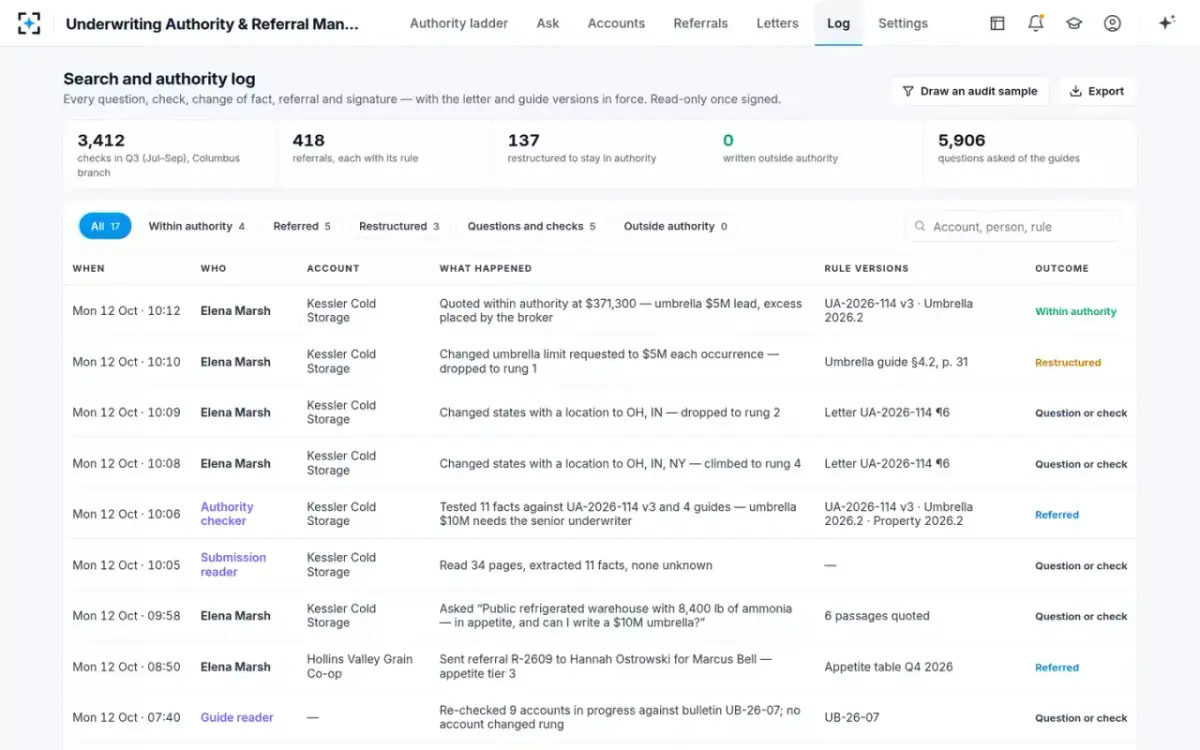
Six reasons are worth a standing place on the list. Credits within two points of the edge of the writer's range. Referrals approved by a delegate rather than the rung holder. Accounts restructured to stay in authority, because a restructure is a decision too. Accounts whose rung changed when a bulletin took effect. Facts that were unknown in the submission and later supplied. And the largest premiums of the month, because the size of a mistake matters. In the sample branch's third quarter, 137 accounts were restructured to stay in authority and 418 were referred, each with its rule; a reviewer can filter either group in seconds.
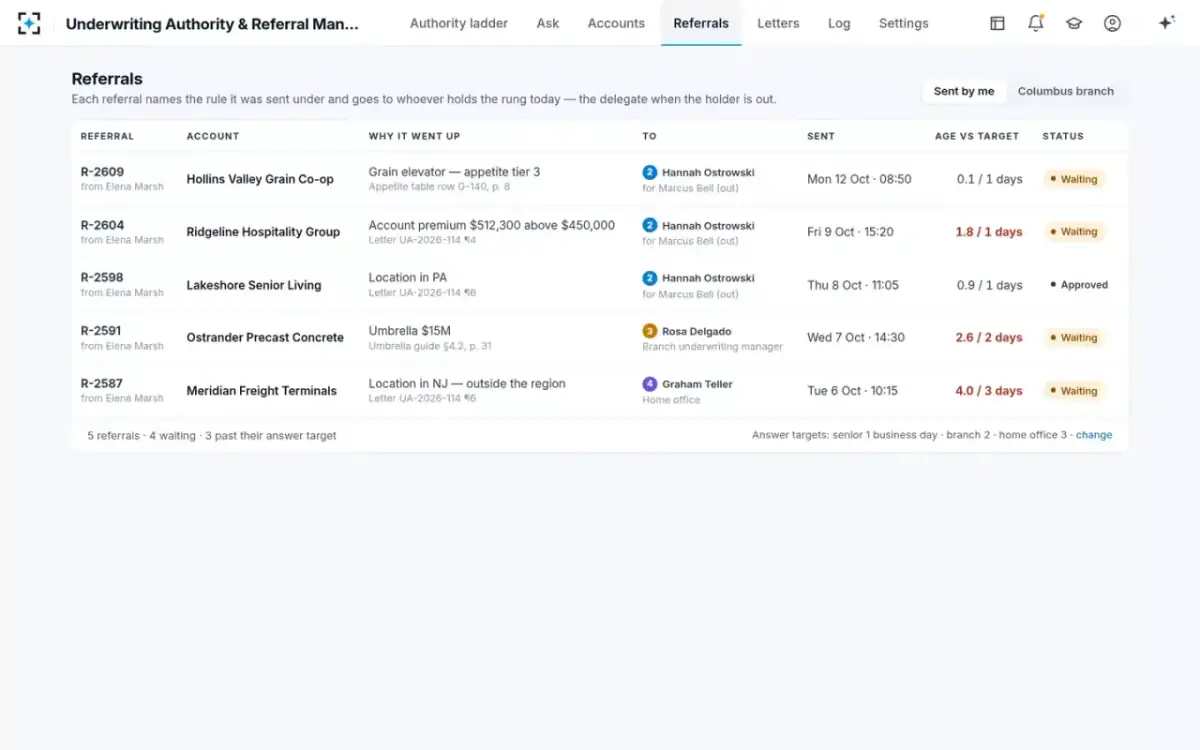
Applied to one underwriter's fortnight in the sample branch, the list is short and specific. Of Elena Marsh's five referrals since 1 October, one, a senior-living account with a Pennsylvania location, was approved by Hannah Ostrowski as delegate while the rung holder was out: it goes on the list. The Kessler Cold Storage account was restructured from a $10 million umbrella to a $5 million lead to stay on her rung: it goes on the list, with the guide sentence that allowed it. Its general-liability credit of −12% sits three points inside her ±15% range, so a two-point rule leaves it off. The nine accounts re-checked when bulletin UB-26-07 took effect did not change rung, so none is listed for that reason. Two or three files, each with a stated reason, replace a random draw that would most likely have missed all of them.
Underwriting Authority & Referral Management: the log a peer reviewer filters
Is underwriting peer review required by regulators?
Not by that name in the sources we reviewed; regulators require a working system of internal controls and test whatever review the carrier says it has. The NAIC's financial examiners list a sample-based QA process as one possible control and re-perform it. International supervisors expect periodic testing "(carried out by objective parties such as an internal or external auditor)" of whether the controls work.
One state goes further for schedule rating and requires a population view rather than a sample. Florida's rule on subjective rating plans requires an insurer, for each policy year and line, to determine the loss ratio of policies that received a debit, of those that received a credit, and of those that received neither, and provides that a plan which "does not bear a reasonable relationship among loss ratios for the debit group, the credit group, and the non-debit/credit group shall be deemed unfairly discriminatory." That is peer review of underwriters' judgement, done by the numbers across the whole book.
How do you track peer review findings? By rule, not only by person
Track peer review findings against the rule they concern as well as the underwriter who wrote the file, and send the rule findings to whoever owns the guide. A finding that recurs across many underwriters usually means a guide sentence that reads two ways, and coaching one person at a time will not fix it.
A log that ties every decision to the rule and version behind it makes that grouping cheap. When a reviewer marks a file, the finding attaches to the same rule the authority check cited, and a quarter later the rules with the most findings are a list the guide owner can act on. The replay approach in piloting an underwriting rules engine uses the same idea on closed files; the solution itself is at Underwriting Authority & Referral Management.
Underwriting Authority & Referral Management lists each referral with its rule
Questions people ask
Who does underwriting peer reviews?
Usually senior underwriters or underwriting managers from the same line, reviewing files they did not write, sometimes with a quality team setting the sample. The reviewer should hold at least the authority level of the file under review, so they can judge the decision as well as the paperwork.
How often should underwriting peer review happen?
Often enough that findings reach the writer while the account is still familiar, which argues for a monthly rhythm rather than a quarterly one. Audits run less often; a peer review that waits for the audit cycle loses its coaching value.
Should new underwriters have more files peer reviewed?
Yes, as a matter of proportion: the probability of an error is higher and the coaching value greatest. A new underwriter's letter is usually narrower too, so more of their accounts will be referred, and the referral notes are themselves worth a reviewer's time.
Can software do underwriting peer review?
Software can do the mechanical part of a review on every file: authority, versions, ranges, missing facts. It cannot judge whether a sound-looking account was a good risk at the price, which is the part of peer review that needs an experienced underwriter.
Is peer review the same as a second signature?
No. A second signature, through a referral, happens before the decision and is needed because the account is above the writer's letter. Peer review happens after the decision, on files the writer was entitled to sign, and asks whether the decision was a good one. A file can need both: a referral approved by a delegate is one of the first a reviewer should read.
What sample size does a state exam use?
Commonly 50 files per line, or every file in a small population. In the North Carolina example on this page, that was 50 of 2,864 workers' compensation policies, under 2% of the book.