An underwriting rules engine is software that applies a carrier's written underwriting rules, authority limits, appetite tiers and referral triggers, to each submission and returns a verdict: within the underwriter's authority, refer to a named rung, or decline. Before trusting one with authority, replay last quarter's closed submissions through it and compare its verdicts with what your underwriters actually did. Every referral it would have missed, every referral it would have added and every rule it could not find is visible on closed files, where a mistake costs nothing. Botminds' Underwriting Authority & Referral Management is piloted exactly that way: its agents read your letters of authority, guides and bulletins as they stood on each quote date, test the quarter's submissions, and leave every disagreement for an underwriter and an auditor to settle.
The examples on this page use the solution's fictional sample branch and accounts; every figure about them is sample data. Supervisory texts are linked where they appear. The pilot length is a target, not a measured result.
A four-week pilot on one closed quarter, by workstream
- Load the rules by versionWeek 1
- Replay the quarterWeek 2
- Explain disputed verdicts from their citationsWeeks 3–4
- Pull referral log and filesWeek 1
- Pick test casesWeek 2
- Settle each disagreementWeek 3
- Decide: go, fix or stopWeek 4
What is an underwriting rules engine? Rules written by people, run by software
An underwriting rules engine is a deterministic program: people write the conditions, such as "umbrella above $5 million refers to the senior underwriter", and the engine applies them to each submission's data. It is the oldest kind of automated underwriting. The U.S. Government Accountability Office describes that first wave of AI as "expert or rules-based systems, whereby a computer was programmed based on expert knowledge or criteria and produced outputs consistent with its programming."
The definition has regulatory weight. The EU AI Act says its definition of an AI system "should not cover systems that are based on the rules defined solely by natural persons to automatically execute operations." A pure rules engine may therefore sit outside that law's definition of AI, while a system that reads guides and infers which rule applies sits inside it. Neither escapes testing: European insurance supervisors note that sectoral rules require proportionate governance for mathematical models whether or not they count as AI systems (EIOPA opinion, 2025).
What is the difference between a rules engine and AI agents reading the guides?
A rules engine applies conditions someone has already transcribed from the guides; agents read the letters, guides and bulletins themselves and cite the passage behind each verdict. The difference shows up when a bulletin arrives on a Friday, when a letter is renewed with one changed line, and when an auditor asks where a rule came from.
Two ways to automate authority checks, row by row
Rules engine: A business analyst transcribes each guide rule into conditions; the guide and the code can drift apart.
Agents reading the letters and guides: Each signed letter, line guide, appetite table and bulletin is read into rules tied to its page, version and effective date.
Rules engine: Waits for the next release of the rule set.
Agents reading the letters and guides: Read when it arrives, shown but not applied until its effective date, then applied and re-checked across open accounts.
Rules engine: Names the condition that fired.
Agents reading the letters and guides: Quotes the guide sentence or letter paragraph, and opens the page with the passage highlighted.
Rules engine: Often a blank field that fails no condition, so it passes.
Agents reading the letters and guides: Treated as unknown: the account refers up a rung until the fact is known.
Rules engine: A transcription error or a stale rule, applied consistently to every file.
Agents reading the letters and guides: A misread passage; which is why each verdict carries its citation for a person to check.
Rules engine: The engine may be allowed to approve within limits.
Agents reading the letters and guides: Agents never approve; the underwriter or the rung holder signs.
Why pilot on last quarter's referrals instead of a demo?
A demo shows what an engine does on accounts chosen to work; a replay on your closed quarter shows what it does on your letters, your guides' quirks and your underwriters' real decisions, and every disagreement can be checked against a signed file. It is also the kind of evidence supervisors describe. The NAIC's AI bulletin lists, among the ways to validate, comparing a model's results on data held back during development with its results after go-live, and measuring them against expert review (NAIC model bulletin; the driving risk score guide quotes it). A replay against the referrals your underwriters actually made is measurement against expert review.
New York's guidance on AI in underwriting and pricing asks insurers to "promote independent review and effective challenge" of validation and testing. A replay builds that in: the people who settle disagreements in week 3 are an underwriter who did not set up the engine and an auditor who answers to neither. The replay also audits the past. Where the engine refers an account your underwriter signed, either the engine misread a rule or the file was written outside authority, and both are findings worth having before an examiner's sample does the same; underwriting peer review covers what a sample can and cannot catch.
What data do you need to pilot underwriting rules?
To pilot underwriting rules you need the rules as they stood, the submissions as they arrived, and the decisions as they were signed, for the same quarter. Most carriers hold all three; the work is finding the versions.
What a replay pilot needs from the carrier
- Every letter of authority in force during the quarter
Including earlier versions where a letter changed mid-quarter, with signer and dates.
- Line guides and the appetite table, by version
The editions in force on each quote date, not today’s.
- The quarter’s bulletins and memos
Each with its effective date, so none is applied early.
- Closed submissions
ACORD forms, statements of values, loss runs and supplementals as received; a few hundred accounts is enough for one line.
- The referral log
Which accounts went up, to whom, under which rule, and the answer.
- Signed quotes and declines
The decisions the replay is compared against, with who signed.
- Last audit’s findings
Known problem files make good test cases; the engine should catch them.
How do you measure a rules engine? Six numbers from the replay
Measure a rules engine against your signed files with a handful of counts, and weight the misses most heavily: a referral the engine fails to raise is a file written outside authority, while an extra referral is a delay. Settle every disagreement before counting, because some will turn out to be your files' errors, not the engine's.
What to count in a replay, and the bar to clear
| Measure | How it is counted | Bar to clear |
|---|---|---|
| Missed referrals | Accounts that needed a higher rung, after settlement, that the engine placed on the underwriter’s own rung | Zero; each one is studied |
| Extra referrals | Accounts the engine sent up that, after settlement, the underwriter could sign | Low, and each traced to an unclear rule or an unknown fact |
| Rung agreement | Accounts placed on the same rung the signed file shows, after settlement | High enough that disagreements are worth reading one by one |
| Citation accuracy | Verdicts whose cited passage, opened, actually says what the verdict claims | Every sampled citation holds |
| Version accuracy | Rules applied in the version in force on each quote date; bulletins never before their effective date | No exceptions |
| Files found wrong | Signed files the replay shows were outside authority | Reported to audit, not counted against the engine |
Scale matters for reading these numbers. The sample branch logged 3,412 authority checks and 418 referrals in its third quarter. A replay of a quarter that size produces enough disagreements to read in a week, and few enough that each can be settled by people rather than by a statistic. If the engine misses one must-refer account, the right response is to read that file, not to compute a rate.
Four kinds of disagreement, and what each one tells you
Every disagreement between the replay and a signed file falls into one of four kinds, and each points at a different owner. Sorting them is most of week 3, and it is where a pilot earns its keep.
The engine refers; the underwriter signed. Either the engine misread a rule, which is a defect to fix before go-live, or the underwriter wrote outside her letter, which is an audit finding, or the rule changed mid-quarter and one side used the wrong version. The citation settles which: open the passage the engine quoted and the version in force on the quote date. The engine places the account on the underwriter's rung; the file was referred. Often the underwriter referred for comfort rather than authority. That is a cost finding, and a sign that a guide sentence is unclear; it may also be a judgement call she was right to share, in which case the carrier should record it as a consultation, not a referral, so the referral count means something. If the engine missed a trigger the letter contains, the pilot stops until the reading is fixed.
The engine refers because a fact is unknown; the underwriter knew it. She learned it on a call with the broker and it never reached the file. The engine is right that the file does not support the decision, and the fix is documentation, not software. Both agree on the rung but cite different rules. The decision stands, but the file and the engine disagree about why. For an audit that matters, because the file must show the rule the decision rested on; check which citation is correct and whether the guide states the rule twice.
Can a rules engine read underwriting guidelines?
A traditional rules engine cannot read underwriting guidelines; someone reads them and writes conditions. Agents built on language models can read the guides directly, which removes the transcription step and its lag, but only if every answer is tied to the passage it came from, so a person can check it in seconds.
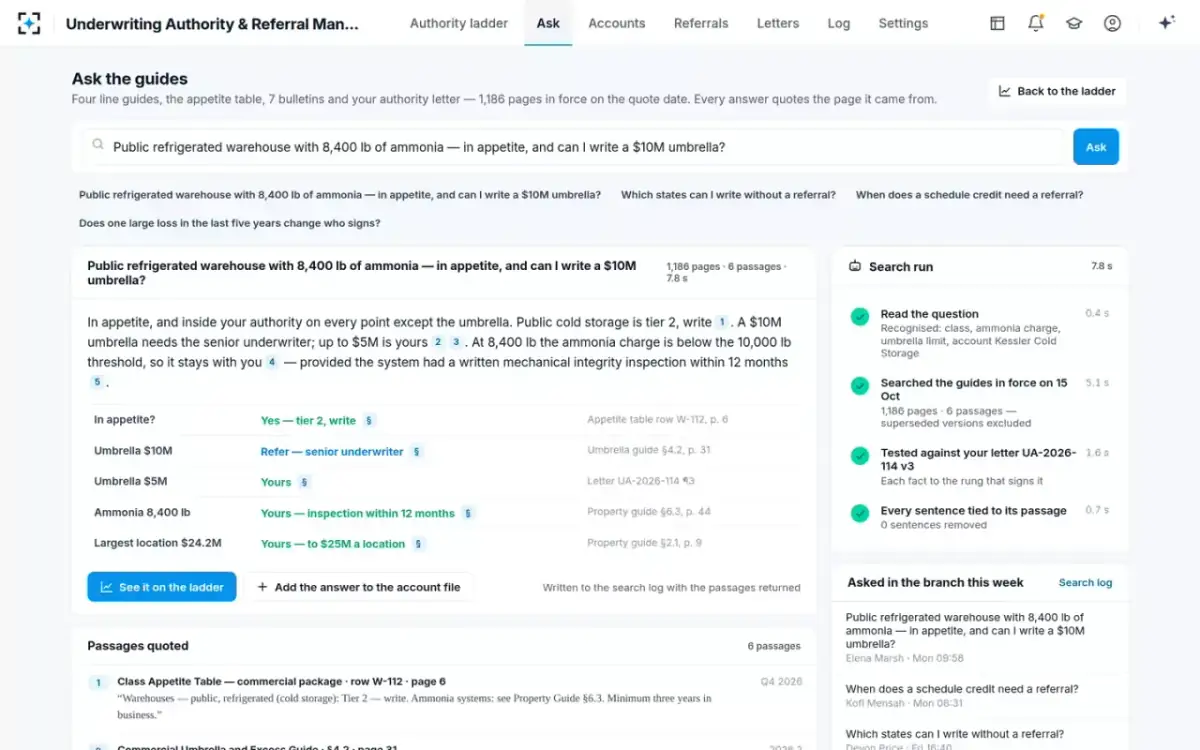
In the solution's sample branch, the guides in force on a quote date run to 1,186 pages: four line guides, the appetite table, seven bulletins and the underwriter's letter. Asked whether a public refrigerated warehouse with 8,400 lb of ammonia is in appetite and whether she may write a $10 million umbrella, the underwriter got an answer in 7.8 seconds on that sample data, quoting six passages: tier 2, write; the $10 million umbrella needs the senior underwriter; 8,400 lb is below the 10,000 lb threshold, provided a written mechanical-integrity inspection is on file within 12 months. That last condition is the sample carrier's own bulletin; the 10,000 lb figure mirrors the federal process-safety threshold for anhydrous ammonia.
Asking the guides in Underwriting Authority & Referral Management, with every passage quoted
Who maintains underwriting rules once the engine is live?
Underwriting rules are maintained by the people who own them in writing: the letter's signer for authority, the guide's owner for appetite and line rules, and the home office for bulletins. IT runs the engine; it should never be the place a limit changes. Supervisors frame this as distance between design and check: an effective control system includes "appropriate distance between those who design a control or operate a control and those who check if such a control is effective in design and operation".
In the solution, the branch underwriting manager sets the rungs and holders, the referral rules and the answer targets; every change is a new version, logged, and applies from its effective date. A letter can be changed only by its signer. That keeps the audit question, who changed this limit and when, answerable from the settings page. How those settings are laid out, rule by rule, is the subject of underwriting automation software.
Where the solution fits in a rules-engine decision, and where it does not
Underwriting Authority & Referral Management fits where the hard part is reading: commercial accounts tested against personal letters, several line guides and a stream of bulletins, with referrals that need a note. It does not rate policies, issue them or replace the rating rules inside a policy administration system, and it never approves. A carrier whose authority is already a short table inside its rating engine, applied to high-volume small accounts, may need no more than that table and a good test of it.
The pilot is the honest way to tell which case you are in. If the replay shows that most referrals come from one or two clean thresholds, a rules engine will serve. If it shows referrals driven by hazards, appetite tiers, states and bulletins spread across hundreds of pages, the reading is the work, and that is what the agents do. Either way, the questions to put to any vendor afterwards are collected in underwriting workflow management: 12 questions, and the solution itself is at Underwriting Authority & Referral Management.
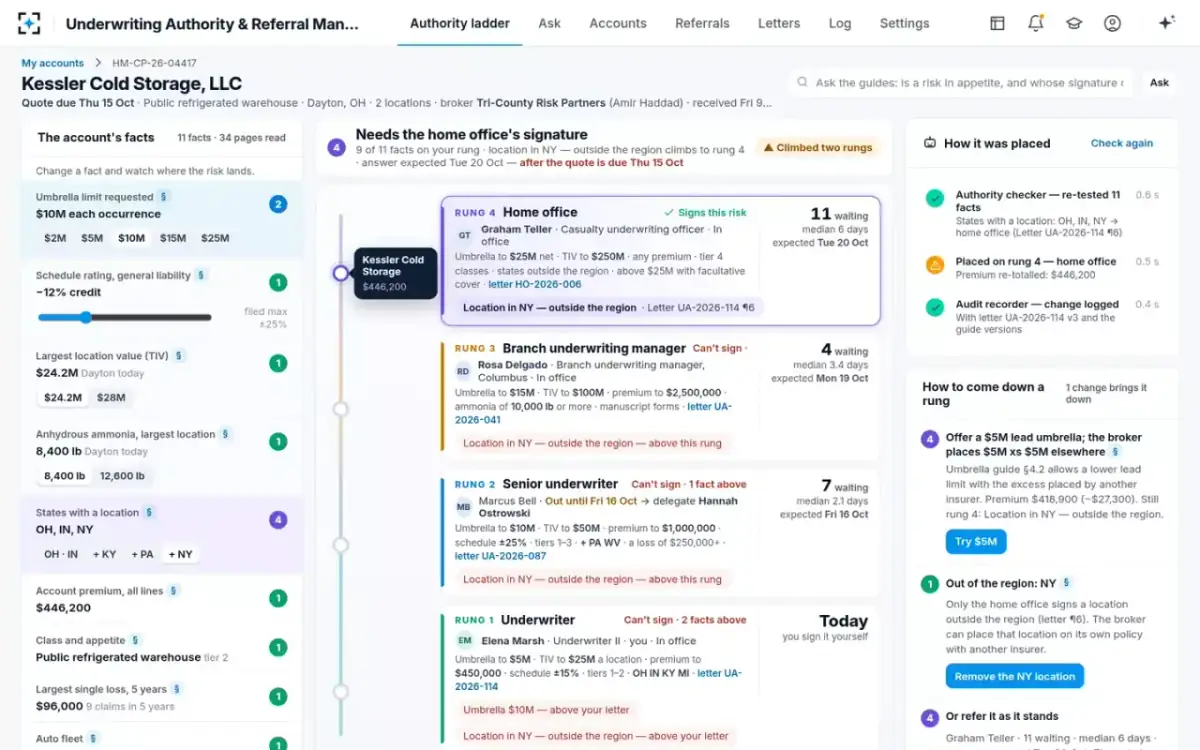
Replaying a change of fact in Underwriting Authority & Referral Management
Questions people ask
How long does an underwriting rules engine pilot take?
Our target is four weeks for one line in one branch: a week to load the rules with their versions, a week to replay the quarter, a week to settle disagreements, and a week to decide. More letters, lines or states mostly lengthen the first and third weeks.
Can a rules engine replace underwriters?
It can replace the reading that tells an underwriter where an account sits, not the judgement about whether to write it. Regulators scale the governance they expect to the extent humans are involved in the final decision, and an engine that approves within limits takes on the controls that would otherwise apply to the underwriter.
What if the pilot shows our past files were wrong?
Report them to underwriting audit, separately from the engine's score. A file the replay shows was written outside authority is a finding the carrier would rather make itself than learn from an examiner's sample.
Do underwriting rules need model validation?
Proportionate testing, yes. European insurance supervisors expect governance for mathematical models whether or not they count as AI, and the NAIC's bulletin describes validation that includes measuring performance against expert review, which is what a replay does.
Is an underwriting rules engine the same as a rating engine?
No. A rating engine calculates premium from filed rates and rating rules. An underwriting rules engine decides whether the account may be written, by whom and on what conditions. Many policy systems contain both; authority checks often live in neither.