Underwriter sign off is the signature that commits a carrier to a risk on stated terms, and with it the signer attests two things: that they hold the authority for this account, and that they checked its facts against their letter of authority and the guides in force. On a commercial desk it is the last step after reading a submission, testing it against limits, choosing between quoting and referring, and writing up the reasons. The same control that keeps the person who prepares a referral from approving it should keep any software that prepares the file from signing it. Botminds' Underwriting Authority & Referral Management is built that way: its agents read, test, place and draft, and only the underwriter, or the rung holder above her, signs.
Examples on this page come from a fictional sample branch of an invented carrier, with invented people and accounts; every figure describing them is sample data. The rules come from supervisors and regulators, linked where they appear.
Maker, checker, signer: what each step may never do
Agent
Maker: the submission readerReads the ACORD forms, statement of values, loss runs and supplementals, and writes down each fact the letters test, with its page.
Never: fills in a fact the submission does not state
Agent
Checker: the authority checkerTests every fact against the underwriter’s own letter and the guides in force on the quote date, and places the account on the rung that can sign it.
Never: approves, or places a risk below its highest trigger
Agent
Maker: the referral writerDrafts the referral note with the rule quoted word for word and the facts filled in, for the underwriter to edit.
Never: sends the note without the underwriter
A person decides
Signer: the underwriterSigns within her letter, edits and sends the referral, or takes the restructure the guide allows.
A person decides
Signer: the rung holder or delegateApproves, declines or changes terms for anything above the underwriter’s letter.
What does underwriter sign off mean? A decision, an attestation and a time
An underwriter sign off means a named person accepted a risk, at a stated time, on stated terms, under a stated authority. It is three things in one act: the decision to bind or quote, the attestation that the decision sits inside the signer's letter, and the moment after which the terms cannot change without a new signature.
That is why "the system approved it" is not a sign off. A routing rule or an extraction model can establish that an account looks within limits; it cannot hold a letter of authority, and so it cannot attest that the account is within its own. The signature is valuable precisely because a person stands behind it and can be asked, later, why.
Why separate the preparer and the approver?
Preparer and approver are separated because the person who assembles a file is the person least able to see what is missing from it, and the most motivated to see it pass. International insurance supervisors write the remedy into their core principles: an effective control system typically includes "sufficient distance between those accountable for a process or policy and those who check if for such a process or policy an appropriate control exists and is being applied".
key decisions should be taken at least by two persons and the practice of double or multiple signatures
IAIS, Insurance Core Principles, ICP 8.2.4 (December 2024)
On a commercial desk the principle shows up as the referral. The underwriter prepares the account and signs what her letter covers; above it, a second person with a wider letter signs. The underwriter who writes a referral never approves it, and a senior who approves it should not be the one who wrote the facts into it. Where two signatures are required, both should rest on the same file, read the same way.
Maker, checker, signer: the four-eyes rule, written for agents
When agents join the desk, the same separation applies to them as roles, not as people. An agent that reads the submission is a maker. An agent that tests the facts against the letter is a checker. Neither is a signer, and the design has to make that impossible rather than merely discouraged.
In Underwriting Authority & Referral Management the separation is in the agents' limits. The authority checker places the risk on a rung but never approves anything. The referral writer drafts the note but never sends it without the underwriter. The restructure advisor finds the smallest change the guides allow but never contacts the broker. The audit recorder writes every question, check, change of fact, referral and signature with the letter and guide versions in force, and entries cannot be edited after signing. Each agent's output is evidence for a person, and the person's signature is what the log records as the decision.
A sign off that attests, and one that only clicks
Sign off as a click: A green tick from a rules screen, or a forwarded email saying the account was fine.
Sign off as an attestation: Every fact with its source page, the rung each one needs, and the rule quoted from the guide.
Sign off as a click: Whatever the guide says today, which may not be what it said on the quote date.
Sign off as an attestation: The letter and guide versions in force on the quote date, saved with the signature.
Sign off as a click: Treated as a pass because nothing flagged them.
Sign off as an attestation: Referred up a rung until the fact is known.
Sign off as a click: Anyone with access to the button.
Sign off as an attestation: Only the holder of the rung, or the delegate the letter’s signer named, with dates.
Sign off as a click: Editable, so the file can be tidied before an audit.
Sign off as an attestation: Read-only; any change of terms needs a new signature, which is logged.
Can AI sign off an underwriting file?
No: an AI system can prepare and check an underwriting file, but it cannot sign one, because sign off attests to an authority that only a person holds. Regulators have not banned automated decisions in commercial underwriting; they have made human involvement one of the things that decides how much governance an automated system needs.
The NAIC's model bulletin on insurers' use of AI, adopted in December 2023, asks each insurer to scale its controls to its own assessment of risk, considering among other factors how far people are involved in the final decision (NAIC model bulletin, factor (iii)). Its risk-management guidance adds that insurers should address "the identification of constraints and controls on automation and design to align and balance function with risk." International supervisors' 2025 paper on AI lists, among the procedures senior management should set up, "Ensuring human oversight provides a robust and objective control".
Read together, those texts make a practical point. A desk where agents prepare and a named person signs keeps the decision where governance frameworks already expect it, with the person's letter as the limit. A desk where software approves within limits is not forbidden, but it has moved the decision into the software, and every control the regulator would apply to the underwriter now applies to the code. For how the EU's rules treat commercial underwriting, see where commercial underwriting stands under the EU AI Act.
What should an underwriting sign off record contain?
An underwriting sign off record should let a stranger rebuild the decision years later: who signed, under which letter version, against which guide versions, on which facts from which documents, with which credits and reasons, and on which terms. Anything less leaves the auditor to reconstruct it from email.
Two state rules show what "enough" means. Utah's rate-modification rule requires the underwriting file to hold, among other things, "the date of the initial and any subsequent evaluation" and "the signature of the individual conducting the evaluation". New York's record-retention regulation requires a policy record to include "other information necessary for reconstructing the solicitation, rating, and underwriting of the contract or policy."
One sign off, field by field: what it records and why
Who signed, on which rung
On the sample accountElena Marsh, Underwriter II, rung 1, under letter UA-2026-114 version 3
Why it is thereTies the decision to a person and to the authority she held that day.
The versions in force
On the sample accountUmbrella, property and general liability guides 2026.2, auto guide 2026.1, appetite table Q4 2026, bulletin UB-26-07
Why it is thereAn auditor in 2028 must read the rules as they stood on the quote date, not as they stand now.
The facts, as read
On the sample account11 facts from 34 submission pages, each with its page and line
Why it is thereShows the decision rested on information developed at inception, from named documents.
Each credit and its reason
On the sample accountGeneral liability schedule credit −12%, inside the ±15% range of her letter
Why it is thereExaminers test whether the reason for each credit is documented, and whether it stays inside the plan’s limits.
What changed, and why
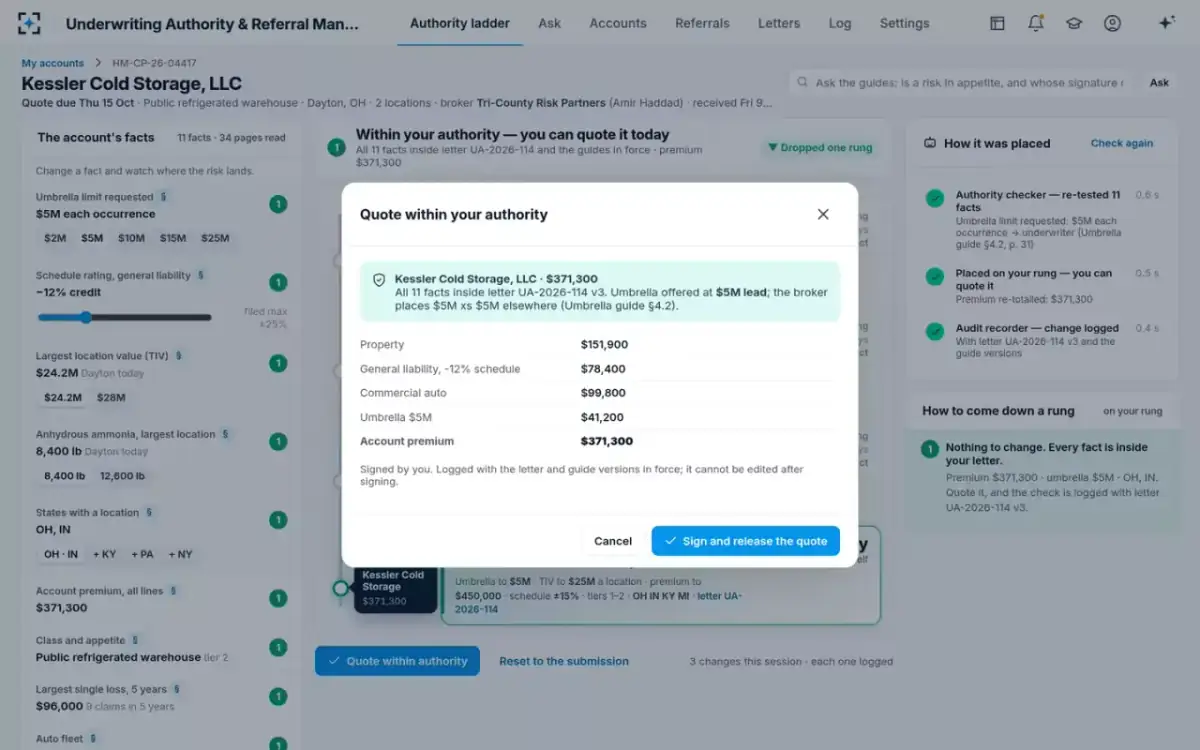
On the sample accountUmbrella reduced from $10M to a $5M lead; excess placed by the broker, as the guide’s §4.2 allows
Why it is thereA restructure is a decision too; the file must show it was the guide’s option, not a workaround.
The terms signed
On the sample accountQuote HM-CP-26-04417, account premium $371,300, released Monday 12 October
Why it is thereThe signature attests to these terms; any later change needs a new one.
Signing in Underwriting Authority & Referral Management: premium, letter, versions
What happens to a sign off when the facts change?
When a fact changes after sign off, the account is re-tested and, if its terms or its rung change, signed again; the old signature attests only to the old facts. A sign off is not a licence for the account; it is a statement about a specific set of facts on a specific date.
Regulators allow reuse only where nothing moved. Utah lets an underwriter reuse a schedule-rating worksheet at renewal: "A previous worksheet may be used when no change in the risk characteristics is indicated and a current date and signature are entered onto the worksheet." The NAIC's market-conduct standards push the timing the other way, testing that decisions rest on "information that reasonably should have been developed at the inception of the policy or during initial underwriting", rather than on information gathered later, through an audit or after a claim.
In the sample branch, every change of fact is a logged event. Add a New York location to the Kessler account and it climbs two rungs to the home office, because New York is outside the region under paragraph 6 of the underwriter's letter; remove it and it drops back. Each move is written to the log with the rule that caused it. Once the quote is signed, the log entry is read-only, so the file shows what was signed, not what someone wished had been.
Automation bias: why the signer must see the rule, not just the verdict
The risk in an agent-assisted sign off is not that the agent signs; it is that the person signs whatever the agent placed. The EU AI Act names the failure for the systems it classes as high-risk, requiring that the people overseeing them be enabled "to remain aware of the possible tendency of automatically relying or over-relying on the output produced by a high-risk AI system (automation bias)". Commercial property and casualty underwriting is not on that list, but the human tendency is the same on any desk.
Design is the remedy. A signer who sees "within authority" learns nothing; a signer who sees the eleven facts, each with its page, the rung each one needs, and the guide sentence quoted, can disagree. That is why the referral writer quotes the rule rather than paraphrasing it, why every citation opens the guide page with the passage highlighted, and why an unknown fact sends the account up a rung rather than letting a gap look like a pass. The person keeps judgement because the evidence is in front of them, not behind a score.
How do you audit underwriting approvals?
You audit underwriting approvals by re-performing them: take a sample of signed files, re-test each against the letter and guides in force on its quote date, and check that the signer held the rung. Where authority levels are enforced in a system, examiners test the system as well as the files.
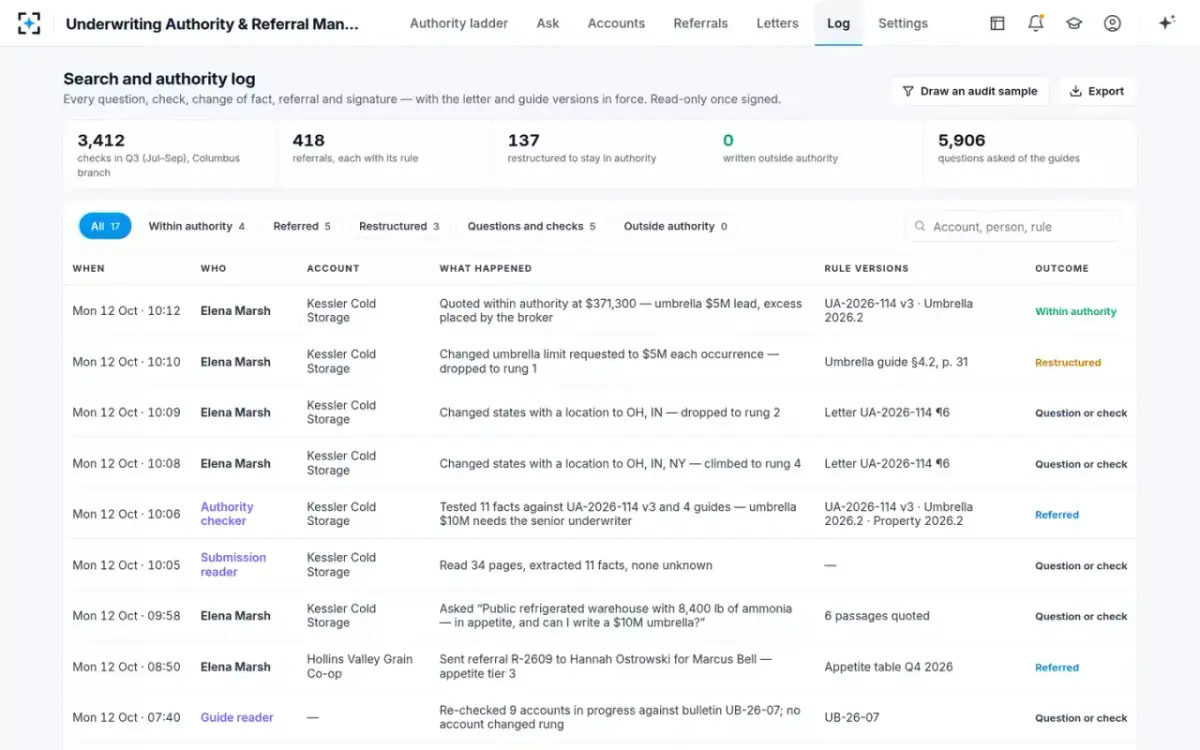
The NAIC's financial examiners describe that test in their 2026 handbook: "Test the operating effectiveness of automated controls (i.e., authority levels) through reperformance and observation." A log that records each check with the versions in force makes re-performance mechanical: the auditor re-runs the check, compares the rung, and reads the signature. In the sample branch's third quarter that log held 3,412 checks and 418 referrals, each with the rule it went up under. The audit side of the same file is laid out in the underwriting audit checklist, and the rungs themselves in underwriting authority levels.
The Underwriting Authority & Referral Management log: every check and signature
To see the chain from the first page of a submission to the signed quote, start from Underwriting Authority & Referral Management.
Questions people ask
Who signs off an underwriting decision?
The underwriter whose letter of authority covers every fact on the account; above that, the holder of the next rung, or the delegate the letter's signer named with dates. In the sample branch an account with a $10 million umbrella needs the senior underwriter, while one with a location outside the region needs the home office whatever its size.
Can an underwriter sign off a referral they wrote?
No. The referral exists because the account is above the writer's letter, so the approval belongs to someone whose letter covers it. If the writer can make the account fit their own letter by a change the guide allows, such as a lower lead limit, they sign the changed account as their own decision, and the file records the change.
Do electronic signatures count on underwriting files?
The NAIC's file-review standard for applications counts them, noting that a complete, signed application "includes electronic signatures". For the underwriter's own approval, what an examiner needs is a named person, a time, the terms and the authority, recorded so it cannot be altered afterwards.
How long must a signed underwriting file be kept?
It depends on the state. New York requires a policy record for six calendar years after the policy is no longer in force, or until the examination report that reviewed it is filed, whichever is longer, and keeps applications that never became policies for six years too. Florida requires schedule-rating documentation to be kept for five years.
What is maker-checker in underwriting?
It is the separation of the person or system that prepares an underwriting file from the one that checks it, and of both from the one who signs. Applied to agents, the reading and drafting agents are makers, the agent that tests the letter is a checker, and only a person with authority signs.