Authority limits are established to cap three risks that a single underwriter's signature can create for a carrier: the size of a mistake, through limits, insured values and premium; the novelty of a risk, through appetite tiers, states and named hazards; and pricing discretion, through a range of schedule credits and debits narrower than the carrier's filed maximum. Each cap routes a decision to someone with the experience, the view of the book and the accountability to take it, and each lets the carrier show supervisors, reinsurers and its own board that its underwriting stays inside the policy they approved. Limits are easy to state and hard to apply, because a commercial account must be read against every line of a personal letter and the guides at once. Botminds' Underwriting Authority & Referral Management does that reading for every account and leaves the signature with a person.
Examples come from the solution's fictional sample branch and carrier; every figure about them is sample data. Rules are quoted from regulators and professional bodies where they appear.
Three risks, and the clause in a letter of authority that caps each
Risk 1
The size of a mistake
What the letter caps
Limit, total insured value per location, account premium
In the sample letter
Umbrella to $5M · $25M per location · premium to $450,000
A mistake costs in proportion to what was written; the cap keeps large exposures with people who see the whole book and the reinsurance behind it.
Risk 2
The unfamiliar risk
What the letter caps
Appetite tiers, states, named hazards, loss history, forms
In the sample letter
Tiers 1–2 · OH, IN, KY, MI · ammonia under 10,000 lb · single loss under $250,000 · filed forms only
An unusual class or hazard is where a writer’s experience is thinnest; the cap sends it to someone who has seen it before.
Risk 3
Pricing discretion
What the letter caps
Schedule-rating credits and debits, inside the filed maximum
In the sample letter
±15% for the underwriter, inside a filed ±25%
Judgement on price is where competitive pressure leaks in; regulators cap it in the filing, carriers cap it again in the letter.
Why are authority limits established? The short answer, and the anchors behind it
Authority limits are established because a carrier's capacity, expertise and pricing freedom are all finite and all regulated, and a signature spends some of each. A limit says how much of each one person may spend alone. Without limits, a carrier's exposure would be the sum of every underwriter's personal judgement, with no point at which a second person looks.
Supervisors expect the limits to exist in writing. International insurance supervisors describe controls on who may commit the insurer as designed "to prevent any major transaction being entered into without appropriate governance review or by anyone lacking the necessary authority and to ensure that borrowing, trading, risk and other such limits are strictly observed." They also expect the responsibilities to be "properly documented, such as in charters, authority tables, governance manuals or other similar governance documents." A letter of authority is the underwriting version of that authority table.
Risk one: the size of a mistake, and the reinsurance behind it
Limits on size exist because an underwriting mistake costs in proportion to what was written, and because the carrier's ability to absorb a large loss depends on reinsurance and capital the individual underwriter does not see. A letter's dollar limits translate the carrier's risk appetite into one person's signing power.
International standards tie the two together. The insurer's underwriting policy should address its "underwriting risk according to the insurer’s risk appetite and risk limits structure" and the "interaction of the underwriting strategy with the insurer’s reinsurance strategy and pricing", and it should include "a process for setting underwriting limits." The NAIC's financial examiners look for the same thing from the other side, listing among possible controls documented risk-exposure limits by state, rating class and line, reviewed and approved by senior management.
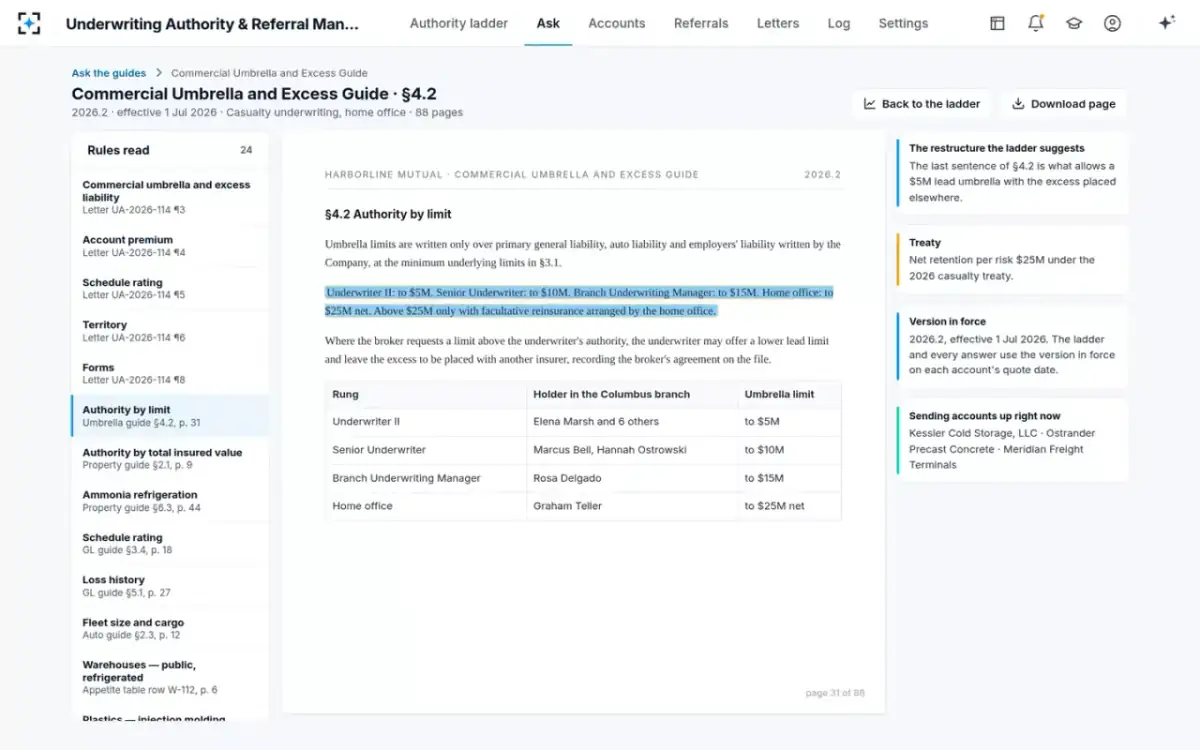
The sample carrier shows the link in one margin note. Its umbrella guide gives the home office authority to $25 million net, and its 2026 casualty treaty retains $25 million per risk. Above $25 million, the guide allows the risk only with facultative reinsurance arranged by the home office. The top of the ladder is where the treaty ends, which is why an underwriter can never be given more than the home office has: the limit is not seniority, it is capacity.
The guide sentence behind a limit, in Underwriting Authority & Referral Management
Risk two: the unfamiliar risk, capped by class, state and hazard
Limits on novelty exist because an underwriter's judgement is weakest where her experience is thinnest: an unusual class, an unfamiliar state's law, a hazard few underwriters see. A small account can need a senior signature if it carries something the junior underwriter has not been trained to judge.
Hazard triggers often borrow an outside threshold. The sample carrier's letters keep anhydrous ammonia under 10,000 lb at a location on the lower rungs and send larger charges to the branch manager with a loss-control survey. The number is not the carrier's invention: it is the threshold quantity for anhydrous ammonia in the federal process-safety standard's list of highly hazardous chemicals, where the table gives "Threshold Quantity in Pounds (Amount necessary to be covered by this standard)". A public refrigerated warehouse with 8,400 lb sits below it; one with 12,600 lb does not, and in the sample branch that single change moves the account to the branch underwriting manager.
States are capped for a different reason. A carrier writes only where it is licensed, and examiners check the certificates of authority for each state, but within its licensed footprint it may still prefer that a regional branch write only its own states. In the sample letters the underwriter may write Ohio, Indiana, Kentucky and Michigan, the senior adds Pennsylvania and West Virginia, and anything outside the region goes to the home office. Loss history, fleet size and manuscript forms work the same way: each is a signal that the account is not the ordinary case. In the sample letter, a single loss of $250,000 or more in five years sends the account up a rung, whatever the premium, because one large loss says more about a risk than a long, quiet history does; a fleet above 50 units does the same under the auto guide's fleet-size rule; and manuscript wording, written for one account rather than filed, belongs to the branch manager and the home office, who can judge what a bespoke clause commits the carrier to.
Risk three: pricing discretion, capped twice
Limits on pricing discretion exist because judgement about price is where competitive pressure most easily enters, and rate regulation forbids it from doing so. The cap appears twice: in the carrier's filed rating plan, which the state reviews, and again in each underwriter's letter, which is narrower.
The Casualty Actuarial Society's ratemaking text explains why the first cap exists: "schedule rating often requires significant underwriting judgment", and credits and debits "are typically subject to an overall maximum modification." States write the maximum down.
Filed schedule-rating caps in three states' rules
25%
Florida: maximum debit or credit on any policy from a subjective rating plan
25%
Utah: maximum debits or credits under a rate modification plan
25%
New Mexico: commercial auto, general liability and property
15%
New Mexico: workers’ compensation
The rules are as clear about what may not drive a credit. Utah's says a plan "must be used to acknowledge variance in risk characteristics and not merely to gain competitive advantage." And the NAIC's examiners are told to "Determine if the regulated entity is adjusting individual premiums to target premium levels for competitive reasons." Florida's rule puts it most directly.
individual risk characteristics shall not include the degree of competition for the risk or the rates which may be offered by other insurers.
Fla. Admin. Code R. 69O-170.004(2)(b)
That is why a letter's range sits inside the filed one. In the sample branch the filed maximum is ±25% and an Underwriter II may apply ±15%; a credit of −20% is lawful but above her authority. The narrower range does not exist to save premium. It keeps the larger credits, the ones most likely to be challenged as competition rather than risk, with someone who must justify them to a reviewer.
What is in a letter of authority?
A letter of authority names the holder, the signer, the version and dates, and then caps each of the three risks dimension by dimension; a good one also says who covers when the holder is out and what happens when an account is written outside it. The table below reads the sample letter clause by clause.
A commercial letter of authority, clause by clause
| Clause | What it says | In the sample letter UA-2026-114 v3 |
|---|---|---|
| Holder, signer, version | Who may sign, who granted it, which version applies from when | Elena Marsh, Underwriter II; version 3 from 1 July 2026 |
| Limits | Maximum limit, insured value per location, account premium | Umbrella $5M; $25M per location; premium $450,000 |
| Appetite | Which appetite tiers the holder may write | Tiers 1 and 2 |
| Territory | Which states | Ohio, Indiana, Kentucky, Michigan |
| Hazards and history | Named hazards, loss history, fleet size | Ammonia under 10,000 lb; single loss under $250,000; fleet to 50 units |
| Pricing | Schedule-rating range inside the filed plan | ±15% |
| Forms | Filed forms only, or manuscript wording | Filed forms only |
| Absence and exceptions | Who covers, named with dates; what happens to an account written outside the letter | Delegates set by the letter’s signer, with dates |
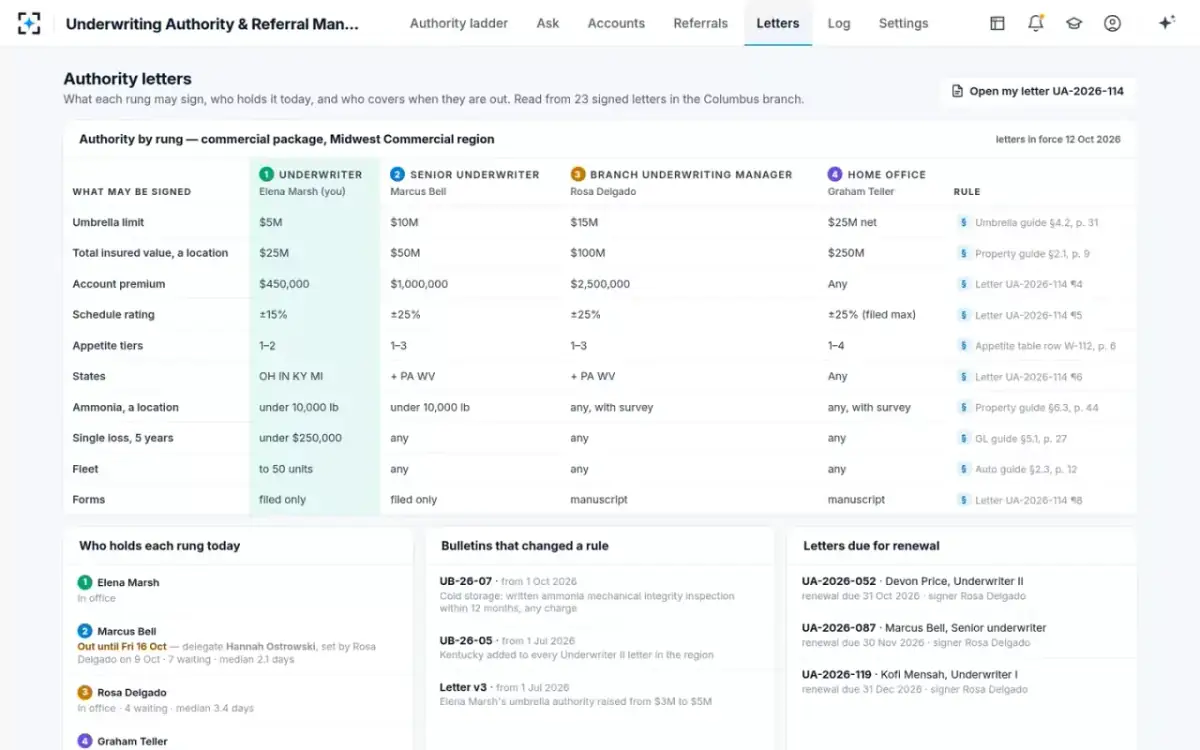
Underwriting Authority & Referral Management: the letters, rung by rung
What is the difference between authority and appetite?
Appetite is what the carrier wants to write; authority is who may sign it. An account can be squarely in appetite and still above an underwriter's authority, and an account inside every dollar limit can still be outside appetite.
Appetite and authority answer different questions
Appetite: Do we want this class, in this place, at all?
Authority: Who here may commit us to it, on these terms?
Appetite: The class appetite table and line guides, set by the home office.
Authority: Each person’s letter of authority, signed by their manager.
Appetite: By bulletin, when the carrier’s view of a class changes.
Authority: By a new letter version, a bulletin that edits letters, or a dated delegation.
Appetite: Public refrigerated warehouse: tier 2, write.
Authority: A $10M umbrella needs the senior underwriter; a $5M lead stays with the underwriter.
Who decides an underwriter's authority, and how are limits set?
An underwriter's authority is decided by the manager who signs their letter, within limits the home office sets for each line from the carrier's underwriting policy, reinsurance and risk appetite, which the board approves. Individual limits are then set by experience, track record and the complexity of the line, and they grow as the underwriter does.
The sample branch shows the growth in one entry: version 3 of Elena Marsh's letter, from 1 July 2026, raised her umbrella authority from $3 million to $5 million. The levels themselves are covered in underwriting authority levels. What examiners test when a limit is broken, from undocumented credits to decisions taken at the wrong level, is in the underwriting audit checklist.
Can authority limits be temporary?
Yes, in two ways, and both should carry dates. A delegation lets someone sign at an absent holder's rung for a stated period; a temporary uplift raises one person's limit for a project or a season. Either should be granted in writing by the letter's signer and expire on its own.
In the sample branch the senior underwriter is out until Friday 16 October, and his delegate, set by the branch underwriting manager on 9 October, signs at his rung until then. Delegation is not free: the delegate already had seven referrals waiting with a median answer of 2.1 days, which is why the cost of each referral, priced in the underwriting referral process, falls hardest when a rung holder is away.
The solution's answer to an account above the letter is not always a referral. On the sample account Kessler Cold Storage, the umbrella guide allowed a lower lead limit with the excess placed by another insurer; at a $5 million lead the account fell inside every line of the underwriter's letter, and she quoted it the same day. That is the limit working as designed: the account was changed to fit the authority, not the authority stretched to fit the account. See the whole solution at Underwriting Authority & Referral Management.
Questions people ask
What is a schedule rating limit?
It is the largest total credit or debit an underwriter may apply under the carrier's schedule-rating plan. There are usually two: the filed maximum, 25% under the Florida and Utah rules, and the narrower range in each underwriter's letter, ±15% for the sample Underwriter II.
Can an underwriter go over their authority limit with approval?
Yes, by referral: the holder of a higher rung approves the account, and their signature, not the underwriter's, carries the part above her letter. Approval after the fact is a ratification, which a well-written letter treats as an exception to be recorded, not a routine.
Why do two underwriters with the same title have different limits?
Because the letter, not the title, carries the authority, and letters reflect each person's experience and track record. In the sample branch the guide gives every Underwriter II $5 million of umbrella authority, but one underwriter's letter carried $3 million until July.
Do authority limits apply to managing general agents?
A carrier that delegates binding to an outside agency sets limits in a binding authority agreement instead of a personal letter, with its own audit regime. This page is about an insurer's own underwriters; the agreements with outside agencies are a separate subject.
What happens to a risk above the home office's authority?
It needs capacity the carrier's own retention does not provide. In the sample guide, umbrella limits above the home office's $25 million net are written only with facultative reinsurance arranged by the home office, because the 2026 casualty treaty retains $25 million per risk. The top rung of a ladder is set by the reinsurance behind it, not by anyone's seniority.
How often should authority limits be reviewed?
At least when a letter is renewed, and whenever a bulletin, a reinsurance renewal or a change in appetite moves the rules underneath it. The sample branch lists three letters due for renewal before the year ends.