The underwriting referral process is how a commercial account that breaks one line of an underwriter's letter of authority reaches someone whose letter covers it: the underwriter spots the trigger, finds the rule, writes a referral note, sends it to the holder of the next rung, and waits for an approval, a decline or changed terms before quoting. Each step is cheap; together they cost hours of underwriter time and days of calendar time, and the days matter more, because the broker's quote date does not move. Most of that time goes on re-reading a file someone has already read and on queues at the rungs with the fewest people. Botminds' Underwriting Authority & Referral Management reads the submission against the letter, drafts the note with the rule and facts filled in, routes it to whoever holds the rung today, and shows when a small change would keep the account off the queue altogether.
The example account and branch below are fictional sample data from the solution. Wage and benefit figures come from the U.S. Bureau of Labor Statistics; the hours per task are our assumptions, stated so you can replace them with your own.
What one referral costs in people's time: about $316, most of it reading
What is an underwriting referral?
An underwriting referral is a request from an underwriter to the holder of a higher authority level to approve, decline or change the terms of an account the underwriter may not sign alone. It is not a second opinion on an account the underwriter could write; it exists because one fact on the account, a limit, a value, a class, a state, a hazard or a credit, sits above the underwriter's letter.
That definition has a practical edge. A referral that was not needed costs the same hours and days as one that was, and adds to the queue of the person whose time is scarcest. A referral that was needed but not sent becomes a file written outside authority. The process is only as good as the reading that decides whether to start it, which is why the authority levels themselves come first.
The underwriting referral process, step by step, and where the days go
The process has five steps and most of the calendar sits in one of them: waiting for the rung holder. Reading, finding the rule, writing the note and assembling the file for audit are each short, but they are done by hand, often twice, once by the underwriter and again by the person who answers.
One referred account: 4.4 working days by hand, 1.4 with the solution
- Reading against the letter1 d
- Rule search0.5 d
- Note0.3 d
- Waiting on the rung holder2.1 d
- Audit file0.5 d
- Four steps0.4 d
- Waiting on the rung holder1 d
The waiting falls by half in that estimate for a reason that has nothing to do with faster approvers. The rung holder receives a note that can be decided from the page: the rule quoted, the facts as read with their sources, and a recommendation. A senior who must reopen the submission to check the account's loss history is reading it for the second time; one who can see the five-year losses, the largest single loss and the source page is deciding.
Why do quotes get referred to a senior underwriter?
Quotes get referred to a senior underwriter because one fact on the account exceeds the underwriter's letter on a dimension the senior's letter covers: a higher limit or insured value, a larger account premium, a class in a higher appetite tier, a state outside the underwriter's list, or a schedule credit beyond her range. Facts that exceed the senior's letter too, such as states outside the region, go past him to the branch or the home office.
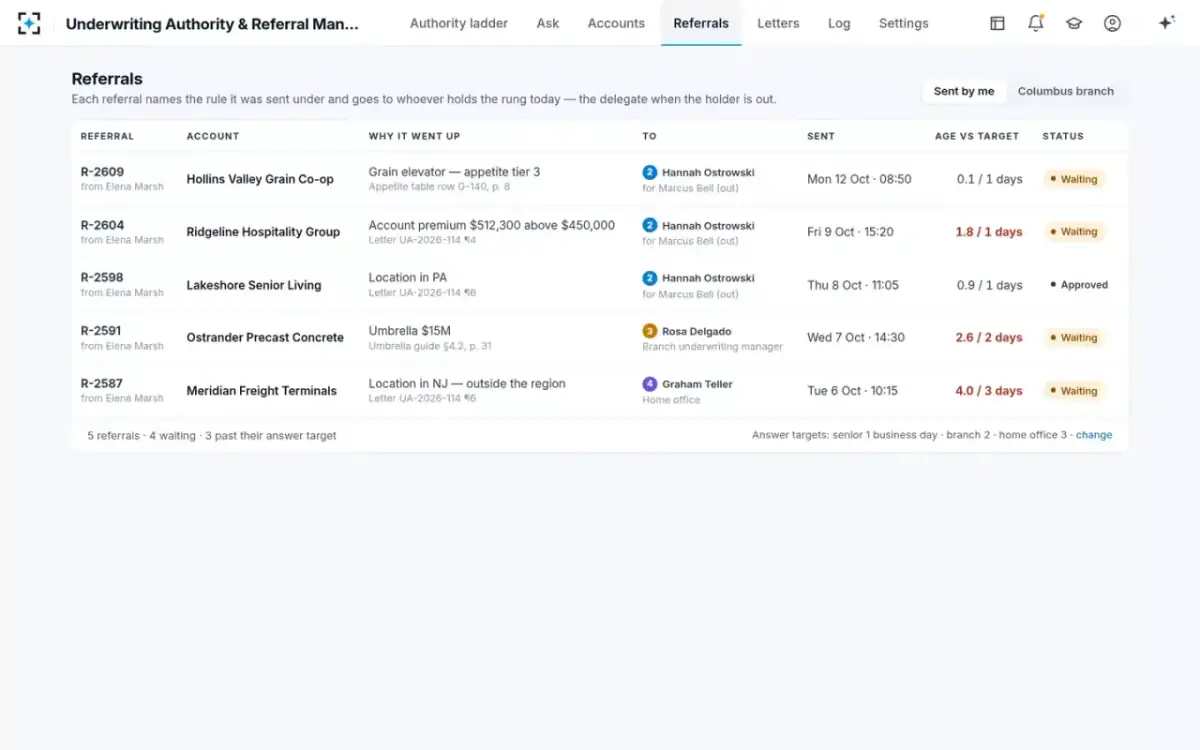
The sample underwriter's month shows how varied the triggers are. Her five referrals since 1 October went up for a grain elevator in appetite tier 3, an account premium of $512,300 against her $450,000, a location in Pennsylvania, a $15 million umbrella, and a location in New Jersey outside the region. Each went to a different rung or for a different reason, and each note names the paragraph of her letter or the guide page that sent it.
Referrals in Underwriting Authority & Referral Management, each with its rule and age
What does an underwriting referral cost?
An underwriting referral costs the hours of everyone who reads the file, plus whatever the delay costs in quotes that miss their date. The first part can be priced from wages; the second depends on your own hit ratios, and no government or academic source publishes those for commercial lines.
On our assumptions, the people cost is about $316 per referral, shown above: 3.75 underwriter hours at a loaded $57.11 and one senior hour at a loaded $101.88. The sample branch sent 418 referrals in its third quarter, which on the same assumptions is about $132,100 of people time in a quarter, before anyone counts the days. The largest single item is the senior's re-reading, because the most expensive person reads last and often from scratch.
The delay is priced differently, and only with your numbers. The formula below is the method; its inputs come from your quote log.
The two costs of a referral, as a formula you can fill in
People time
Σ hours × loaded hourly rate
Each person who reads, finds the rule, writes or re-reads. Loaded rate = wage ÷ 0.685 for full-time private-industry workers (BLS, June 2026).
Underwriting operations
Quotes that miss their date
referrals × share answered after the quote date
From your referral log: answer date against the broker’s quote date.
Underwriting operations
Premium lost to lateness
late quotes × (hit ratio on time − hit ratio late) × average premium
Both hit ratios from your own quote and bind history; no public benchmark exists.
Distribution and finance
Referrals avoided
accounts restructured to stay on the underwriter’s rung × people time per referral
Only restructures the guides allow, agreed with the broker.
Underwriting leadership
How long do underwriting referrals take?
Underwriting referrals take as long as the queue at the rung that must answer, and that varies by rung, by week and by who is out; there is no published industry benchmark, so the useful number is your own median by rung. Queues follow simple arithmetic: the average wait is roughly the number waiting divided by the number the holder answers each day.
The sample branch shows the pattern. The senior underwriter's rung had seven referrals waiting and a median answer of 2.1 days; the branch underwriting manager had four waiting and 3.4 days; the home office had eleven waiting and 6 days. The answer targets the branch set were one business day for the senior, two for the branch and three for the home office, and three of the underwriter's five referrals were already past them. A holder who answers about three referrals a day with seven waiting gives a wait of a little over two days. A holder who is out answers none, which is why the delegate matters.
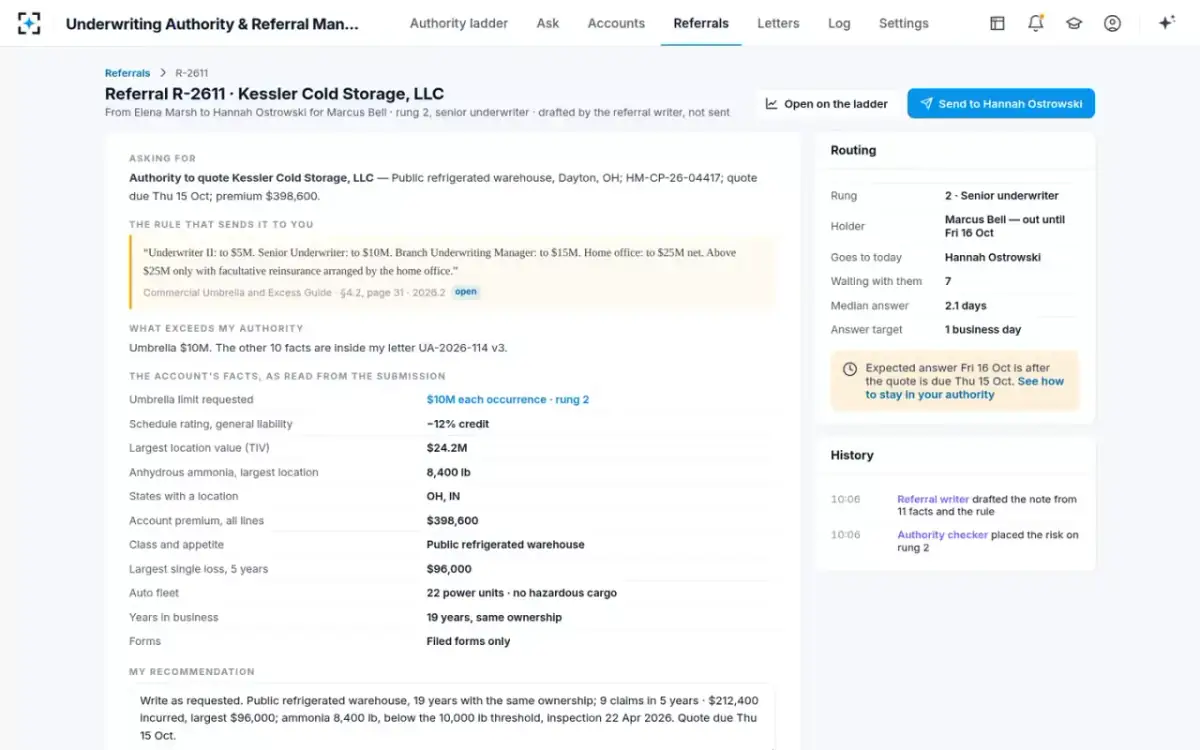
Those numbers decide outcomes on specific accounts. On the sample account Kessler Cold Storage, a public refrigerated warehouse with its quote due Thursday 15 October, the senior was out until Friday and his delegate's expected answer was Friday too. The referral would have answered a day after the quote was due.
What information goes in an underwriting referral?
A referral should carry everything the rung holder needs to decide from the page: what is being asked, the rule that sends it up, quoted, what exactly exceeds the underwriter's authority, the account's facts with their sources, the loss history, a recommendation, and the date the quote is due. Anything the holder has to look up is a day added.
A referral note that can be decided without reopening the file
- What is asked
Authority to quote, bind or change terms on a named account, with the quote date.
- The rule that sends it up, quoted
The guide or letter sentence word for word, with its page and version.
- What exceeds the underwriter’s authority
The one or two facts above her letter; the rest stated as inside it.
- The facts as read
Each with the document and page it came from, so the reader can check one without reading all.
- Loss history in one line
Claims, incurred and largest loss over five years, from the loss runs.
- A recommendation the underwriter wrote
Drafted for her to edit; it carries her judgement, not the software’s.
- Routing and timing
Who holds the rung today, the delegate if the holder is out, and the expected answer against the quote date.
A referral note drafted by Underwriting Authority & Referral Management, not yet sent
How do you speed up underwriting referrals? Four levers, in order
Speed up underwriting referrals by sending fewer, sending them complete, sending them to whoever can answer today, and holding each rung to a target. Faster approvers come last, because they are the scarcest resource and the one least within an operations leader's control.
Send fewer. Many accounts above a letter are one guide-permitted change away from it. On the Kessler account the umbrella guide allowed a lower lead limit with the excess placed elsewhere; at a $5 million lead the account dropped to the underwriter's own rung and was quoted the same day at $371,300. In the sample branch's quarter, 137 accounts were restructured to stay in authority against 418 referred, so roughly a quarter of the accounts that hit a trigger never joined a queue (our arithmetic on sample data). Send them complete. A note with the rule quoted and the facts sourced removes the senior's re-read, the largest single cost above. Send them to whoever holds the rung today. A referral addressed to someone on leave waits for their return unless a delegate, named in writing by the letter's signer, picks it up. Set targets and remind. The sample branch's targets are one, two and three business days by rung, with a reminder at half the target.
Which of these software can do is the question behind underwriting workflow management; testing whether a tool raises the right referrals before you trust it is set out in piloting an underwriting rules engine.
Who approves a referred risk, and what happens if a referral is declined?
A referred risk is approved by the holder of the rung whose letter covers its highest trigger, or by the delegate the letter's signer named for the dates the holder is out. A decline ends the quote on those terms; the underwriter may offer different terms that fit her own letter, or decline the account.
A declined referral still leaves a record. New York requires an insurer to keep an application on which no policy was issued for six calendar years (11 NYCRR 243.2), or until the examination report that reviewed it is filed, whichever is longer, so the note, the rule and the decline belong in the file. Where the account is written on different terms from those applied for, the NAIC's file-review standard asks examiners to "Verify that when a policy is issued on a basis other than applied for, that notice of an adverse underwriting decision is provided in accordance with applicable state statutes and regulations." And where a referral ends in a schedule debit, some states require the reasons to reach the applicant: New Mexico's rule requires a plan to provide that the applicant is notified in writing of "the factors and resulting amounts which resulted in the rating modification".
The whole chain, from the first page of the submission to a signed or declined referral, is shown at Underwriting Authority & Referral Management.
Questions people ask
Is an underwriting referral the same as a decline?
No. A referral asks someone with more authority to decide; the answer can be approval, a decline or changed terms. In the sample underwriter's month, one of five referrals had been approved, a location in Pennsylvania, and four were still waiting.
Can an underwriter send a referral straight to the home office?
Only when the account's highest trigger needs the home office. A location in a state outside the region climbs straight to the home office in the sample branch, skipping the senior and the branch manager, because neither of their letters covers it. Sending everything to the top lengthens the queue with the longest wait, six days in the sample branch.
Who sets the answer targets for referrals?
Usually the branch or regional underwriting manager, as part of the same settings that define the rungs. The sample branch uses one business day for the senior underwriter, two for the branch manager and three for the home office, with a reminder to the holder at half the target.
Should brokers see why an account was referred?
They should know that it was referred and when to expect an answer; the underwriter's personal limits are usually kept internal. In the solution the broker view is off by default, and when it is on, brokers see only "in authority" or "referred".
What makes a referral note good?
It can be decided without opening the submission. That means the rule quoted rather than paraphrased, the facts listed with the documents they came from, the one line that exceeds the underwriter's letter named, and a recommendation the underwriter has written or edited herself.