Underwriting automation software takes the repetitive reading and checking out of underwriting: extracting a submission's facts, testing them against the carrier's rules, routing what needs another signature, and recording what was decided. For commercial authority, those rules do not sit in a database. They sit in each underwriter's letter of authority, in several line guides, in an appetite table and in a stream of bulletins with effective dates, which is why the software is only as good as its settings. A limit with no letter version, or a bulletin applied the day it was read rather than the day it took effect, produces confident answers that an auditor cannot reconstruct. Botminds' Underwriting Authority & Referral Management reads those documents into settings, each tied to its page, version and effective date, and keeps every change as a new version.
Settings, letters and accounts on this page come from the solution's fictional sample branch; every value describing them is sample data. Rules are quoted from regulators where they appear.
Letters and guides as settings: every rule with its source, version and owner
Umbrella limit an Underwriter II may sign: $5M
SourceLetter UA-2026-114 ¶3; umbrella guide §4.2, p. 31
VersionLetter v3 · guide 2026.2
Applies from1 Jul 2026
Who may change itThe letter’s signer
Schedule rating an Underwriter II may apply: ±15%
SourceLetter UA-2026-114 ¶5
VersionLetter v3
Applies from1 Jul 2026
Who may change itThe letter’s signer
Schedule rating maximum: ±25%
SourceThe carrier’s filed rating plan
VersionAs filed
Applies fromPer filing
Who may change itNobody in the branch: a rate filing
Kentucky added to every Underwriter II letter in the region
SourceBulletin UB-26-05
Version—
Applies from1 Jul 2026
Who may change itThe bulletin’s issuer
Cold storage: written ammonia mechanical-integrity inspection within 12 months
SourceBulletin UB-26-07
Version—
Applies from1 Oct 2026
Who may change itThe bulletin’s issuer
Public refrigerated warehouse: appetite tier 2, write
SourceAppetite table row W-112, p. 6
VersionQ4 2026
Applies fromQ4 2026
Who may change itThe appetite table’s owner
An unknown fact refers the account up a rung
SourceBranch settings
VersionLogged change
Applies fromIts change date
Who may change itBranch underwriting manager
Answer target at the senior underwriter’s rung: 1 business day
SourceBranch settings
VersionLogged change
Applies fromIts change date
Who may change itBranch underwriting manager
What is underwriting automation software? Four layers, one of them authority
Underwriting automation software is any software that does part of an underwriter's work without a person doing it by hand, and in commercial lines it comes in layers. Intake software reads submissions and extracts their data; the questions to ask of it are in AI for commercial underwriting. Rating software calculates premium from filed rates. Workflow software routes work between people. Between them sits the authority layer: whether this account may be written, by whom, under which rule.
Those three are the easier ones to automate, because they are bounded: an ACORD form has fields, a rate table has cells, a queue has owners. The authority layer is harder because its rules are written in prose, change during the year and differ by person. It is also the layer examiners test most directly, because it decides whether the right person signed. This page is about that layer, and about what the software must do with the documents that define it.
Is commercial underwriting automated? What examiners ask about the split
How much of commercial underwriting is automated varies by carrier and by line, and regulators treat the split as something a carrier should know. The NAIC's 2026 handbook for financial examiners includes, in its sample interview questions for underwriting, "What percent of your cases are automatically underwritten vs. manually underwritten?"
For an authority layer the more useful question is narrower: which decisions does the software take, and which does it only prepare? In the solution the answer is fixed. Agents read, test, place, suggest and draft; they never approve, and the referral note is never sent without the underwriter. A carrier can still automate approval of very small accounts in its policy system, but then the approval rules themselves become the controls an examiner will test.
What the sample branch’s settings are read from
23
signed letters of authority in the branch
1,186
pages of guides, appetite table, bulletins and letter in force on a quote date
7
bulletins, each applied only from its effective date
4
rungs, from underwriter to home office
From one letter paragraph to settings: the states clause, worked through
A single paragraph of a letter usually becomes several settings, and a bulletin can change one of them without anyone re-signing the letter. The states clause in the sample branch shows how.
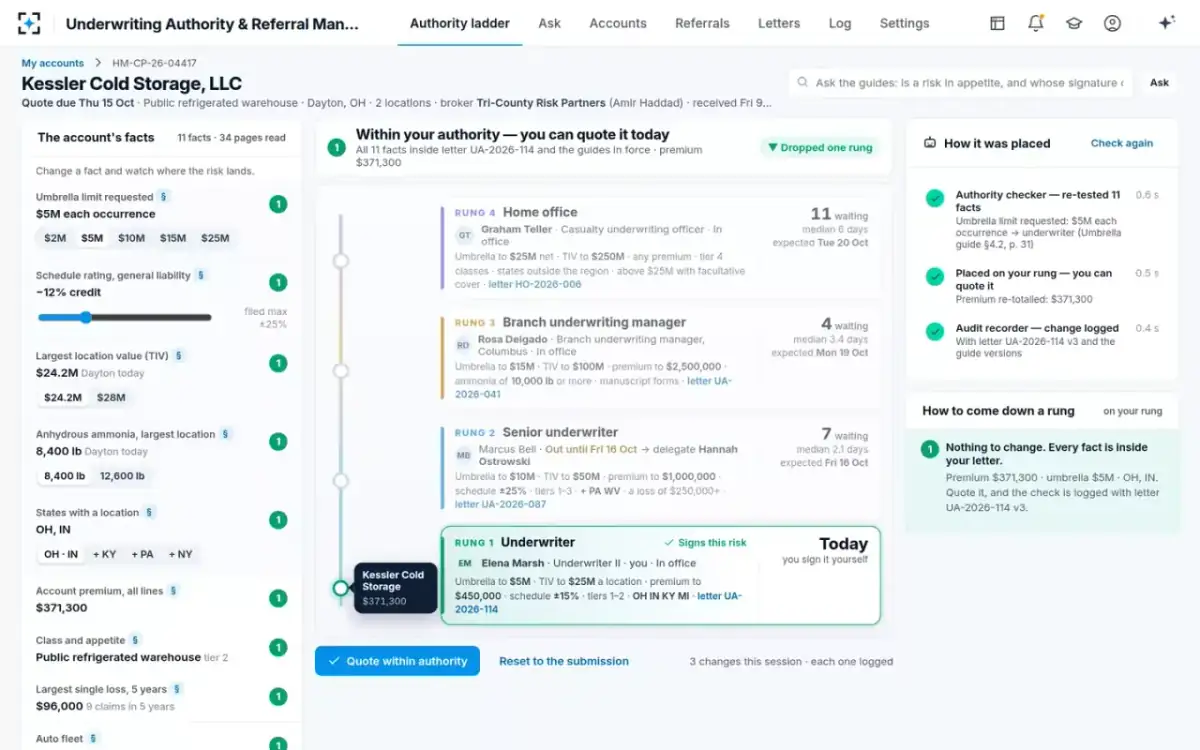
Paragraph 6 of the underwriter's letter, UA-2026-114, governs the states she may write; read with the bulletins in force, that is Ohio, Indiana, Kentucky and Michigan. The senior underwriter's letter adds Pennsylvania and West Virginia; anything outside the region belongs to the home office. Read into settings, that is three rules, one per rung, each pointing back to its paragraph. Kentucky arrived in the underwriter's list not through her letter but through bulletin UB-26-05, effective 1 July 2026, which added Kentucky to every Underwriter II letter in the region. The setting therefore has two sources and a date: the letter for Ohio, Indiana and Michigan, the bulletin for Kentucky from 1 July. A file quoted in June with a Kentucky location needed a higher rung; one quoted in August did not.
The same structure is what makes a "what if" trustworthy. Add a New York location to the sample account Kessler Cold Storage and the account climbs two rungs to the home office, citing paragraph 6; take it away and the account drops back. Cut the umbrella to a $5 million lead, as the umbrella guide's §4.2 allows, and every fact sits inside the underwriter's letter. Each move is computed from the same settings, and each is logged with the rule that caused it.
Back on the underwriter's own rung in Underwriting Authority & Referral Management
How are underwriting bulletins applied? From their effective date, never before
Underwriting bulletins should be applied from their effective date: shown to underwriters as soon as they are read, used in checks only from the day they take effect, and kept alongside the version they replaced. Every account in progress should be re-checked on that day, because an account quoted under the old rule and bound under the new one may have changed rung in between.
Examiners read bulletins as part of the guidelines. The NAIC's file-review standard for following underwriting guidelines lists "Underwriting bulletins" among the documents to be reviewed, next to the guidelines and declination procedures. In the solution's sample branch, bulletin UB-26-07 took effect on 1 October 2026; the guide reader had read it earlier, showed it, and applied it only from that date. Overnight, all nine accounts in progress were re-checked against it; none changed rung, and the log says so.
How do you version underwriting guidelines?
Version underwriting guidelines by keeping every edition with its effective date, recording who approved each change and why, and checking each account against the edition in force on its quote date. A PDF overwritten on a shared drive destroys the one thing an auditor needs: the rule as it stood.
New York's guidance on AI in underwriting and pricing describes the documentation it expects in terms that fit any automated rule set: "a description of the process for tracking changes of an insurer’s use of ECDIS and AIS over time, including documented explanation of any changes, associated rationale for such changes, and parties responsible for the approval of such changes", ECDIS and AIS being its terms for external consumer data and AI systems. New York's record rules add the reason it matters: every insurer must keep its "claims, rating, underwriting, marketing, complaint, financial, and producer licensing records" for examination, and an underwriting record without the rule it applied cannot be read the way the decision was made.
A letter as a PDF, and a letter as a versioned setting
PDF on a shared drive: Open the latest file, if it is clear which one that is.
Versioned setting: Read the matrix: each rung’s limit, with the paragraph behind it.
PDF on a shared drive: A new PDF replaces the old one, or sits beside it with a similar name.
Versioned setting: Version 3 applies from 1 July; version 2 stays readable for files quoted before.
PDF on a shared drive: The signature on the PDF, if anyone checks it.
Versioned setting: Only the letter’s signer can change it; the change is logged with the reason.
PDF on a shared drive: Reconstruct which PDF was current on the quote date.
Versioned setting: The check on the file names the letter version it used.
PDF on a shared drive: Noticed when someone asks.
Versioned setting: Listed as due for renewal, with the date and signer.
Who can change underwriting rules in software?
Only the person who owns the rule in writing should be able to change it in software: the letter's signer for an underwriter's authority, the guide's owner for line rules, the bulletin's issuer for bulletins. Administrators run the system; they should not be able to raise a limit. Any change should take effect from a stated date and leave the old version readable.
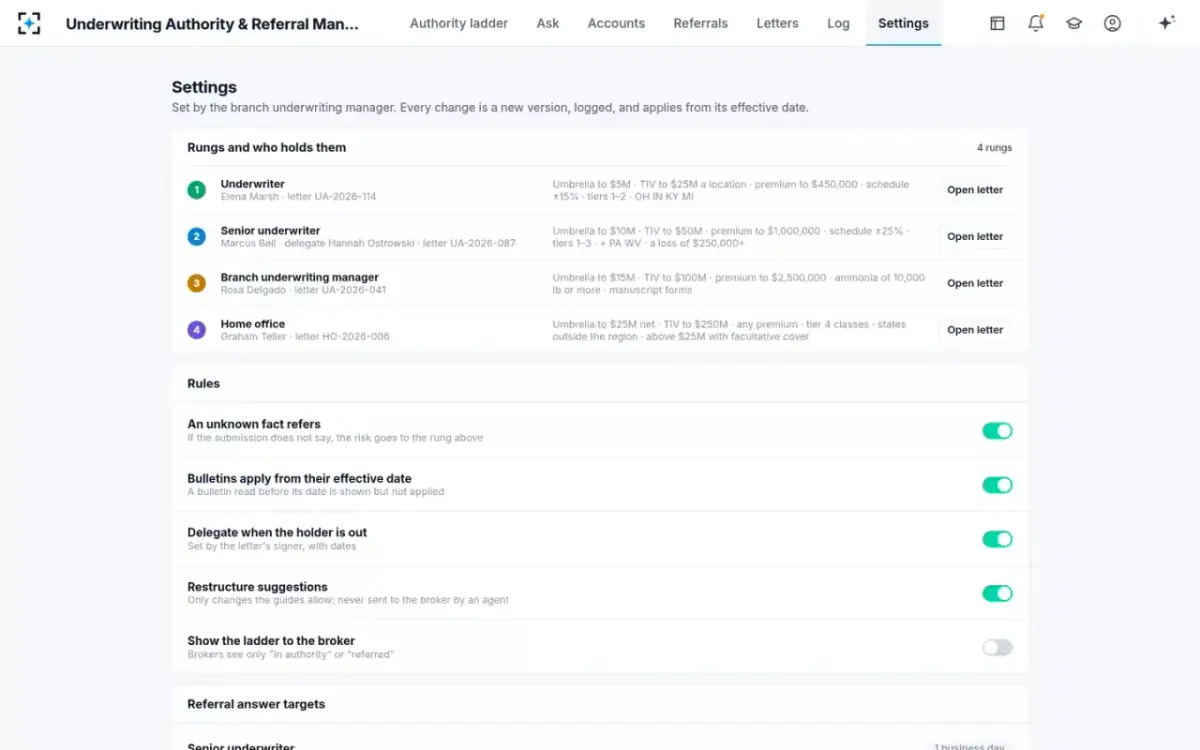
The solution's settings follow that split. The branch underwriting manager sets the rungs and who holds them, the referral rules and the answer targets, and every change is a new version, logged, and applied from its effective date. Delegates for an absent rung holder are set only by the letter's signer, with dates. The rule that an unknown fact refers the account up a rung is on by default; switching it off is itself a logged decision a manager will be asked about.
Settings in Underwriting Authority & Referral Management, set by the branch underwriting manager
Schedule rating ranges: two limits the software must keep apart
Schedule rating has two limits that automation software must hold separately: the maximum in the carrier's filed rating plan, which is regulated, and the narrower range in each underwriter's letter, which is internal. The sample branch's filed maximum is ±25%; an Underwriter II may apply ±15%. A credit of −20% is lawful and still above her authority.
Versioning the filed plan has its own rule in some states. Utah, for example, provides that when a carrier revises its plan, "A change in an established debit or credit for a risk currently insured must be based on a change in the risk and not on a change in the provisions of a rate modification plan." Software that recalculates every in-force credit the day a plan changes would break that rule; software that keeps the plan's versions, and ties each credit to the risk evidence behind it, would not. Why the letter's range sits inside the filed one is the subject of why authority limits are established.
What should underwriting automation software not do?
Underwriting automation software should not take any step that an auditor would expect a named person to have taken, and it should never let a gap in the data look like a pass. The list below is the set of limits the solution's six agents work under; it is a useful test for any tool.
Eight things authority software should never do
- Approve an account
The underwriter signs within her letter; the rung holder or delegate signs above it.
- Guess a fact the submission does not state
An unknown fact refers the account up a rung until it is known.
- Apply a bulletin before its effective date
Read early, shown, not applied.
- Edit a letter of authority
Only its signer can; the software reads it.
- Place a risk below its highest trigger
One fact above a letter is enough to need the next rung.
- Suggest a change a guide forbids
Restructures cite the sentence that allows them.
- Contact the broker or send a referral alone
Notes are drafted for the underwriter, who decides whether and when to send.
- Let a signed entry be edited
Read-only once signed; a change of terms needs a new signature.
Buying underwriting automation software: test it on your own letters
The fastest way to judge underwriting automation software is to give it your letters, guides and bulletins and a closed quarter of submissions, and compare its placements with what your underwriters signed. A demo on the vendor's sample proves the interface; a replay on your files proves the reading. The four-week version of that test is laid out in piloting an underwriting rules engine, and twelve questions to put to any vendor are in underwriting workflow management.
Be honest about fit. The solution suits carriers whose commercial authority is spread across personal letters, several line guides and frequent bulletins, where underwriters spend time finding out whose signature an account needs. It does not rate or issue policies, and a book of small, uniform accounts with two or three thresholds may be served well by the rules already inside a policy system. The full solution is at Underwriting Authority & Referral Management.
Questions people ask
Can underwriting guidelines be automated?
The checking can; the judgement cannot. Software can read a guide, apply its thresholds and cite the passage, and in the sample branch it answers from 1,186 pages with the passages quoted. Deciding whether a risk that passes every rule is a good one stays with the underwriter.
How do you keep underwriting rules up to date in software?
Treat each letter, guide and bulletin as a versioned source with an effective date and an owner. When a new version arrives, the software should read it, show it, apply it from its date, keep the old one for files quoted before, and re-check the accounts in progress.
Does underwriting automation software replace the policy administration system?
No. Policy systems rate, issue and service policies. Authority software decides who may sign an account and prepares the referral; it hands a signed decision to the policy system rather than replacing it.
What should a demo of underwriting automation software show?
An account placed on a rung with the letter paragraph behind it, a bulletin applied only from its effective date, an unknown fact referring the account, and a log entry that cannot be edited after signing. If a demo cannot show those on the vendor's data, it will not show them on yours.
Who owns underwriting rules after go-live?
The same people who owned them before: letter signers for authority, guide owners for line rules, the home office for bulletins. The software makes their changes visible and versioned; it should not create a second owner in IT.