Underwriting workflow management is the software and practice of moving underwriting work, submissions, referrals, approvals and quotes, between the right people in the right order, and recording who did what. Routing is what workflow tools are built for. The ones that hold up in an examination also know who may sign each item, under which rule and which version of it, and never let the software itself approve. Twelve questions, asked of any vendor with your own letters of authority on the table, separate the two kinds. Botminds' Underwriting Authority & Referral Management is built around those questions for commercial underwriting: six agents read the submission and the letters, place each account on the rung that can sign it, draft the referral, route it to whoever holds the rung today, and log every step with the versions in force, while people sign.
The product examples come from the solution's fictional sample branch; all figures about it are sample data. Regulatory texts are quoted where they appear.
Twelve questions for any underwriting workflow tool, and what a good answer looks like
- 1
Does it place each account on the rung that can sign it, and say why?
Good evidenceA placement naming the letter paragraph or guide page behind it, for every fact that matters.
Why it mattersExaminers test whether final decisions were taken at an appropriate authority level.
- 2
Does it read our letters and guides, or must we re-key them?
Good evidenceYour signed letters shown as a matrix, each limit linked to its source document.
Why it mattersRe-keyed rules drift from the documents people sign.
- 3
Does it keep every version of every rule, with dates?
Good evidenceA bulletin shown when read, applied only from its effective date, the old version still readable.
Why it mattersEvery file must be judged against the rule of its quote date.
- 4
What does it do with a fact the submission does not state?
Good evidenceTreats it as unknown and refers the account up a rung.
Why it mattersA blank that passes a check is the quietest way to write outside authority.
- 5
Can it approve anything on its own?
Good evidenceNo: approval needs a named person whose letter covers the account.
Why it mattersAutomated approval moves the decision, and its controls, into the software.
- 6
Can a referral be decided from the note alone?
Good evidenceThe rule quoted, the facts with their sources, what exceeds the letter, a recommendation.
Why it mattersThe senior’s re-read is the most expensive step in a referral.
- 7
Does it route to whoever holds the rung today?
Good evidenceDelegates named by the letter’s signer, with dates, picked up automatically.
Why it mattersA referral addressed to someone on leave waits for their return.
- 8
Does it show each referral’s age against a target?
Good evidenceAnswer targets per rung, reminders, and late items visible before the quote date.
Why it mattersThe broker’s date does not move.
- 9
Does it suggest only changes the guides allow?
Good evidenceEach suggestion cites the guide sentence; nothing goes to the broker without the underwriter.
Why it mattersA restructure is a decision and must be defensible.
- 10
Is the log read-only after signing, and can we export a sample?
Good evidenceEvery check, change, referral and signature with versions; filter, draw, export.
Why it mattersRecords must reconstruct the underwriting and be produced on request.
- 11
Can its authority controls be tested by re-performance?
Good evidenceAn auditor can re-run any logged check and get the same rung.
Why it mattersThat is how examiners test automated authority levels.
- 12
Will you run it on our last quarter before we sign?
Good evidenceA replay on closed files, with every disagreement settled by your people.
Why it mattersA demo shows the interface; a replay shows the reading.
What is underwriting workflow management? Routing, deciding and recording
Underwriting workflow management covers three jobs: routing work to the right person, helping that person decide, and recording the decision so it can be reconstructed. The first is the easiest to demonstrate; the second and third are harder, which are what auditors and examiners read.
For commercial authority, routing depends on deciding. A tool cannot send an account to "the right person" until it knows which line of which letter the account breaks, and that knowledge sits in prose: personal letters, line guides, an appetite table and bulletins with effective dates. A workflow tool that routes on a few re-keyed thresholds will route the easy cases correctly and the hard ones wherever its thresholds happen to point.
What is the difference between an underwriter workbench and workflow management?
An underwriter workbench is the screen an underwriter works an account in, bringing the submission, data and tools together; workflow management is the layer that moves work between people and tracks its state. Many products combine them, and neither, by itself, decides who may sign.
Workbench, workflow and the authority layer between them
Workbench and workflow: Assemble the account for the underwriter; move it between queues; track status.
Authority layer: Decide which rung can sign it and why; prepare the referral; record the versions.
Workbench and workflow: Queue rules, assignment rules, service levels.
Authority layer: Every letter of authority, line guide, appetite table and bulletin, by version.
Workbench and workflow: The account, its documents and its status.
Authority layer: The rung the account needs, the fact that sends it there, and the smallest allowed change.
Workbench and workflow: Was the work done and recorded?
Authority layer: Was the decision taken at an appropriate authority level, under the right rule?
Can workflow tools enforce authority limits?
Workflow tools can enforce authority limits only as well as they can read them; a limit typed into a queue rule is enforced exactly, and stays exactly as it was typed when the letter changes. Examiners treat system-enforced authority as a control to be tested. The NAIC's financial examiners describe the control as "Underwriters are restricted in the type and amount of policies that they underwrite by authority levels built into the system."
The sample branch's letters show why reading matters. They cap ten dimensions across four rungs, and they change in three ways: a new letter version, such as the one that raised one underwriter's umbrella authority from $3 million to $5 million on 1 July 2026; a bulletin that edits every letter of a grade, such as the one that added Kentucky to every Underwriter II letter the same day; and a dated delegation. A tool that enforces limits must see all three, apply each from its date, and say which version it used on each file. How those limits become settings is shown in underwriting automation software.
How do workflow tools handle referrals?
Good workflow tools handle referrals by sending them complete, to whoever can answer today, with a clock: the note carries the rule and the facts, the routing follows dated delegations, and every referral shows its age against the rung's answer target. Weak ones forward an email and a link to the file.
One underwriter's referrals in the sample branch, against their targets
5
referrals sent since 1 October, each naming the rule it went up under
4
still waiting on a rung holder or delegate
3
already past their rung’s answer target
1
approved, by the delegate of a rung holder who was out
Referrals in Underwriting Authority & Referral Management, routed to whoever holds the rung
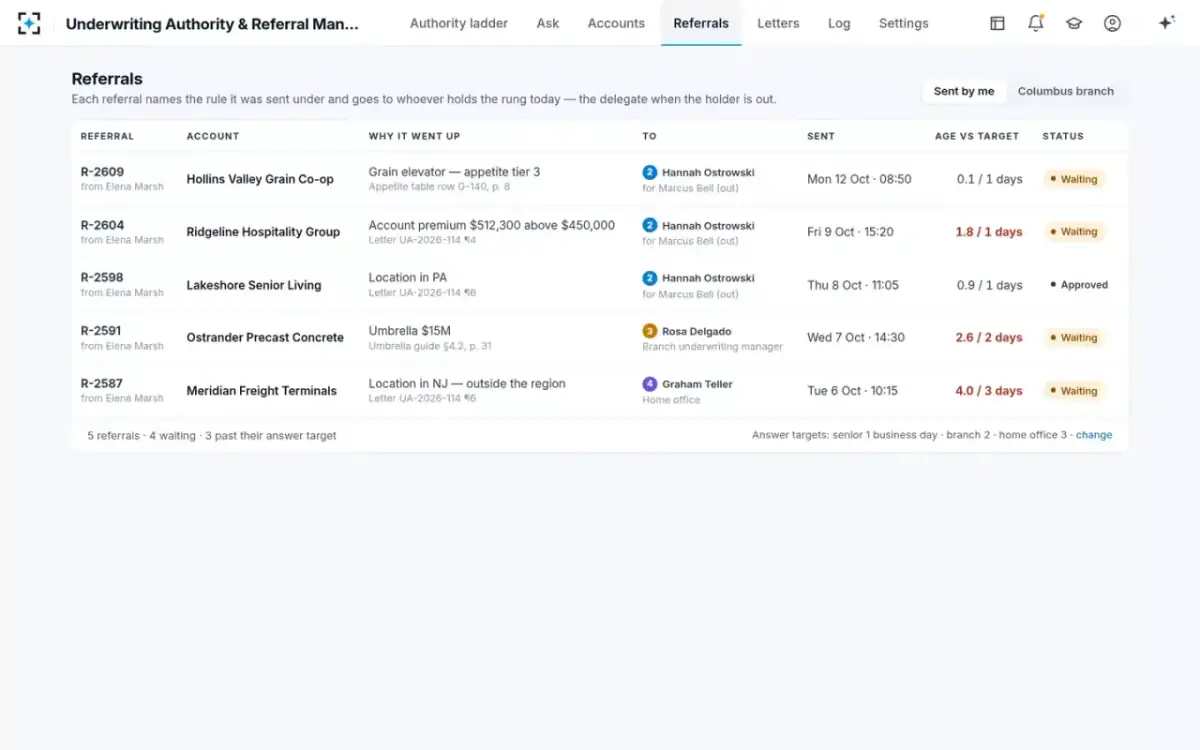
The cost side of the same queue, hours and days per referral, is priced in the underwriting referral process.
Does underwriting workflow software keep an audit trail?
It should keep one that can reconstruct each decision, cannot be edited after signing, and can be produced quickly, because state record rules require exactly that of the insurer, whoever's software holds the record. New York requires that "The records shall be readily available and easily accessible to the superintendent" and "in a readable form", and its Circular Letter No. 7 asks insurers to keep documentation of AI systems used in underwriting "consistent with 11 NYCRR 243".
Many workflow tools log status changes: received, assigned, approved. That is an activity log, not an underwriting record. The record an examiner needs says who approved, under which letter version, against which guide versions, on which facts from which pages. In the solution, every question asked of the guides, every check, change of fact, referral and signature is written with the letter and guide versions in force, read-only once signed; the auditor filters by outcome, draws a sample and exports it. The fields that make a signature re-performable are listed in underwriter sign off.
How do you evaluate underwriting software? On your own files, not the vendor's
Evaluate underwriting software by giving it your letters, guides and bulletins and a closed quarter of submissions, and comparing what it does with what your people did. A vendor's demonstration account is chosen to work; your quarter contains the bulletin that arrived mid-month, the letter renewed with one changed line, and the account that was referred for the wrong reason.
Supervisors frame testing the same way. International insurance supervisors' 2025 paper on AI lists among the procedures senior management should set "Setting clear guardrails on when an AI system can or cannot be deployed." A replay against your underwriters' signed decisions is the evidence for that guardrail. Ask for it before signing, with two rules: your auditor settles every disagreement, and a referral the tool would have missed counts more than ten it would have added. The four-week version of that test is set out in piloting an underwriting rules engine.
Five red flags in an underwriting workflow demonstration
Five things in a demonstration should make a buyer ask for the replay before anything else. Each is a sign that the tool routes well but decides somewhere you cannot see.
A green tick with no citation. If "within authority" cannot be clicked through to the letter paragraph and guide page behind it, an auditor will have to rebuild the reasoning from scratch. Limits typed into an administration screen. If the vendor's team keys your letters into a rules table, ask who will re-key them at the next renewal and how the tool will know which version a file used. Blank fields that pass. Ask what happens when the submission does not state the ammonia charge or the largest loss; if the answer is that nothing flags, the tool treats ignorance as compliance. An approve button the software can press. Automated approval within limits may suit some books, but then the approval rules themselves are what an examiner will test, and the vendor should say so. An editable history. If a signed decision can be changed in place, the log records what the file looks like now, not what was signed.
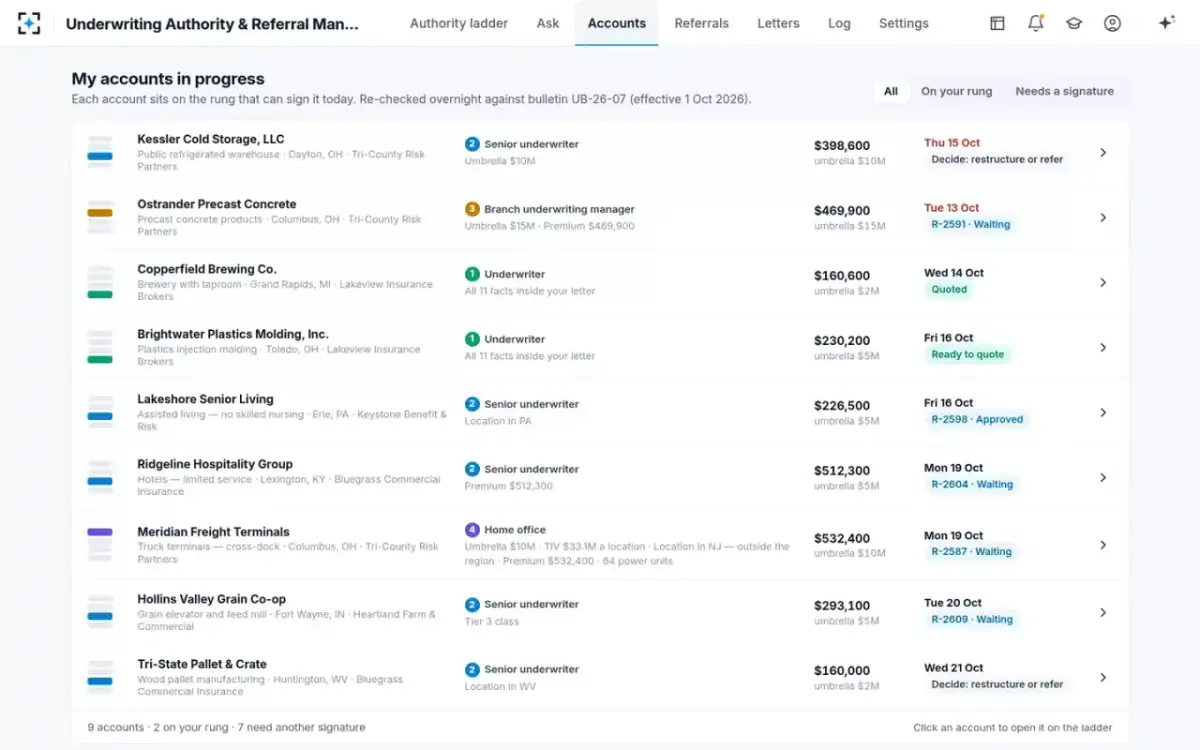
None of these is exotic; all of them are easy to check in an hour with three of your own files: one plainly inside a letter, one that breaks a single line, and one with a fact missing. The sample branch's account Kessler Cold Storage is a good template for the second kind: ten facts inside the underwriter's letter and one, a $10 million umbrella, above it.
How long does underwriting workflow software take to deploy?
Deployment time depends less on the software than on the documents: how many letters, lines and states, how readable the guides are, and how many bulletins are in force. No public source gives a benchmark, so plan from what you bring rather than from a vendor's average.
What the carrier brings, and why each item sets the timetable
- Every signed letter of authority, with versions
The ladder is read from them; missing versions slow the replay most.
- Line guides and the appetite table, by edition
Hundreds of pages per line; readable PDFs go faster than scans.
- Bulletins and memos in force, with effective dates
Each changes a rule from a date; undated ones must be dated first.
- A closed quarter of submissions and the referral log
For the replay that decides go or no-go.
- Named rung holders, signers and delegates
Routing depends on who holds each rung and who may set delegates.
- Answer targets per rung
Set by the branch underwriting manager; they turn a queue into a clock.
Where the solution fits in an underwriting workflow, and where it does not
Underwriting Authority & Referral Management fits where commercial authority is spread across personal letters, several line guides and frequent bulletins, and underwriters lose time finding out whose signature an account needs. It is an authority and referral layer: it reads, places, suggests, drafts, routes and records. It does not rate or issue policies, generate quote documents or replace a workbench, and it hands a signed decision to the systems that do.
It is a weaker fit for books of small, uniform accounts governed by two or three clean thresholds, where a rule inside the policy system may be all that is needed, and it never approves on its own. If those limits match your case, put the twelve questions to it on your own letters, starting from Underwriting Authority & Referral Management; if they do not, the questions still apply to whatever tool you choose.
Underwriting Authority & Referral Management: every account on the rung that can sign it
Questions people ask
What features should underwriting workflow software have?
Beyond routing and status, it should place each account on the authority level that can sign it with the rule cited, keep every version of letters, guides and bulletins by effective date, send complete referrals to whoever holds the rung today, show age against targets, and keep a read-only, exportable record. It should never approve on its own.
Is underwriting workflow software the same as a policy administration system?
No. A policy administration system rates, issues and services policies. Workflow software moves underwriting work between people before and around that point. A carrier may run both, and the authority check fits naturally in neither.
Can underwriting workflow software be used for referrals between branches?
Yes, if it routes by rung rather than by office. In the sample branch an account with a location outside the region goes past the branch to the home office, whatever its size, because no branch letter covers it.
Should brokers see an underwriting workflow?
They should see status, not limits. In the solution the broker view is off by default; when on, brokers see only "in authority" or "referred", which answers their real question, when they will get a quote, without exposing an underwriter's personal caps.
What makes underwriting workflow software audit-ready?
A record that reconstructs each decision with the rule versions in force, that cannot be edited after signing, and that can be filtered and sampled by an auditor. The NAIC's file-review standards also look for the underwriter's file or notes on a system log, so the log should be readable by someone outside the system.