AI for commercial underwriting means software that reads, matches, classifies, ranks or recommends on commercial risks: reading broker submissions and keying them, clearing them against the book, testing appetite, summarising loss runs and schedules, and supporting pricing. Federal reviews of the industry list underwriting among insurers' uses of AI, and it is allowed, under rules that put the insurer, not the vendor, on the hook for the outcomes: the NAIC's model bulletin on AI systems, which its map showed adopted in 29 jurisdictions on 8 October 2026, and New York's Circular Letter No. 7. So the questions a buyer should ask are less about the model and more about the evidence: can every output show its source, what may the system never do, who oversees the vendor, and can a decision be replayed for an examiner. Botminds' Commercial Submission Intake & Clearance is an agentic solution for the intake end of that work, and the ten questions below are the ones we would want any vendor, including ourselves, to answer.
Examples refer to a fictional sample carrier, Keelwater Insurance Group, in the solution; names and figures describing it are sample data. Regulatory sources are linked where they are used; the Compliance view of the NAIC bulletin is covered in depth by AI Governance and Model Inventory.
Ten questions to ask before buying AI for commercial underwriting
- What will it decide, and what will it only recommend?
A list, action by action. Anything that reaches a broker or an insured, or binds the carrier, should be a person’s decision.
- Can every output show its source?
The page and box behind a keyed value; the fields behind a match; the rule behind a verdict.
- What does it do when the source is silent?
It should say "missing". A plausible value where the document is blank is the most expensive kind of error.
- What may each component never do, and how is that enforced?
Written limits the software enforces, not guidelines the model is asked to follow.
- Whose rules does it apply, and who approves a change?
Your appetite guide and clearance rule, versioned, with a named approver and a history.
- How will we test it on our own files before we sign?
Past submissions with known outcomes, scored field by field and match by match.
- What will we be able to show an examiner?
A replay of any decision: input, each step, evidence, rule version, the person who decided.
- What audit and cooperation rights does the contract give us?
Audit rights or audit reports, and the vendor’s cooperation with regulatory inquiries.
- Where does our data go, and who can see it?
Processing and storage location, access controls, encryption and incident notice, in writing.
- Could it affect a consumer, and how is fairness tested?
Commercial lines can reach sole proprietors; if a use could, testing and documentation are expected.
How is AI used in commercial underwriting?
AI is used in commercial underwriting in three broad places: at intake, to read submissions, key them, find duplicates and test appetite; in analysis, to summarise loss runs, check schedules of values and pull outside data on a risk; and in pricing and selection, through models that score or rate risks. The rules bite differently on each, and so should a buyer's questions.
The federal reviews confirm the breadth without measuring it. The Treasury's 2024 report on AI in financial services records that "In the insurance industry, respondents highlighted AI's role in underwriting, claims processing, fraud detection, marketing, and risk management." The Federal Insurance Office's 2026 annual report lists underwriting among the sector's AI use cases and notes that the NAIC's AI Systems Evaluation Tool was being piloted by 12 states as of March 2026. Neither gives a share of commercial underwriting done with AI, and we found no government or research figure that does.
The rules around AI in underwriting, in four numbers
29
jurisdictions shown adopting the NAIC AI model bulletin, 8 October 2026
4
states with their own AI guidance for insurers instead: California, Colorado, New York, Texas
12
states piloting the NAIC AI Systems Evaluation Tool, March 2026
−4%
projected change in underwriter employment, 2025 to 2035
Is AI allowed in insurance underwriting?
Yes. No US rule we know of bars an insurer from using AI in commercial underwriting; the rules instead require the insurer to govern it, document it, oversee its vendors and stand behind its outcomes. The question for a buyer is not whether AI is permitted but whether the insurer could defend each use if asked.
Outside the US the picture is similar for commercial lines. The EU's AI Act lists as high-risk the AI systems used for risk assessment and pricing of natural persons in life and health insurance, and commercial property and casualty underwriting is not on that list (Regulation (EU) 2024/1689, Annex III). That is not a licence to ignore the Act, whose other duties, such as transparency obligations, can still apply, and its high-risk rules for the life and health uses now start on 2 December 2027 (where commercial underwriting stands under the EU AI Act); it is a reason a US carrier's commercial underwriting AI is governed mainly by its state regulators.
Does the NAIC AI bulletin apply to commercial lines?
The NAIC model bulletin is written for AI systems used in regulated insurance practices generally, and underwriting is one; it is not limited to personal lines. In the states that adopted it, a carrier's commercial underwriting AI belongs in the same written AI programme as everything else, scaled to the risk it poses.
The bulletin's definition is broad enough to cover intake software built on generative models. An "AI System", it says, is "a machine-based system that can, for a given set of objectives, generate outputs such as predictions, recommendations, content (such as text, images, videos, or sounds), or other output influencing decisions made in real or virtual environments." An agent that keys a submission, recommends a clearance decision or drafts a decline note produces exactly such outputs. The programme it belongs in should be proportionate, and New York's Department, answering commenters who said commercial products may not always touch consumers, kept its expectation that insurers take "an appropriate, risk-based approach" and decide their own sufficiency thresholds by product and use.
What does New York Circular Letter 7 require?
New York's Circular Letter No. 7, issued on 11 July 2024, sets the Department's expectations for insurers using external consumer data and AI systems in underwriting and pricing: governance with board and senior management accountability, oversight of third-party vendors, testing for unfair or unlawful discrimination with documented methods, and transparency to the people affected. It notes that commercial property and casualty may or may not have a direct consumer impact, pointing to policies issued to sole proprietors, and expects a risk-based approach.
Two passages define the accountability. On governance, the Department kept "the expectation that both senior management and the board have a responsibility for the overall outcomes of the use of ECDIS and AIS, not the day-to-day implementation." On vendors, insurers need not understand a model's inner workings but should perform appropriate due diligence and oversight, and "are ultimately responsible for the outcomes of that use." On testing, an insurer should document how it tests for unfair or unlawful discrimination and why it chose that method, commensurate with its use (NY DFS; the letter's testing requirements). Each of those becomes a question to the vendor: what evidence will we have when the Department asks?
Where the regulatory weight falls: pricing and selection models versus intake agents
Models that price or select risks: Who is offered cover, and at what price.
Agents that read, key, clear and draft: How fast and how accurately a submission reaches a person who decides.
Models that price or select risks: Unfair discrimination, including through proxies in external data.
Agents that read, key, clear and draft: Wrong values stated confidently; matches or verdicts accepted without checking.
Models that price or select risks: Testing for unfair discrimination, documented; variables and data sources explained.
Agents that read, key, clear and draft: Sources for every value, written limits, rule versions and a replayable trail.
Models that price or select risks: The model shapes the decision itself.
Agents that read, key, clear and draft: People decide; the agents prepare and cite.
What should I ask an AI underwriting vendor? The evidence behind each question
Ask each of the ten questions for evidence, not assurance: a screen, a document, a contract clause or a test on your own files. A vendor that answers with a description of its model instead of a demonstration on your data has answered a different question.
Ten questions, the evidence to ask for, and the answer that should worry you
| Question | Ask to see | A worrying answer |
|---|---|---|
| 1. Decide or recommend? | A list of every action the system can take without a person | Any action that reaches a broker or binds the carrier |
| 2. Source for every output? | Click a keyed value and see the page and box; open a match and see the fields | A confidence score instead of a source |
| 3. Silent source? | A test file with blanks, keyed live | Blanks filled with plausible values |
| 4. Written limits? | The limits per component, and how the software enforces them | Limits that live only in a prompt |
| 5. Whose rules? | Your appetite guide loaded with versions and an approver | Rules the vendor maintains for you |
| 6. Test on our files? | A replay on past submissions with known outcomes, scored | Accuracy figures from the vendor’s own test set only |
| 7. Examiner evidence? | A full replay of one decision, end to end | Logs that need the vendor to interpret them |
| 8. Audit and cooperation? | Contract terms for audit rights and regulatory cooperation | Audit limited to a summary report on request |
| 9. Data location and access? | Written answers for your third-party security policy | Answers that change by salesperson |
| 10. Consumer reach? | Where a use could reach sole proprietors, the testing plan | "Commercial lines are out of scope" |
Question 8 is the one buyers skip and regret. The NAIC bulletin expects an insurer's AI programme to consider, where appropriate and available, contract terms that "Provide audit rights and/or entitle the Insurer to receive audit reports by qualified auditing entities" and that require the third party to cooperate with the insurer on regulatory inquiries and investigations about its product. A contract signed without those terms leaves the carrier explaining a vendor's system to a regulator with no right to look inside it.
Who is responsible when an AI tool is wrong?
The insurer is. The NAIC bulletin and New York's letter both put responsibility for an AI system's outcomes on the insurer that uses it, whoever built it. A vendor contract can share the cost of an error; it cannot transfer the regulatory responsibility.
The practical risk is not only the tool's error but the people's trust in it. NIST's generative AI profile names the failure: people may over-rely on such systems, a failure it calls automation bias, or excessive deference to the machine (NIST AI 600-1). An underwriter shown a 97% clearance match with no evidence may simply accept it; one shown the FEIN, three of three locations and the same contact, side by side, can check it in seconds and own the decision. Design that shows its work is the main defence against automation bias, and it is cheap.
Commercial Submission Intake & Clearance shows the evidence, not just the score
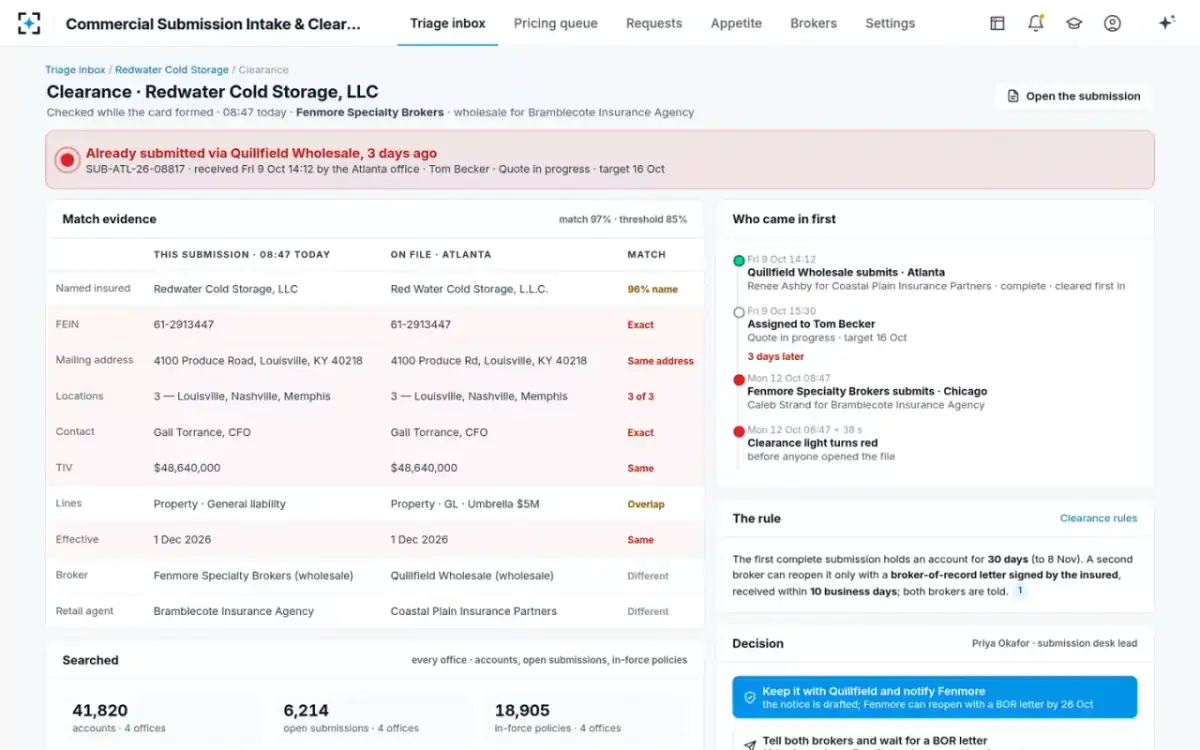
How do you test underwriting AI on your own files?
Test it by replaying past submissions whose outcomes you already know: the duplicates your desk caught, the risks you declined, the files that needed requests, and a random sample of the rest. Score each component on its own job, and report errors in both directions.
For keying, score field by field against the source page, counting values present but wrong separately from values marked missing that were there; the method is set out in underwriting data quality. For clearance, count true duplicates missed and false duplicates raised, because a threshold that reduces one raises the other. For appetite, check that every verdict cites the rule that applied and that the rule is the one in your guide. For drafted requests, check that nothing asked for was already in the file. A vendor that resists this test, or wants to run it on its own sample, has told you what it expects the result to be.
Can AI replace commercial underwriters?
Not the decisions. AI can take over much of the reading, keying and searching that surrounds a commercial underwriting decision, but the decision itself, to accept, price or decline a risk and stand behind it, remains a person's, and the rules above assume it does. What changes is how an underwriter's day is spent.
The labour data point the same way. The BLS projects underwriter employment to fall 4% between 2025 and 2035, about 6,800 openings a year remaining, and attributes the decline to automated underwriting software, while noting that complex lines rely more on analytical insight. O*NET's task list for the job still begins with judgement: examining documents to determine the degree of risk, and "Decline excessive risks." A field study of generative AI at work, published by the NBER, measured customer support, not underwriting: access to an assistant raised issues resolved per hour by 14% on average and 34% for novice and low-skilled workers (NBER working paper 31161). It suggests where gains come from, the routine part of skilled work, without telling us their size in underwriting.
Where Commercial Submission Intake & Clearance fits, and where it does not
Commercial Submission Intake & Clearance fits the intake end of commercial underwriting: six agents read the region's mailboxes, key the forms with the page and box behind every value, clear each submission across every office, test it against the carrier's approved appetite guide, draft requests for what is missing and rank what is ready. It works from what the broker sent, the carrier's own book and its written rules.
In Commercial Submission Intake & Clearance every appetite verdict cites an approved rule
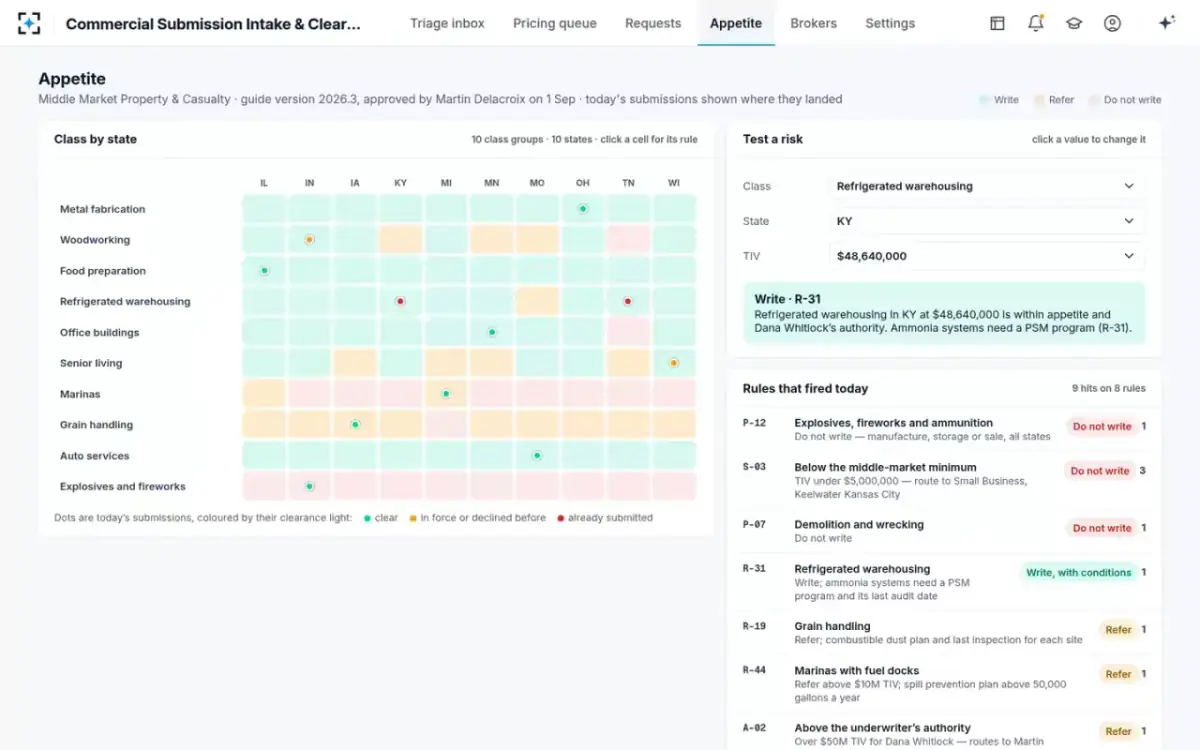
Answered against the ten questions: it recommends and drafts, and people decide every clearance conflict, decline and message to a broker; every keyed value, match and verdict shows its source; a value not in the file is marked missing; each agent's limits are written down and enforced; the appetite guide and clearance rules are the carrier's, versioned with who changed them and when; and every step is on an audit trail that can be replayed. It is meant to be proved on the carrier's own submissions before anything else.
Where it does not fit: it does not price or select risks, so the testing questions that apply to pricing models are not its questions; it does not replace the policy system or the underwriting workbench, which submission management system or intake layer discusses; and the producer appointment and sanctions checks sit outside its six agents in the sample flow. What happens after intake, who may sign which risk and how referrals travel, is a different purchase, covered in underwriting automation software. Data location, access and contract terms are questions to put to Botminds as to anyone else. The agents and their limits are set out in submission intake automation, and the solution is at Commercial Submission Intake & Clearance.
Questions people ask
How many states have adopted the NAIC AI bulletin?
The NAIC's implementation map listed 29 jurisdictions, including the District of Columbia and Puerto Rico, as adopting the model bulletin as of 8 October 2026. California, Colorado, New York and Texas were listed separately with their own insurance-specific AI regulation or guidance.
Does the EU AI Act treat commercial underwriting AI as high-risk?
Its Annex III high-risk list covers AI for risk assessment and pricing of natural persons in life and health insurance, not commercial property and casualty. Other obligations of the Act can still apply to a system used in the EU, so the answer is "not as high-risk", not "out of scope".
Is generative AI covered by the same rules as predictive models?
Under the NAIC bulletin's definition, yes: an AI system includes machine-based systems that generate content such as text, as well as predictions and recommendations. A drafting agent belongs in the insurer's AI programme alongside its rating models, with controls scaled to its risk.
What is the NAIC AI Systems Evaluation Tool?
An NAIC tool for the state supervision of insurers' AI. The Federal Insurance Office, describing that supervision in its 2026 report, said the tool's pilot was running in 12 participating states as of March 2026.
Should a vendor's AI be explainable to the underwriter?
Explainable enough that the underwriter can check it before relying on it. For intake, that means sources rather than model internals: the page behind a value, the fields behind a match, the rule behind a verdict. New York's letter makes the insurer, not the vendor, answerable for the outcome either way.