An underwriting submission checklist is the list of documents and facts a broker sends with a commercial submission so that the carrier can clear it, test it against appetite and price it without asking for anything else: a signed application naming the insured exactly as it appears on its tax filings, the FEIN, every location written the same way everywhere, a section for each line requested, a usable schedule of values, loss runs for every year the carrier asks for, recent financials, payroll and revenue by class, and supplements for special hazards. The files quoted first are the ones that need no follow-up email, because every request to the broker adds a round trip, and a carrier's reminders run on a clock of days, not minutes. This page is written for the broker's side of the desk. It explains what a carrier checks when a file arrives, using Botminds' Commercial Submission Intake & Clearance, an agentic solution that reads, keys and clears each submission on arrival and drafts a request listing only what is missing.
The examples follow a fictional sample carrier, Keelwater Insurance Group, and submissions from fictional brokers on Monday 12 October 2026; the statutes and examination standards cited are real and linked.
The underwriting submission checklist: twelve items a carrier checks at intake
- The named insured, exactly, with every trading name
Clearance matches on the name. "Red Water Cold Storage, L.L.C." and "Redwater Cold Storage, LLC" are one business to a good match and two to a careless one.
- The FEIN
The single strongest identifier a carrier can match on. It settles whether two submissions are the same business faster than any spelling.
- Mailing and location addresses, written the same way everywhere
The application and the schedule of values should agree, so each location is matched and priced once.
- A signed, dated application
Examiners test for signed applications where they are required; an unsigned one comes back.
- A section for every line requested
Completeness is judged per line. A property quote cannot start from a general liability section.
- A schedule of values in a spreadsheet, every column filled
Address, construction, year built, area, protection and values for each location. A blank column is a request.
- Loss runs for every year asked, from every prior carrier
All pages, currently valued. A run that stops at page one of two is incomplete, and so is a missing year.
- Recent financial statements
The latest year at least; they support size, revenue and the carrier’s view of the insured.
- Payroll and revenue by class
The exposure bases most liability and workers’ compensation rates are built on, with the class codes explained.
- Supplements for special hazards
Ammonia refrigeration, fuel docks, cooking, height work: whatever the carrier’s appetite rules ask about, answered in full.
- The covering email: effective date, expiring premium, what to quote
Options, limits and exclusions the insured wants priced, so the first quote is the right one.
- One submission per carrier, through one channel
A second submission of the same account, through another office or wholesaler, is a duplicate the carrier will block.
What should be included in a commercial insurance submission?
A commercial insurance submission should include everything the carrier needs to identify the insured, describe the exposure for each line requested and see the loss history, so that it can clear the account, test appetite and price without asking for more. In practice that is the twelve items above, and the ones most often left out are the ones that look minor to the sender: a trading name, a FEIN, a year built, a page of a loss run.
The minor items matter because they are what the carrier's first checks run on. Clearance needs the name, FEIN and addresses before anything else; appetite needs the class, state, size and loss history; completeness needs every section for every line. A file that has all twelve can be cleared, tested and ranked in the minute after it arrives. In the sample, a structural steel fabricator's submission arrived at 08:45 at 100% complete, cleared and in appetite, and was second in the senior underwriter's pricing queue before 09:00.
What do underwriters look for in a submission?
Underwriters look for the exposure: what the insured does, where, at what size, with what values at risk and with what loss history, and anything unusual that would change the price or the decision. O*NET's description of the job puts it in one line: "Examine documents to determine degree of risk from factors such as applicant health, financial standing and value, and condition of property."
For a broker, the useful translation is that underwriters look for the facts that move price and eligibility first, and read the rest only if those pass. Class and state decide appetite; insured values and payroll decide size and authority; construction, protection and year built drive property pricing; the loss runs drive both. A submission that leads with those, clearly and completely, is read faster than one that buries them in a narrative. The carrier's examiners look for the same things in the file afterwards: the NAIC examination standard asks whether the underwriting file contains what the insurer needs to know the exposure it took on.
What is the difference between ACORD 125 and 126?
ACORD 125 is the general commercial insurance application, carrying the applicant's identity, addresses, nature of business, prior carriers and loss history; ACORD 126 is the commercial general liability section, carrying the schedule of hazards, the classifications and the exposure bases the liability premium is built on. A general liability submission needs both, and property adds ACORD 140.
The forms in a typical package, what each carries, and the gap carriers see most
| Form | What it carries | What to check before sending |
|---|---|---|
| ACORD 125, general application | Named insured and trading names, FEIN, addresses, nature of business, prior carriers, loss summary | Name and FEIN exactly as the insured files taxes; every location also on the schedule |
| ACORD 126, general liability section | Schedule of hazards: classifications, exposure bases such as payroll or sales, products and completed operations | Class descriptions that match what the insured actually does; exposure figures that match the financials |
| ACORD 140, property section | Location and building details: construction, occupancy, protection, values | Year built and protection for every building; values that agree with the schedule of values |
| Schedule of values | One row per location with address, construction, year built, area, sprinklers and values | No blank columns; the total equals the insured values in the covering email |
| Loss runs | Claims history from each prior carrier, by policy year | Every year asked for, every page, a recent valuation date |
The difference matters because errors hide between the forms. A location listed on the 125 but missing from the schedule of values is a location the carrier cannot price; a class on the 126 that does not match the business described on the 125 is a question to the broker. The same fact written twice should say the same thing twice. In the sample, Redwater's covering email gave insured values of $48,640,000 across three locations and the schedule's total agreed, which is exactly the consistency a carrier checks.
How many years of loss runs do underwriters need?
The usual request is for several years, and the carrier's own requirement governs; the laws that oblige carriers to give insureds their loss history show the range. Florida requires a loss run statement covering the preceding five years when an insured asks in writing, Louisiana requires commercial insurers to provide five previous policy years of loss information within ten business days, and the NAIC's examination standard tests whether insurers provide three previous years within 30 days of a written request.
For a broker, two practical points follow. Request loss runs early, because the statutory clocks are measured in business days or weeks, not hours. And send every page of every year from every prior carrier: in the sample, a marina's runs covered 2021, 2024 and 2025 but not 2022 and 2023, and a cold-storage operator's 2021 run stopped at page one of two. Both became requests, and both cost days. Louisiana's statute adds a limit on the other side: a prospective insurer may not ask for more detailed loss information than it reasonably needs to underwrite the line. How carriers read and check loss runs once they arrive is covered in how to read a loss run report.
What makes a submission complete? Complete for each line, on arrival
A submission is complete when an underwriter can price every line requested without asking the broker anything. The sample carrier calls this complete on arrival: no request was needed before pricing. It is judged line by line, so a file can be complete for liability and incomplete for property.
The rate can vary widely by broker. Over 30 days, the sample carrier's Central region saw one retail broker's submissions arrive complete 88% of the time and another's 49%, and across 1,002 submissions about two in three arrived complete. The gaps behind the sample's requests were rarely hard items: a blank column, a missing year, a supplement left unanswered. A broker who checks the twelve items above before sending moves from the second group to the first, and the carrier's queue rewards it: in the sample, only complete, cleared, in-appetite submissions are ranked for pricing.
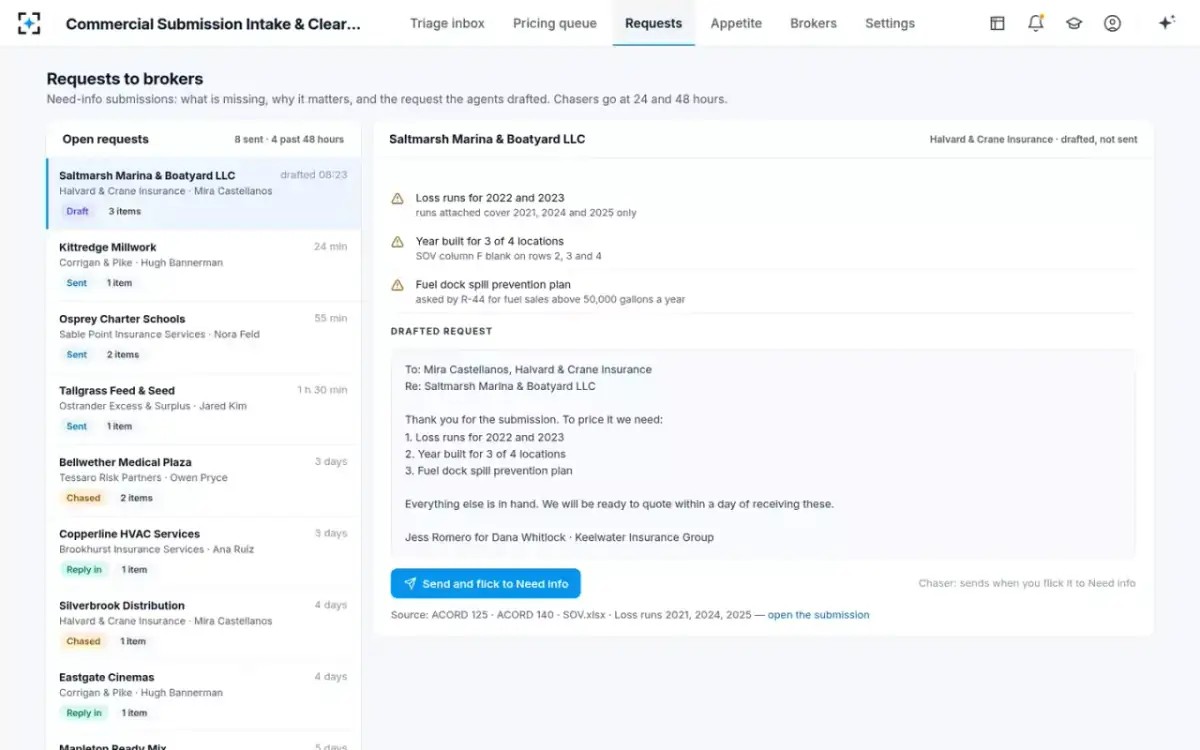
Commercial Submission Intake & Clearance turns a gap into a three-line request
Do I need a schedule of values for a quote?
For property with more than one location, yes: carriers price property building by building, and the schedule of values is where each building's address, construction, year built, protection and values live. A single-location risk can sometimes be priced from the property section alone, but a schedule in a spreadsheet is still the fastest thing to read.
What makes a schedule usable is that every column is filled for every row, the addresses match the application, and the total matches the insured values the broker quoted in the email. In the sample, the marina's schedule left the year built blank for three of four locations, which turned an otherwise quotable submission into a request. Carriers that validate schedules in depth, including values against construction costs and flood zones against maps, use tools such as Schedule of Values Validation, whose SOV template guide lists the columns to gather; at intake, the question is simpler: is every box filled and does the total agree.
Why does my submission keep getting declined?
A submission is declined for one of three reasons, and the fix depends on which: the risk is outside the carrier's appetite, the account is already with the carrier through another broker or office, or the file is too incomplete to price before the effective date. A good carrier says which; if yours does not, ask.
Commercial Submission Intake & Clearance cites the appetite rule that fired
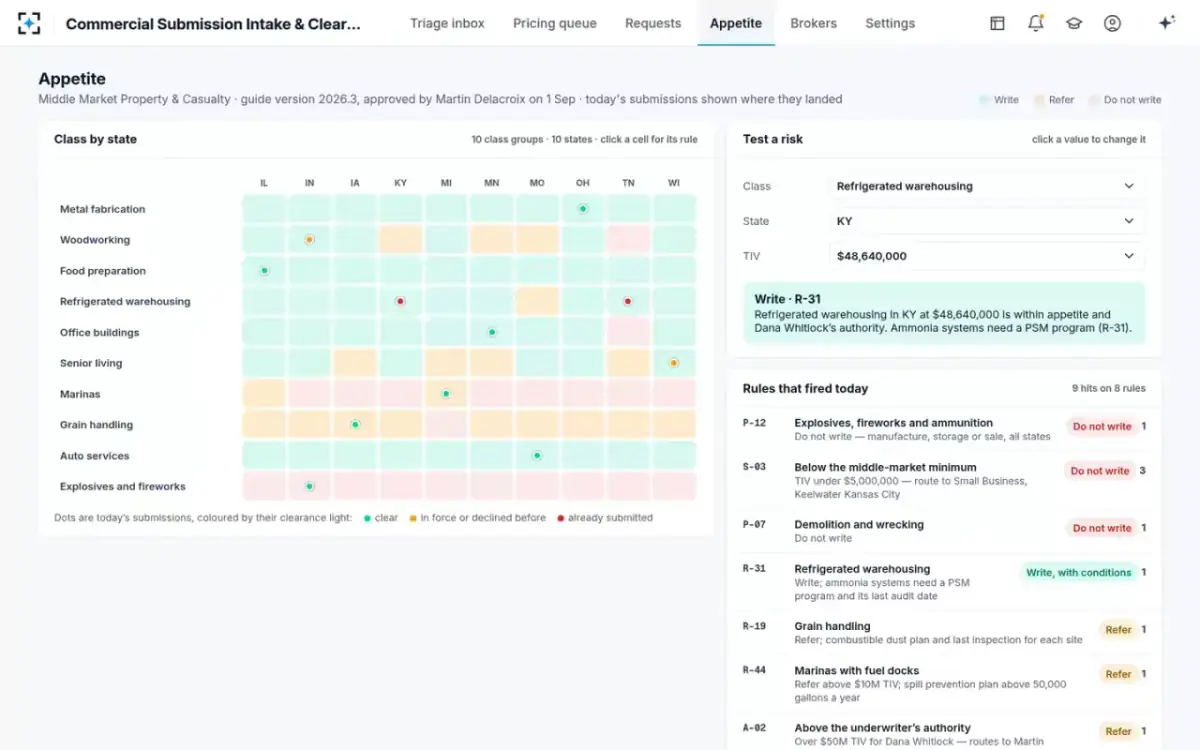
Appetite declines are about the risk, and three forms appear in the sample: a prohibited class (fireworks distribution under rule P-12, do not write in any state), a size below the carrier's minimum (rule S-03, insured values under $5,000,000 route to the small business unit), or a class the carrier writes only with conditions. Clearance declines are about the order of arrival, not the risk; the broker can reopen the account only through the insured, with a broker-of-record letter under the sample carrier's rule, as what a blocked market means explains. Incompleteness is the one decline the broker fully controls.
One more reason sits outside the file. Before a carrier accepts business from a producer it must be able to deal with that producer, and where the state requires it, appoint it; North Carolina's examiners, for one, applied a zero tolerance to unappointed producers. A broker placing with a carrier for the first time should expect that check, and can speed it by sending the agency's licence details with the first submission.
How do I get a faster quote from a carrier?
Send one complete submission, once, to the mailbox the carrier names, for a risk inside its appetite, and answer any request in full the same day. Each of those removes a wait the carrier cannot remove for you.
The rest is about the carrier's checks. Make clearance easy by giving the exact legal name, every trading name and the FEIN. Make appetite easy by describing the operations in plain words and answering the supplements. Make completeness easy with a schedule in a spreadsheet and every loss run page. On the carrier's side, the sample's request promised what that buys: "Everything else is in hand. We will be ready to quote within a day of receiving these." For workers' compensation in particular, expect to stand behind the classification: in Florida the employer swears to the accuracy of the application, and the agent swears to having explained the class codes.
The application must contain a sworn statement by the agent attesting that the agent explained to the employer or officer the classification codes that are used for premium calculations.
Florida Statutes § 440.381(2), on workers' compensation applications
The same account, sent two ways
Sent in a hurry: Trading name only; no FEIN.
Sent to be quoted first: Legal name, trading names and FEIN, the same on every form.
Sent in a hurry: Four on the application, three on the schedule.
Sent to be quoted first: Four on both, addresses written the same way.
Sent in a hurry: A PDF with year built blank on three rows.
Sent to be quoted first: A spreadsheet with every column filled and a total that matches the email.
Sent in a hurry: Three of five years; one run missing its second page.
Sent to be quoted first: Every year asked for, from every prior carrier, every page, recently valued.
Sent in a hurry: Fuel dock mentioned in the email; no supplement.
Sent to be quoted first: The spill prevention plan attached, with annual fuel volume stated.
Sent in a hurry: Also sent to another office by a second wholesaler.
Sent to be quoted first: One submission, to the mailbox the carrier names.
Sent in a hurry: A request for four items, a clearance conflict, and days.
Sent to be quoted first: Cleared, in appetite and ranked for pricing the same morning.
The carrier's side of this page, how a submission desk reads what brokers send, is in the commercial insurance submission process. To see how a carrier's agents read your files, start from Commercial Submission Intake & Clearance.
Questions people ask
Does the application need a fraud warning?
Where the state requires one, yes, and examiners check for it: the NAIC examination standard tells them to "Examine new business applications for the required fraud warning statement." The wording and whether it is required depend on the state, so use the carrier's or the state's current form.
Should I send the same submission to several offices of one carrier?
No. A carrier that searches all its offices will find the second copy and treat it as a duplicate, and one that does not may have two underwriters work the same account. In the sample, every duplicate the carrier caught in a month involved at least one wholesaler.
What is a FEIN and why do carriers ask for it?
It is the federal employer identification number, which the IRS describes as a federal tax ID for businesses and other entities. Carriers ask for it because it identifies the insured more reliably than any spelling of its name, which makes clearance faster and more accurate.
Is it better to send a partial submission early or a complete one later?
A complete one, unless the effective date is close. Under a first-in rule like the sample carrier's, the hold starts only with the first complete submission, so a partial file sent early does not reserve the account, and it starts a round of requests.
How fast should a carrier answer a submission?
That is the carrier's standard to set and publish. The sample carrier's target is ready to price the same business day the submission arrives, and its out-of-appetite declines went out in a median of four minutes over the sample week. Ask your carriers what they measure.