A broker of record letter, or BOR letter, is a written statement signed by an insured telling an insurer that a named broker or agent will act as its representative. In commercial lines it is how an insured moves an account, or a submission still being quoted, from one broker to another. New York's regulator has described it as an industry document rather than a creature of statute, which leaves each carrier to decide what it checks before acting on one. The switch looks simple and is not: the letter changes who represents the insured, but on a policy already placed it may leave the commission with the broker who placed it, and acting on a defective letter can produce an examination finding or a dispute between two brokers. Botminds' Commercial Submission Intake & Clearance is an agentic solution that matches each incoming submission against the carrier's book, so a letter arrives at a desk that already knows which broker holds the account and since when.
The sample examples follow a fictional carrier, Keelwater Insurance Group, and a fictional cold-storage account two wholesalers sent it three days apart. The letter shown below was written for this guide to illustrate the checks; the regulator opinions and statutes are real and linked.
What a carrier checks before it acts on a broker of record letter
- The signer is the named insured
An officer or owner with authority signs for the entity whose name and FEIN match the account or submission on file, not a subsidiary or a trade name the carrier has never seen.
- The new broker is named exactly
The agency entity and the individual producer, so the carrier can check the right licence and appointment.
- The producer is licensed for the line, in the state
Under the NAIC model, no one may sell, solicit or negotiate insurance without a licence for that line of authority.
- The producer is appointed, or the appointment is filed in time
Where states require appointment, the model gives the insurer 15 days from the first application to file it. Examiners test this.
- The scope is clear
Which policies, lines or pending submission the letter covers, so a property switch does not quietly move the umbrella too.
- The date is prospective
The change takes effect on or after the date the carrier receives the letter. Coverage dates are never moved backwards to fit it.
- The wholesale chain is settled
Whether the carrier’s contract requires the account to stay with the original wholesale broker even though the retail broker changes.
- The letter arrived inside the carrier’s window
If the account is held for another broker, the rule’s window for a signed letter (10 business days in the sample) decides whether it reopens.
- Both brokers are told, as the contracts require
No New York law requires notice to the former broker; the agreements may, and telling both is the safer habit.
- The file shows who decided, and when
The letter, the checks, the decision and the person who made it, kept with the submission or policy file.
What is a broker of record letter?
A broker of record letter is the insured's own written instruction to a carrier naming the broker or agent that will represent it, for one policy, several, or a submission not yet quoted. New York's Office of General Counsel defined it this way: "A broker of record letter is a written statement signed by an insured advising an insurer that a particular broker or agent shall act as the insured’s representative."
Two features of that definition carry the weight. The letter is signed by the insured, not by either broker, which is why it settles a dispute two brokers cannot settle between themselves. And it is addressed to the insurer, which means the carrier, not the outgoing broker, is the party that must act on it, check it and keep it. Searches such as "bor letter insurance meaning" and "broker of record change" are typed from one side of that switch; the carrier's submission desk is on the other.
Is there a law on broker of record letters?
In New York there is not, and the state's regulator has said so more than once. Its 2007 opinion put it in two sentences: the letter "is not a creation of statute or regulation; it was developed by the insurance industry as a means of conducting business," and "There are no laws or regulations governing broker of record letters." Opinions in 2003 and 2006 said the same, and added that whether the former broker must be told depends on the agreements between broker and insured and broker and insurer.
The absence of a statute does not leave the carrier free of law. The letter triggers duties that do have statutes behind them: the new producer's licence and appointment, the sanctions status of the insured, the effective date of any coverage, and the records the carrier must keep. A carrier that treats the letter as a formality is relying on the brokers to have checked those things for it. The 2007 opinion makes the practical point for wholesale business: the insurer may require, subject to any contractual limits, that a new retail broker keep placing the account through the original appointed wholesale broker, because that too is "a contractual matter".
Who signs a broker of record letter?
The insured signs it: an officer, owner or other person with authority to bind the named insured. Neither the incoming nor the outgoing broker can sign for the insured, and a letter signed by the broker who benefits from it is the first thing a careful desk rejects.
The signature can be electronic. Federal law provides that in interstate commerce a signature or record cannot be refused legal effect just because it is electronic (E-SIGN Act, 15 U.S.C. § 7001). That settles the format, not the authority; the check that matters is whether the person signing can act for the entity named on the account. A letter from "Redwater Cold Storage" signed by the plant manager of one warehouse is a different document from one signed by the company's chief financial officer, who in the sample was also the contact on both brokers' submissions.
An illustrative broker of record letter, annotated with what the desk checks
Redwater Cold Storage, LLC · 4100 Produce Road, Louisville, KY 40218
To: Keelwater Insurance Group, Central region submissions
Re: Property and general liability, effective 1 December 2026
We appoint Fenmore Specialty Brokers as our broker of record for the coverages above, effective on receipt of this letter. This replaces any prior appointment for these coverages.
Gail Torrance, Chief Financial Officer · signed electronically · 21 October 2026
- Named insured and address. Match the account and FEIN on file, not a trade name.
- Scope. Property and general liability only; any other line stays where it is.
- New broker. Check the agency’s and the producer’s licence and appointment.
- Effective on receipt. Prospective; no coverage date moves.
- Signer. An officer with authority; electronic signature acceptable.
- Date. Inside the carrier’s window, here 10 business days to 26 October.
What a broker of record letter changes, and what it leaves alone
A broker of record letter changes who represents the insured from the date the carrier acts on it: who negotiates, who services, who receives the next quote. On a policy already placed, it does not by itself move the commission the first broker earned.
New York's regulator, asked twice which broker is paid after a change of broker of record, answered that the Insurance Law has no rule on it and described the case law instead: "New York courts have generally held that, absent an agreement to the contrary, a licensed insurance agent or broker earns its commission when it brings about the relationship of insurer and insured." Applied to the facts in front of it, the 2004 opinion concluded that the original agency had earned the commission on the policy, "including the renewals thereof, when the policy was placed". The 2006 opinion, written for a broker hoping to take clients to a new firm, reached the same conclusion.
Whether notification must be given to the former broker that a broker of record letter was filed naming a new broker is dependent upon the terms of the broker-insured, and broker-insurer, agreements.
New York State Insurance Department, Office of General Counsel, Opinion 06-01-11
A broker of record letter moves the representation, not the past
Moves to the new broker from the date the carrier acts: Who receives the carrier’s quotes and talks terms for the insured.
Stays as it was unless an agreement says otherwise: Terms already quoted or bound through the old broker.
Moves to the new broker from the date the carrier acts: Who handles endorsements, certificates and questions from now on.
Stays as it was unless an agreement says otherwise: Work the old broker already did on the placed policy.
Moves to the new broker from the date the carrier acts: Commission on business the new broker brings about.
Stays as it was unless an agreement says otherwise: In New York case law as the regulator describes it, the commission the placing broker earned, renewals included.
Moves to the new broker from the date the carrier acts: The retail broker named in the letter.
Stays as it was unless an agreement says otherwise: The original wholesale broker, if the carrier’s contract requires it to stay.
Moves to the new broker from the date the carrier acts: Nothing: the letter changes no term.
Stays as it was unless an agreement says otherwise: The effective date, which may never be moved back to fit a switch.
For the carrier, the practical result is that the switch has two halves with different owners. The submission desk owns the representation half: which broker the carrier deals with from today. Finance and the broker agreements own the money half. A desk that confuses them, by telling an outgoing broker it has "lost" a commission the contract says it earned, creates a dispute the letter never required.
What does a carrier check before accepting a BOR letter? The two checks with law behind them
Of the checks on the list above, two rest on statute and are tested by examiners: the new producer's licence and its appointment with the carrier. The rest protect the carrier from disputes; these two protect it from findings.
The NAIC's Producer Licensing Model Act states the licence rule plainly: "A person shall not sell, solicit or negotiate insurance in this state for any class or classes of insurance unless the person is licensed for that line of authority in accordance with this Act." Its optional appointment section, where a state adopts it, gives the insurer fifteen days from the agency contract or the first application to file the appointment. A broker-of-record letter from a wholesaler the carrier has never dealt with is exactly such a first application.
Examiners count the misses. In North Carolina's 2020 examination of a commercial lines carrier, producers were not properly appointed on two of 50 commercial auto policies sampled, and the state applied a zero tolerance to unappointed producers; in the same sample one file did not contain the name of the individual producer at all. A letter that names only the agency, not the person, makes the second error easy. Where a carrier wants appointments tracked end to end, Producer Licensing and Appointment Management covers that work.
How long does a broker of record change take, and what is a BOR waiting period?
A broker of record change takes as long as the carrier's rule and the broker agreements say, because no New York statute sets a timetable. Two kinds of period can appear in a carrier's rule: a window in which a second broker must produce a signed letter to reopen an account another broker holds, and a waiting period between receiving a letter and acting on it, during which the incumbent can respond.
The sample carrier uses the first. When a second wholesaler's submission is blocked because the first wholesaler holds the account, the second can reopen it with a letter signed by the insured within ten business days, a setting the region can change to five, fifteen or twenty. For the Redwater account, blocked on Monday 12 October, that meant a letter by Monday 26 October. A waiting period is a different tool. It is meant to give the incumbent a chance to obtain a rescission from the insured, which protects the carrier from acting on a letter the insured is about to withdraw, at the cost of delaying a switch the insured has asked for. The search "broker of record letter waive waiting period" is that cost, typed into a search box.
Either period should be written into the rule, the same in every office, and stated in the notice the broker receives. A window the broker learns about only after it closes is how a desk turns a routine switch into a complaint.
Does the old broker get notified of a BOR letter?
Not by force of New York law. The regulator found no notification requirement in 2003, 2006 and 2007, and in each case pointed to the agreements between the broker, the insured and the insurer. An agreement may require notice, and a carrier that has promised it in a producer agreement is bound by that promise.
The sample carrier tells both brokers whenever a clearance conflict is resolved, whichever way it goes. The reason is practical rather than legal. A broker who hears from the insured that its account has moved, before hearing from the carrier, assumes the worst about the carrier's clearance desk; one who hears from the carrier, with the date of the letter and the rule that applied, has nothing to argue with but the insured's choice.
Can a broker of record letter be rescinded?
An insured that signed one letter can sign another, and no New York statute stops it; "rescinding broker of record letter" is a phrase people search because it happens. What the carrier needs is a rule for which letter governs, for example the latest letter, validly signed, received before the carrier acted on the earlier one, or inside any waiting period the rule provides.
The rule matters most when two brokers are each holding a signed letter from different officers of the same company. The desk cannot resolve that on the documents; it has to ask the insured, in writing, which instruction stands, and keep the answer. New York's records rule shows why the paper matters after the fact: insurers must keep licensing records "so as to show clearly the dates of appointment and termination of each licensee", and the underwriting file must hold the information needed to reconstruct how the business was solicited.
The date on the letter, and the 2003 backdating case
A broker of record letter changes representation from a date; it never changes when coverage started. The 2003 New York opinion arose from a placement in which both rules were tested, and one was broken.
Nine days of coverage that was never bound: the 2003 New York case
- Backdated term, 11 to 20 Aug9 days
- No order to bind yet11–13 Aug
- Bind order to broker A; insured shops broker B; BOR filed13–20 Aug
The insurer in that case had done the clearance step right. It refused to bind through the second broker until it had a broker-of-record letter. Then the policy's effective date was moved back to 11 August, nine days before coverage was bound on 20 August. The Department's conclusion was unequivocal: "The effective date of coverage on a commercial general liability insurance policy may not be "backdated" regardless that an unauthorized insurer wrote the policy." The opinion's reasoning is that an insurance contract depends on a future event; a term that starts before the bind covers days that had already passed when the insurer took the risk.
Broker switches create the temptation. The insured wants no gap between the old broker's placement and the new one's; the new broker wants the account to look seamless. The answer is to bind on time, not to rewrite the date, and a desk that checks the effective date against the bind timestamp catches the error before it is on the declarations page.
How Commercial Submission Intake & Clearance handles a broker-of-record conflict
In Commercial Submission Intake & Clearance, a broker-of-record question reaches the desk lead already framed: which broker holds the account, since when, which fields matched, and how long the second broker has to bring a signed letter. The clearance checker never blocks or releases a broker itself; it recommends and the submission desk lead decides.
In Commercial Submission Intake & Clearance the desk lead sees the rule, the clock and the options together
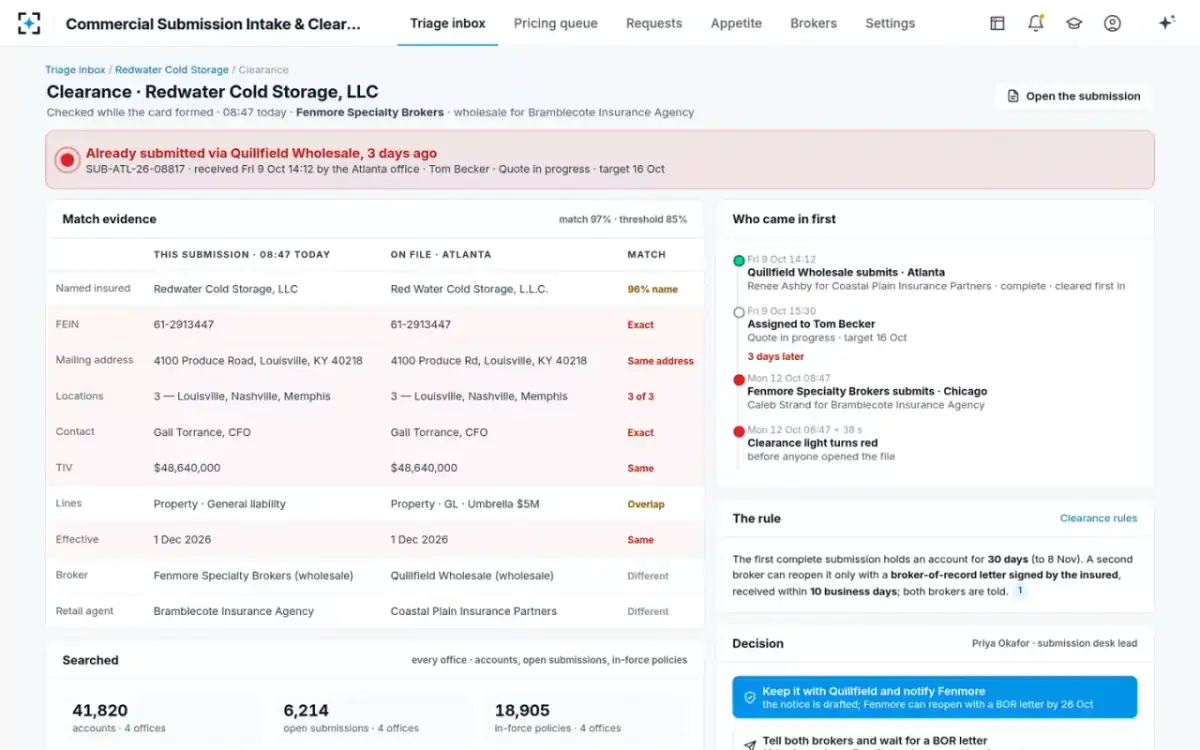
The desk lead's choices in the sample are the ones a written rule should offer: keep the account with the first broker and notify the second, tell both brokers and wait for a letter, or release the account. Release without a signed letter needs the regional underwriting manager's approval and a reason. Every choice is recorded with who made it and when, and moving a submission back to triage leaves what was already sent on the file. Why the first broker holds the account at all, and for how long, is the subject of what a blocked market means; the checks that come before any of this, at the moment the email arrives, are in the commercial insurance submission process. The solution is at Commercial Submission Intake & Clearance.
Questions people ask
Is a broker of record letter the same as an agent of record letter?
In substance, yes. New York's definition covers a letter naming "a particular broker or agent" as the insured's representative, and the name used tends to follow whether the producer is a broker or an agent. The checks a carrier runs are the same.
Can a broker of record letter be sent by email?
Yes. Under the federal E-SIGN Act a signature or record in interstate commerce may not be denied legal effect solely because it is electronic. What a desk must still confirm is that the person who signed can act for the named insured, which email alone does not show.
Does a BOR letter apply to a submission that has not been quoted yet?
It can, and at a carrier's submission desk that is where a clearance rule puts it to work. In the sample, a letter signed by the insured within ten business days would have reopened a cold-storage account another wholesaler held, with both brokers told.
Does the new broker get paid on renewals of a policy the old broker placed?
Not automatically in New York. The regulator's 2004 opinion concluded that, absent an agreement to the contrary, the original agency had earned the commission on the policy "including the renewals thereof" when it was placed. The broker agreements decide the rest.
What should a carrier keep after acting on a BOR letter?
The letter, the checks run on the new producer, the decision, who made it and when, and the notices sent. New York, for instance, requires insurers to keep licensing records for six calendar years after the relationship ends, showing the dates of each appointment and termination.