Submission intake automation is software that does the work between a broker's email and an underwriter's first look at a commercial submission: splitting the email, reading the applications, schedules of values and loss runs, keying them, checking whether the carrier already has the account, testing it against the appetite guide, asking the broker for what is missing and ranking what is ready to price. Most of that work is reading and typing, which is why it is worth automating. It is risky for the same reason: software that reads confidently can key a wrong value confidently, miss a duplicate, or send a broker something no person approved. Botminds' Commercial Submission Intake & Clearance is an agentic solution that splits the work among six agents, each with one job and a written line it may not cross, and leaves every decision that affects a broker or an insured with a named person.
The examples come from a fictional sample carrier, Keelwater Insurance Group, on the morning of Monday 12 October 2026; every broker, insured and person is invented, and the timings are what the solution showed on that sample. Regulatory and research sources are linked where they are used.
Six agents in Commercial Submission Intake & Clearance, and the line under each
Agent
Mailbox readerWatches the region’s submission mailboxes, splits each email, sorts every attachment by type and routes non-submissions, such as certificate requests, to the right team.
Never: replies to a broker or deletes an email
Agent
Submission keyerKeys the applicant, locations, values, coverages, prior carrier and loss history, with the page and box each value came from.
Never: guesses a missing value; it marks it missing
Agent
Clearance checkerMatches named insured, trading names, FEIN, addresses and contact against every office’s accounts, open submissions and in-force policies, scores the match and applies the carrier’s clearance rules.
Never: blocks or releases a broker
A person decides
Submission desk leadDecides any clearance conflict and signs the notice to the brokers.
Agent
Appetite checkerTests class, state, size, insured values and loss history against the approved appetite guide and returns write, refer or do not write with the rule; drafts the decline note for a prohibited class.
Never: declines on its own
Agent
Completeness and request writerScores completeness by line and drafts the request to the broker for what is missing.
Never: sends without a person, or asks for what is already in the file
Agent
Triage rankerRanks cleared submissions by fit, size and days to the effective date, and routes them by authority and workload.
Never: assigns past an underwriter’s authority
A person decides
UnderwriterMoves each submission to quote, need information or decline, sends the decline note and prices what is ready.
What is submission intake automation? The work it takes over
Submission intake automation takes over the reading, keying and searching a submission desk does before an underwriter is involved, and hands the underwriter a submission that is keyed, cleared and checked. People also call it submission ingestion or submission triage; the three names describe the same span of work from different ends.
The span is narrower than "underwriting automation" and the difference matters when buying. Intake automation does not price, does not set terms and does not bind. It decides nothing about the risk that an underwriter would recognise as judgement. What it changes is the condition of the file when judgement starts and the hour at which it can start. Botminds estimates that a typical middle-market submission worked by hand takes about eight desk hours before an underwriter opens it, half of them keying, and then waits about 16 working hours for an underwriter to open it; with the agents, the desk hours fall to about one and the wait to about two. That is an estimate from our product team, not a measurement, and the right number for any carrier is its own.
The federal description of the underwriter's job explains why the stage exists at all. Underwriters, the Bureau of Labor Statistics notes, use software that takes "specific information about an applicant" and returns recommendations; somebody has to get that information out of a broker's PDF and into the software first. That somebody is the intake desk, and the information is only as good as the keying.
Six jobs, six written limits: why each agent does only one thing
Each agent does one job so that each limit can be one sentence, and a one-sentence limit is one a reviewer can test. An agent that reads, keys, clears and declines in one pass has no line anyone can audit; six agents with six lines give the carrier six places to check that nothing crossed.
The limits matrix: what each agent may write, and who owns the decision after it
| Agent | What it writes | What it may never do | Who decides next |
|---|---|---|---|
| Mailbox reader | The sorted attachments and the route for non-submissions | Reply to a broker; delete an email | No one: routing only |
| Submission keyer | Field values, each with page and box | Fill a value that is not in the file | The underwriter, on review |
| Clearance checker | A match score, the fields matched and the rule that applies | Block or release a broker | Submission desk lead |
| Appetite checker | Write, refer or do not write, with the rule; a drafted decline note | Decline a submission | Underwriter; above authority, the regional manager |
| Completeness and request writer | A completeness score by line and a drafted request | Send to a broker; ask for what is already in hand | Underwriting assistant or underwriter |
| Triage ranker | A ranked queue, routed by authority and workload | Assign a risk above an underwriter’s authority; rank a red clearance | Underwriter and regional manager |
The middle column is the one to read in any vendor's design. "Never replies to a broker" means no message leaves the carrier on an agent's authority; "never guesses a missing value" means a blank in the application stays blank in the submission; "never blocks or releases a broker" means a clearance conflict is a person's decision even when the match is 97%. Each is a rule the software enforces and the audit trail can prove, not a guideline the agents are asked to follow.
Can AI read ACORD forms? Yes, if it shows its page
AI can read commercial applications, line supplements, schedules and loss runs, scanned or digital, and key them in seconds. Whether it should be trusted depends on one design choice: that every keyed value carries the page and box it came from, and that a value not in the file is marked missing rather than produced.
The risk is not that the reading fails loudly. It is that it fails quietly. NIST's profile of generative AI names the failure "confabulation" and defines it as producing false or wrong content stated with confidence (NIST AI 600-1). A model asked for a year built that the schedule leaves blank may supply a plausible one, and a plausible year built is worse than a blank, because nobody goes looking for it. Requiring a page citation turns that failure into one a reviewer can see: a value with no page behind it is a value the agent invented.
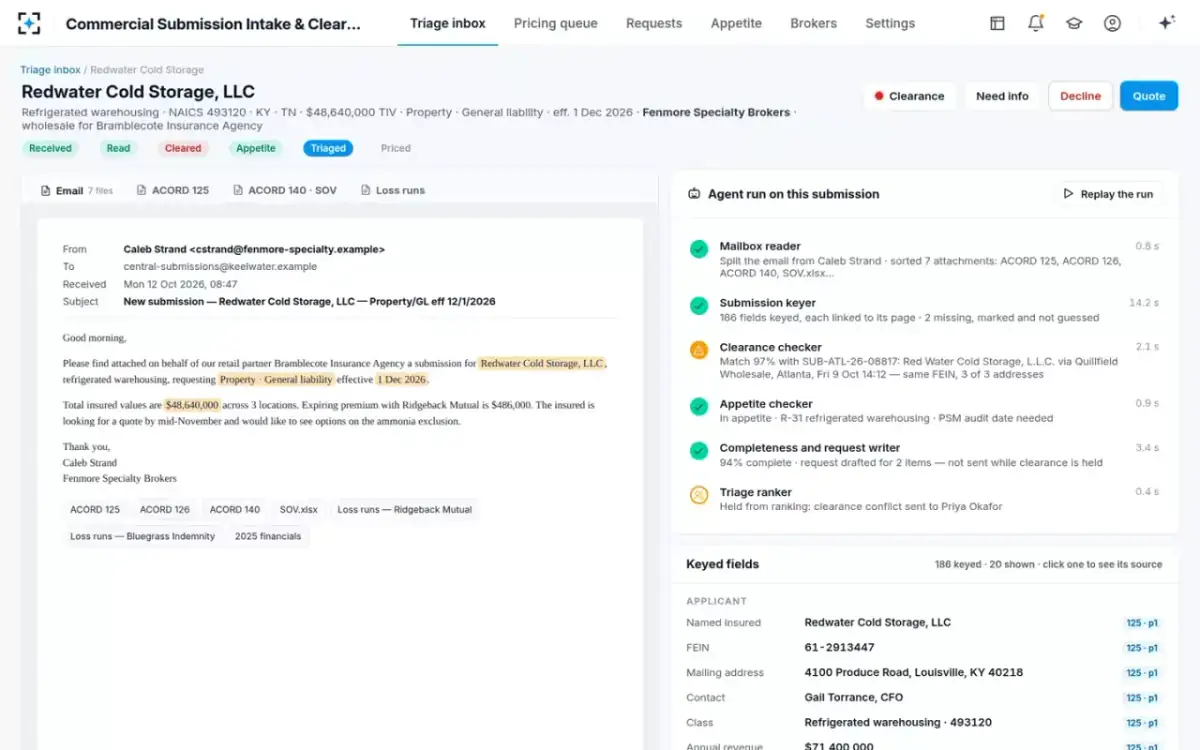
Commercial Submission Intake & Clearance keys 186 fields, each linked to its page
How accurate is AI data entry from an ACORD 125?
No regulator or research body publishes an accuracy figure for AI keying of commercial applications, and a vendor's figure measured on its own test set tells you little about your brokers' files. The useful number is one you measure: on a sample of your own past submissions, the share of keyed fields whose value matches the source page exactly, counted separately for fields that were filled and fields the agent marked missing.
Two counts matter more than the average. The first is how many values the system produced where the source was blank, because those are invisible errors. The second is how many it marked missing where the source had a value, because those cost a request to a broker who already sent it. A system that cites pages makes both counts cheap: a reviewer opens the cited box and compares. How to build that test, and why "complete" is the wrong measure, is set out in underwriting data quality: a complete submission can still be wrong.
One sample submission, from email to a decided conflict
7
attachments sorted by the mailbox reader in 0.8 seconds
186
fields keyed in 14.2 seconds, each linked to its page
2
values missing from the file, marked missing, not guessed
38s
from the email to a red clearance light, before anyone opened the file
How does AI clear submissions? Matching on every field at once
AI clears a submission by matching it against the carrier's accounts, open submissions and in-force policies on every identifying field at once, scoring how likely the two are the same business, and applying the carrier's rule above a threshold. Matching on the name alone is the weak version, because commercial names arrive with every possible spelling, suffix and punctuation.
The strongest single field is the federal employer identification number. The IRS describes it simply: "An EIN is a federal tax ID number for businesses, tax-exempt organizations and other entities." When both submissions carry it and it matches, the names hardly matter. When one lacks it, matching falls back on what statisticians call fuzzy matching, which a Census Bureau paper on business record linkage describes as an approach that "allows imprecision in the characteristics used to identify common entities" across datasets. The paper's examples are the ones a clearance desk sees every day: typographical errors in names, unusual abbreviations, a digit wrong in an address.
In the sample, the Atlanta office had keyed "Red Water Cold Storage, L.L.C." and the Chicago submission said "Redwater Cold Storage, LLC". The name matched 96%; the FEIN matched exactly; so did the mailing address written two ways, three of three locations and the contact. Overall, 97% against the carrier's 85% threshold. The checker searched 41,820 accounts, 6,214 open submissions and 18,905 in-force policies across four offices to find it, and showed every field it matched on so that the desk lead could check its work in a glance.
What parts of intake should stay human?
Every decision that changes what a broker or insured is told, or what the carrier owes, should stay with a named person: declining a submission, deciding a clearance conflict, releasing an account, sending anything to a broker, and of course quoting and binding. Agents should prepare each of those decisions so well that the person spends seconds, not hours, but the decision and its signature stay human.
The NAIC's model bulletin on AI, which the NAIC's own map listed as adopted in 29 jurisdictions on 8 October 2026, frames the reason in governance terms: an insurer's written AI programme has to cover every AI system used in a regulated insurance practice, whether the insurer built it or bought it from a vendor (NAIC model bulletin). Underwriting is a regulated practice. A carrier that lets software send declines has to defend each one as its own decision; a carrier that has software draft declines for an underwriter to send has a person who can.
The line is drawn where consequences start, not where difficulty does. Keying 186 fields is hard and stays with the agents; moving a fireworks distributor to decline is easy and stays with the underwriter, because a decline is a document with uses outside the carrier: a broker placing a New York risk in the surplus lines market, for example, may need it as one of the three declinations New York's excess line rule requires. The rule is 11 NYCRR 27.3, and it is one reason a decline should leave with a person's name on it.
Can an agent decline a submission?
In Commercial Submission Intake & Clearance, no. The appetite checker returns write, refer or do not write with the rule, and for a prohibited class drafts the decline note with that rule cited, but the underwriter moves the submission to decline and sends the note. That is a design choice, and the right one, because a decline has an audience outside the carrier.
Commercial Submission Intake & Clearance drafts the decline with the rule; the underwriter sends it
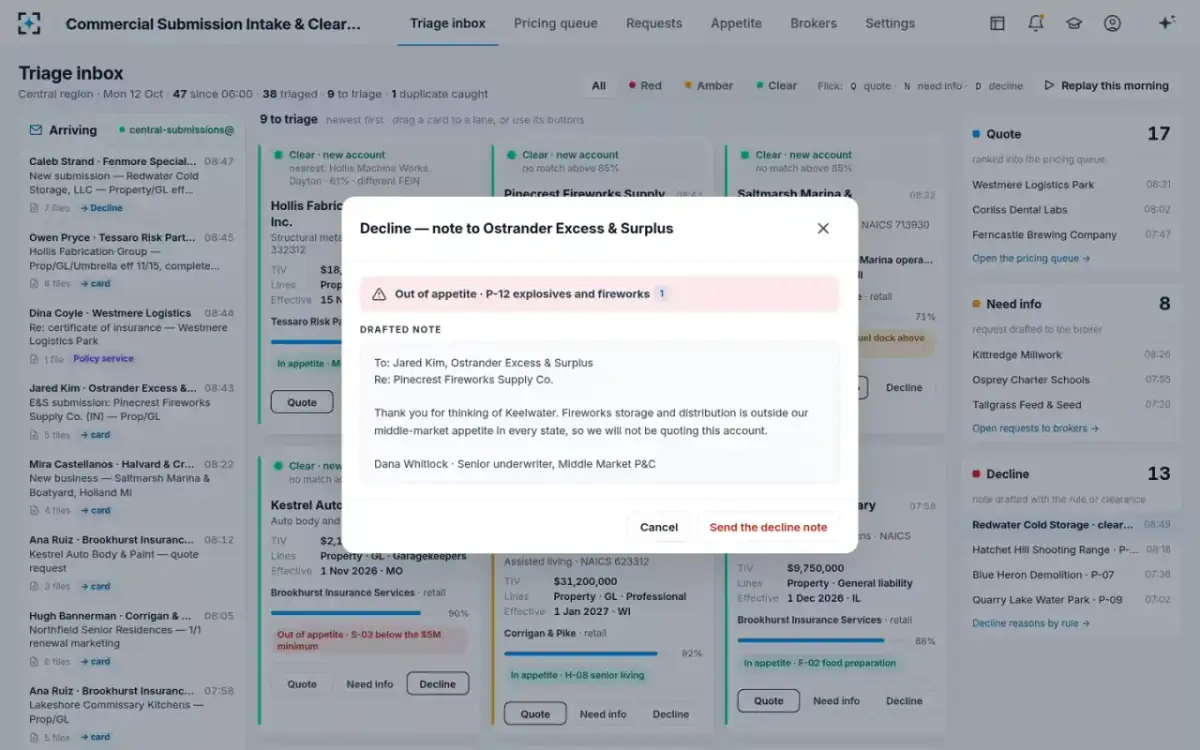
The sample morning shows why the split costs nothing in speed. Over the sample week the median time from an out-of-appetite email to the decline note was four minutes, with the note drafted before the underwriter reached the file. The broker hears quickly, the rule is cited in words it can act on, and a person stands behind the decline. The carrier also keeps what it declined: New York, for one, requires an insurer to keep an application that never became a policy for six calendar years (11 NYCRR 243.2) or until the examination report that reviewed it is filed, whichever is longer.
Does submission automation need broker consent?
We found no rule requiring a broker's consent before a carrier uses software to read what the broker sent it. The obligations that do apply run to the carrier: to protect the nonpublic information in the submission, to oversee any third-party service provider that holds it, and to answer for the outcomes of any AI system it uses, whoever built it.
That is a reason to ask a vendor different questions, not fewer. Where do the emails and attachments sit while the agents read them? Who at the vendor can see them? Does anything leave the carrier's control, and can the carrier audit that it does not? Those questions, and the state rules behind them, are worked through in submission management system or intake layer.
How do you audit an automated intake decision?
You audit it by replaying it: the email as received, each agent's step with its time and output, the evidence for every value and match, the rule version in force that day, and the person who decided. If any of those is missing, the decision cannot be reconstructed, and a decision that cannot be reconstructed cannot be defended.
The standard to meet is the records rule, not a vendor's dashboard. New York's version requires a policy file to hold, among other things, whatever else is needed to reconstruct how the policy was solicited, rated and underwritten (11 NYCRR 243.2; the underwriter sign off guide quotes it). An automated intake step is part of the solicitation and underwriting of every policy it touches. In the sample, every submission carries its agent run step by step with timings, every field links to its source, every clearance result shows the fields matched and the threshold, every verdict cites its rule from the approved guide, and every setting change is saved as a new rule version with who and when.
Buying submission intake automation: what to look for, and where this solution fits
Buy intake automation on evidence you can check against your own files, not on a demonstration of a clean application. The checklist below is what we would ask any vendor, including ourselves, and the paragraphs after it say plainly where Commercial Submission Intake & Clearance fits and where it does not.
Ten things to ask before buying submission intake automation
- Show the page for every value
Click any keyed field and see the box it came from. A value with no page is a value someone made up.
- Show what happens to a blank
Give it an application with a blank field and confirm the blank survives as "missing".
- Show every field a clearance match used
Not a score alone: the name, FEIN, addresses, locations and contact side by side, and the threshold.
- Name every action an agent may take on its own
And confirm none of them reaches a broker, releases an account or declines a risk.
- Cite the rule on every appetite verdict
Rule number and text from your approved guide, with the guide’s version and approver.
- Version every setting
Threshold, hold, windows, authority: each change saved with who made it and when.
- Search every office
Accounts, open submissions and in-force policies across all offices that can quote the same insured.
- Replay a decision
Pick last month’s duplicate and reconstruct it: email, agents, evidence, rule version, decider.
- Run it on your own submissions first
A sample of past files, with the outcomes your desk already knows, before any contract.
- Say where your data goes
Where emails and attachments sit, who can see them, and how the carrier audits it.
Where it fits: a commercial carrier whose submissions arrive by email with application forms, schedules, loss runs and financials attached; several offices or regions that can receive the same insured; a written appetite guide, or one that can be written; and underwriters who spend too much of the day reading. That is the work the six agents were built for, admitted or surplus lines, retail or wholesale.
Where it does not: it does not price, quote or bind, and it does not replace the policy administration system or the underwriting workbench; it fills them. It cannot apply an appetite guide the carrier has never written down. In the sample flow the producer appointment and sanctions checks sit outside the six agents, with the carrier's own tools. And a carrier whose brokers already submit structured data through a portal will gain less from the reading and keying, though clearance across offices still applies. To see the agents on your own submissions, start from Commercial Submission Intake & Clearance; the broader buying questions for AI in underwriting are in AI for commercial underwriting: ten questions before you buy.
Questions people ask
Does intake automation work on scanned or handwritten applications?
Scanned applications, schedules and loss runs, yes; the solution reads PDFs, scans and spreadsheets. Handwriting is harder for any reader, which is why the page citation matters most there: a reviewer can see the box and judge it.
What happens to emails that are not submissions?
The mailbox reader routes them. In the sample, a certificate request went to policy service and a signed application was added to the file it belonged to, before any underwriter saw either.
Can the agents work in more than one region or office?
Yes, and clearance is better for it. Each region sets its own rules, and the search scope is a setting; the sample carrier searches all four offices, which is how a Chicago submission found its Atlanta duplicate.
Who changes the rules the agents apply?
People do, as settings. The appetite guide is approved by a named manager (version 2026.3 in the sample, approved on 1 September) and clearance settings are versioned, so a verdict on any date can be traced to the rule in force that day.
How long do the six agents take on a submission?
On the sample Redwater file, under 25 seconds of agent time in total across the six steps, and 38 seconds from the email arriving to the red clearance light. The waiting that remains is for people, which is why the solution's target is ready to price the same business day, not the same minute.