A submission clearance specialist is the person on a commercial carrier's submission desk who decides, before any underwriter opens a broker's file, whether the carrier can work on it at all: whether the account is already in the house through another office or another broker, which broker came first, whether that producer may place business with the carrier, and whether the applicant can be insured. The seat never prices a risk, yet it settles which broker the carrier deals with and whether an underwriter spends a day on a file another office is already quoting. The work is hard because the same business arrives under different spellings, in different formats, from wholesalers who never see each other's emails. Botminds' Commercial Submission Intake & Clearance is an agentic solution that reads, keys and clears each submission as it lands, so the specialist starts from the match evidence instead of the search.
The examples below follow a fictional sample carrier, Keelwater Insurance Group, and its Central region desk on Monday 12 October 2026, as it runs through the solution. Every person, broker and insured named is invented. The research comes from state regulators, the NAIC and the Labor Department's occupational data, linked where it is used.
Four seats around one duplicate, and what each one keeps
Today
Owns clearance conflicts and broker-of-record letters, and hears about a duplicate only when somebody happens to notice it.
With agents
Sees the conflict the minute the second email lands, with the two submissions side by side and the carrier’s first-in rule beside them.
Still theirs: The decision on every conflict, and the signature on every clearance notice.
Today
Starts the day with 40 to 60 new submissions for the region and can find out a file was a duplicate only after working it.
With agents
Opens files that are already keyed, cleared and tested against appetite, and moves each to quote, need information or decline.
Still theirs: Every quote, every decline and every judgement about the risk itself.
Today
Retypes applications from PDFs and chases brokers for loss runs and missing schedules.
With agents
Sends requests that list only what is missing, with follow-ups at 24 and 48 hours.
Still theirs: The relationship with the broker’s account team.
Today
Approves risks above an underwriter’s authority and wants underwriters pricing, not reading email.
With agents
Receives above-authority risks routed automatically and sees each broker’s duplicates and completeness for the month.
Still theirs: Approval of the appetite guide, and of any release of an account without a signed broker-of-record letter.
What does a submission clearance specialist do? Four checks, in order
A submission clearance specialist runs four checks on every new submission: is the insured already here, who brought it first, may this producer place business with us, and may we insure this applicant at all. Only a submission that passes all four should reach an underwriter's queue, because each failure is cheaper to catch at the door than after a day of underwriting.
The first check is a search. The specialist looks for the named insured, its trading names, its federal employer identification number, its mailing and location addresses and its contact across every office's accounts, open submissions and in-force policies. The second applies the carrier's own rule to whatever the search finds, for example that the first complete submission holds the account for a set number of days. The third confirms the producer is licensed and appointed. The fourth screens the applicant and its owners against the sanctions lists.
The four checks between a broker's email and an underwriter's queue
Agent
Mailbox reader and submission keyerSplit the email, sort each attachment and key the named insured, trading names, FEIN, addresses and contact, each linked to the page it came from.
Never: guesses a value that is not in the file
Agent
Clearance checkerSearches every office’s accounts, open submissions and in-force policies while the submission is still forming, scores the match and applies the first-in, broker-of-record and prior-decline rules.
Never: blocks or releases a broker
A person decides
Submission desk leadDecides any conflict the checker raises: keep the account with the first broker, tell both brokers and wait for a signed letter, or release it with the regional manager’s approval and a recorded reason.
A person decides
Desk, with the carrier’s producer and sanctions listsConfirms the producer is licensed and appointed, and screens the applicant against the sanctions lists before any quote leaves the building.
None of the four checks needs underwriting judgement, and all four need care. A missed duplicate costs an underwriter's day and a broker relationship; a missed appointment is an examination finding; a missed sanctions hit can be a federal violation. That is why the seat sits apart from underwriting even at carriers where underwriters clear their own files: it is a control, not a courtesy.
What is submission clearance in insurance?
Submission clearance is the step that matches a new submission against everything the carrier already holds on the same insured and applies the carrier's rules to the result. It is not underwriting, because it makes no judgement about the risk, and it is not an appetite check, because a risk can be squarely in appetite and still be blocked by clearance.
The federal description of the underwriter's job shows where clearance comes from. Among the tasks O*NET lists for insurance underwriters is to "Review company records to determine amount of insurance in force on single risk or group of closely related risks." Clearance is that search done earlier, at the door, by someone whose job is to do it the same way every time, and with a second purpose: to find not only how much the carrier already has on the risk, but who brought it in.
The sample shows the difference between clearance and appetite in one file. Redwater Cold Storage, LLC, a refrigerated warehouse operator with $48,640,000 of insured values across Louisville, Nashville and Memphis, arrived at the Chicago office at 08:47 from a wholesaler. The appetite guide said write, under the refrigerated warehousing rule. Clearance said stop: another wholesaler had sent the same account to the Atlanta office three days earlier, and an underwriter there was already quoting it. Blocked by clearance, not by appetite, and the broker deserves to be told which.
What happens when two brokers submit the same account?
When two brokers submit the same account, the carrier applies its own clearance rule. In the sample carrier's rulebook the first complete submission holds the account for 30 days, and the second broker can reopen it only with a broker-of-record letter signed by the insured. No statute writes that rule; New York's regulator has said in writing that no New York statute or regulation addresses an insurer quoting one account to more than one broker, which is why a blocked market is a carrier practice, not a right.
The hard part is not the rule but the match. The second submission need not look like the first. In the sample, Atlanta had keyed the insured as "Red Water Cold Storage, L.L.C."; Chicago received "Redwater Cold Storage, LLC". A name search alone could have scored the pair as different businesses. The match held because the clearance checker compared every identifying field together: the same FEIN, the same mailing address written two ways, three of three locations, the same chief financial officer as contact, the same insured values and the same effective date.
Commercial Submission Intake & Clearance catches a duplicate 38 seconds after the email
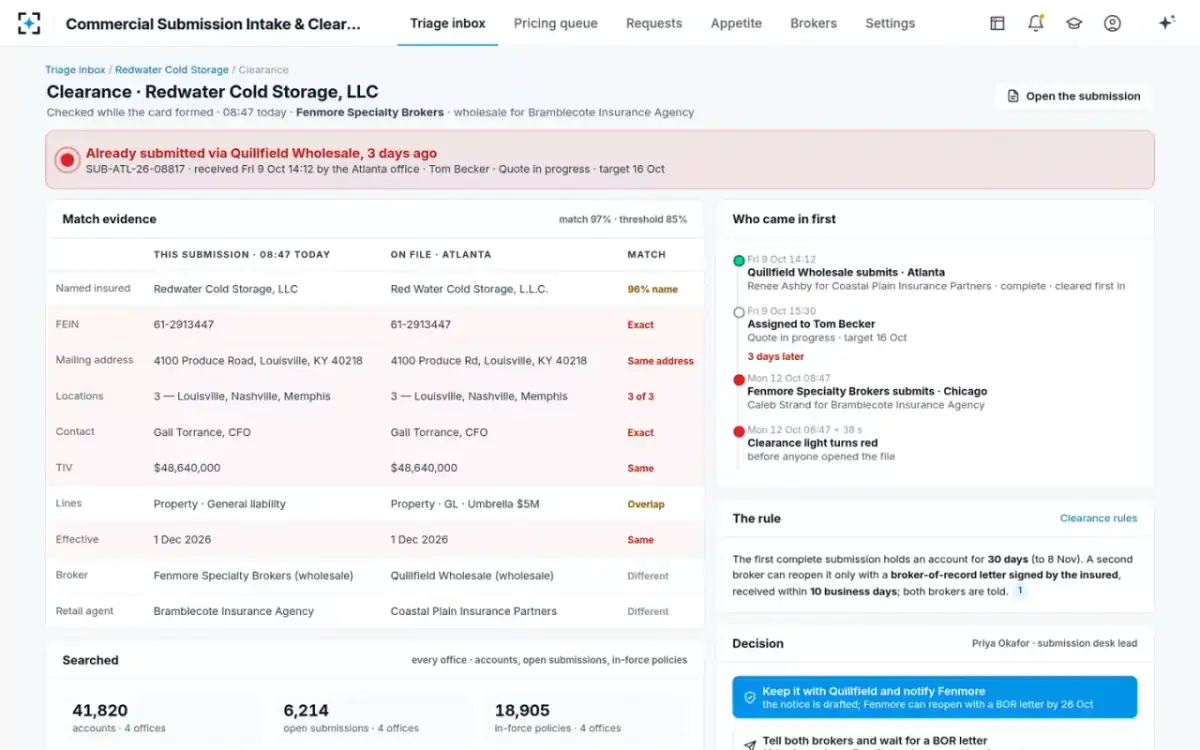
Under the sample carrier's rule, Quillfield Wholesale held Redwater until 8 November, thirty days from its complete submission on Friday 9 October. Fenmore Specialty Brokers could reopen it only with a letter signed by the insured within ten business days, by 26 October, and both brokers would be told. The desk lead's options and their consequences are set out in what a carrier checks before it switches a broker of record.
Who decides which broker gets a submission?
A named person at the carrier decides, applying a written rule: in the sample, the submission desk lead, with a manager's approval for exceptions. Not the broker, not the agent who keyed the file, and not the software. What makes the decision defensible is that it is the same decision the carrier would make for any broker in the same position, written down before the conflict arose.
Examiners read for exactly that. The NAIC's examination standard for underwriting warns that handling like risks differently, even by accident and even in what extra information is requested, can amount to unfair discrimination (NAIC exam standards; see the underwriting audit checklist). The same standard tells examiners that guidelines can differ by region and should be reviewed office by office. A clearance rule applied one way in Atlanta and another in Chicago is two rules, and the broker who loses under the stricter one can find out.
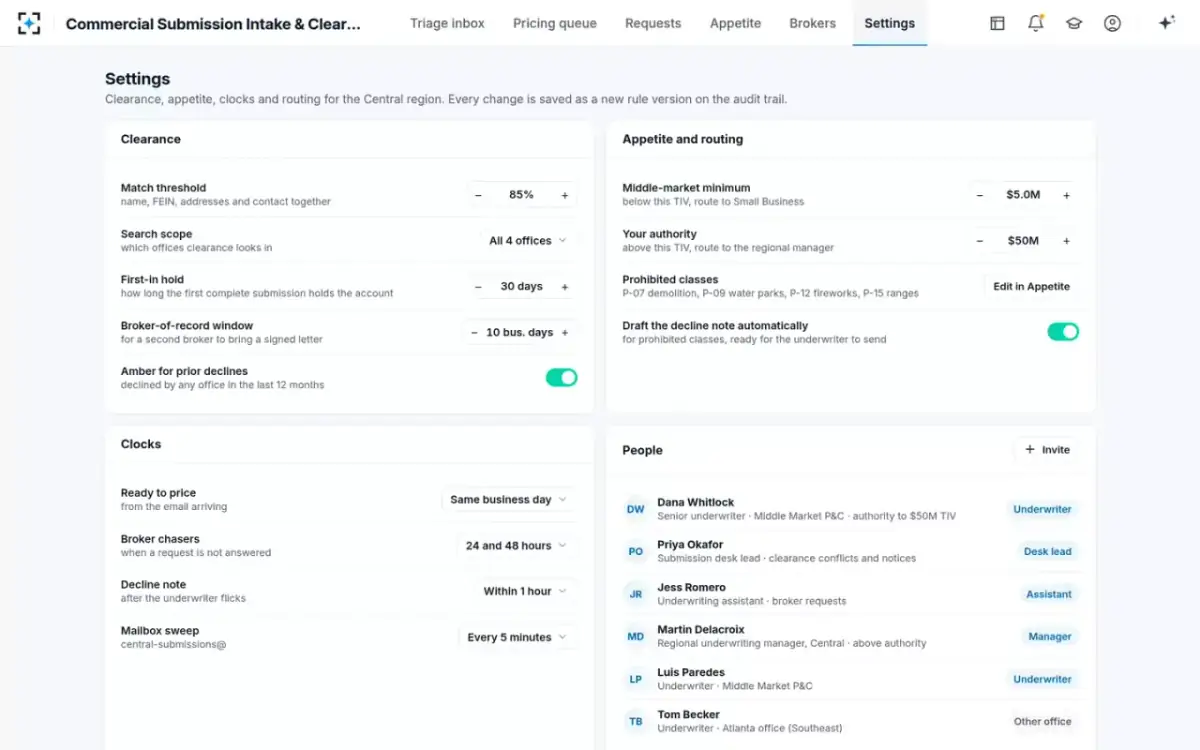
In the sample, the rule is a setting each region owns: the match threshold, which offices clearance searches, how long the first complete submission holds the account, and how many business days a second broker has to bring a signed letter. Every change is saved as a new version with who changed it and when. Releasing an account to the second broker without a signed letter needs the regional underwriting manager's approval and a reason, which is the exception an examiner or an aggrieved broker will ask about first.
The two checks examiners do test: appointment and sanctions
Whatever the carrier's clearance rule says, two intake checks rest on law and are tested in examinations: that the producer is licensed and appointed, and that the applicant is not a sanctioned party. Both belong at the door, because both are cheaper to catch before a quote than after a bind.
The appointment check has a clock attached. Under the NAIC's Producer Licensing Model Act, "An insurance producer shall not act as an agent of an insurer unless the insurance producer becomes an appointed agent of that insurer." In states that follow the model, the carrier files the appointment "within fifteen (15) days from the date the agency contract is executed or the first insurance application is submitted". The clearance desk can be the first place a carrier sees a new wholesaler's name, which makes it a natural place to start that count.
Examiners do find the gap. North Carolina's market conduct examination of a commercial lines carrier, published in 2020, cited it because "the producers were not properly appointed by the Companies for two of the active" commercial auto policies in its sample of 50, applied a 0% tolerance to unappointed producers, and directed: "Procedures must be put into place to verify producers are properly appointed by the Companies." Carriers that want the appointment side handled end to end can look at Producer Licensing and Appointment Management.
The sanctions check carries a different kind of risk. OFAC's insurance guidance says it can impose civil penalties on a strict liability basis (OFAC insurance FAQs), which it explains as liability even without knowledge that a transaction was prohibited. The same guidance covers the moment an application arrives: "If the blocked person sends a deposit to the insurer along with the application, the deposit must be blocked and reported to OFAC within 10 business days, unless authorized or exempt."
The people who do intake work, and what an hour of their time costs
239,100
insurance claims and policy processing clerks employed in 2025
O*NET, from BLS data
$23.67/hr
median wage of those clerks, 2025
125,600
insurance underwriter jobs in 2025
BLS Occupational Outlook Handbook
$39.12/hr
median underwriter pay, 2025
Does a clearance specialist need a license?
Not for clearance as such under the NAIC model's terms, though the answer turns on each state's definitions and on what else the job includes. The NAIC model act requires a license to sell, solicit or negotiate insurance (broker of record letter quotes it); searching the book, matching a submission and applying a written rule are, on their face, none of those. A clearance specialist who also discusses terms with brokers or quotes is doing something else, and should be licensed for it.
The federal occupational data place the work closest to policy processing rather than to underwriting. O*NET's profile of insurance claims and policy processing clerks lists "Underwriting Assistant" among its reported job titles, and its tasks include "Review and verify data, such as age, name, address, and principal sum and value of property, on insurance applications and policies." That is the matching half of clearance. The rule-applying half, deciding a conflict between two brokers, is a judgement a carrier should give to a named lead with written authority, whatever the job title.
How many submissions does a clearance desk handle a day?
No regulator or research body publishes a figure for clearance volumes, and the honest answer is the one in your own mailboxes. Count submissions by received timestamp, take out the email that is not a submission (certificate requests, endorsements, loss-run requests from insureds), and count duplicates per hundred. Those three numbers size the desk better than any industry average.
The sample desk gives a sense of the shape. By 08:47 on the Monday the Central region had received 47 submissions since 06:00. Over the preceding 30 days it received 1,002 submissions from ten brokers and wholesalers, and clearance caught 14 duplicates, nine of them between two wholesalers. None was quoted twice. Fourteen in a thousand sounds small until each one is priced as an underwriter's lost day and a broker told late that his work was wasted.
Where a submission's eight desk hours go when it is worked by hand
One middle-market submission, by hand
- Keying applications, schedules and loss runs · 50%
- Opening, sorting and logging · 12.5%
- Clearance search · 12.5%
- Appetite and authority · 12.5%
- Writing the request for what is missing · 12.5%
The estimate makes one point clearly. The search itself is a small share of the desk's hours; keying is the large one. A clearance specialist who also keys spends most of the day typing, and the search that matters most happens last, after the hours have already been spent. Moving the search to the minute the email lands, before anyone keys anything, is what turns clearance from a filter into a front door.
Is submission clearance being automated? What moves, and what stays with the desk
The search is being automated; the decision should not be. Matching names, FEINs and addresses across hundreds of thousands of rows is work a machine does faster and more consistently than a person. Deciding which broker keeps an account is a business judgement with commercial and regulatory consequences, and it stays with the desk lead.
In Commercial Submission Intake & Clearance, the clearance checker runs while the submission is still forming. On the sample Monday it searched 41,820 accounts, 6,214 open submissions and 18,905 in-force policies across four offices and turned Redwater's light red 38 seconds after the email arrived, before anyone opened the file. Its written limits are short: it never blocks or releases a broker, and it shows every field it matched on. The triage ranker holds a submission out of the pricing queue while its clearance is red, so no underwriter is handed a file the desk has not decided.
Automation also has to get the opposite case right. Hollis Fabrication Group, a structural steel fabricator in Dayton and Springfield, Ohio, arrived the same morning and resembled an existing account, Hollis Machine Works. The name matched 61%, the FEIN differed, and the checker cleared it. A name-only search might have sent it to the desk as a possible conflict; the federal statisticians who match business lists for a living put the trade-off plainly: "The divide between false negatives and false positives is a key element of any classification exercise." The threshold that sets it is the carrier's to choose.
In Commercial Submission Intake & Clearance, clearance rules are the region's own settings
For the desk, the job changes shape rather than disappearing. The specialist stops searching and starts reviewing: confirming that a 97% match really is the same business, deciding conflicts, signing notices and keeping the rule consistent across offices. The pressure on the underwriting side is real; the BLS projects underwriter employment to fall 4% between 2025 and 2035 and names automated underwriting software as a reason. A clearance seat that owns the rule and the evidence is harder to replace than one that owns the search. What the seat is worth in the funnel is worked out in the quote to bind ratio and the KPIs behind it, and the whole solution is at Commercial Submission Intake & Clearance.
Questions people ask
Is submission clearance the same as checking underwriting appetite?
No. Appetite asks whether the carrier wants this class, state and size; clearance asks whether the carrier already has the account and who brought it. In the sample, Redwater Cold Storage was in appetite under the refrigerated warehousing rule and still blocked, because another wholesaler had submitted it to the Atlanta office three days earlier.
What do red, amber and green clearance results mean?
In the sample carrier's settings, red means the account is already submitted and held by another broker or office, amber means the insured is already in force with the carrier or was declined by any office in the last 12 months, and green means no match above the threshold. Amber is a prompt to look, not a block.
What match threshold should clearance use?
There is no standard figure; it is a trade between missed duplicates and false alarms. In a Census Bureau test on 700 hand-checked business pairs, missed matches made up 31.44% of the sample under one method and 1.42% under another, while false matches rose from 2.70% to 12.51%. The sample carrier uses 85% on name, FEIN, addresses and contact together, adjustable from 70% to 95%.
Should clearance search every office or only the region?
Every office that can quote the same insured. The duplicates that cost most are the ones between offices, because neither underwriter can see the other's queue; in the sample, the Redwater conflict was between Chicago and Atlanta. The search scope is a setting, so a carrier can start with one region and widen it.
What happens to the application when clearance blocks a submission?
It is kept. In New York, for example, an insurer must keep "An application where no policy or contract was issued for six calendar years" or until after the examination report that reviewed it is filed, whichever is longer. A blocked or declined submission is therefore part of the underwriting file an examiner can ask for.