Underwriting data quality is the degree to which the values an underwriter relies on, such as the named insured, FEIN, locations, insured values, class, payroll and prior losses, match the documents they came from and the facts those documents describe. The measure most desks use, how complete a submission is, answers a different question: whether every box is filled. A submission can be complete and wrong, and a complete-but-wrong file is worse than an incomplete one, because nothing about it invites a second look. The law and the examiners care about accuracy, and they care when the information was obtained. Botminds' Commercial Submission Intake & Clearance is an agentic solution that keys commercial submissions with the page and box behind every value and marks what is not in the file as missing, so that accuracy can be checked one click at a time.
The examples come from a fictional sample carrier, Keelwater Insurance Group, and the submissions its Central region received on Monday 12 October 2026; all names and figures describing them are sample data. The legal and statistical sources are linked where they are used.
Complete is not correct: the four states a submission can be in
Matches its source page? Yes on the left, no on the right
Complete, and every value matches its page
Ready to price
Every box the line needs is filled and each value traces to the application, schedule or loss run it came from. In the sample, a structural steel fabricator arrived 100% complete and went straight to the pricing queue.
Complete, but a value does not match its page
The dangerous quadrant
Every box is filled, so nothing prompts a second look. A dropped digit turns $48,640,000 of insured values into $4,864,000; a year built copied from last year’s schedule describes a roof that has since been replaced.
Incomplete, and the blanks are marked
Ask the broker, precisely
What is there is right and what is missing is named. In the sample, a marina at 71% complete was missing two years of loss runs, a year built for three of four locations and a spill plan.
Incomplete, and the gaps were filled by guessing
Wrong, and looks complete
The blanks were filled with plausible values to make the file look ready. It moves from the honest quadrant to the dangerous one, and nobody can tell which values were invented.
What is underwriting data quality? Two tests, not one
Underwriting data quality has two tests: is every value the line needs present, and does each present value match its source. The first is completeness and the second is accuracy, and only the second tells an underwriter whether the price will rest on the risk that was actually submitted.
The NAIC's examination standard puts both tests in one sentence. Examiners are to verify that "Application or enrollment forms are properly, accurately and fully completed, including any required signatures, and file documentation adequately supports decisions made." Accurately and fully are separate words. A desk that measures only how full the file is has measured half of what the standard asks, and the easier half.
There is a third dimension the standard implies and practitioners know: timing. Underwriting information is supposed to describe the risk as it was when the carrier took it on, and to be in the file when the decision was made. A value corrected after a loss is a different thing from a value checked at intake, however accurate it turns out to be.
Complete is not correct: why the dangerous quadrant is the full one
The most dangerous submission is the one that is complete and wrong, because every control that looks for blanks waves it through. An incomplete submission announces its own problem; a complete one with a misstated value hides it until the claim, the audit or the examination.
The four quadrants above are not equally likely to be caught. Blanks are caught by any completeness score. Wrong values are caught only by comparing each value with its source, which is slow by hand, so a desk working by hand can only sample it. And the fourth quadrant, gaps filled by guessing, is the one that software can make far worse. A system that produces plausible values where the source is blank turns every honest gap into a hidden error, and raises the completeness score while it does it.
That is why the sample's keyer has one written limit before any other: it never guesses a missing value. On the Redwater Cold Storage submission it keyed 186 fields and marked two missing: the date of the last process safety audit, left blank on the ammonia supplement, and the second page of a 2021 loss run that stopped at page one of two. A completeness score of 94% with two named gaps is worth more to an underwriter than 100% with two invented values, and the difference is invisible unless each value carries its page.
What is the difference between complete and accurate data? What the law cares about
Complete data has every required value; accurate data has the right values. The law of insurance contracts cares about accuracy, and specifically about whether a wrong value would have changed the carrier's decision. A missing value is a gap the carrier can see and ask about; a wrong one can unwind the policy.
New York's statute shows the structure. A representation is a statement of fact made by or for the applicant before the contract is made, and "A misrepresentation is a false representation, and the facts misrepresented are those facts which make the representation false." It matters only if material, and "No misrepresentation shall be deemed material unless knowledge by the insurer of the facts misrepresented would have led to a refusal by the insurer to make such contract." The same section adds that, on materiality, "evidence of the practice of the insurer which made such contract with respect to the acceptance or rejection of similar risks shall be admissible." A carrier that cannot show what it was told, and what it does with risks like this one, is poorly placed to argue either.
Florida's workers' compensation statute goes further for one line. Applications must carry, among other things, past and prospective payroll, employee classification and "any other information necessary to enable a carrier to accurately underwrite the applicant", and giving false, misleading or incomplete information on an application in order to lower the premium is a third-degree felony (Florida workers comp audit rules). Incomplete appears in that list too, but paired with a purpose; an honest blank and a deliberate one are different things in law as in underwriting.
A completeness check and a source check find different problems
Completeness check: Is every box the line needs filled?
Source check: Does each filled value match the page it came from?
Completeness check: Blank fields, missing schedules, missing years of loss runs.
Source check: Dropped digits, transposed figures, values copied from the wrong year or the wrong location.
Completeness check: Any value that is present and wrong.
Source check: Nothing about the source itself: a schedule that is accurate to its page can still be out of date.
Completeness check: Seconds per file.
Source check: Minutes per field, so desks sample it.
Completeness check: Unchanged.
Source check: One click per field: open the cited box and compare.
What do examiners check in underwriting files?
Examiners check that the application is complete, accurate and signed where required, that the file holds enough to show what exposure the carrier took on, and that the decision is supported by what the file contains. They do it on a random sample, field by field, against a tolerance.
The NAIC standard's review procedures are direct: the application "should be complete and signed, where required (includes electronic signatures)", and examiners are to determine that the underwriting file contains the information necessary to tell the insurer what exposure it has, and when the insurer requires an inspection, motor vehicle report or other information "to confirm exposure or premium basis". Those are intake questions. Each is answered, or not, before an underwriter ever opens the file.
The findings are concrete. In North Carolina's 2020 examination of a commercial lines carrier, examiners drew 50 general liability policies at random from 2,249 and found that "two of the files reviewed did not contain signed applications", a 4.0% error ratio, and reminded the carrier of the state rules. In the commercial auto sample, one file did not contain the name of the individual producer. Neither is an underwriting error in the usual sense. Both are data quality errors made at intake, and both are visible to anyone who opens the file.
Why do ACORD forms have errors?
Commercial applications carry errors for the same reasons any administrative data does: the same facts are typed more than once, by different people, from different sources, at different times. Each retyping is a chance to drop a digit; each copy from last year's file is a chance to carry last year's facts.
Business names and addresses are the worst affected. The Census Bureau's working paper on business record linkage observes that "The significant variation in the structure and quality of business name and address strings in administrative data" is what makes matching hard, and illustrates it with typographical errors, unorthodox abbreviations and a single wrong digit in an address. On a submission, those variations do two kinds of damage. They create apparent new accounts that are really duplicates, and they break the link between a location on the application and the same location on the schedule of values.
Schedules and loss runs add errors of their own. A schedule of values assembled for last year's renewal may carry last year's values; a loss run valued months before the submission may not show a claim reserved since. Neither is a keying error, and neither is caught by comparing a value with its page, which is why a source check is necessary but not sufficient. Schedules have their own discipline, covered in the statement of values guide, and loss runs theirs, in how to read a loss run report.
How do you measure submission data accuracy?
Measure it at the field level, on a sample, against the source: pick submissions at random, pick the fields that drive price and eligibility, open each field's source page and record whether the keyed value matches. The result is a field accuracy rate, and it should be reported in two parts, because the two kinds of error have different costs.
The first part is values present but wrong, including values present where the source is blank. The second is values marked missing where the source had them, which cost a needless request to the broker. The same split appears in any matching problem, including clearance, and the Census Bureau's test of two business-matching methods on 700 hand-coded pairs shows why a single accuracy number hides it: where the line between missed matches and false alarms falls is, in the statisticians' words, a key element of any classification (U.S. Census Bureau; see submission clearance specialist).
Fewer missed matches, more false ones: two methods on the same 700 business pairs
A field accuracy test you can run on last month's submissions
- Draw at random, not by convenience
Twenty or thirty submissions across brokers and lines, chosen by number, not the ones that were easy to find.
- Choose the fields that move price or eligibility
Named insured, FEIN, locations, insured values, class, payroll, revenue, effective date, prior losses.
- Open the source for every field
The application page, schedule row or loss-run line the value should have come from.
- Record four outcomes, not two
Matches; wrong; present where the source is blank; marked missing where the source has it.
- Report the rates separately
One accuracy figure hides the trade between invented values and needless requests.
- Repeat after any change
A new broker, a new form version or new software is a reason to run the test again.
How often are submissions missing information?
No regulator or research body publishes how often commercial submissions arrive incomplete, so the figure that matters is your own, by broker. It can vary widely by broker, and that variation is where the improvement lies.
Complete on arrival, broker by broker, in Commercial Submission Intake & Clearance
The spread is the point. In the sample, one retail broker's submissions arrived ready to price 88% of the time and another's 49%. The second is not a worse broker; it may simply send schedules with the year built left blank, as the marina submission did. A request that names exactly what is missing, and a monthly view of which items each broker leaves out, is how the 49% moves. What carriers ask for, and why each item costs days when it is missing, is set out for brokers in the underwriting submission checklist.
Who is responsible for bad underwriting data?
The applicant is responsible for what it represents, and the carrier is responsible for what it keys, relies on and keeps. Brokers stand between the two and answer to both. Legally, the burdens differ; operationally, the carrier is the one that has to price on the data and defend the file.
The applicant's side is in the statutes above: New York treats a material misrepresentation as grounds to avoid the contract, and Florida requires a workers' compensation applicant's sworn statement attesting to the accuracy of the application. The carrier's side is in the examination standard: the file has to support the decision, whoever supplied the error. A carrier that keyed a broker's correct value wrongly cannot blame the broker, and one that priced on a value it never compared with its source has accepted the risk that it was wrong.
Software does not move that responsibility. A carrier that uses a vendor's tool to key submissions still owns the keyed values. The practical consequence is to demand a tool that makes checking cheap, which in practice means a citation on every value and a blank wherever the source is blank.
How do you fix data quality at intake? Cite every value, guess none
Fix it at intake with four habits: tie every keyed value to its page and box, leave every blank visibly blank, compare the same fact where it appears twice, and ask the broker only for what is actually missing. Each habit is cheap at intake and expensive at any later stage.
In Commercial Submission Intake & Clearance every location and the total trace to the schedule
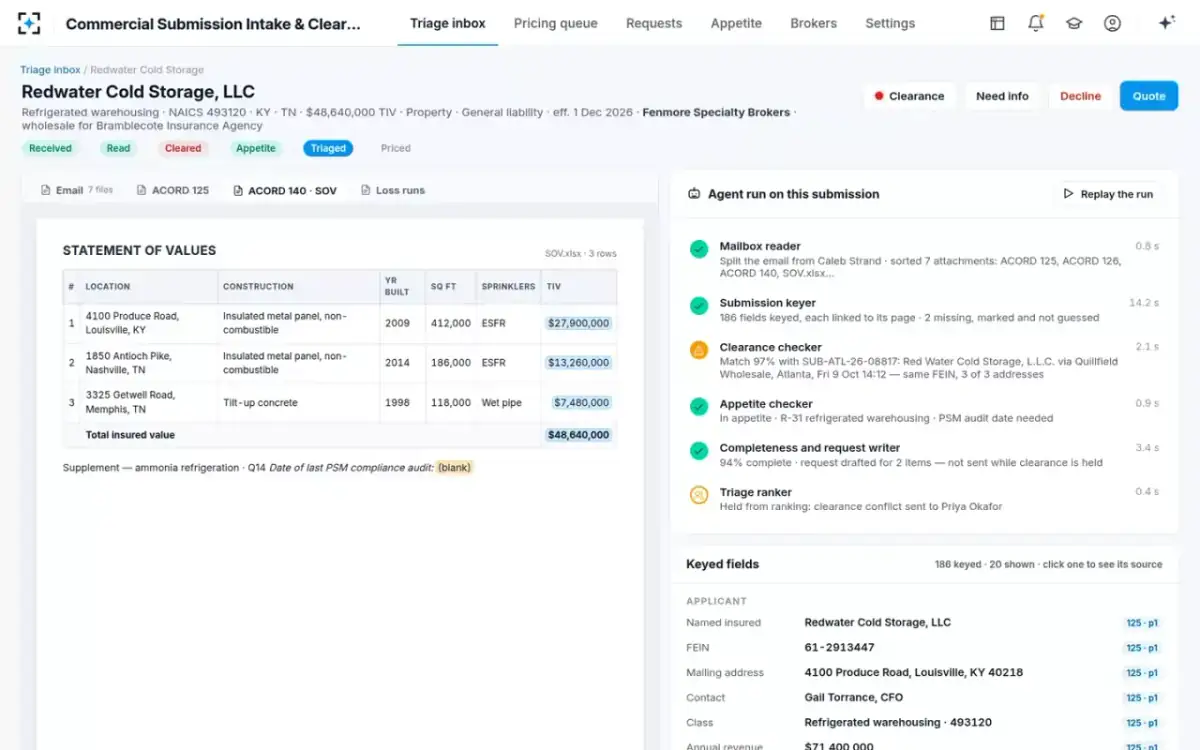
The third habit is the easiest to skip. A submission states the same fact in several places: the broker's email gave Redwater's insured values as $48,640,000 across three locations, and the schedule's total said the same. When two places agree, the value is probably right; when they disagree, the disagreement is the most useful thing on the file. The fourth habit protects the relationship. A request that asks for loss runs the broker already sent tells the broker the carrier did not read the submission, and the sample's request writer has the limit written down: it never asks for what is already in the file.
None of this needs new data. It needs the data a submission already contains, read once, tied to its source and compared with itself. To see it on your own submissions, start from Commercial Submission Intake & Clearance; the six agents and their limits are set out in submission intake automation.
Questions people ask
Is a completeness score useless, then?
No. It is the right measure of what to ask the broker for, and the sample scores completeness by line so a property gap does not hold up a liability quote. It is the wrong measure of whether the file can be priced, because a complete file can still be wrong.
Should the desk correct an obvious error on the application?
Not silently. A value the desk believes is wrong should be flagged and confirmed with the broker, with the correction and its source kept on file. New York's statute ties the consequences of a misstatement to what the applicant represented, so the file should show what was represented and what was changed.
Does an electronic signature satisfy the signed-application requirement?
The NAIC examination standard says the application should be signed where required and expressly includes electronic signatures. Whether a signature is required at all, and in what form, is set by each state's rules and the carrier's own forms.
Which fields matter most for data quality at intake?
The ones that drive clearance, eligibility and price: named insured, FEIN and addresses for clearance; class, state and insured values for appetite; payroll, revenue, locations and prior losses for price. In the sample, the clearance match used name, FEIN, addresses, locations and contact together.
How long should intake data be kept?
As long as the policy file. New York, for example, requires insurers to keep the application and the information needed to reconstruct the underwriting for six calendar years after the policy is no longer in force, or until the examination report that reviewed it is filed, whichever is longer.