A Florida workers comp audit is governed by section 440.381 of the Florida Statutes and by rule 69O-189.003 of the Florida Administrative Code. Together they require a final audit at the expiration of each voluntary-market policy, a physical audit on policies with $10,000 or more of estimated annual premium and on new construction policies, a review of all payments to employees, subcontractors and independent contractors using state and federal wage reports and certificates of insurance, signatures with proof of identification from both the auditor and the employer, and penalties for employers that block the audit: $500, or a premium of up to three times the estimate. Telephone audits are not allowed in place of mail or physical ones. For carriers, those rules shape the method and the file of every Florida audit; Botminds' Premium Audit Automation records each audit's method, records and signatures so the file shows the rule was met.
The statute is quoted from the Florida Senate's 2026 edition, unchanged since 2024, and the rule from the version amended effective 9 March 2025. This is a plain-words summary for practitioners and employers, not legal advice; the rule also incorporates the rating organization's Florida special audit rules, which are not reproduced here. Examples come from a fictional sample carrier in the solution.
What is Florida statute 440.381? The audit clauses, what each requires and of whom
| Clause | What it requires | Who it applies to |
|---|---|---|
| § 440.381(1)–(2) | What it requiresThe application must carry payroll, revenue, class and employee information; a false application to cut premium is a third-degree felony; the agent swears to having explained the class codes. | Who it applies toEmployer and agent, at application |
| § 440.381(3) | What it requiresAudit rules must review all sources of payment to employees, subcontractors and independent contractors and verify classification. Non-construction employers at least every two years; construction above the experience-rating threshold every year, physically on site at $10,000 or more of estimated premium. | Who it applies toCarriers, through the Financial Services Commission’s rules |
| § 440.381(3), last sentence | What it requiresEmployer or officer and auditor print and sign their names on the audit and attach proof of identification. | Who it applies toEvery completed audit |
| § 440.381(4) | What it requiresThe employer sends the carrier its quarterly earnings report each quarter, with self-audits and a sworn statement. | Who it applies toEmployer, every quarter |
| § 440.381(5) and (8) | What it requires$500 if the audit cannot be completed for lack of access; up to three times the latest estimated annual premium for failing to give reasonable access to payroll records. | Who it applies toEmployer that blocks the audit |
| § 440.381(6) | What it requiresTen times the premium difference for concealing payroll, duties or experience-rating information; an onsite audit within 30 days of a state finding. | Who it applies toEmployer that misrepresents; carrier on notice |
| § 440.381(7) | What it requiresEmployer indemnifies the carrier for an injured employee missing from the last quarterly report, unless hired after it. | Who it applies toEmployer |
How often are workers comp audits required in Florida?
The statute sets the floor and the rule raises it. Section 440.381(3) says the rules "must require that employers in all classes other than the construction class be audited at least biennially", and that construction employers above the experience-rating premium threshold "must be audited at least annually." It allows more frequent audits for particular classes "based on factors such as amount of premium, type of business, loss ratios, or other relevant factors."
Rule 69O-189.003 then requires voluntary-market carriers and employers to comply with minimum audit requirements "at the expiration of each policy", new and renewal alike. In practice every voluntary-market policy gets a final audit, and only the method varies with premium and class.
Which final audit each Florida voluntary-market policy needs
| Policy | Final audit required | How often |
|---|---|---|
| Estimated annual premium $10,000 or more, any governing class | Physical audit | Every year |
| Estimated annual premium $1 to $9,999 | Mail or physical audit | Every year |
| New business with construction classifications, any premium | Physical audit | Every year |
| Construction classifications, estimated premium $10,000 or more | Physical onsite audit | Every year |
| Per capita policies | Mail or physical audit | At least every two years |
| Any policy, at the employer’s request | Physical audit, unless the request is unnecessarily repetitive | When asked |
When must a Florida workers comp audit be physical?
On any voluntary-market policy with $10,000 or more of estimated annual premium, on every new construction policy whatever its premium, and whenever the employer asks for one. The rule says "Physical audits will be made whenever requested by the employer unless such request is unnecessarily repetitive." For construction classes at $10,000 and over, the rule specifies an onsite audit, matching the statute's "physical onsite audits for policies only if the estimated annual premium is $10,000 or more."
There is one more trigger, and it is fast. If the state determines that an employer has materially understated payroll, misrepresented employee duties or concealed experience-rating information, it must tell the carrier, and "The carrier shall commence a physical onsite audit of the employer within 30 days after receiving notification from the department." If the carrier does not, the department hires auditors at the carrier's expense. The carrier can avoid the audit only by giving written notice of cancellation within 30 days and auditing in conjunction with the cancellation.
Can a Florida workers comp audit be done by phone?
No. The rule is short and absolute about it.
"Telephone audits are not permitted in lieu of mail or physical audits."
Florida Administrative Code rule 69O-189.003(4)(f)
Mail audits, in which the employer reports by mail, are allowed only where a physical audit is not required. What the industry calls a virtual audit, with records sent electronically and questions answered by video or phone, is not named in the rule. Whether one counts as a physical audit, a mail audit or neither is a question a carrier writing Florida business should settle with its own counsel and the Office of Insurance Regulation, and then apply consistently, because the method is something an examiner will check against the premium band.
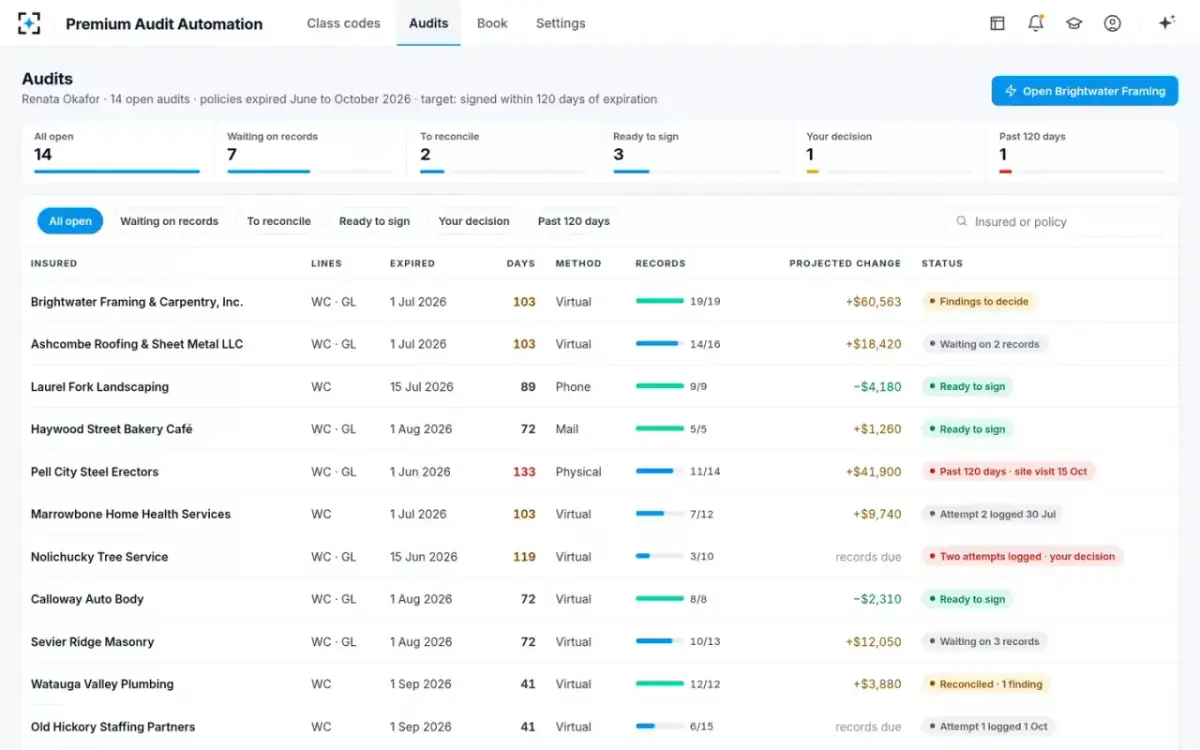
In Premium Audit Automation, virtual, phone, mail and physical audits all sit on the same worklist, each with its method shown, so an auditor can see at a glance which audits a Florida rule would not accept by phone and which need a site visit booked.
One worklist in Premium Audit Automation, each audit's method in its own column
What records does Florida require for a workers comp audit?
The statute names the categories and the rule lists the records. Section 440.381(3) says audit rules must use "state and federal reports of employee income, payroll and other accounting records, certificates of insurance maintained by subcontractors, and duties of employees." The rule turns that into a list for physical audits.
Records a Florida physical audit examines, as applicable
- Reemployment Tax (RT) forms
The state quarterly earnings reports the employer also sends to the carrier each quarter.
- Federal reports of employee income
Such as the quarterly Form 941 and the year-end W-2s.
- Payroll records
The register by employee, for the policy period.
- Cash disbursement journals
Where payments outside payroll, to contractors and casual labour, show up.
- Other acceptable accounting records
Whatever else supports the payroll and payments.
- Certificates of insurance covering subcontractors
For every subcontractor paid, covering the dates paid.
- Independent contractor documents
Evidence that people paid as contractors really are.
- Any other records needed to establish premium or assign classes
The rule’s catch-all.
Florida also keeps the quarterly reports flowing during the year. Under section 440.381(4), "Each employer must submit a copy of the quarterly earnings report required by chapter 443 at the end of each quarter to the carrier". The rule treats the reports as timely "if received within 45 days of the end of the quarter reported", tells each carrier to set its own procedure for terminating coverage when they do not arrive, and requires the carrier to keep them for at least three years. A carrier that holds four quarterly reports before the audit begins has half the reconciliation done.
Who signs a Florida workers comp audit?
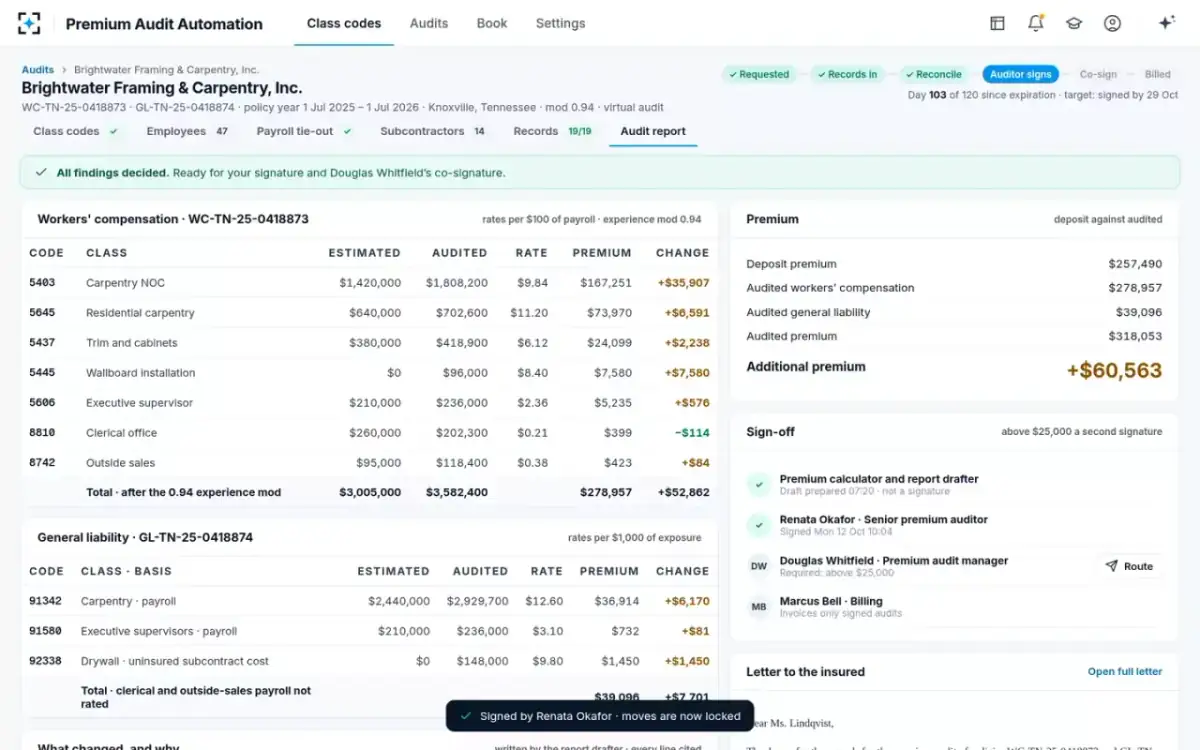
Both sides, by name, with identification. The statute says that at the completion of an audit, "the employer or officer of the corporation and the auditor must print and sign their names on the audit document and attach proof of identification to the audit document." The rule names the forms: an Auditor's Statement, a "Statement of Individual Providing Audit Information" for an employee who supplied the records, and a separate statement for a partner, sole proprietor or corporate officer. Carriers may use their own forms if approved and containing the same text.
Electronic signatures are allowed, within limits: the rule says "It is permissible for insurers to accept electronic signatures in satisfaction of the signature requirements of Section" 440.381(3), to the extent they comply with Florida's electronic signature law. That matters for remote audits, where the signing is the one moment both people must be identified.
Signatures by named people in Premium Audit Automation: the draft is not a signature
What is the penalty for refusing a workers comp audit in Florida?
$500 if the audit cannot be completed, and a premium of up to three times the estimate if the employer fails to give reasonable access to payroll records. Section 440.381(5) requires employers to make all records available and to permit the auditor to inspect the operation; if the employer fails to provide access and "the carrier cannot complete the audit as a result", it pays $500 to defray the audit's cost. Section 440.381(8) adds that it "shall pay a premium to the carrier or self-insurer not to exceed three times the most recent estimated annual premium."
Misrepresentation carries heavier consequences. Under section 440.381(6), an employer that understates or conceals payroll or misrepresents duties to avoid proper classification pays the carrier a penalty of ten times the premium difference plus reasonable attorney's fees. Under section 440.381(2), submitting a false application "with the purpose of avoiding or reducing the amount of premiums for workers’ compensation coverage is a felony of the third degree". And under section 440.381(7), an employer whose injured employee was missing from the last quarterly report must indemnify the carrier for the benefits paid, unless the employee was hired after the report; failure to indemnify within 21 days lets the carrier cancel immediately. How Florida's approach compares with the national noncompliance charge is set out in the audit noncompliance charge.
Contractors, subcontractors and certificates in Florida
Florida makes a contractor liable for its subcontractors' employees unless the subcontractor secured coverage, and requires the contractor to collect the evidence. Section 440.10(1)(b) deems the employees of a contractor and its subcontractors on the same contract work to be employed in one business, and section 440.10(1)(c) makes the contractor require evidence of workers' compensation cover from each subcontractor (Fla. Stat. § 440.10; see uninsured subcontractors). A corporate subcontractor with an exempt officer must hand over its certificate of exemption.
Florida's rules on where payroll belongs are also strict for construction. Any employer with employees working in Florida must have a Florida policy or endorsement using Florida class codes and rates, and "the construction industry employees performing new construction or alterations in Florida shall be assigned to Florida even if the employees return to their home state each night." An out-of-state contractor's audit therefore needs payroll by state as well as by class. The date-by-date certificate check that decides uninsured labour is set out in uninsured subcontractors in workers compensation.
The Joint Underwriting Association's stricter audit rules
Employers insured through the Florida Workers' Compensation Joint Underwriting Association face a tighter schedule. The rule requires final physical audits "For all policies producing an estimated annual premium of $4,000 and over regardless of governing classification code;" at least once every three years between $3,000 and $3,999; on all new construction business; for staffing and employee-leasing employers; for policies with a loss ratio of 120% or more; and, regardless of premium, for a list of governing classes.
That list is heavy with construction trades: "2702, 2710, 5022, 5403, 5437, 5445, 5474, 5551, 5606, 5645, 6217, 7219, 8829, 8835, 8861 and 9110". Five of them, 5403, 5437, 5445, 5606 and 5645, are classes on the fictional sample contractor's own audit. Under the Joint Underwriting Association's rule, an employer like it, whose governing class is 5403, would get a final physical audit at every expiration whatever its premium.
Questions people ask
Does Florida require audits for policies under $10,000?
Yes, in the voluntary market. Rule 69O-189.003 requires a final mail or physical audit every year on policies with estimated annual premium of $1 to $9,999, and a physical audit on any new construction policy regardless of premium.
Is Florida's audit rule current?
Rule 69O-189.003 was last amended effective 9 March 2025 and incorporates the rating organization's Florida special audit rules as approved by the Office of Insurance Regulation. Section 440.381 in the Florida Senate's 2026 edition was last amended by chapter 2024-6.
What happens if a Florida employee is hurt but was not on the quarterly report?
The employer must indemnify the carrier for all benefits paid for that employee, unless the employee was hired after the report was filed. If the employer does not indemnify within 21 days of the carrier's demand, the carrier can cancel coverage immediately.
Do certificates of insurance matter in a Florida audit?
Yes. Certificates covering subcontractors are on the rule's list of records a physical audit must use, and the statute requires contractors to obtain evidence of coverage from each subcontractor. A payment to a subcontractor without coverage on its date can put that labour on the contractor's premium.
Can a Florida carrier estimate payroll instead of auditing?
The rule's minimums require a final audit at each expiration, and the statute provides penalties when an employer blocks it: $500, or up to three times the estimated annual premium. What a carrier does after an audit fails for lack of access should follow its filed rules and be documented on the file.