Uninsured subcontractors are charged on a contractor's workers compensation policy because the contractor can become liable for their workers' injuries. When a subcontractor has no coverage of its own, state law in places such as Florida treats its workers as part of the contractor's business, so the contractor's policy carries the exposure, and the premium audit adds the labour paid to that subcontractor to the contractor's payroll. The test is not whether the subcontractor ever had a certificate of insurance, but whether a certificate was in force on the date of each payment. A certificate that lapsed in February does not cover the invoices paid in March. Botminds' Premium Audit Automation includes a subcontractor certificate checker that matches every payment to a certificate in force on its date and leaves the decision to add the labour with the auditor.
The rules here are quoted from Florida's statutes and rules, Alaska's and Oregon's insurance regulators, and two state-published studies of misclassification in construction, linked where they appear. The worked example is a fictional framing contractor and its fictional drywall subcontractor, run through the solution as sample data.
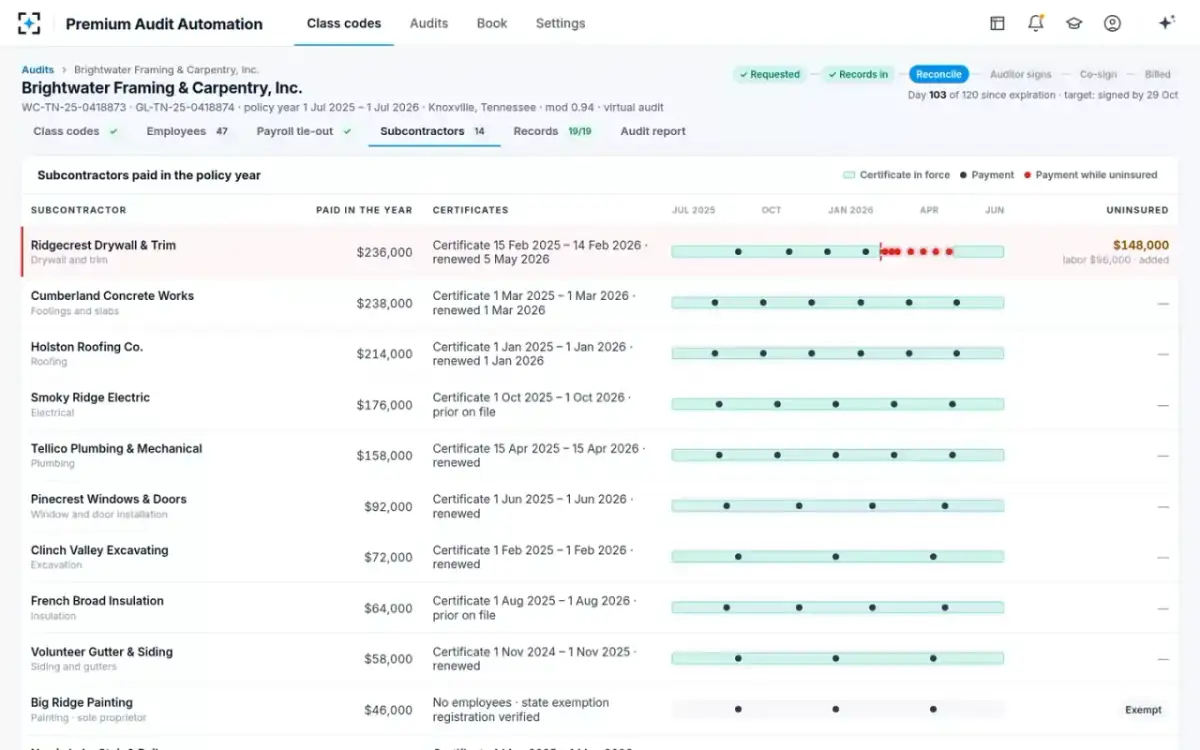
One subcontractor, one policy year: covered, then 79 days uninsured, then covered again
- Covered: certificate to 14 Feb 2026229 days
- Uninsured: 7 invoices, $148,000 paid79 days
- Covered: renewed 5 May 202657 days
Are uninsured subcontractors charged on workers comp?
Yes, as a rule of the rating manual, not as a penalty. Alaska's insurance division quoted the rule in 2018: for each subcontractor not providing evidence of workers' compensation insurance, "additional premium must be charged on the contractor's policy for the uninsured contractor's employees". In the same bulletin it disapproved a separate audit noncompliance charge, which shows the difference: one is premium for exposure the policy really carried, the other a charge for behaviour.
Regulators expect auditors to look for it. Oregon tells insurers to "investigate all possible sources of earnings, including those for uninsured contract employment." Its own test audits review "the cash disbursements journal to develop the remuneration paid to contract labor and casual labor". Florida's statute requires its audit rules to review "all sources of payments to employees, subcontractors, and independent contractors", and its rule lists "Certificates of insurance covering subcontractors" among the records a physical audit must use.
Who is liable for an uninsured subcontractor's injury?
In Florida, and in other states with similar laws, the contractor. Florida's statute says that when a contractor sublets part of its contract work, "all of the employees of such contractor and subcontractor or subcontractors engaged on such contract work shall be deemed to be employed in one and the same business or establishment", and the contractor "shall be liable for, and shall secure, the payment of compensation to all such employees, except to employees of a subcontractor who has secured such payment."
That is why the premium follows. If a drywall installer employed by an uninsured subcontractor falls from a ladder on the contractor's job, the contractor's insurer pays the claim, so the contractor's policy must be priced for that labour. Florida lets the contractor recover what it pays: it "shall be entitled to recover from the subcontractor all benefits paid or payable plus interest", "unless the contractor and subcontractor have agreed in writing that the contractor will provide coverage." Whether a contractor can pass on the audit premium itself is a matter for its subcontract, not the statute.
The duty to check comes first. "A contractor shall require a subcontractor to provide evidence of workers’ compensation insurance." A corporate subcontractor whose officer has elected to be exempt must give the contractor a copy of the certificate of exemption. Other states' contractor-liability rules differ in their details; check the statute where the work is done.
What if a subcontractor's certificate expired? Why the date matters more than the certificate
Payments made after a certificate's end date, and before any renewal takes effect, are treated as payments to an uninsured subcontractor. A certificate is evidence of a policy for a stated period; it says nothing about the days outside that period. Auditors therefore match each payment's date against the coverage dates, not the subcontractor against a folder of certificates.
The fictional sample shows how the arithmetic goes. Ridgecrest Drywall & Trim's certificate ran from 15 February 2025 to 14 February 2026. Its renewal began on 5 May 2026. The contractor paid Ridgecrest $236,000 during the policy year: $88,000 while the certificate was in force, and $148,000 on seven invoices between 15 February and 4 May, when it was not. The insured's office manager confirmed it in writing: the subcontractor said its policy lapsed in February and was renewed in May. Only the $148,000 is in question.
Premium Audit Automation's subcontractor view: every payment against its certificate
How is uninsured subcontractor cost calculated?
The labour portion of what was paid becomes payroll in the class of the work, and is rated like the contractor's own payroll. Materials are not payroll, so the auditor needs invoices that separate them. Where invoices show only a lump sum, the carrier's own rules decide; in the fictional sample carrier's settings, the rule is to take the labour from the invoice where it is shown, and otherwise the whole price.
From uninsured payments to premium: one subcontractor, two policies
Paid while uninsured
$148,000
7 invoices, 15 Feb to 4 May 2026
Labour shown on the invoices
$96,000
The other $52,000 on the invoices is not payroll
Workers’ compensation
+$7,580
$96,000 in 5445 wallboard installation at $8.40 per $100 × 0.94
General liability
+$1,450
$148,000 of uninsured subcontract cost at $9.80 per $1,000
Had the invoices shown only a single price, the sample carrier's rule would have put the whole $148,000 into 5445: about $11,690 of workers' compensation premium instead of $7,580, at the same rates.
The class follows the subcontractor's work, not the contractor's governing class. A framing contractor's uninsured drywall subcontractor goes to the wallboard class, which in the sample carries a different rate from carpentry. Invoices that describe the work and split labour from materials therefore save the contractor money twice: they keep materials out of payroll and put the labour in the right class.
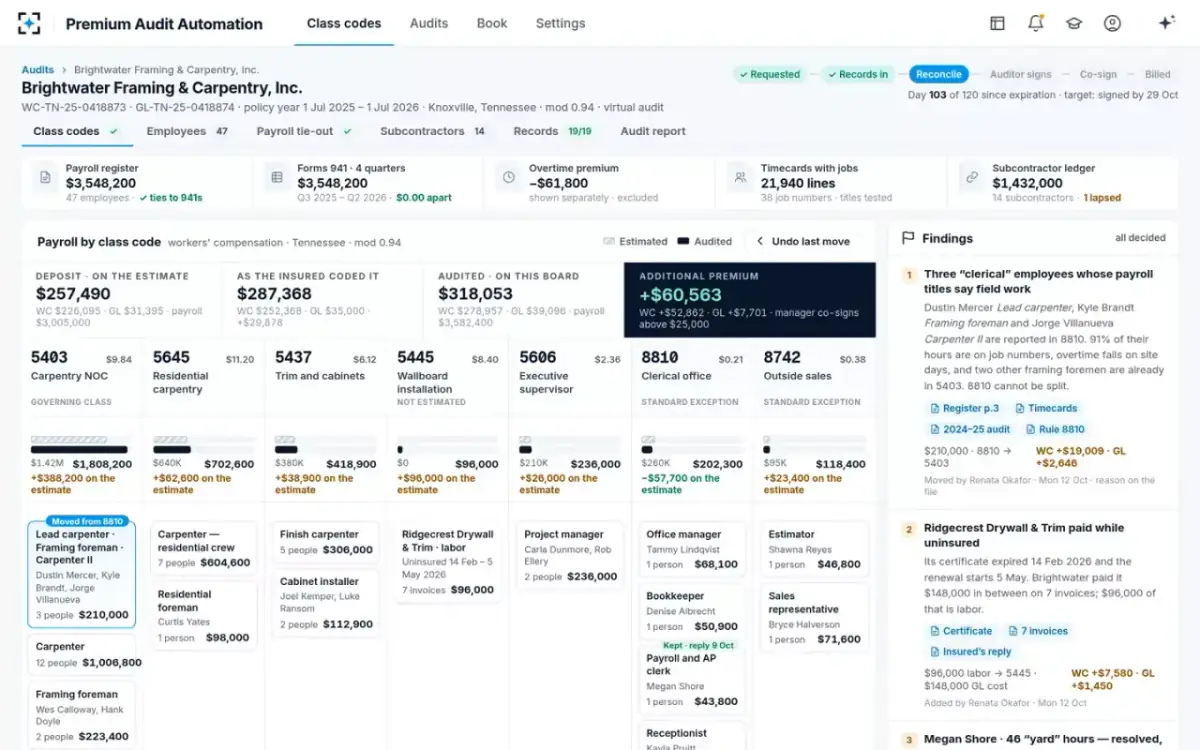
The auditor decides, and the evidence is shown. In the sample, the auditor, Renata Okafor, added Ridgecrest's $96,000 of labour to class 5445 and the $148,000 cost to general liability; the audit report showed the change on its own line with the certificate, the seven invoices and the insured's reply. The certificate checker never treats an expired certificate as current, and never adds payroll itself.
All findings decided: the uninsured labour in its own column, beside the class moves
How an audit checks subcontractors, step by step
A sound subcontractor check runs from the payments outward, not from the certificates inward. Start with every payment in the disbursements and the subcontractor list, group them by payee, then ask of each payment whether a certificate or a valid exemption covered its date. Only the uncovered payments need labour figures, and only the labour needs a class.
From the payments to a decision: who does each step in Premium Audit Automation
Agent
Payments gatheredEvery payment to every subcontractor in the policy year, from the subcontractor list, the disbursements and the general ledger.
Agent
Certificate checkerMatches each payment date to a certificate in force on that date, or to a verified state exemption.
Never: Treats an expired certificate as current.
Agent
Labour shareReads labour from the invoices for uncovered payments, or takes the whole price where labour is not shown.
Agent
Record requesterAsks the insured for any missing certificate, naming the dates it must cover.
A person decides
Premium auditorAdds the labour to the class of the work, or does not, with the certificate, invoices and reply cited.
The order matters because the errors hide in the payments. A certificate folder that is complete for every subcontractor the insured remembers says nothing about the casual crew paid from the disbursements journal, which is why Oregon's regulator-run test audits include a review of that journal. In the sample, the request for Ridgecrest's missing certificate named the dates it had to cover, and the reply settled the question in one exchange.
Do 1099 workers count as uninsured subcontractors?
They can, and they can also turn out to be employees. A person paid on a Form 1099 who runs a real business with its own coverage, or a valid exemption, is a covered subcontractor. One without coverage doing the contractor's work is an uninsured subcontractor for audit purposes. And one who works under the contractor's direction may be an employee whatever the paperwork says: Minnesota's legislative auditor summarised the usual test, "If a worker must follow the organization’s instructions on when, where, and how to do the work, he or she is more likely to be an employee."
States enforce the line separately from the audit. Florida's statute lets its Department of Financial Services assess a penalty "not to exceed $5,000 for each employee of that employer who is classified by the employer as an independent contractor" but does not meet the statutory criteria. At audit, Oregon requires the insurer's final bill to name each person reclassified from contractor to employee, with what each one did and why the insurer decided as it did (Oregon's billing rule). Alaska's list of records an insurer may request at audit includes Forms 1099 and 1096.
Sole proprietors are the common edge case. A sole proprietor with no employees may not need coverage at all, depending on the state, and some states let such a person register an exemption. In the fictional sample, Big Ridge Painting was a sole proprietor whose state exemption registration the checker verified, so its $46,000 of payments added nothing.
How common is misclassification in construction?
Common enough that auditors are told to look every time. The best state-published estimates are old but consistent. Minnesota's Office of the Legislative Auditor estimated in 2007 that "An estimated 15 percent of employers in the construction industry misclassified at least one employee, but misclassification appeared to be higher among certain subgroups, such as roofing, drywall, and residential remodeling." A 2005 study for Maine, by researchers at the University of Massachusetts Boston and Harvard's Labor and Worklife Program, found at least one in seven construction employers misclassifying each year in 1999–2002.
Two state-published studies: about one construction employer in seven misclassified workers
The Maine study also put a price on it for workers' compensation: "We estimate that up to $6.5 million of worker" compensation premiums went unpaid each year for misclassified construction workers in a state with about 29,000 construction workers at the time. When misclassification happens, the study found, it is extensive: over four in ten workers at the employers found misclassifying. For a premium auditor, the lesson is to read every subcontractor and every 1099, not a sample of them.
What a contractor should keep to avoid paying for uninsured subcontractors
Keep a certificate for every subcontractor, covering every payment date, and invoices that split labour from materials. The habits below cost little during the year and settle most subcontractor questions at audit.
A contractor's subcontractor file, ready for audit
- A certificate before the first payment
Florida’s statute requires the contractor to obtain evidence of workers’ compensation insurance from each subcontractor.
- The expiry date on a calendar
Ask for the renewal before the next payment after expiry; in the sample, 79 days without one cost $9,030.
- Exemptions on file for sole proprietors and exempt officers
Florida requires a corporate subcontractor with an exempt officer to provide its certificate of exemption.
- Invoices that separate labour from materials
Otherwise the whole price may be treated as labour.
- A list of every subcontractor and amount paid
Alaska’s list of audit records includes vendors and subcontractors with amounts paid, and their certificates.
- A written agreement if you will cover a subcontractor
Florida’s recovery right depends on whether you agreed in writing to provide coverage.
For the insurer, the same checks are what the subcontractor certificate checker runs on every audit: every payment matched to a certificate covering its date, labour read from the invoices or the whole price where it is not shown, exemption registrations checked for sole proprietors, and a request to the insured for any certificate still missing. What an insured can expect from the rest of the audit is in what a workers comp audit looks for.
Questions people ask
Do I need certificates of insurance from subcontractors?
In Florida the statute requires it: a contractor must obtain evidence of workers' compensation insurance from each subcontractor. Elsewhere it is still the record that keeps a subcontractor's labour off your premium at audit, so collect one before the first payment and again at each renewal.
Why am I paying workers comp for subcontractors?
Because your policy covered their workers. Where a subcontractor had no coverage of its own, laws such as Florida's make the contractor liable for its workers' injuries, and the manual rule adds that labour to your premium. With a certificate in force on each payment date, the labour stays off your audit.
Can I recover the extra premium from the subcontractor?
That depends on your subcontract. Florida's statute gives a contractor that pays a claim for an uninsured subcontractor's worker a right to recover the benefits plus interest, unless it agreed in writing to provide coverage; it says nothing about premium. Some contractors write certificate and reimbursement terms into their subcontracts for this reason.
Does general liability charge for uninsured subcontractors too?
Often, when the general liability policy is rated on subcontract cost. In the fictional sample, the policy rated uninsured subcontract cost at $9.80 per $1,000, so the $148,000 paid in the gap added $1,450. Check your policy's rating bases.
What about a subcontractor with no employees?
A sole proprietor with no employees may not need workers' compensation, depending on the state, and some states provide an exemption the proprietor can register. Keep the exemption on file as you would a certificate; in the sample, a verified exemption meant a painter's $46,000 added no premium.