A workers comp audit looks for four things: what you actually paid your workers during the policy year, which job class each person's pay belongs in, whether anyone you paid as a contractor should be counted as covered payroll, and whether your records support all three. The auditor compares your payroll register with your quarterly federal and state tax returns, reads job titles and duties against the class codes on your policy, separates overtime where the rules allow, lists your officers, and matches every subcontractor you paid against a certificate of insurance for the dates you paid them. Your premium was based on an estimate made at the start of the year; the audit turns it into the real figure, which can be higher or lower. On the insurer's side, software such as Botminds' Premium Audit Automation now does much of the reading and matching, so the questions you get are fewer and more specific, but a person still decides and signs.
This guide is general information drawn from state insurance regulators' rules and bulletins, linked where they appear, not advice on your own policy; your policy and your state's rules govern. The worked examples come from a fictional sample audit of a framing contractor run through the solution, whose people and figures are sample data.
What documents are needed for a workers comp audit?
Expect to be asked for your payroll records, your quarterly tax returns, your payments to contractors and their certificates of insurance. The standard policy itself requires you to keep them: as Alaska's insurance division explains, "The policy requires that the insured maintain records of information needed to compute premium" and provide copies when asked. Its bulletin lists what an insurer may request.
The records a workers comp auditor may ask for
- Payroll register or payroll-service reports
Gross pay by employee for the policy period, with job titles and, ideally, overtime shown separately.
- IRS Form 941 for every quarter in the policy period
The federal quarterly return the register is checked against.
- State quarterly unemployment reports
A second independent check on total wages and headcount.
- Forms W-2 and W-3, 940, 1099 and 1096
Annual totals for employees, and what you paid people you treated as contractors.
- A list of subcontractors and vendors, with amounts paid
Every business you paid for work during the policy term.
- Certificates of insurance for those subcontractors
Showing workers’ compensation coverage for the dates you paid them, or their state exemption.
- Timecards or job-costing records
Used when a job title and a class code disagree.
- Your general liability audit, and in some cases bank statements or tax returns
Alaska’s list adds Schedule C and Form 1120 “in unique circumstances”.
Florida's rule for physical audits adds cash disbursement journals and "Independent contractor documents." The disbursement journal is where an auditor finds payments that never went through payroll, such as cash paid to casual labour, so expect questions about it if you pay people outside your payroll system.
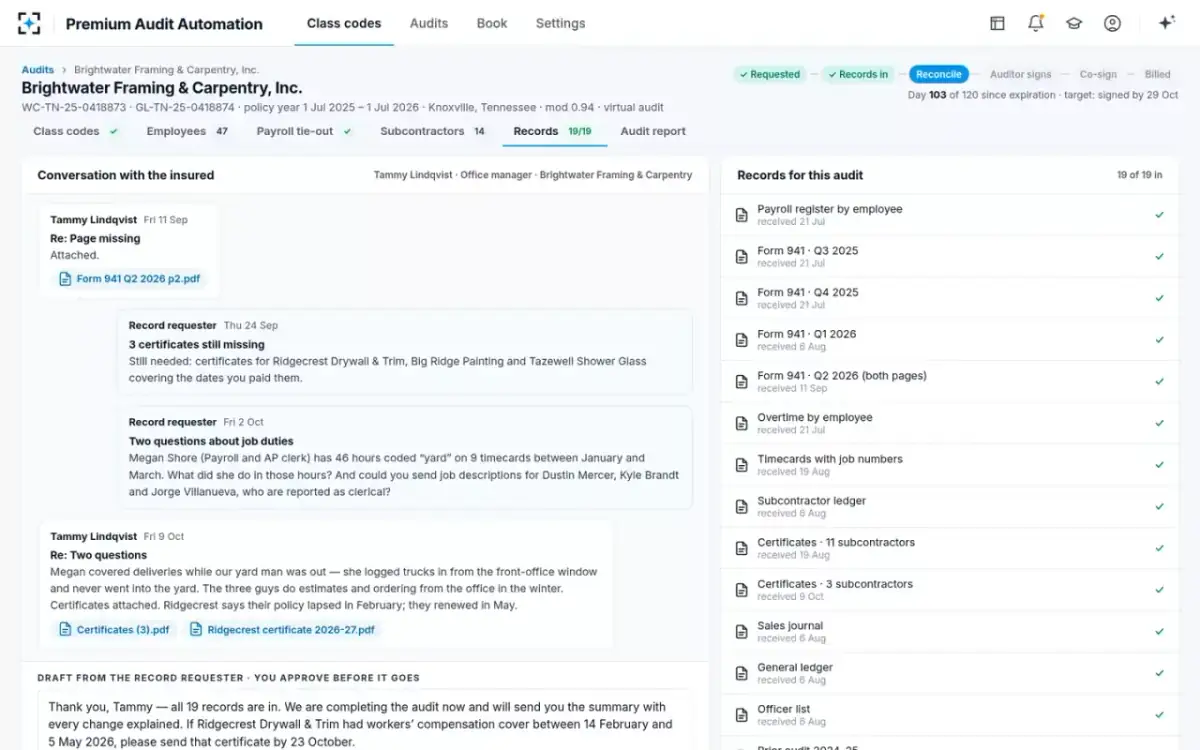
On the insurer's side, a clear list sent once saves both parties weeks. In the fictional sample audit, the insurer's notice went out the day after the policy expired with the 11 records needed for the insured's classes, followed by reminders naming exactly what was still missing and, later, specific questions: a missing page of one quarter's Form 941, three certificates, and what one clerk did during 46 hours coded to the yard.
The insurer's side in Premium Audit Automation: one list, specific questions, replies kept
What does the auditor check when comparing your payroll and your 941s?
The auditor ties your payroll register to your quarterly returns, quarter by quarter, and asks you to explain any difference. Regulators expect it: Oregon's audit rule requires the total payroll to be reconciled with records other than the ones it was first added up from (Oregon's audit procedure rule). Differences are normal; unexplained ones are what create questions. These are the usual reasons the numbers differ, and what to bring.
Why your register and your 941s may not match, and what clears it up
| Item | Why it causes a difference | What to bring |
|---|---|---|
| Pre-tax retirement deferrals | Why it causes a differenceLine 2 of Form 941 carries only what goes in box 1 of the W-2s, and box 1 leaves out employees’ 401(k) and 403(b) deferrals. | What to bringThe payroll service’s deferral totals by quarter. |
| Overtime | Why it causes a differenceManual rules can let overtime pay come out of premium payroll, but only where your state allows it and your records show it separately. | What to bringA register or report with overtime premium in its own column, by employee. |
| Quarters that straddle the policy year | Why it causes a differenceA policy that starts mid-quarter cuts across the 941 quarters, and one that starts after January cuts across tax years; the auditor needs payroll inside the policy dates. | What to bringPayroll by pay date for the months where the policy and the quarters do not line up. |
| Expense reimbursements | Why it causes a differencePayments for travel or tools may sit in your register without being wages; the auditor will ask what each is. | What to bringYour reimbursement policy and the totals paid. |
| Officers and owners | Why it causes a differenceOwners may be excluded or included, and covered officers’ payroll may be capped or set at a minimum, by state rule. | What to bringThe officer list and any election forms filed with the state. |
The first item catches many businesses out. The IRS tells employers to report on line 2 amounts that "would also be included in box 1 of your employees’ Forms W-2", and box 1 does "not include elective deferrals (such as employee contributions to a section 401(k) or 403(b) plan)". If you run a retirement plan, your gross register will be higher than your 941s by the deferrals. Bring the totals, and the difference becomes a line on the worksheet instead of a question.
Why do I owe money after a workers comp audit?
Usually for one of three reasons: you paid more payroll than you estimated, some pay belonged in a higher-rated class, or you paid uninsured subcontractors whose labour was added to your policy. Texas's insurance commissioner described the mechanism in a 2016 order: the employer estimates payroll at the start, the carrier audits it after the term, and "As a result of the audit, an employer's premium could increase or decrease for the audited period."
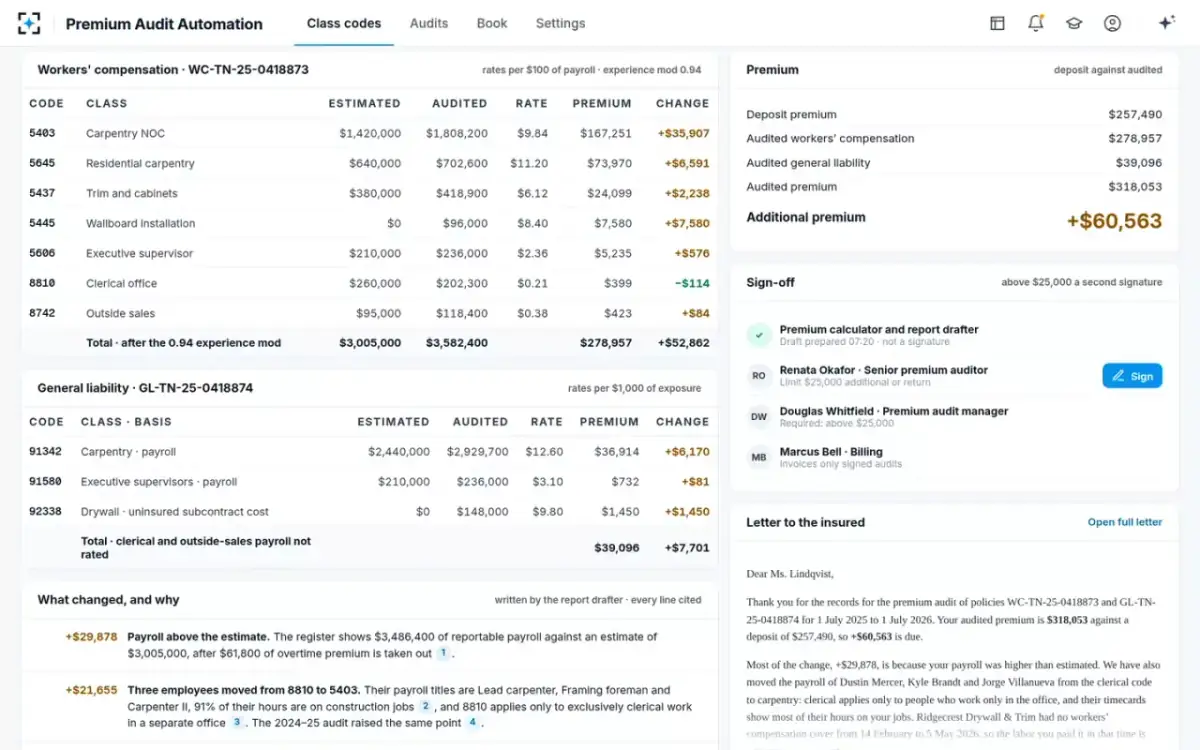
The fictional sample shows all three. The contractor estimated $3,005,000 of payroll and paid $3,486,400 of reportable payroll: $29,878 more premium. Three employees reported as clerical had field titles and 91% of their hours on construction jobs; moving them to carpentry added $21,655. One subcontractor was paid $148,000 while its insurance had lapsed, $96,000 of it for labour; adding it cost $9,030. In all, $60,563 on a $257,490 deposit, and the letter to the insured explained each part.
The bill with its reasons, as Premium Audit Automation drafts it: one line per change
"The final premium is determined after the policy ends by using the actual payroll and the proper classifications and rates that lawfully apply to the business and work covered by the policy."
Alaska Division of Insurance, Bulletin B 15-08
The class code is often the larger lever. A dollar of clerical payroll and a dollar of construction payroll can carry very different rates; at the fictional sample's illustrative rates, $0.21 and $9.84 per $100. If your office staff also go to job sites, or your foremen do paperwork, read the rules in class code 8810 vs 8742 before the audit, not after.
Is overtime included in workers comp payroll?
Often only partly. The manual rules Oregon's audit rule refers to allow overtime pay to come out of premium payroll, but only where your records show it separately, and the treatment varies by state. Oregon's audit rule asks the auditor to note whether overtime was paid and whether the records "permit the exclusion of overtime remuneration from total payroll, as allowed by Basic Manual rules." If they do not, the auditor should explain how to keep them so you get the credit next year.
The practical step is in your payroll setup, not in the audit. A register that pays 50 hours at a single blended rate cannot show the overtime premium; one that pays 40 hours straight time and 10 hours at time and a half can. In the fictional sample, the register showed overtime premium separately, and $61,800 came out of reportable payroll under the policy's rules. Check what your state and policy allow before assuming the credit.
Do 1099 contractors count in a workers comp audit?
They can. If someone you paid on a Form 1099 had no workers' compensation coverage of their own and was doing your work, the audit may treat what you paid them for labour as your payroll. Alaska's insurance division restated the manual rule in a 2018 bulletin: when a subcontractor provides no evidence of coverage, your policy is charged additional premium for its employees (Alaska Bulletin B 18-06). Florida's statute makes a contractor liable for compensation to its uninsured subcontractors' employees.
What protects you is a current certificate of insurance for every subcontractor, covering the dates you paid them, or proof of a valid state exemption for a sole proprietor with no employees. A certificate that lapsed mid-year covers only the payments made before it lapsed. The date-by-date logic, and how labour is separated from materials, is set out in uninsured subcontractors in workers compensation. If the audit reclassifies a person you treated as an independent contractor as your employee, Oregon requires the insurer's bill to name each person, describe what each did, and give the reason for the decision (Oregon's billing rule).
What happens if I don't do my workers comp audit?
The insurer can bill you on an estimate, cancel the policy, and in some states charge a penalty. Texas's commissioner listed the two remedies carriers already have: cancel the policy, or estimate the payroll and bill on the estimate (Texas Order No. 4448). An estimated bill is usually not in your favour, because the insurer has no records to estimate down from.
Florida writes penalties into statute. If you fail to give the auditor access to the records and the audit cannot be completed, you pay "$500 to the carrier to defray the costs of the audits." If you fail to provide reasonable access to payroll records, you can owe a premium of up to three times your most recent estimated annual premium. The rating organization also filed an audit noncompliance charge of up to twice the estimated annual premium; Texas rejected it and Alaska disapproved it, so whether it applies depends on your state and your policy's endorsements. The state-by-state picture is in the audit noncompliance charge.
Misstating payroll is a different matter from not responding. Florida's statute imposes a penalty of ten times the premium difference on an employer that "understates or conceals payroll, or misrepresents or conceals employee duties so as to avoid proper classification for premium calculations". An audit is easier, and cheaper, when the records arrive whole.
Can I dispute a workers comp audit?
Yes. Start by asking the insurer for the full calculation, then use the state's formal route if the answer does not resolve it. Delaware's insurance department told carriers in February 2026 to send, with the audit bill, every calculation and document needed to support the audited premium (Delaware bulletin, 2026), including the payroll reviewed, the classes applied, adjustments and the full premium calculation. That is a fair standard to ask for anywhere.
The formal routes and their deadlines differ by state. In Oregon, a written request for a hearing must reach the Division of Financial Regulation within 60 days after you receive the final premium audit billing, and the clock keeps running while you negotiate with the insurer. In California, you can appeal an insurer's or the rating bureau's written decision on a classification complaint to the Department of Insurance, generally within 30 days of the written rejection or decision. In Delaware, an appeal can be made to the state's rating bureau during the policy period or within 12 months after it ends. Keep every letter and note the date you received the bill.
How do I prepare for a workers comp audit?
Set up your records during the year so the audit is a matter of sending them. Oregon requires insurers to tell policyholders, at or before issuance, "What remuneration is subject to premium charges", how to divide payroll between classes, "The requirements for verifiable records" and the existence of audits and the appeal process. Read that material, or ask your agent for it; Alaska's insurance division encourages policyholders to discuss the audit requirements with their agent or insurer before the final audit.
The same audit, with records ready and without
Records not ready: A year-end total from the bookkeeper; the 941s found later.
Records ready: Register by employee and quarter, with the four 941s and state returns attached.
Records not ready: Paid at a blended rate; no credit possible.
Records ready: Overtime premium in its own column, so it can come out where allowed.
Records not ready: Titles only; the auditor assumes the worst-rated class for anyone in doubt.
Records ready: Short duty descriptions for anyone whose title and work differ, such as an estimator who visits sites.
Records not ready: A pile of invoices; certificates requested after the fact.
Records ready: A list with amounts and dates, and a certificate for each covering those dates.
Records not ready: Weeks of back and forth, an estimate if it stalls, a bill that is hard to check.
Records ready: Fewer questions, a result that matches your own figures, a bill you can verify line by line.
Two habits matter most. Collect a certificate of insurance from every subcontractor before you pay them, and diary its expiry date so you collect the renewal before the next payment. And keep overtime and job duties visible in payroll. Most audit surprises trace back to one of those two.
Questions people ask
Why does workers comp audit me every year?
Because the rules require regular audits on many policies. Oregon requires an annual field audit on policies with $10,000 or more of annual standard premium, until two consecutive policy years show an audit premium difference under five percent. Florida requires annual audits for construction employers above the experience-rating threshold and a final physical audit on every new construction policy.
Can the audit lower my premium?
Yes. If your actual payroll was below the estimate, or a class change goes your way, the insurer owes you a return premium. Delaware's 2026 bulletin says carriers must refund an overpayment directly rather than as a credit on future bills, unless you ask otherwise.
Why is a second auditor asking for my records?
It may be a test audit. In Oregon the state's rating organization re-audits a random sample of insurers' policies to check the insurer's work, and must tell you in writing at least ten days before the visit. Oregon's rules say test audit findings cannot be used by the insurer to enforce premium collection.
Do I need to be there for the audit?
Someone who knows the business should be. Oregon's rules require the auditor to contact a principal or representative familiar with the operation to get the classification right. Florida requires the employer or an officer to print and sign their name on the completed audit and attach proof of identification.
Can the audit be done by phone or email?
Sometimes. Oregon's rules recognise desk audits away from your premises and, in some years, a payroll report in place of an audit. Florida's rule says telephone audits are not permitted in place of mail or physical audits and requires physical audits on some policies. You can ask for a physical audit in Florida, and the insurer must make one unless the request is unnecessarily repetitive.