An audit noncompliance charge is an extra charge a workers' compensation insurer may bill when an employer does not let it examine and audit the records it needs to set the final premium. It was created by a national filing from the National Council on Compensation Insurance, Item B-1429, made in 2015, which added a rule, a policy endorsement and a statistical code; as filed, the charge could be up to two times the estimated annual premium, at the carrier's discretion. Not every state accepted it. Texas's commissioner rejected the filing in 2016 as potentially unfairly discriminatory, Alaska's insurance division disapproved it in 2018, and Florida's statute sets its own penalties, a $500 fee and a premium of up to three times the estimate. Whether the charge can apply to a policy therefore depends on the state and on whether the endorsement is attached. Botminds' Premium Audit Automation sends each insured a records request and logs documented attempts, but never applies a charge: in the solution only a person can.
The filing's text is quoted here only as Texas's regulator described it in its notice and order; Alaska's position is quoted from its bulletin. Examples come from a fictional sample carrier's audit worklist in the solution, whose insureds and figures are sample data.
The audit noncompliance charge in three states: refused, disapproved, and set by statute
| Texas | Alaska | Florida | |
|---|---|---|---|
| Position on the charge | Rejected by Commissioner’s Order No. 4448, 9 May 2016. | Disapproved for use; insurers may not use the endorsement or rule (Bulletin B 18-06, 8 June 2018). | Florida’s action on the filing is not covered here; its statute sets audit penalties directly (Fla. Stat. § 440.381). |
| What applies | The carrier may cancel the policy or estimate the payroll. | Premium follows the approved rules; no extra charge for noncompliance. | $500 if the audit cannot be completed for lack of access; up to 3× the latest estimated annual premium for failing to give reasonable access to payroll records. |
| Main reason given | Not tied to a cost; could vary for the same behaviour; “attempt” undefined. | The approved rules do not allow a charge “to incent compliance or for punitive purposes.” | The legislature set the amounts directly. |
| Still charged on an uninsured subcontractor | Not addressed in the order. | Yes: the manual’s rule adding premium for uninsured subcontractors’ employees still applies. | Contractor liable for uninsured subcontractors’ employees (§ 440.10). |
What is an audit noncompliance charge?
It is a charge for not cooperating with the premium audit, separate from the premium itself. The Texas Department of Insurance summarised the filing in its notice: "Item B-1429 is a national filing that establishes an Audit Noncompliance Charge (ANC) rule, endorsement, and statistical code." Its purpose was "to provide carriers an option to apply an ANC to an employer that does not allow the carrier to examine and audit the employer's records, as Part Five – Premium, Sections F and G of the standard workers compensation policy requires."
Those policy sections are the reason audits happen at all. The standard workers' compensation policy obliges the insured to keep the records needed to compute premium and to let the insurer examine and audit them. Without the records, the carrier cannot apply rates to actual payroll, which is how workers' compensation premium is set. The filing proposed to apply to policies effective on or after 1 January 2017.
How much is the audit noncompliance charge?
As filed, up to twice the estimated annual premium, and the amount was left to the carrier. Texas's notice said that if approved, "carriers will have the discretion to bill employers for the Audit Noncompliance Charge, which may be up to two times the estimated annual premium." Its order added that the amount would be "based on the carrier's underwriting judgment".
The scale is large. For a policy with $226,095 of estimated annual workers' compensation premium, the deposit in the fictional sample, a charge at the ceiling would be $452,190. That is not a fee for the cost of chasing records; it is an amount designed to make non-cooperation more expensive than cooperation. Which is exactly the property two regulators objected to.
Why did Texas reject the audit noncompliance charge?
Because it was not tied to any cost, could vary between employers for the same behaviour, and solved a problem Texas did not have. Commissioner David Mattax's order of 9 May 2016 held that the filing "could violate the rate standards in Insurance Code §560.002 and §2053.002 by allowing an unfairly discriminatory rate." The findings behind that conclusion are a checklist of what a fair charge would need.
Why Texas rejected the charge, finding by finding
Finding 11
Not tied to a cost
The charge “does not appear to be tied to a cost or expense”, as Texas rate law requires of a rate.
Finding 12
Discretionary at every step
Carriers would choose whether to attach the endorsement and whether to apply the charge, and its size “could vary between policyholders for the same behavior.”
Finding 13
No definition of an attempt
The filing “does not define what constitutes an attempt to obtain the audit information from the employer”.
Finding 14
Remedies already exist
A carrier “may cancel the policy or estimate the payroll for audit purposes.”
Finding 15
No problem to solve
Staff were unaware of problems with audit noncompliance or complaints about uncooperative employers.
Conclusion 5
Thirty quiet years
With “few or no complaints over the past 30 years”, the existing remedies appeared sufficient.
The hearing record adds a detail that explains who objected. All five written comments came from premium finance companies, which worried the charge would deter them from financing workers' compensation policies "because it would increase their risk of not recovering unearned premium for a canceled policy." NCCI proposed a revision at the hearing to address that. The commissioner rejected the filing anyway, finding that the existing remedies "appear to be sufficient to compel employers to comply with the policy's payroll audit provision." We found no later Texas order approving the charge.
Does Alaska allow the audit noncompliance charge?
No. Alaska's Division of Insurance wrote in Bulletin B 18-06 of 8 June 2018 that it disapproved the filing for use in Alaska, and that accordingly insurers may not use the ANC endorsement or rule there. It explained the principle as well as the decision.
"NCCI's approved rules do not allow an insurer to apply an additional charge based on a policyholder's noncompliance or to otherwise inflate the premium or premium basis to incent compliance or for punitive purposes."
Alaska Division of Insurance, Bulletin B 18-06 (2018)
The bulletin drew a line that matters for contractors. Insurers may still charge additional premium under the manual's rule for uninsured subcontractors, which it quoted: for each subcontractor that gives no evidence of coverage, the contractor's policy is charged additional premium for that subcontractor's employees (Alaska Bulletin B 18-06; see uninsured subcontractors). That is premium for real exposure, not a penalty. The distinction between the two is the subject of uninsured subcontractors in workers compensation.
What is the Florida penalty for refusing a workers comp audit?
Florida sets its own amounts in statute. Section 440.381 says that if the employer fails, on the auditor's request, to provide access to the documents and the audit cannot be completed as a result, the employer pays the carrier $500 toward the cost of the audit. Separately, an employer that fails to give reasonable access to its payroll records owes a premium of up to three times its most recent estimated annual premium (Fla. Stat. § 440.381(5) and (8); the wording is set out in Florida workers comp audit rules).
The two provisions do different jobs. The $500 is a cost recovery tied to a failed audit, the kind of link Texas found missing in the national charge. The three-times ceiling is a premium, capped by law rather than left to underwriting judgement. Florida's statute also reaches deliberate misstatement, with a penalty of ten times the premium difference for concealing payroll or employee duties. The full set of Florida rules is in Florida workers comp audit rules.
How many attempts before a noncompliance charge?
The filing Texas reviewed did not say. Finding 13 of the Texas order records that, as proposed, the item "does not define what constitutes an attempt to obtain the audit information from the employer", so an employer could not know when it had been tried enough times to count as uncooperative. Whatever the rule in a given state, a carrier that might charge, cancel or estimate needs its own definition, applied the same way to every insured.
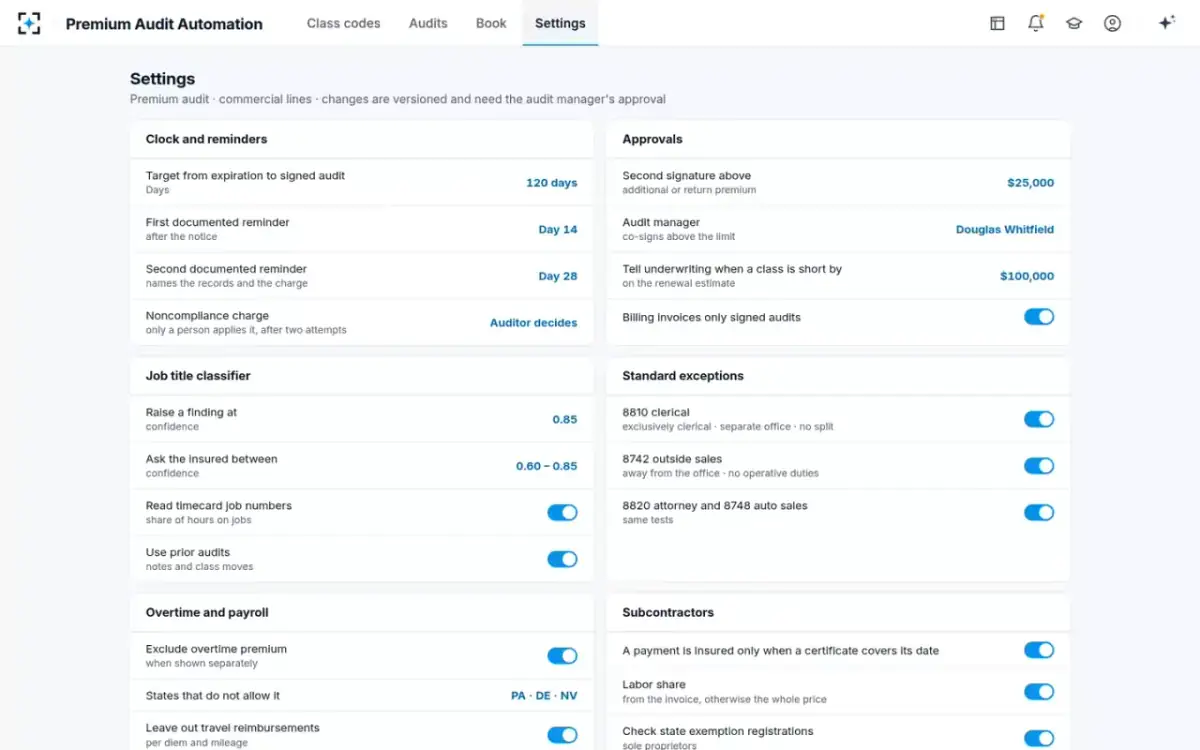
In Premium Audit Automation that definition is a setting. In the fictional sample carrier's settings, the record requester sends the audit notice with the list of records for the insured's classes, then documented reminders on day 14 and day 28 after the notice, each naming the records still missing and the charge the carrier may apply. After the second attempt, the audit goes to the auditor's decision; nothing is charged automatically.
Documented attempts in the sample carrier's settings: two reminders, then a person decides
- Notice and record list sentDay 0–14
- Attempt 1 loggedDay 14–28
- Attempt 2 logged, then the auditor decidesDay 28 on
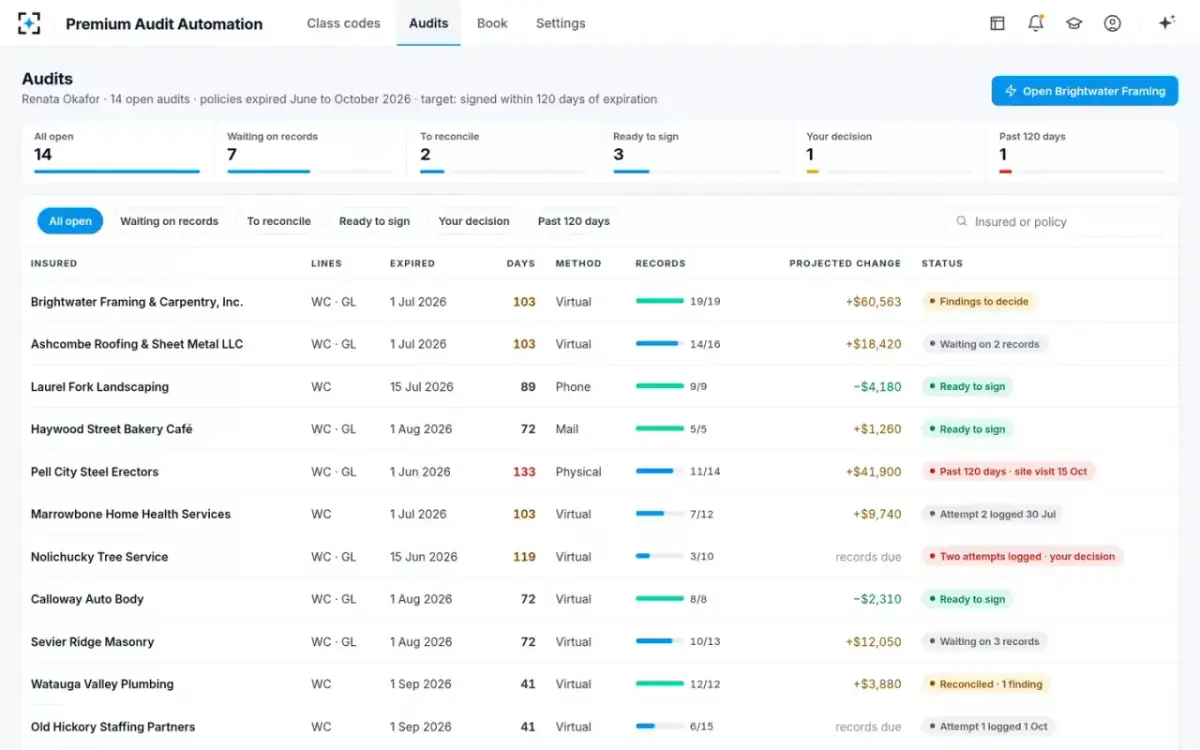
On the sample worklist, one audit shows what that looks like. Nolichucky Tree Service, a fictional insured, is on day 119 since expiration with 3 of 10 records received; its status reads "Two attempts logged · your decision". The auditor can extend, try a phone call, book a physical visit, close on an estimate with the basis recorded, or, where the policy and the state allow, recommend a charge. Each choice is hers, and each is logged.
Two attempts logged in Premium Audit Automation, and the decision with a person
What happens if I refuse a premium audit?
Expect an estimated bill or a cancellation, and in some states a statutory charge. Texas's order names the carrier's standing remedies: it "may cancel the policy or estimate the payroll for audit purposes." Florida adds the $500 and the up-to-three-times premium. Where a state approved the national filing and the endorsement is on the policy, the noncompliance charge may apply as well.
An estimated bill also narrows the insured's options. Oregon's rules on premium audit hearings tell the director to dismiss a request where "The billing is based on an estimate of compensation paid by the insured to its employees who are Oregon subject workers and not on actual audit results." In practice the route out of an estimated bill is to produce the records and ask for the audit to be completed.
How a carrier makes any charge or estimate defensible
Document every attempt, apply one rule to everyone, and keep the decision with a named person. The Texas findings read as a specification of what regulators will look for, whether the carrier is charging, estimating or cancelling. NAIC examiners also verify each carrier's procedure for waiving audits and that "the basis is reasonable." An audit closed on the estimate after silence is a waiver with consequences for the insured, and the file should show why.
What makes a noncompliance decision defensible
- A written definition of an attempt
How many, how far apart, by what channel. Texas faulted the national filing for not having one.
- Each attempt names the records and the consequence
An insured who did not know what was missing, or what would follow, was not given a fair chance.
- The same rule for every insured
Texas objected that the charge “could vary between policyholders for the same behavior.”
- Cost-based amounts where the law allows a charge
Florida’s $500 is tied to the cost of the failed audit; Texas found the national charge tied to no cost.
- A person decides, and the reason is on the file
Estimate, cancel, charge or extend: each needs a name and a basis an examiner can read.
- A route back
If the records arrive late, the audit should still be completed on actual figures.
The solution's settings encode the first three points and leave the last three with the auditor and the audit manager, who must approve any change to the reminder days or the charge rule. The setting row reads, in the sample, "Noncompliance charge: Auditor decides, only a person applies it, after two attempts".
The rule as a setting in Premium Audit Automation: reminder days, and a person decides
Questions people ask
Can I get the audit noncompliance charge removed?
The usual route is to provide the records and ask the insurer to complete the audit on actual figures. In Texas and Alaska the charge cannot be used at all. Elsewhere, check whether the endorsement is on your policy, ask the insurer what attempts it made, and contact your state insurance department if the answer does not hold up.
Does Texas allow the audit noncompliance charge?
No, as of Commissioner's Order No. 4448 of 9 May 2016, which rejected the filing and had the manuals state "This rule does not apply in Texas." We found no later Texas order approving it. Texas carriers can still cancel or estimate payroll when an employer will not cooperate.
Is the noncompliance charge on general liability too?
The filing Texas reviewed amended the workers' compensation manuals, forms and statistical plan only. General liability policies carry their own audit conditions; what follows a refused general liability audit depends on the policy and the state, not on this filing.
Why did premium finance companies object to the charge?
All five written comments in the Texas proceeding came from premium finance companies. They feared the charge would make it harder to recover unearned premium when a financed policy was cancelled, and so deter them from financing workers' compensation policies.
Is a charge for an uninsured subcontractor the same thing?
No. Additional premium for an uninsured subcontractor's workers is premium for exposure the policy actually covered, under the manual's subcontractor rule. Alaska's bulletin disapproved the noncompliance charge while confirming that the subcontractor rule still applies.