Class code 8810 is for clerical office employees and class code 8742 is for outside salespersons, collectors and messengers. Both are standard exceptions: classes that sit outside an employer's governing class and usually carry much lower rates, but only for employees whose duties fit the definition exactly. The difference between them is where the work happens. 8810 is for work confined to keeping records, correspondence, phones and data in an office kept apart from the operation; 8742 is for people who sell or collect away from the employer's premises and do only clerical work otherwise. Anyone who also supervises the crew, does physical work or works where the hazards are goes to the class of that work, with no split. Regulators single these codes out: Oregon's audit rule tells insurers to verify the use of 8810, 8742 and the drivers' code 7380 on every audit. Botminds' Premium Audit Automation includes a job title classifier agent that tests every employee against the standard exceptions and hands the auditor a suggestion with its evidence; it never moves payroll itself.
The rules here come from regulators' own copies: the National Council on Compensation Insurance (NCCI) Basic Manual text as filed with and published by the Texas Department of Insurance in 2025, and California Insurance Commissioner decisions from the 1990s that quote the state's plan of the time. Both are dated and should be checked against the manual in force where the policy is written. The examples follow a fictional sample audit, a framing contractor called Brightwater Framing & Carpentry, run through the solution; its people and figures are sample data and its rates illustrative.
What is the difference between class code 8810 and 8742?
The difference is where the employee works and what the work is. 8810 keeps an employee inside a clerical office doing clerical work; 8742 sends the employee out to sell or collect, with clerical work for the rest of the time. Both share the same discipline: the definition is a list of permitted duties, any duty outside the list moves the whole salary, and neither can be split with another class.
Class code 8810 vs 8742 at a glance
8810 · clerical office: Employees who keep records, correspondence, files and computer programs, draft, take phone calls and do data entry or general office work.
8742 · outside sales: Employees who sell or collect away from the employer’s premises, or do that part of the time and spend the rest on clerical office work.
8810 · clerical office: In a clerical workstation kept apart from the operation. California’s 1996 plan named “buildings, floors, partitions, railings or counters” as the separation.
8742 · outside sales: Off the premises. Selling from a showroom to the end customer has been held not to be outside sales.
8810 · clerical office: Banking deposits, fetching mail, buying office supplies, entering the work area for a clerical purpose such as handing out paychecks.
8742 · outside sales: Clerical office duties for the rest of the time.
8810 · clerical office: Outside sales, supervising non-clerical workers away from the office, physical labour, demonstration or instruction, work exposed to the operation’s hazards.
8742 · outside sales: Selling inside the premises to end users, or any duty that is neither outside sales nor clerical.
8810 · clerical office: No. 8810 is not available for division of payroll.
8742 · outside sales: No. 8742 is not available for division of payroll.
8810 · clerical office: $0.21 per $100 of payroll
8742 · outside sales: $0.38 per $100 of payroll
What is a standard exception class code?
A standard exception is a class for an occupation so common that it is kept out of the employer's main class unless that class says otherwise. The manual text filed in Texas puts it this way: "Standard exception classifications describe occupations that are common to many businesses. These common occupations are not included in a basic classification unless specified in the classification phraseology." The filed list is short: 8810 for clerical office and drafting employees, 8871 for clerical telecommuters, 7380 for commercial drivers, 8742 for outside salespersons, collectors and messengers, and 8809 for "Executive Officers NOC—Performing Clerical or Outside Salespersons Duties Only."
The exceptions only apply where the business's own class leaves room for them. Texas's commissioner explained in March 2026 that "Employees are assigned to these codes only if the basic class code assigned to the business does not overlap with the exception." If the governing class already includes clerical employees in its wording, 8810 is not available, however clerical the work.
That governing class is the class that describes the whole business. California's plan, quoted in a 1998 decision, stated the single enterprise rule: where one operation prevails, "the entire exposure of the business shall be assigned to that single classification." The exceptions are the only routine way out of it. A framing contractor's governing class carries carpentry's hazard, and every employee who is not a pure clerk or an outside salesperson shares it, whatever the payroll title says.
Who qualifies for clerical class code 8810?
An employee qualifies for 8810 when the duties are clerical, the workstation meets the separation rule, nothing else in the rules forbids it, and the business's class does not already include clerical work. The filed duties are specific: create or maintain records, correspondence, computer programs or files; drafting; "Perform telephone duties, including telephone sales."; data entry and word processing; and running a copier or fax machine "unless the employer's business provides photocopy or fax services to the public."
The rules allow a few non-clerical errands: "depositing funds in a bank", fetching mail, buying office supplies, and "entering another area of the workplace for clerical purposes, such as to deliver paychecks." They then list what disqualifies. An employee falls out of 8810 for "conducting outside sales or meeting with outside representatives", for "directly supervising nonclerical employees at a work area that does not meet the criteria described in Code 8810 clerical office employee" workstations, for "performing physical labor, demonstration, or instruction", and for work in an area exposed to operative hazards.
The workstation test is the one most often missed. California's plan of 1996 applied 8810 only to people "who work exclusively in areas which are separated from all other work places of the employer by buildings, floors, partitions, railings or counters". An estimator who prices jobs at a desk in the shop, with the saws a few metres away, does not meet it, however much of the day is spent at the desk.
What is outside sales class code 8742?
Code 8742 covers salespersons, collectors and messengers who work away from the employer's premises. California's 1996 plan defined them as employees "who are engaged exclusively in sales or collection work away from the premises of the employer or who are engaged in such work for any portion of their time and devote the balance of their time in clerical office duties." The test has two halves, and both must hold: the selling is done outside, and whatever is done inside is clerical.
California read it tightly. Its commissioner held that carpet salespeople who spent 20% of their time in the showroom and 80% at customers' homes were not outside salespersons, because they did not work exclusively off site and in the showroom did more than clerical work. The rating bureau's classification committee refused 8742 to floor-covering staff who sold only from a showroom, "because they sold direct to consumers as opposed to buyers for other stores." In 1994 it put an employee who spent only five or six percent of his time on the sales floor in the store class.
For a contractor the live question is the estimator. An estimator who visits a site to measure and price, then returns to an office, can fit 8742. One who stays to direct the crew is supervising non-clerical workers at a work area, and belongs in the governing class or in an executive supervisor class where the manual has one. In the fictional sample book, auditors moved estimators supervising crews on site from 8742 to 5606, executive supervisor, on nine audits.
Can an employee be split between 8810 and another class?
No. Standard exception payroll cannot be divided. The filed rule says that when an employee interchanges between operations, "you must assign the entire payroll of employees who interchange to the highest-rated classification representing any part of the employee's work." It then names the standard exceptions, 7380, 8742, 8809, 8810 and 8871, as not eligible for division. California's 1996 plan said the same: the entire payroll of a clerical employee also exposed to an operative hazard "shall be assigned to the highest rated classification of work to which the employee is so exposed."
The rule turns small exposure into whole-salary consequences. A framing foreman who spends winter mornings doing estimates in the office and the rest of the year on site does not earn a share of 8810 for the winter. The question is whether the employee is exposed to the operation at all, not how much of the time. At the illustrative rates in the sample, the difference on a $74,200 salary is $156 of premium in 8810 against $7,301 in carpentry 5403, before the experience mod.
What is class code 8871, and what changed on 1 July 2026?
Code 8871 is the standard exception for clerical telecommuters, and Texas adopted it for new and renewal policies effective on or after 1 July 2026. Under the order, an employee goes to 8871 if the duties are clerical, the employee telecommutes for at least half the time, and the business's class does not include clerical employees; the filed rule, quoted below, draws the line exactly, sending 50% or less to 8810. Texas noted that "In most states, this code already exists." The filing itself was to "Establish Code 8871 and related rules in Montana, Oregon, and Texas."
Three details matter at audit. The telecommuter's workstation must be separate and distinct from any location of the employer. Payroll goes to 8871 only when the employee "spends more than 50% of the time worked telecommuting", and to 8810 at 50% or less, never split. And at the start the code costs the same as 8810: "the initial loss cost and rating values of code 8871 will be equal to the loss cost and rating values of code 8810" until it has experience of its own. The change applies only to policies effective on or after that date, so a Texas policy that began earlier is audited without 8871.
How strictly do regulators read the 8810 and 8742 exceptions?
Strictly, and against the employer more often than not. The Evans Rents decision of 1998 surveyed California's precedents and found that "Both the C&R Committee and the Commissioner have been quite strict in their interpretations of what an "outside salesperson" is." and that "The Commissioner has been equally strict about extensions of the clerical operations exception." The pattern across the cases is that the employee's role in the operation decides, not where the desk sits.
Six California decisions: employees who did office work and still lost 8810 or 8742
| Decision | The employees | What was held |
|---|---|---|
| Bob Remy Automotive (1993) | The employeesService managers writing repair orders in an office | What was heldAuto repair shop class, not 8810: “Since the service manager is a part of the overall shop operations, it is not a clerical or bookkeeping function.” |
| Hi-Tech Collision and Painting (1994) | The employeesManagers who wrote estimates, ordered parts and supervised the shop | What was heldBody shop class: their paperwork was “directly connected with the body work.” |
| L.A. Fitness Sports Clubs (1995) | The employeesReceptionists who also took phone messages | What was heldHealth club class: their main duties were “greeting patrons, confirming membership status, making court reservations, and dispensing towels”. |
| Talbert’s Contract Carpet & Tile (1996) | The employeesCarpet salespeople, 20% in the showroom and 80% at customers’ homes | What was heldNot outside sales: they did not work exclusively off the premises, and in the showroom did more than clerical work. |
| Sunset Haven (1997) | The employeesNursing facility administrators and directors of nursing | What was heldNot clerical, “by virtue of their supervisorial and managerial job duties”. |
| Evans Rents (1998) | The employeesDistrict, showroom and assistant showroom managers | What was heldFurniture store class 8015, not 8810 or 8742, “Although the managers devote much of their time to office work”. |
Regulators also check that auditors look. Oregon's audit rule requires insurers to "Verify the proper use of Classifications 8810 - Clerical Office Employees NOC, 8742 - Salespersons or Collectors - Outside, and 7380" drivers, and to show the clerical, outside sales and driver payroll analysis on the worksheets. The regulator's own test audits list "by name, duties and earnings" everyone placed in a standard exception. How a carrier can hold its audits, and its software, to that bar is the subject of premium audit standards.
How Premium Audit Automation's job title classifier reads an employee, and stops
The classifier gathers the evidence an auditor would want before moving anyone, and stops at a suggestion. For each employee it reads the payroll title, the share of timecard hours booked to job numbers, the overtime pattern and any note in prior audits, then tests the standard exception rules strictly, including the no-split rule. Above a confidence the carrier sets, 0.85 in the sample, it raises a finding with evidence for and against. Between 0.60 and 0.85 it drafts a question to the insured instead.
From payroll title to a class the auditor decides
Agent
Payroll register readerReads each employee’s title, gross pay and overtime from the register, tied to the Forms 941.
Never: Alters the insured’s figures.
Agent
Job title classifier: evidenceAdds the share of timecard hours on job numbers, overtime on site days and notes from prior audits.
Agent
Job title classifier: testTests duties, workstation and the no-split rule for 8810, 8742 and the other exceptions the carrier switches on.
Never: Splits one employee across a standard exception.
Agent
Finding or questionAt 0.85 or above, a finding with evidence for and against; from 0.60 to 0.85, a drafted question to the insured.
Never: Moves payroll.
A person decides
Premium auditorAccepts, rejects or asks for more. A move is logged with the reason and can be undone until signature.
In the sample audit, three employees reported in 8810 drew a finding. Dustin Mercer's payroll title is lead carpenter, Kyle Brandt's framing foreman, Jorge Villanueva's carpenter II. Between them, 5,754 of their 6,324 timecard hours, 91%, were booked to construction jobs, and their overtime fell on site days. The prior year's audit had raised the same point. The classifier suggested 5403, carpentry, at a confidence of 0.94.
Share of timecard hours on job numbers: three “clerks” look like the crew
The block of three opened in Premium Audit Automation: titles, hours on jobs, where it can go
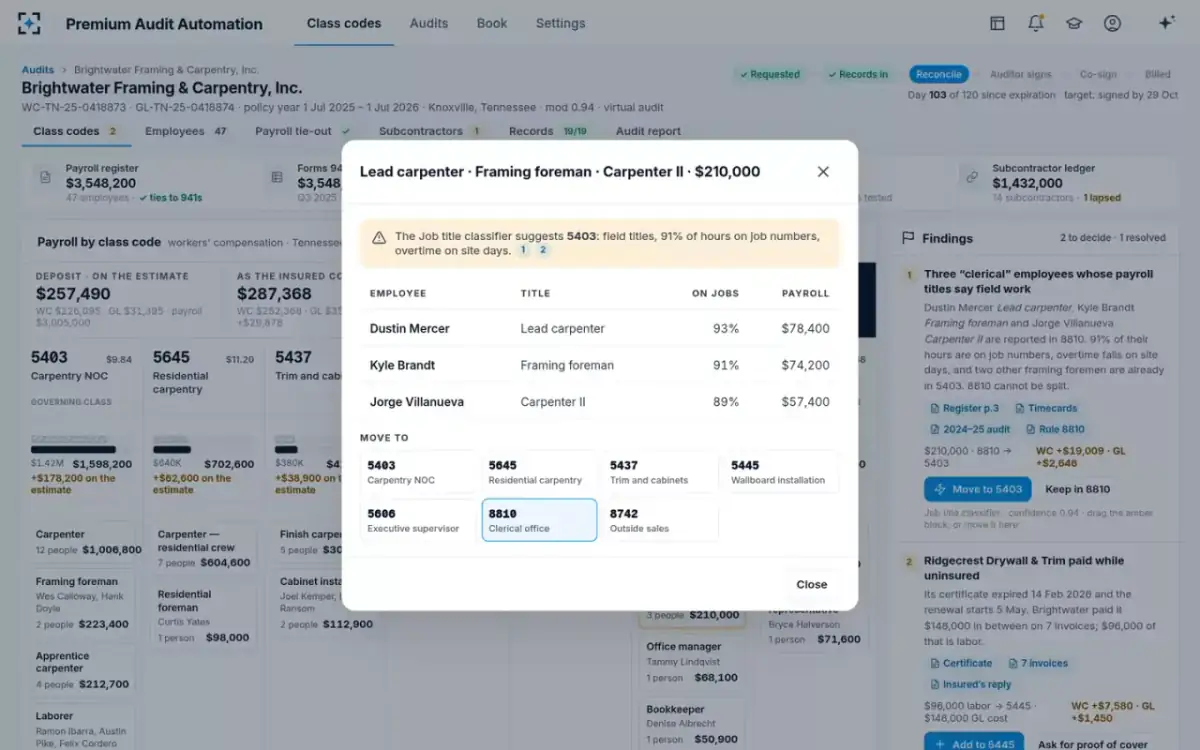
The insured had an answer, and the classifier put it on the file. Brightwater's office manager wrote that the three do estimates and ordering from the office in winter. That is the interchange the filed rule addresses: an employee who works in the operation at all takes the whole payroll to the highest-rated class. The auditor, Renata Okafor, moved the $210,000 to 5403. At the illustrative rates and the 0.94 experience mod, workers' compensation premium rose by $19,009, and general liability by $2,646, because the sample policy rates carpentry payroll for general liability and not clerical.
The same tests cleared another employee. Megan Shore, the payroll and accounts payable clerk, had 46 hours coded "yard" on nine timecards between January and March. No finding was raised; the record requester asked the insured what she did in those hours. The reply said she logged deliveries from the front-office window and never went into the yard. Logging deliveries from an office window is clerical work done in the office, and she stayed in 8810 with the reply on file.
One clerk, two readings: the evidence for and against moving Megan Shore
Points to the yard
- 46 hours coded “yard” on 9 timecards, January to March
- A yard is an area exposed to the operation’s hazards
Points to the office
- Payroll title: payroll and accounts payable clerk
- 2.2% of hours on job numbers
- Insured’s reply of 9 October: logged deliveries from the front-office window, never went into the yard
Decision: kept in 8810 by the auditor, $0 change, reply kept on the audit file.
Every employee in Premium Audit Automation, reported code against suggested code
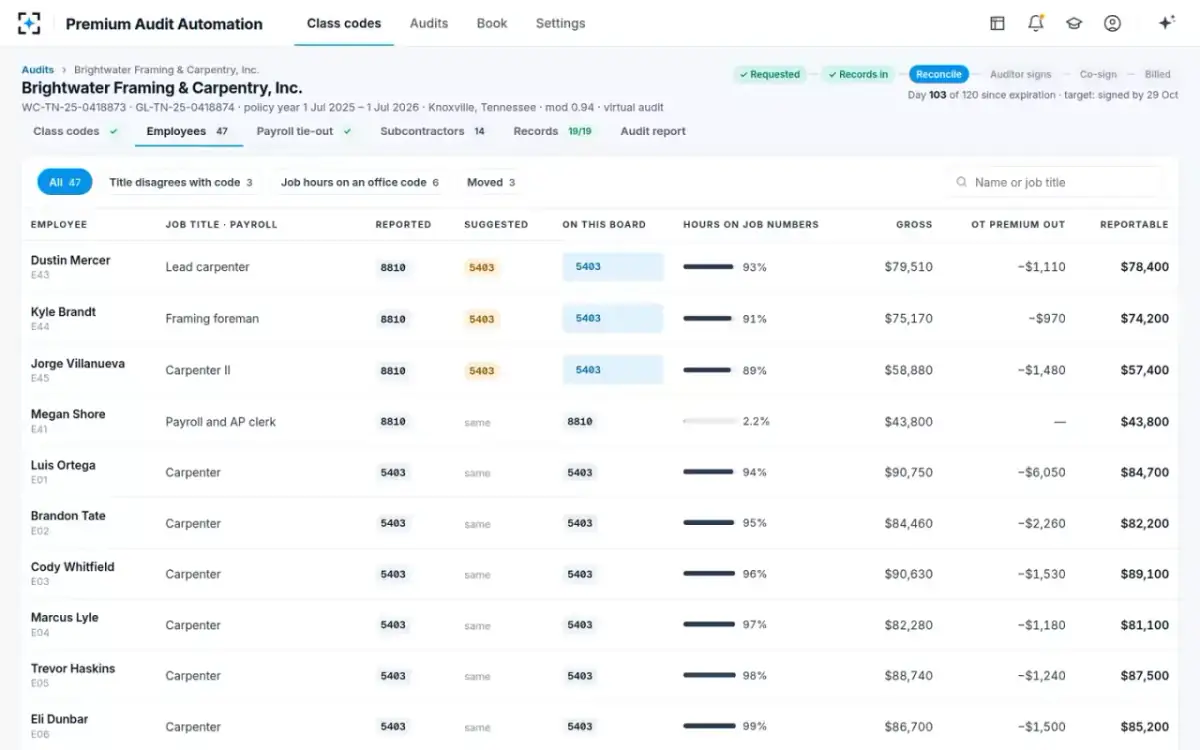
The design choice is deliberate. A classifier that moved payroll on its own would be applying a rule that regulators read case by case, on evidence an insured has the right to contest. Every finding in the solution carries the register page, the timecards, the prior audit and the rule it relied on, so the auditor can defend the move to the insured, the manager and an examiner, or reject it. What the six agents may and may not do is set out on the Premium Audit Automation page, and the effect of a single moved block on the bill is traced in what a premium auditor does.
Questions people ask
What is code 8809?
It is the standard exception for executive officers who perform only clerical or outside sales duties, listed in the filed manual as "Executive Officers NOC—Performing Clerical or Outside Salespersons Duties Only." An officer who also works in the operation, or supervises the crew on site, does not fit it. The officer's payroll then follows the work. Oregon, for one, has auditors verify the minimum and maximum payroll set for covered officers.
Does an office manager who walks onto the shop floor lose 8810?
Not for a clerical errand. The filed rules let 8810 employees enter another area of the workplace for clerical purposes, such as delivering paychecks. Directly supervising non-clerical employees out there, doing physical work or demonstrating something does disqualify, and the whole payroll then goes to the higher class.
Is an estimator who visits job sites in 8742?
Possibly, if the site visits are sales work and the rest of the job is clerical. California's 1996 plan required outside salespersons to sell away from the premises and otherwise do only clerical office duties. An estimator who supervises the crew while on site fails that test.
Can my insurer reclassify employees at the audit?
Yes, the audit applies the classes that fit the work, and the insurer should explain any change. In California, an employer can appeal an insurer's or the rating bureau's decision on a classification complaint to the Department of Insurance, generally within 30 days of the written rejection or decision.
Is 8810 the same in every state?
No. Each state approves its own version of the manual, and California, for one, has its own plan. Texas only adopted the telecommuter code 8871 for policies effective from 1 July 2026, and California's decisions quote California's own plan. Check the manual in force for the policy's state and effective date.
What rate difference is at stake between 8810 and a construction class?
Usually a large one, because clerical work carries little hazard. In the fictional sample, the illustrative rates were $0.21 per $100 of payroll for 8810 and $9.84 for carpentry 5403, a factor of almost 47. Real rates are filed by state and carrier, so compute it from your own rate pages.