A premium auditor sets the final premium on an auditable commercial policy, most often workers' compensation and general liability, after the policy year has ended. The policy was priced on the insured's own estimate of payroll, sales or subcontract cost. The auditor collects the actual records, ties the payroll register to the federal and state wage reports, places every employee's pay in the class code that fits the work, checks each subcontractor against a certificate of insurance, and signs a report that turns the deposit into a bill or a refund. The job is hard because the records sit with the insured and arrive in pieces, and because the classification rules are narrow and strictly read. Botminds' Premium Audit Automation is premium audit software in which six agents chase the records, reconcile the payroll and draft the audit, so the auditor's hours go to the decisions only an auditor can make.
The worked examples below follow a fictional sample audit as it runs through the solution: Brightwater Framing & Carpentry of Knoxville, Tennessee, a framing contractor with 47 employees, audited by its workers' compensation and general liability carrier for the policy year 1 July 2025 to 1 July 2026. Every name and figure about it is sample data, and its rates are illustrative. The rules come from state regulators, the NAIC and the Casualty Actuarial Society, linked where they appear.
What does a premium auditor do? Five decisions, and what each one settles
| Decision | What it settles | The rule behind it | In the sample audit |
|---|---|---|---|
| Which records are enough | What it settlesWhether the audit can be finished on actual figures at all. | The rule behind itThe policy lets the insurer ask for journals, registers, vouchers, contracts, tax reports, payroll and disbursement records (Alaska Bulletin B 15-08). | In the sample audit19 of 19 records in, after two reminders and four targeted asks. |
| What the payroll really is | What it settlesThe exposure every rate is multiplied by. | The rule behind itReconcile the payroll with records not used to build it, such as the quarterly tax and unemployment reports (Oregon OAR 836-043-0115). | In the sample audit$3,548,200 on the register and on four Forms 941; $61,800 of overtime premium out. |
| Which class each dollar belongs in | What it settlesThe rate: $0.21 or $9.84 per $100 of payroll in the sample. | The rule behind itVerify the proper use of 8810 clerical, 8742 outside sales and 7380 drivers, the codes most often stretched (Oregon OAR 836-043-0115). | In the sample audit$210,000 moved from 8810 to 5403; one clerk kept in 8810 on her written reply. |
| Which subcontractors count as insured | What it settlesWhether their labour is added to the contractor’s premium. | The rule behind itCertificates of insurance covering subcontractors are among the records a Florida physical audit must use (Fla. Admin. Code 69O-189.003). | In the sample audit13 of 14 covered on every payment date; $96,000 of labour added for the fourteenth. |
| When the audit closes, and on what | What it settlesActual figures, or the estimate when records never came. | The rule behind itExaminers verify the carrier’s procedure for waiving audits and that “the basis is reasonable” (NAIC exam standard 9). | In the sample auditSigned on day 103 of a 120-day target; above $25,000 a manager co-signs. |
Why do insurance companies do premium audits? Because the premium was an estimate
Insurers audit because a workers' compensation or general liability premium is a rate multiplied by an exposure nobody can know until the year is over. Texas's insurance commissioner put it in one line: "For workers compensation, the carrier applies rates to payroll—the exposure base—to determine premium." The employer estimates payroll when the policy starts, and the carrier audits it after the term ends. Alaska's insurance division says the same from the other side: the final premium is worked out after the policy ends, from the actual payroll and the classes and rates that lawfully apply to the business (Alaska Bulletin B 15-08).
The sums involved are large. In 2023, according to the National Academy of Social Insurance, workers' compensation programs covered "nearly 150 million jobs and close to $11 trillion in wages". Every one of those dollars of wages sits in a class with its own rate. General liability works the same way on a base such as payroll, sales or subcontract cost. The Casualty Actuarial Society's ratemaking text names payroll for workers' compensation and receipts for general liability as exposure bases that move with inflation.
The class matters more than the volume. In the sample audit, Brightwater estimated $3,005,000 of payroll and actually paid $3,486,400 of reportable payroll, about 16% more. But the illustrative rates on its board run from $0.21 per $100 for clerical office work to $9.84 for carpentry, a factor of almost 47. Three carpenters reported as clerks shift far more premium per dollar than a payroll that runs a little over its estimate.
What does a premium auditor look at? The records, and what each one proves
A premium auditor looks at the insured's payroll records, its federal and state wage reports, its disbursements, and the certificates of insurance of anyone it paid for labour, and uses each to prove something different. Alaska's insurance division published the list an insurer may ask for: Forms 941, 940, 1099 and 1096, W-2 and W-3, the state quarterly unemployment report, certified payroll, the latest general liability audit, and "A list of vendors and subcontractors used during the policy term (including the amounts paid) and copies of Certificates of Insurance". In unusual cases it adds bank statements, Schedule C and Form 1120.
The register says what the insured thinks it paid each person. The quarterly reports say what it told the government it paid, so the two are reconciled before anything else. Oregon's audit rule requires exactly that: "Reconciling the total payroll with records not used in the original tabulation". Oregon's regulator-run test audits go further and reconcile chargeable payroll with the state unemployment and FICA quarterly reports as "independent control records".
The reconciliation is not a demand that two numbers match. Line 2 of Form 941 carries the amounts that "would also be included in box 1" of employees' W-2s, and box 1 excludes elective deferrals such as employee contributions to a 401(k). A contractor with a retirement plan will show less on line 2 than on its gross register, for a reason the auditor can name. The skill is in listing every reconciling item, not in forcing a tie.
The payroll tie-out: four quarters of Form 941 against the register
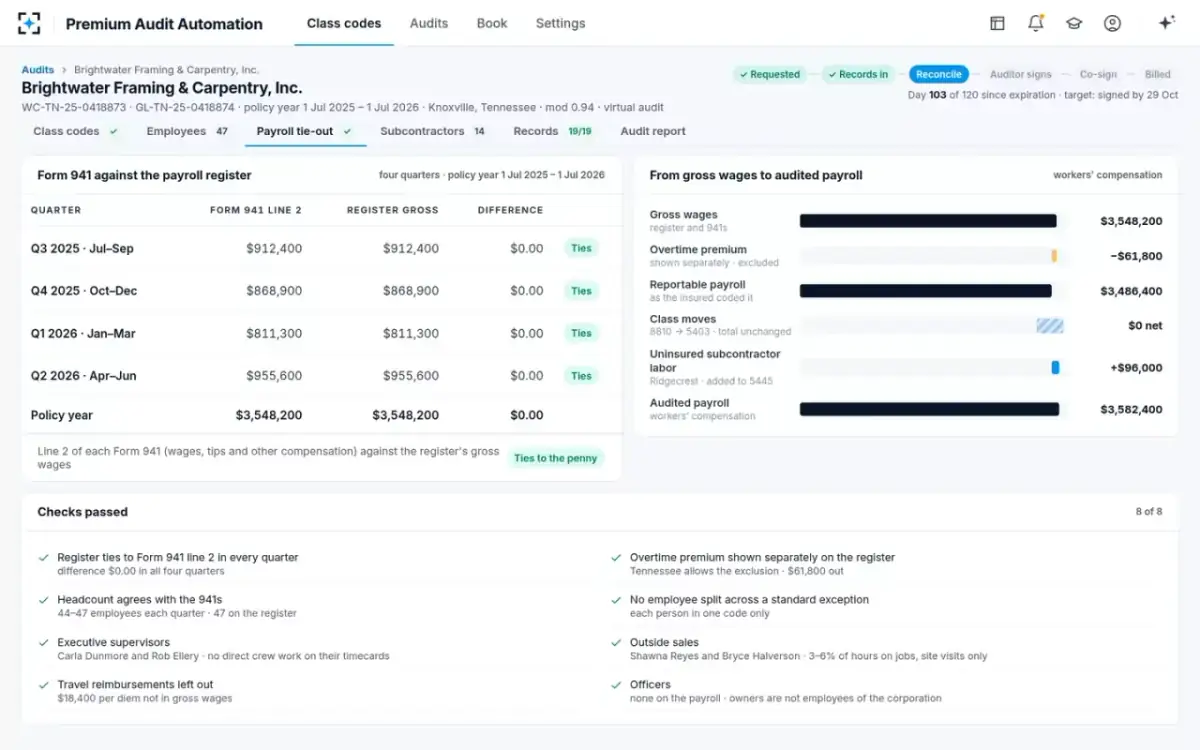
Payroll is only half the file for a contractor. Florida's rule for physical audits lists, among the records examined, subcontractors' certificates of insurance and independent contractor documents (Fla. Admin. Code 69O-189.003). Oregon tells insurers to look into every source of earnings, uninsured contract labour included (Oregon's audit procedure rule; see uninsured subcontractors). A subcontractor paid while its coverage had lapsed is, for audit purposes, part of the contractor's own workforce. The certificate dates that move premium are a separate guide.
Field, desk, mail, phone or virtual: which kind of audit is it?
Audits differ by where the records are examined, and state rules treat the kinds differently. Oregon's rule defines a field audit as one performed "at the insured's principal place of business, work site, or other site mutually agreed to", and a desk audit as one at a site other than the principal place of business. It adds that a desk audit is not simply reading a payroll report the insured sent in. A payroll report is the insured's own declaration, used in years when no audit is done.
Florida is stricter about method. Its rule for the voluntary market bars telephone audits in place of mail or physical ones (Florida workers comp audit rules). Mail audits are allowed only where a physical audit is not required, and a physical audit must be made whenever the employer asks for one, unless the request is unnecessarily repetitive. What the industry now calls a virtual audit, records sent electronically and discussed by video or phone, does not appear by that name in either rule we read. Whether it counts as a physical or a mail audit is a question for each state's own rules, and a carrier should have an answer on file.
Frequency follows premium and hazard. Oregon requires a field audit at least once a year on policies producing $10,000 or more of annual standard premium, and lets an insurer drop to auditing every third renewal once two consecutive policy years show an audit premium difference of less than five percent. Florida requires construction employers above the experience-rating threshold to be audited every year, and its rule requires a final physical audit on every new construction policy, whatever the premium. The Florida workers comp audit rules are set out clause by clause in their own guide.
How long does a premium audit take?
From expiration to final premium, a workers' compensation audit typically takes months, not days. The Casualty Actuarial Society's ratemaking text puts the payroll audit that fixes the final premium some three to six months after expiry (CAS, Basic Ratemaking; premium audit tracking shows how to measure it). The NAIC's examination standard asks examiners to find each company's own time frame, noting that companies usually set themselves a deadline for finishing an audit after expiry (premium audit standards). It sets no number.
Almost all of that time is waiting. In the sample audit the notice went out the day after expiration, the first records arrived on 21 July, and the last answer came on 9 October. Reconciling, classifying and drafting took the agents eight minutes on the morning of 12 October, and the auditor signed the same day, day 103 of a 120-day target the carrier sets for itself.
One sample audit: 100 days of waiting for records, three days of deciding
- Expiry to first records20 d
- Chasing the rest: reminders and targeted asks80 d
- Decide and sign3 d
- Left before target17 d
- Up to 3 months90 d
- 3 to 6 months+90 d
Is a premium auditor an employee of the insurer?
Sometimes. Carriers run audits with their own staff, with independent audit firms, or with both, and regulators expect either. The NAIC exam standard has examiners check who conducts the audits, the carrier's own auditors or independent ones (NAIC exam standards). Whoever does the work, the carrier answers for it: the NAIC's operations standard expects an insurer to monitor any firm that takes on a business function for it (NAIC). What that oversight looks like is covered in the guide to premium audit vendors.
In Florida, the auditor's identity is part of the audit itself. When the audit is complete, the employer or an officer and the auditor both print and sign their names on it and attach proof of identity (Fla. Stat. § 440.381(3)). The state's rule prescribes an Auditor's Statement and a statement from whoever provided the audit information, and allows electronic signatures within the limits of Florida's electronic signature law.
Can a premium auditor change my class code?
Yes. The audit applies the classifications that fit the work, not the ones on the policy's information page. Oregon requires the insurer to explain if the classifications assigned at audit differ from those on the policy or on the rating bureau's inspection report, and to obtain a description of the operations from the person best able to give one. If the audit turns a person the insured treated as an independent contractor into an employee, Oregon's final premium audit billing must give "the name of each person, a description of the positions or tasks of each named person, and the basis for the determination".
The insured can challenge the result. In Oregon a hearing request must reach the Division of Financial Regulation within 60 days of receiving the billing. California's Department of Insurance lists audit disputes and classification disputes among the workers' compensation issues it handles. Delaware's insurance department told carriers in February 2026 to send the insured "all calculations and supporting documentation necessary to justify the audited premium amount" with the audit bill. The narrow rules behind the most common reclassification are in class code 8810 vs 8742.
Who waits on the premium auditor's report?
Four other people cannot finish their work until the auditor signs: the audit manager who co-signs large changes, the underwriter renewing the account, billing, and the insured's own office manager. In the sample carrier's settings, any additional or return premium above $25,000 needs the manager's second signature, and billing invoices only signed audits.
Five people, one audit: what each needs from the premium auditor
Today
Half the week goes on chasing records by email and re-keying payroll registers.
With agents
Opens each audit with the records in, the payroll tied and the class questions already raised.
Still theirs: Every move of payroll between classes, and the signature.
Today
Co-signs large changes and answers the disputes that follow, line by line.
With agents
Sees every change with its reason and its source before co-signing anything above the limit.
Still theirs: The second signature and the rules.
Today
Renews on last year’s estimate without knowing the audit found a different class mix.
With agents
Is told when a class is short on the renewal estimate.
Still theirs: The renewal decision.
Today
Invoices a number the insured cannot follow, then takes the calls.
With agents
Invoices only signed audits, with a letter that explains each change.
Still theirs: Collection and refunds.
Today
Gets vague requests for “your audit records” between payroll runs.
With agents
Gets one list, exact follow-up questions and an upload link.
Still theirs: The answers only the business can give.
The underwriter's interest is easy to miss. NAIC exam standards say underwriting, rating and classification should rest on information developed at or near inception, not after the fact. An audit that finds carpenters reported as clerks is evidence the next estimate should start from, and the solution passes the accepted class moves to the underwriter before the renewal.
What the seat looks like when Premium Audit Automation does the chasing
The premium auditor keeps the decisions; agents take the clerical work around them. Botminds estimates the hand-run version of a virtual workers' compensation and general liability audit at about 19 auditor hours, and about 5 with the agents. The estimate is ours, built from the steps in the sample audit, not a measured result; a carrier can test it on its own closed audits.
Where a premium auditor's 19 hours go on one audit, and the 5 that remain
Chasing the insured for records
Reading titles and timecards for class codes
Re-keying the register and tying it to the 941s
Rating, report and letter to the insured
Matching subcontractor payments to certificates
Review and signature
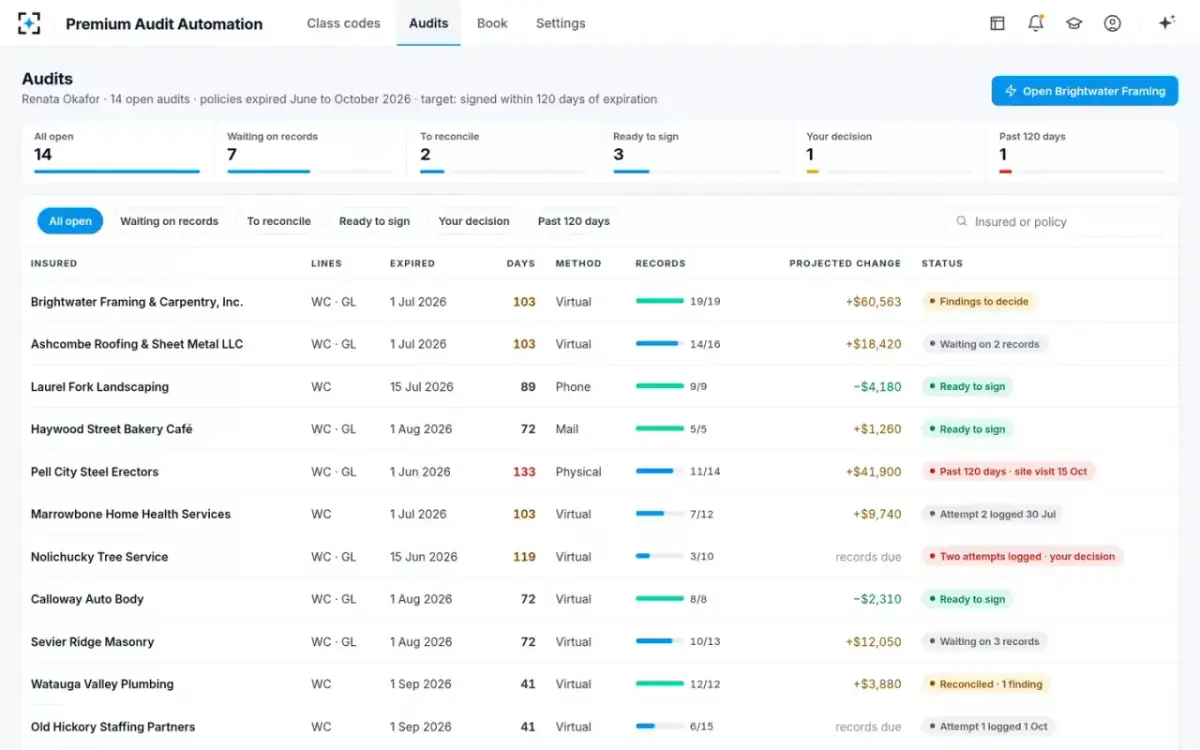
Six agents divide the rest. The record requester sends the notice and the record list for the insured's classes, reminds on day 14 and day 28 as documented attempts, and asks targeted follow-up questions. The payroll register reader ties the register to the 941s by quarter and separates overtime premium where the policy's rules allow. The job title classifier tests each employee against the standard exceptions and suggests a class with evidence for and against. The subcontractor certificate checker matches every payment to a certificate in force on its date. A general liability exposure reader and a premium calculator build the report and the letter. None of them moves payroll, signs, bills or applies a charge.
The premium auditor's worklist in Premium Audit Automation: fourteen open audits
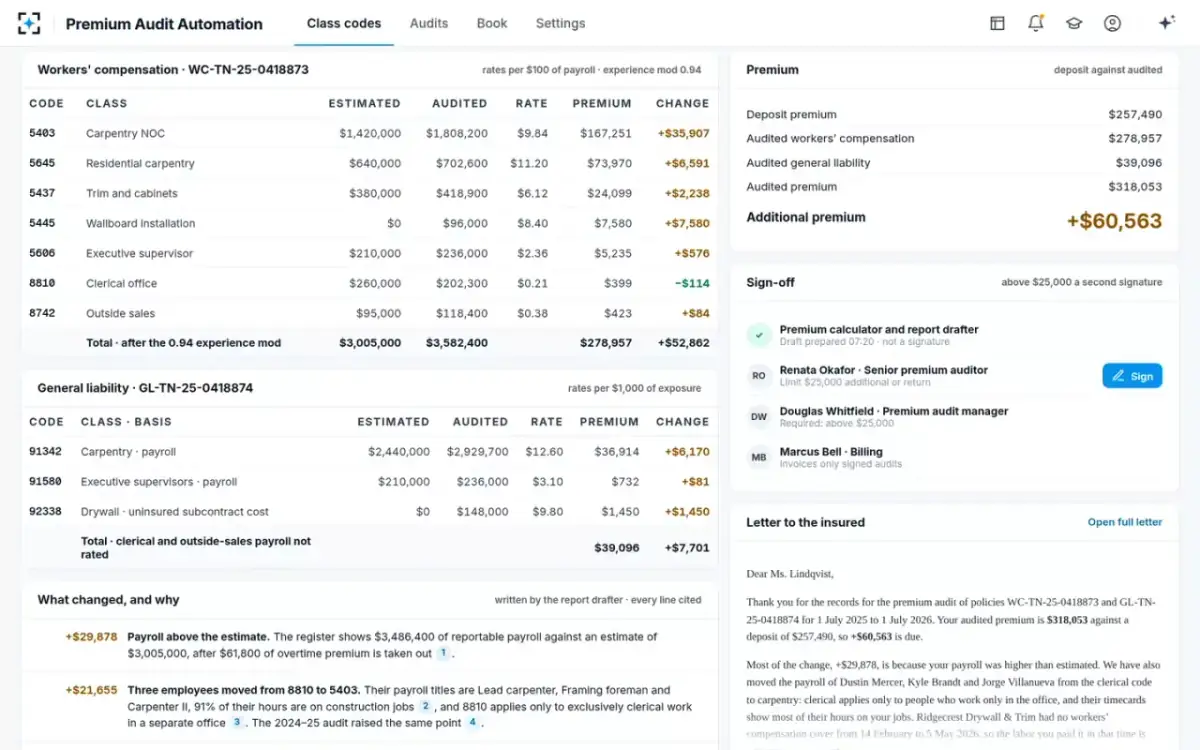
The draft lands as a report the auditor can defend line by line. In the sample, the additional premium of $60,563 breaks into $29,878 for payroll above the estimate, $21,655 for three employees moved from clerical to carpentry, and $9,030 for an uninsured subcontractor, each line pointing to the register page, timecard, certificate or reply behind it. The auditor accepted both findings and kept a fourth employee in clerical on the insured's written explanation.
Premium Audit Automation's audit report: every change explained before anyone signs
Questions people ask
What is a premium audit in insurance?
A premium audit is the review, after a policy year ends, of the records that measure what the policy actually covered: payroll for workers' compensation, and payroll, sales or subcontract cost for general liability. The audited exposure is multiplied by the rates for the right classes, and the difference from the deposit is billed or refunded. Texas's commissioner described the result plainly: the audited premium can go up or down.
What is a virtual premium audit?
It is an audit in which the insured sends records electronically and answers questions by phone or video, with no visit. The state rules read for this guide do not use the term: Oregon distinguishes field audits, desk audits and payroll reports, and Florida forbids telephone audits in place of mail or physical ones. A carrier running virtual audits should know which category each state's rules put them in.
Why does my insurer audit me every year?
Because the rules require it for many policies. Oregon requires a yearly field audit at $10,000 or more of annual standard premium, until two consecutive policy years show an audit premium difference under five percent. Florida requires annual audits for construction employers above the experience-rating threshold, and a final physical audit on every new construction policy.
What happens if the audit shows I overpaid?
The carrier owes a return premium, and regulators watch how fast it arrives. NAIC examiners are told to check independently that refunds reach insureds on time. Delaware's 2026 bulletin says carriers must refund overpaid audited premium directly, not as a credit on future bills, unless the insured asks otherwise.
Does a premium audit cover general liability too?
Yes, when the general liability policy is rated on an auditable base. Alaska's list of records an insurer may request even includes a copy of the latest general liability audit report for the workers' compensation audit. In the fictional sample, general liability was rated on carpentry payroll, supervisor payroll and uninsured subcontract cost, and the audit added $7,701.
What does a premium auditor sign?
The audit document, and in Florida a prescribed statement as well. Florida's statute requires both the employer or officer and the auditor to print and sign their names and attach proof of identification, and its rule names an Auditor's Statement form. In Premium Audit Automation the agents' draft is marked "not a signature"; only the auditor, and above the carrier's limit a second person, can sign.