Premium audit tracking means measuring the audit programme as a whole, not just working through the queue: how many auditable policies have expired and how many are signed, how long each audit took, how many closed on the estimate because records never came, how much additional and return premium the audits produced and from which sources, how fast refunds reached insureds, and how often results were disputed or reversed. Those few numbers show where earned premium leaks, and where an audit desk is slow or unfair to the people it bills. Regulators already ask for most of them: the NAIC's examination standard checks an insurer's time frame for completing audits, its basis for waiving them, and whether return premiums arrive on time. Botminds' Premium Audit Automation keeps those measures as a by-product of the audits its agents prepare and its auditors sign.
The figures in this guide come from a fictional sample carrier's audit book in the solution, covering policy year 2025–26, and are sample data, not a customer's results. The definitions are ours unless a rule is cited.
What should premium audit tracking measure?
Track eight things: speed, completion on actual figures, coverage by method, the size of the audit difference, where audited premium came from, refunds, disputes, and what the audit tells underwriting. Each has a formula an audit manager can compute monthly from the audit file, and most map to a line in a regulator's rule.
Eight premium audit KPIs, with formulas and the rule each answers to
| KPI | Formula | Why it matters |
|---|---|---|
| Days to signed audit | Median days from expiration to final signature; share of audits past the carrier’s target. | NAIC examiners ask for the company’s own time frame for completing audits after expiration. |
| Closed on the estimate | Audits finalised without the insured’s records ÷ auditable policies expired. | NAIC examiners verify the procedure for waiving audits and that its basis is reasonable. |
| Coverage by method | Field, desk, mail and payroll-report audits ÷ policies, by premium band. | Oregon and Florida set minimum audit methods by premium and class. |
| Audit premium difference | (Audited standard premium − estimated) ÷ estimated, per policy; share over 5%. | In Oregon, on policies of $10,000 or more, a difference of five percent or more keeps the policy on annual field audit. |
| Net audited premium by source | Additional and return premium split into payroll, class moves, uninsured subcontractors, overtime and other. | Shows whether the money comes from volume or from judgement. |
| Days to refund | Days from signature to return premium received, and share refunded as credits. | NAIC examiners independently verify that return premiums reach insureds on time. |
| Disputes and reversals | Audits disputed ÷ audits billed; disputes resolved in the insured’s favour ÷ disputes. | Oregon gives insureds 60 days to request a hearing; Delaware asks carriers to justify every audited figure. |
| Renewal estimates short | Classes whose audited payroll exceeds the renewal estimate by the carrier’s threshold. | Underwriting should start from information developed at or near inception, not after the year. |
Two of the eight are fairness measures, not revenue measures, and they belong on the same page as the revenue ones. A desk whose additional-premium line climbs while its refund days and dispute rate climb with it is not getting better at auditing. It is getting better at billing, and an examiner sampling its files will see the difference.
What does closed on the estimate mean?
An audit closes on the estimate when the insured's records never arrive and the carrier finalises the premium on the payroll it estimated, or on a figure it estimates afresh, instead of the payroll it can verify. Texas's commissioner named it as one of a carrier's two existing remedies against an insured that will not cooperate: it may cancel the policy, or it may estimate the payroll (Texas Order No. 4448). It is legal. It is also an audit not done, and each one is a policy whose true exposure, and true class mix, the carrier never learns.
It also changes what the insured can contest. Oregon's rules on premium audit hearings tell the director to dismiss a request when the bill rests on an estimate of the insured's Oregon payroll rather than on an actual audit (Oregon's hearing rule). An invoice built on a payroll report without an audit is not a final premium audit billing at all. The estimate closes the file without the protections an audit carries.
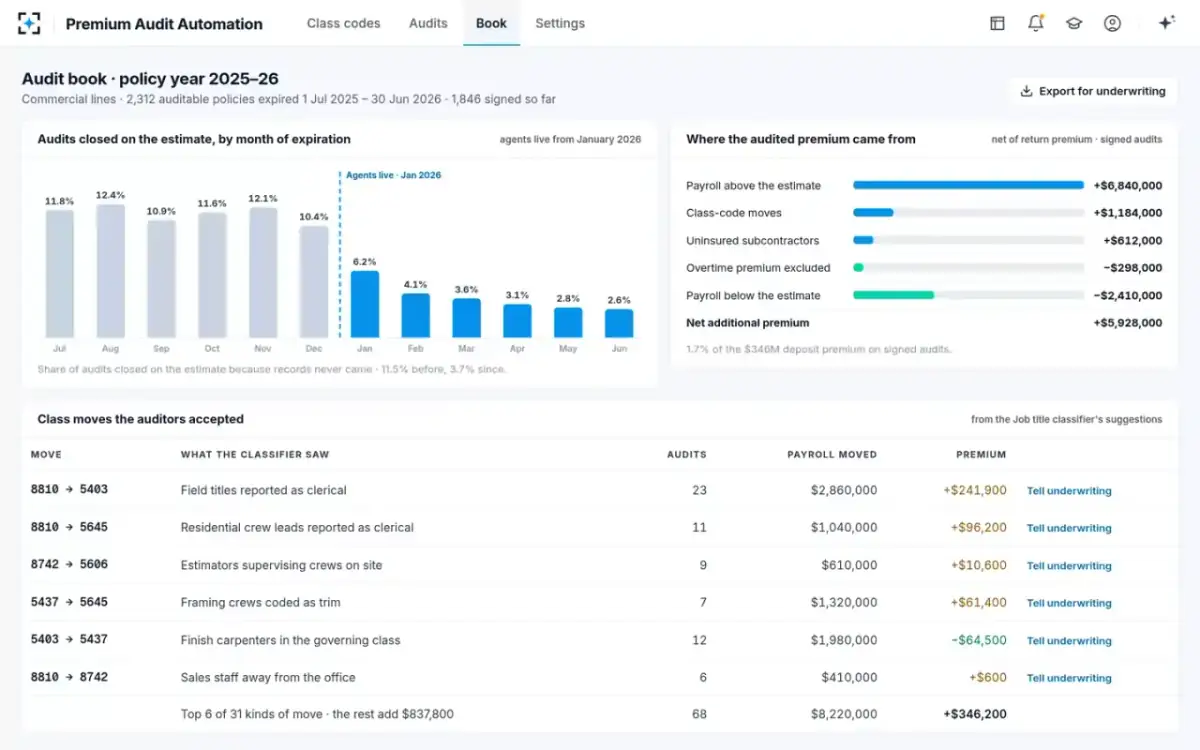
In the fictional sample carrier's book, 11.5% of audits closed on the estimate in the six months before the agents started chasing records, and 3.7% in the six months after. The carrier's design target in the solution is fewer than 3 in 100. The chart shows the sample month by month; it is sample data in the solution, not a measured result.
Share of audits closed on the estimate, by month of expiration, in a sample book
How long should a premium audit take, and how do you measure it?
Measure the median and the tail, against a target the carrier writes down. The Casualty Actuarial Society's ratemaking text puts the final workers' compensation premium "about three to six months after the policy expires." The NAIC's standard expects each company to have its own time frame and examiners to test against it. The sample carrier in the solution sets 120 days from expiration to signature.
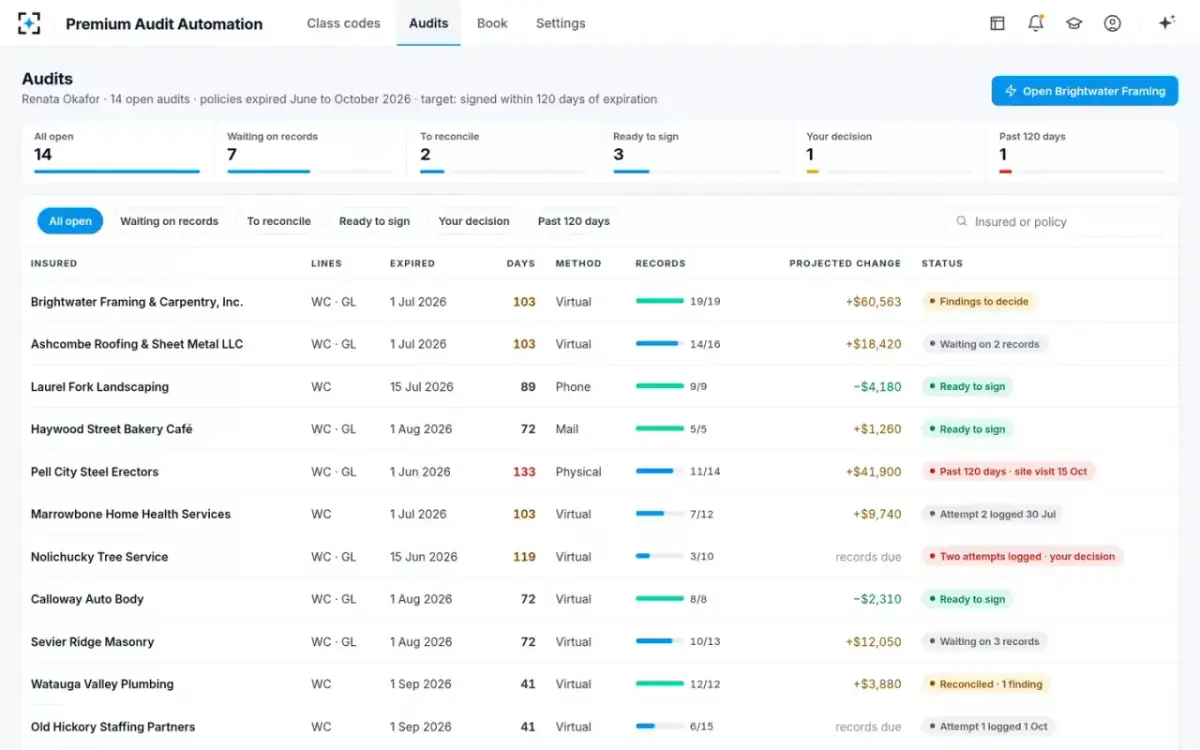
A median alone hides the audits that matter. A desk whose median is 75 days can still have one audit in ten past 180, and those are usually the ones with missing records, a dispute or a class question nobody wanted to decide. Track the share past target by reason (waiting on records, waiting on a decision, waiting on a second signature), because each reason has a different owner. In the sample worklist, the status column does exactly that: waiting on records, to reconcile, ready to sign, needs the auditor's decision, past 120 days.
A worklist that says what each audit waits on
Where does audited premium come from?
From five places, and most of the money comes from the least interesting one. In the fictional sample book, signed audits produced a net $5,928,000 of additional premium. Payroll running above the estimate brought in $6,840,000; payroll below the estimate gave back $2,410,000. Class-code moves added $1,184,000, uninsured subcontractors $612,000, and overtime premium excluded from payroll took off $298,000.
Where a sample book's audited premium came from: volume brings the dollars, judgement brings the corrections
The split matters because the lines behave differently. Payroll above or below the estimate is volume: it tracks the insured's business and the economy, and an audit desk mostly records it. Class moves and uninsured subcontractors are judgement: they exist only because an auditor read titles, timecards and certificates and decided something. Overtime and payroll below the estimate are money owed back to insureds. A programme that tracks only the net cannot tell whether a good year came from inflation or from audit quality.
Inside the judgement lines, track which moves auditors accept. In the sample book, the most valuable move was field titles reported as clerical, 8810 to carpentry 5403, on 23 audits for $241,900. The next was residential crew leads reported as clerical, on 11 audits for $96,200. One move went the other way: finish carpenters placed in the governing class were moved to the trim class on 12 audits, lowering premium by $64,500. The 8810 and 8742 tests explain why the clerical moves dominate.
How do you track return premium?
Track the days from the auditor's signature to the money in the insured's hands, and how the refund was paid. NAIC examiners are told to verify independently that insureds receive their return premiums on time (premium audit standards). Delaware went further in February 2026: carriers "must issue a direct refund of any overpaid amount rather than applying the credit to future billing cycles, unless the insured expressly requests otherwise." It added that "Premium refunds must be issued using the same method as the original premium payment".
The same bulletin set an expectation on the billing side: carriers should give insureds at least 30 calendar days from the date an audited premium bill is issued to pay it. It recorded a complaint that explains why: "Businesses may not receive audit documentation in time to review charges before funds are withdrawn." A tracking report that shows days to bill and days to refund side by side makes that asymmetry visible before an examiner does.
Disputes, reversals and what they tell you
Count disputes per hundred audits billed, the share resolved in the insured's favour, and the reason. Insureds have formal routes: in Oregon, a hearing request must reach the Division of Financial Regulation within 60 days of the final premium audit billing; in Delaware, an appeal to the rating bureau during the policy period or within 12 months after the policy ends. Delaware's bulletin also recorded that "Many carriers do not reverse audit bills once issued", applying corrections as credits instead.
A dispute that ends in a reversal is a free quality sample: an audit an insured has already re-performed. Read them by type. A cluster of reversals on class moves says the classification evidence is thin; a cluster on uninsured subcontractors says certificates are being missed at audit and found by the insured afterwards. Oregon's test audits treat an advisory difference, a single error offset by another, as worth reporting even when the net is small; a dispute log should do the same.
Premium development: why the book is not final at expiration
Audited premium arrives months after the policy year ends, so the book's premium keeps changing after the year is over, and finance and actuarial teams track it as premium development. The CAS ratemaking text says plainly that "Premium for lines of business subject to premium audits will continue to develop after the end of the policy year period." Its worked example shows the arithmetic.
Premium development in the CAS worked example: one policy year, measured twice
| Step | Calculation | Result |
|---|---|---|
| The book | One workers’ compensation policy written each month of 2011, each booked at $500,000 estimated premium. | 12 policies |
| The audit effect | Every policy develops upward by 8% at its first audit, six months after expiration. | × 1.08 |
| At 24 months (31 Dec 2012) | 6 × $500,000 × 1.08 + 6 × $500,000: half the audits done. | $6,240,000 |
| At 36 months (31 Dec 2013) | 12 × $500,000 × 1.08: all audits done. | $6,480,000 |
| Development factor, 24 to 36 months | $6,480,000 ÷ $6,240,000 | 1.0385 |
The audit desk shapes that factor. The CAS lists among its drivers "The stability of the historical relationship between the original premium estimate and the final audited premium", along with the company's own auditing procedures. A desk that closes more audits on actual figures, and closes them sooner, gives the actuaries a factor that settles faster and moves less. The audited figures also travel into the statistical reports: Texas collects unit statistical data on every workers' compensation policy written there (Texas Department of Insurance; see the unit statistical report guide). A wrong audit becomes wrong data for rates and experience mods.
A premium audit tracking scorecard you can copy
Run the scorecard monthly, by audit team and by auditor, with each line owned by a named person. Most of it can be built from the audit file itself if each audit records its expiration date, method, records received, findings, signatures, bill and refund dates, and any dispute.
A monthly premium audit scorecard, and who owns each line
- Expired, signed and open, by method
Owner: audit manager. Compare the method mix with each state’s minimums, such as Florida’s physical audit thresholds.
- Median days to signature, and share past target by reason
Owner: audit manager. Reasons: records, decision, second signature.
- Closed on the estimate, with the basis for each
Owner: audit manager. The basis is what an examiner will ask for.
- Net audited premium by source
Owner: finance. Volume, class moves, uninsured subcontractors, overtime, payroll below estimate.
- Class moves accepted, by kind
Owner: audit manager, shared with underwriting.
- Days to refund, and refunds paid as credits
Owner: billing.
- Disputes, reversals and their reasons
Owner: audit manager, with a sample re-read each quarter.
- Renewal estimates short by more than the threshold
Owner: underwriting. The sample carrier flags a class short by $100,000.
Be careful how auditor productivity is measured. Audits signed per auditor per month, weighted by method and size, is a fair measure; additional premium per auditor is not, because it rewards the auditor who never finds a return premium. Texas's commissioner rejected a noncompliance charge partly because its amount could differ between policyholders who behaved the same way (Texas Order No. 4448). Incentives that vary an audit's outcome with the auditor carry the same risk.
The audit book in Premium Audit Automation: closed on the estimate, premium by source, class moves
Where Premium Audit Automation fits in premium audit tracking, and where it does not
It fits where the measures are born: in the audit file. Each audit in the solution carries its expiration date, method, the record list and every request and reply with its date, each finding with the record behind it, every class move with who made it and why, and the signatures with their times. The book page above is a query over those audits, not a spreadsheet someone fills in, so days to signature, closed on the estimate, premium by source and accepted class moves come out without separate data collection.
It does not replace the systems that hold the money. Refund dates, payment dates and complaint outcomes live in billing and complaint systems; a scorecard that wants days to refund or reversals needs those dates brought in or reported alongside. It does not set the targets: the 120-day clock, the $25,000 co-signature limit and the threshold for telling underwriting are the audit manager's settings, versioned and changed with approval. And it cannot measure audits it never sees: a carrier that keeps part of its book with an outside audit firm should bring those audits into the same measures, which is the subject of premium audit vendors. For the per-audit view behind the totals, see what a premium auditor does.
Questions people ask
What is audit additional premium?
It is the amount by which the audited premium exceeds the deposit premium the insured paid on its estimate, billed after the audit. The opposite, return premium, is owed when the audit comes in below the deposit. In the fictional sample audit, a $257,490 deposit became a $318,053 audited premium, $60,563 of additional premium.
What is a good premium audit completion rate?
There is no published industry benchmark in the regulator sources. The NAIC standard expects each carrier to set its own time frame and to justify waived audits, so the honest measure is performance against your own target and the share of audits closed on the estimate, tracked by month.
How do you measure premium auditor productivity?
Count audits signed per auditor, weighted by method and size, and watch days to signature and the share of findings later reversed. Avoid measuring auditors on additional premium, which rewards one-sided audits. Florida's rule even requires physical audits on request, which a pure volume measure would discourage.
Does an audit correction change the experience mod?
It can, because audited payroll and classes flow into the statistical data used for rating. Oregon requires an insurer that agrees with a test audit finding to file corrected information on a revised unit statistical report. Corrected payroll by class changes the expected losses an experience rating is measured against.
What is premium audit tracking software?
Software that records each audit's status, dates, findings and results so the programme can be measured. The useful kind computes the scorecard from the audit work itself; the less useful kind needs the measures typed in after the fact. In Premium Audit Automation the book view is built from signed audits.