A unit statistical report, or unit stat report, is the filing a workers' compensation insurer makes to the state's rating organization for each policy it writes: the audited payroll by class code and every claim on the policy, with its incurred medical and indemnity losses and its coding, valued at set intervals after the policy starts. In Texas, the regulator states that "Unit Stat is collected and maintained for every workers' compensation policy written in Texas." These reports are what experience mods are made of: the rating organization does not see claim files or payroll registers, only what insurers report. So an injury type miscoded or a reserve left high when the report is valued becomes next year's mod, and stays in it for up to three ratings. Botminds' Experience Mod Verification reads the figures each report put on the worksheet against the prior carrier's loss runs and audits, and drafts the correction request when they differ.
From a claim to a mod: where a unit report sits, and who touches it
A person decides
Claims adjusterOpens the claim, sets reserves for medical and wage benefits, and decides whether it is medical only or lost time.
A person decides
Premium auditorAudits payroll by class code after the policy ends; a dispute can produce a revised final audit months later.
A person decides
Insurer’s statistical reportingFiles the unit report: in Texas the first is valued 18 months after the policy starts and due by month 20, later ones every 12 months.
A person decides
Rating organizationUses the most current 1st, 2nd and 3rd reports, and corrections, to calculate each mod.
Agent
Loss run reader and payroll matcherCompare the report figures on the worksheet with the prior carrier’s loss runs and the final and revised audits, line by line.
Never: Infer a claim or re-class payroll
A person decides
UnderwriterSends the correction request to the reporting insurer, through the broker, and quotes on the bureau’s mod meanwhile.
What is a unit statistical report?
It is the policy's statistical record for the rating system: one report per policy per valuation, carrying the exposure and the losses in a standard format. NCCI's plan defines the experience a mod uses as "the payroll and losses that the insurance provider reports in accordance with NCCI's Statistical Plan", and losses as "the incurred medical losses and incurred indemnity losses for each classification in the experience period" (NCCI Experience Rating Plan Manual, Texas edition). Payroll is "payroll or other exposures for each classification", as reported.
The data has a second use besides mods. The Texas Department of Insurance notes that it is "used in developing job classification relativities, expected loss rates, and discount rates for use by the industry" (Texas Department of Insurance). The same reports that set an employer's mod set the expected loss rates every employer's mod is compared with.
A unit report is not a loss run. A loss run is the insurer's listing of claims for the policyholder or a broker, and state laws on loss runs differ on what it must show: Florida, for one, does not require an insurer to give reserve figures at all (Florida Statutes § 627.444). The unit report is filed with the rating organization, carries incurred values at a fixed valuation date, and codes each claim for rating. When the two disagree, the loss run is often the better evidence of what happened and the unit report the only evidence of what the bureau used.
Who files unit stat reports, and when?
Every insurer writing the coverage. In Texas the filers are "All insurers or other entities licensed to and currently writing workers' compensation in Texas", reporting to NCCI as the department's designated statistical agent. In California, a precedential decision summarises the statistical plan's requirement that insurers file "unit statistical reports" for every policy extending coverage under the state's workers' compensation laws (B.D.D. Pest Control, California Department of Insurance).
The schedule is the same in outline in both states. Texas: "The first report for a policy is valued 18 months after the effective date of the policy and due 18 to 20 months after the effective date of the policy", later reports are valued "12 months after the valuation date of the preceding report" and due two months after, and they continue "up through the 10th reporting level or until all claims are closed, whichever comes first". California values first reports 18 months after the month the policy began, due by month 20, with second and third reports at 30 and 42 months (Just Like Home, California Department of Insurance).
One policy's unit reports, and the three a mod can use
- Policy year12 mo
- 1st18 mo
- 2nd30 mo
- 3rd42 mo
- 4th and later, yearly54 mo +
- Not yet rated
- Rating 11st
- Rating 22nd
- Rating 33rd
- Out of the period
How does unit stat data affect your experience mod?
Directly: it is the mod's raw material. NCCI's plan says the rating organization "uses the risk's most current data from its 1st, 2nd, and 3rd Unit Reports and corrections to those reports to calculate experience rating modifications", and that the same policy's reports can be used in more than one rating, even "in more than three experience rating modifications" where the experience period allows. One policy year usually reaches three mods, each time through a later report, and an error that survives from one report to the next is charged in each.
Payroll on the report sets the expected losses; claims set the actual losses. Each claim's incurred value is split at the split point, its excess weighted by the employer's size, and medical-only claims have their primary and excess losses cut by 70%. Some claims are left out altogether because of how they are coded: the plan excludes claims "reported as noncompensable", claims "reported as fraudulent", coal mine disease claims, and COVID-19 claims reported under Catastrophe Number 12 for accidents from 1 December 2019 to 30 June 2023. Each of those exclusions depends on a code the insurer enters.
The fields on a unit report that move a mod
A handful of fields decide most of the mod. They are worth knowing by name, because a correction request has to say which field is wrong.
Fields on a unit report that move an experience mod, and the error each invites
| Field | What it does to the mod | Common error |
|---|---|---|
| Payroll by class code | Sets expected losses: payroll ÷ 100 × the class’s expected loss rate | Payroll left in the class the first audit used after a revised audit moved it |
| Incurred indemnity and medical, by claim | Sets each claim’s actual loss, split into primary and excess | A reserve from the first notice carried after the claim closed for less |
| Medical only or lost time | Medical-only claims count at 30% in NCCI states | A claim with a released wage reserve and no days lost still coded lost time |
| Claim status and reopenings | A reopened claim returns at its new value at the next report | A reopening missed, which understates the mod |
| Catastrophe, noncompensable and fraud codes | Coded claims are excluded from the mod | A denied claim reported without the noncompensable code |
| Type of claim | Separates workers’ compensation from employers liability and liability-over claims | An employers liability claim reported as workers’ compensation |
| Subrogation recovery | Reduces the loss once a correction report is filed | A recovery collected but never reported |
The medical-only field deserves its weight. Medical care is a large share of what workers' compensation pays: more than 47% of the $64.1 billion in benefits paid in 2023, by the National Academy of Social Insurance's count (NASI, 2026). The plan's reduction exists, a Casualty Actuarial Society paper by an NCCI actuary explains, so that employers gain nothing by leaving small medical claims unreported (Evans, 2014). A miscoded claim undoes that bargain for one employer.
Can a unit stat report be corrected?
Yes, by the insurer that filed it, and the bureau then recalculates. NCCI's plan: "The insurance provider may submit correction reports to the 1st, 2nd, and 3rd Unit Reports in accordance with NCCI's Statistical Plan", and "The rating organization automatically recalculates the current and up to two preceding experience rating modifications when it receives correction reports". Payroll has its own window: an insurer that finds "within three years of the policy expiration date" that reported payroll was wrong may "submit correction reports".
Three limits shape what a correction can achieve. It must come from the reporting insurer; a broker, a new carrier or the employer can only ask. Revisions reach the current and two preceding mods, with an exception for special fund reimbursements and subrogation recoveries, which can reach back "to the risk's fifth most recent rating effective date". And class changes made because the business changed, or because the classification system itself changed, do not reopen old mods: the plan does not revise a mod where the change in classification results from "a change in risk operations" or "a filed and approved change to the classification system".
When a correction lowers the mod, the plan applies the decrease back to the start of the policy. How to write the request so the reporting insurer can act on it without calling back is shown in the experience mod review guide.
When a claim closes after the valuation date
Then the report was right when filed, and the change waits for the next one. A precedential California decision shows the rule at its hardest. A claim was reported open at $43,031 in the first and second reports; it closed in May 1998, and the third report valued it at $27,508. The October 1998 mod used $43,031, because the plan used "the data reflected in the latest report (first, second or third)" that was due a month before the rating, and the closed value entered the 1999 mod instead. As the rating bureau put it, neither plan provides for a corrected filing when a claim closes between the valuation date and the mod's effective date (B.D.D. Pest Control, 2000).
NCCI's plan uses "the risk's most current data" from the 1st, 2nd and 3rd reports, so the question in an NCCI state is which report is current when the mod is calculated. On the fictional sample account, a shoulder-strain claim in the 2023–24 policy year sat on the worksheet at $31,500 from the first report; it closed in February 2026 for $12,800, and the second report, valued 1 June 2026, was filed on 9 September, after the worksheet was issued on 14 August. The drafted question asks the prior carrier to confirm that the second report carries the closed value; whether this rating is revised for it is the bureau's call. A verification that called it an error would be wrong. A verification that ignored it would leave $18,700 of reserve in the mod without a question.
One claim's unit-report line beside the prior carrier's loss run
Why does my mod show a claim as lost time?
Because that is how the reporting insurer coded it on the unit report, and the bureau uses the code as filed. The code usually follows the claim's history: a claim becomes lost time when wage benefits are owed, which depends on the state's waiting period, explained in the lost time claim definition guide. The error comes when the history changes and the code does not.
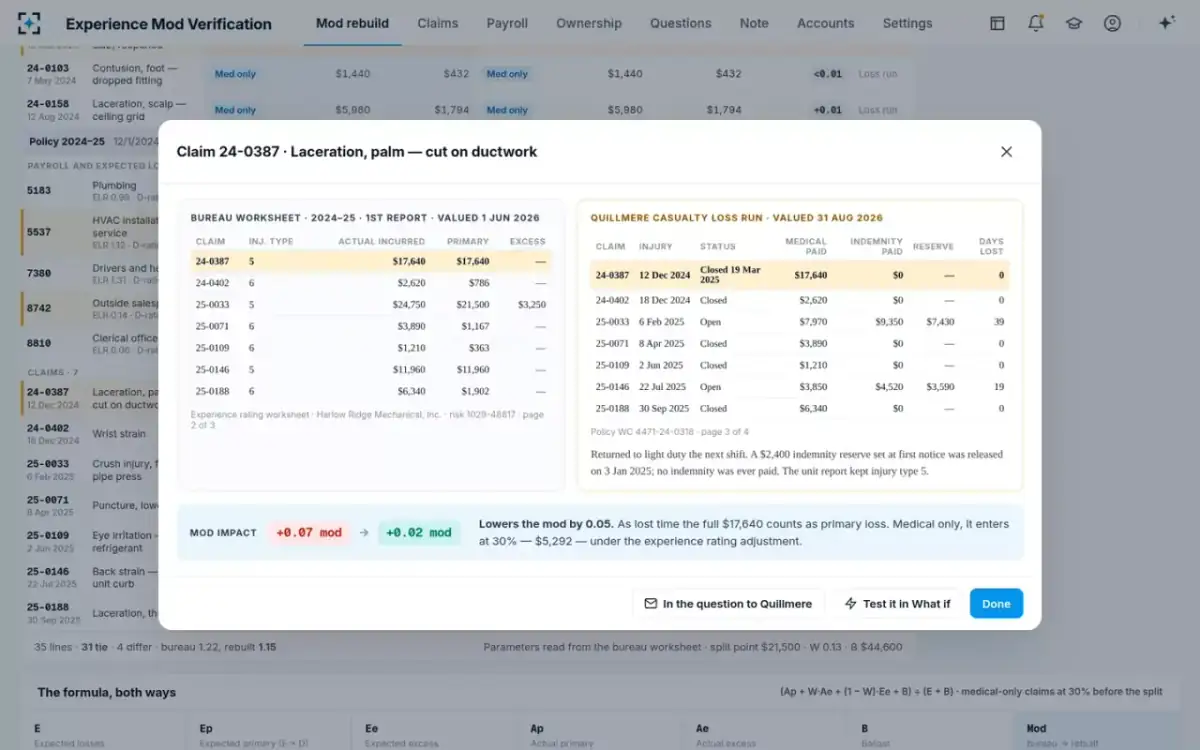
The sample claim shows how. A worker cut a palm on ductwork in December 2024 and returned to light duty the next shift. An indemnity reserve of $2,400 was set at first notice, released on 3 January 2025, and no wage benefit was ever paid; the claim closed in March 2025 with $17,640 of medical bills. The unit report kept it as lost time. On the bureau's worksheet that made it worth 0.07 of the mod; coded medical only, 0.02. The correction request names the claim, the loss-run page that shows $0 indemnity and no days lost, and the field to change.
The incentive to get this right runs both ways. When NCCI's 2022 changes were before the Texas regulator, Texas Mutual Insurance Company warned that some small employers pay claims out of pocket to avoid a debit mod (Texas Commissioner's Order 2023-7897). Accurate coding of the claims that are reported is the honest answer to that pressure; keeping claims off the report is not.
Reading unit reports against loss runs and audits
A worksheet shows the unit-report figures; it does not show the reports' errors. Those appear only when each figure is set beside the document that should support it. Botminds' Experience Mod Verification does this for every line before quote: its loss run reader matches every claim to the prior carrier's loss runs by number, date and value, and its payroll and class matcher ties every class and year to the final and revised audits. On the sample account, 20 of 20 claims matched with three differences, and the payroll for one year was found in the class the first audit used rather than the class the revised audit settled on.
Checking a worksheet's unit-report figures against their sources
- Note each policy year’s report level and valuation date
They tell you which loss run to compare with, and which differences are timing.
- Match every claim, in both directions
A claim on the loss run but not the worksheet is an omission; one on the worksheet but not the loss run may belong to another policy.
- Compare the medical-only coding with indemnity paid and days lost
A released wage reserve does not make a claim lost time.
- Compare each value with the loss run at the nearest valuation
Large gaps at the same date are errors; gaps across dates are development.
- Look for reopenings and recoveries since the report
Both change the next report; neither should be a surprise at renewal.
- Tie payroll by class and year to the final and any revised audit
A revised audit filed after the unit report is the commonest payroll gap.
- Check the exclusion codes
Denied, fraudulent and Catastrophe Number 12 claims should not be in the mod at all.
Payroll by class and year: the worksheet beside the final audits
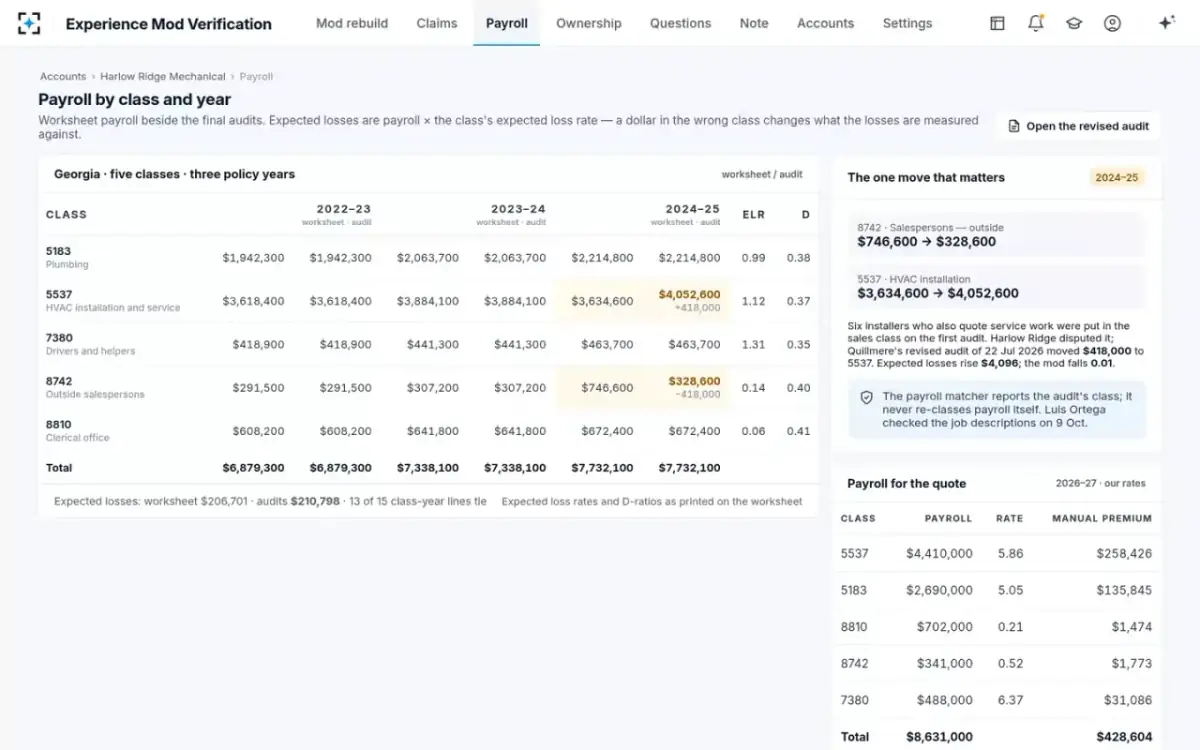
What the solution does not do is file anything. Only the reporting insurer can file a correction report, so the solution drafts the request for the underwriter to send, and records the answer against the line it concerns. The worksheet as a whole, block by block, is read in the experience mod worksheet, annotated.
Questions people ask
Who files unit statistical reports?
The insurer that wrote the policy, to the state's designated rating organization or statistical agent. In Texas that is every insurer or other entity licensed to and writing workers' compensation there, reporting to NCCI; in California, insurers report to the rating bureau the Insurance Commissioner designates. Employers and brokers do not file them.
When are unit stat reports filed?
In Texas the first report is valued 18 months after the policy starts and due by month 20; later reports are valued every 12 months and due two months after each valuation, until the 10th report or until all claims close. California's first three follow the same 18, 30 and 42-month valuations.
What is a unit stat correction?
A corrected report the insurer files to replace figures on its 1st, 2nd or 3rd unit report, for a claim value, a code or payroll. When the rating organization receives it, it recalculates the current and up to two preceding mods; a decrease applies back to the start of each affected policy.
How does a claim's injury type affect the mod?
It decides whether the claim is treated as medical only. In NCCI states a medical-only claim's primary and excess losses are reduced by 70%, so a $17,640 claim counts as $5,292 if coded medical only and $17,640 if coded lost time. The code is the reporting insurer's, and only it can correct it.
Is a unit statistical report the same as a loss run?
No. The loss run is the insurer's claim listing for the policyholder or broker; the unit report is the insurer's filing with the rating organization, at fixed valuation dates, in the statistical plan's format. Comparing the two is how errors in the unit report are found.