An experience mod worksheet, the experience rating worksheet a rating bureau issues for each eligible employer, shows how the workers' compensation experience mod was calculated: payroll and expected losses for every class code and policy year in the experience period, every claim with its reported value and type, the weighting and ballast values for the employer's size, and the totals that give the mod. It is the official document; letters and certificates only repeat its result. Read line by line it is also a list of sources, because almost every number on it was supplied by someone other than the bureau: payroll by the auditor and the insurer, claims by the insurer's claims staff, ownership by the employer. Botminds' Experience Mod Verification reads it that way, rebuilding each line from the document it should have come from.
The worksheet below is a reconstruction of part of a fictional sample account's worksheet as it appears in the solution: Harlow Ridge Mechanical, a Georgia HVAC and plumbing contractor, rating effective 1 December 2026, printed mod 1.22. Layouts differ by bureau; the elements do not.
An experience mod worksheet, annotated: seven blocks, each from a different source
- 1Header
Risk name and identifier, the entities combined into this risk, the rating effective date and the status. From the bureau, using the ownership filings.
- 2Policy line
Carrier, policy number and which unit report the figures come from, with its valuation date. One per policy year in the experience period.
- 3Payroll by class
Audited payroll as the insurer reported it on its unit report. Wrong here means the audit, or the report, is wrong.
- 4ELR and D-ratio
The bureau’s rating values for the class, state and rating date. They come from the rate filing, not from the employer.
- 5Expected and expected primary
Arithmetic: payroll ÷ 100 × ELR, then × D-ratio. Right if lines 3 and 4 are right.
- 6Claims
Each claim as reported: injury type, open or closed, actual incurred, and the primary part. Medical-only claims enter at 30%.
- 7Totals and mod
Weighting and ballast from the bureau’s size tables; Total A over Total B, to two decimals, subject to the maximum debit.
How do you read an experience mod worksheet?
Top to bottom, in four blocks, asking of each who supplied it. The header says whose mod it is and from when. The payroll block turns audited payroll into expected losses. The claims block lists actual losses as the insurers reported them. The totals apply the formula. NCCI's plan describes the result in one line: the experience rating modification "reflects the difference between the individual risk and the average employer" (NCCI Experience Rating Plan Manual, Texas edition).
The same plan defines what goes in: the payroll and losses that insurers report under NCCI's statistical plan (the unit statistical report). That sentence is the key to reading a worksheet: apart from the rating values, almost every figure on it is a reported figure, and the report it came from is named on the policy line.
Who gets to read it is limited. The rating organization tells the employer how to get a copy and gives access to the carrier of record and the producer of record; anyone else needs the employer's written authorization. If you are a contractor, your broker can usually get you yours; if you are asked for your mod by a general contractor, what they usually receive is a letter restating this page, covered in the EMR verification letter guide.
The header: whose mod, from when, and in what status
The header carries four things worth checking before any number. The risk name and identifier, because a mod can belong to a group: the plan combines companies under common majority ownership into one rating. The rating effective date, defined as "the earliest date that the insurance provider applies a specific experience rating modification to a policy". The status: "The three types of experience rating modifications are preliminary, final, and contingent modifications." And the issue date, because a worksheet can be reissued when data changes.
A preliminary worksheet uses rating values expected to change with a pending rate filing; a contingent one is missing some data an insurer is expected to submit. Either will be replaced. Reading a difference into a preliminary worksheet's third decimal is wasted effort; reading the claims on it is not, because the claims will not change when the rating values do.
Where does the payroll on my mod come from?
From the final audit of each policy, as the insurer reported it on its unit statistical report. The plan takes payroll, or another exposure base, for each class in the experience period, as reported under the statistical plan. So the worksheet's payroll is two steps from your books: the auditor's classification, then the insurer's report of it.
Either step can lag the other. On the sample account, the insured disputed its first 2024–25 audit, and a revised final audit moved $418,000 of HVAC installers from 8742, outside salespersons, to 5537, HVAC installation. The unit report had been filed before the revision, so the worksheet still showed the installers as salespeople. The plan allows the fix: an insurer that finds, within three years of the policy's expiry, that reported payroll was wrong can file correction reports (unit statistical report). Until it does, the worksheet is wrong in a way no one reading the worksheet alone could see.
Payroll on the worksheet beside the revised audit: installers in the sales class
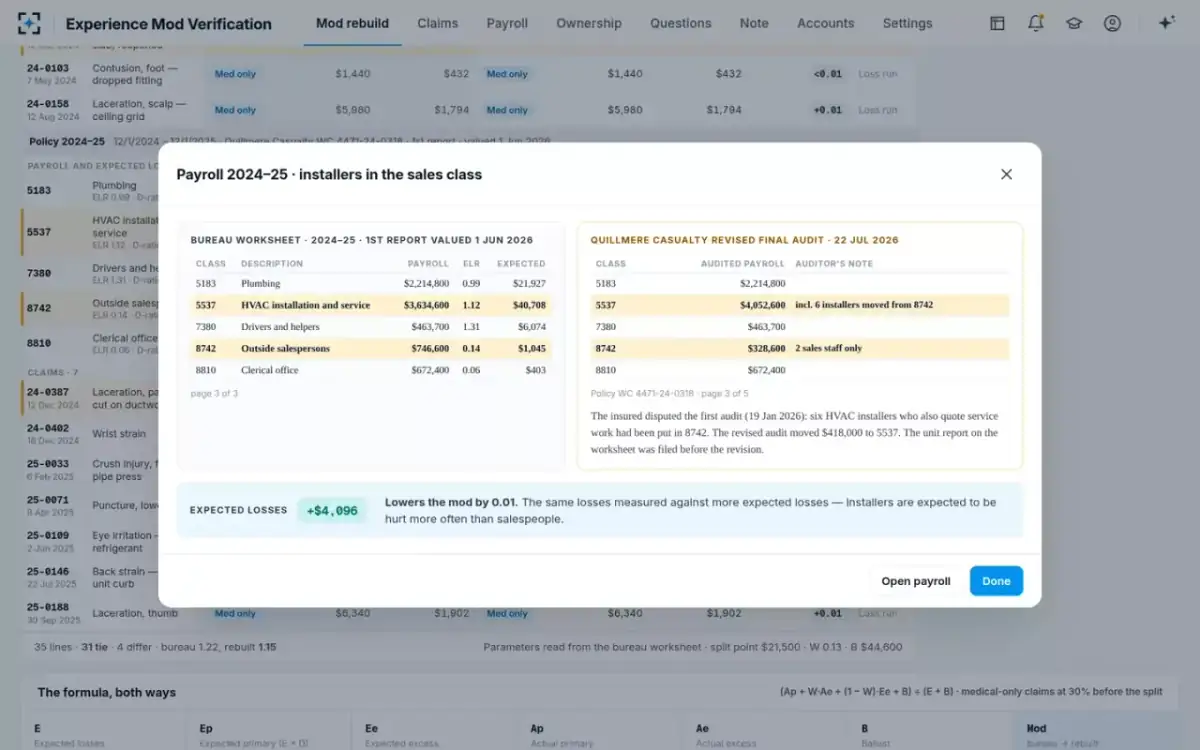
Expected losses, the ELR and the D-ratio
Expected losses are what an average employer with this payroll would have lost. The plan divides payroll by 100 and multiplies by the expected loss rate, rounded to the nearest whole number, with the expected loss rate taken from the bureau's tables for the class and state. The D-ratio then splits it: expected losses times the D-ratio give expected primary losses, and expected excess is the rest.
These are the lines where the worksheet is least likely to be wrong and most likely to be misread. The rates are the bureau's, set with each rate filing; in Texas the regulator notes that unit statistical data also feeds the class relativities, expected loss rates and discount rates the industry uses (Texas Department of Insurance). Since NCCI's Item E-1409, D-ratios vary only by hazard group: the filing found the class-level adjustment "does not add value" (NCCI Item E-1409). A D-ratio that differs from last year's is usually a new filing, not an error.
The payroll in front of the rate matters more. A dollar of payroll in a class with an ELR of 1.12 adds eight times the expected losses of a dollar at 0.14, so moving payroll between classes moves the mod even when no claim changes.
What are actual primary losses, and why are some claims shown as medical only?
Actual primary losses are each claim's value up to the split point, counted in full. The plan defines the split point as the dollar level at which the rating organization cuts each incurred loss in two, and the primary portion as the part up to it (experience mod calculation). The split point is a state value set with each rating, and it is printed on the worksheet; a reader should take it from there, never from memory or from another state. Above it, only a weighted share of each claim counts, and each claim is also capped at the state's per-claim limit.
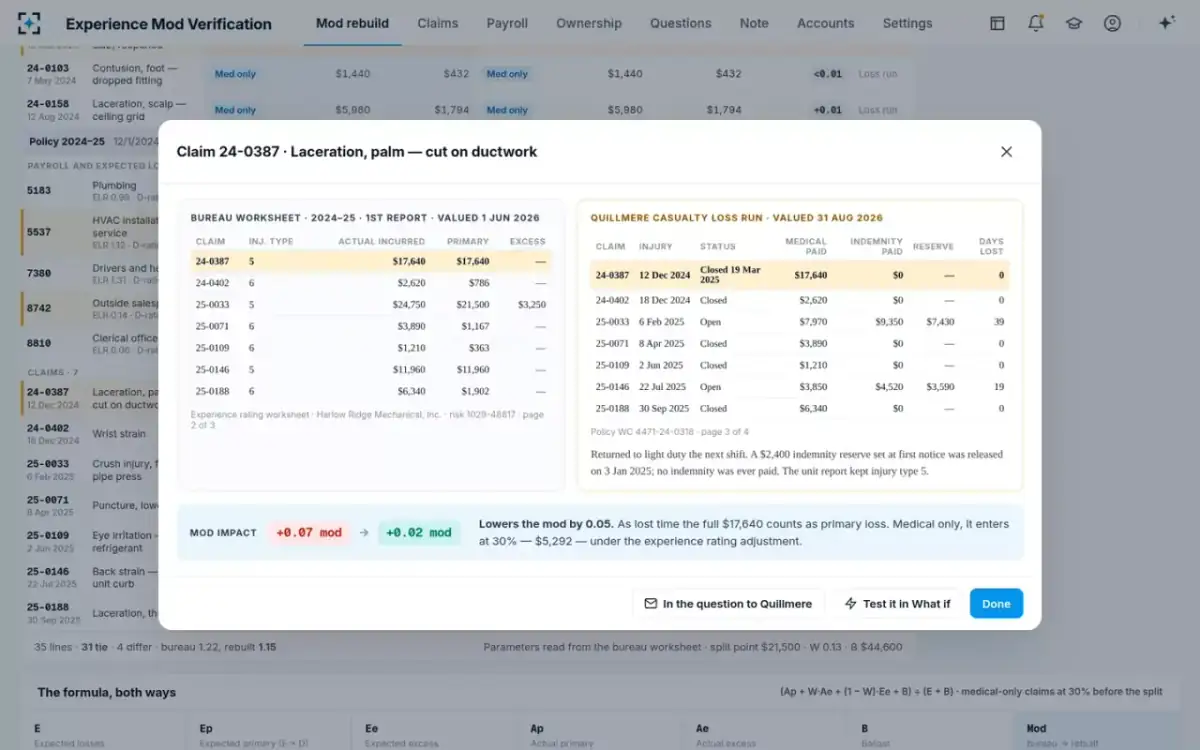
Medical-only claims carry a lower weight. "For a loss that is medical-only, the actual incurred loss, actual primary loss, and actual excess loss amounts are reduced by 70%." The reason, given in a Casualty Actuarial Society paper by an NCCI actuary, was to stop employers from keeping small medical claims off the record (Evans, 2014). On the annotated sample, claim 24-0402, $2,620 of medical treatment, enters at $786.
Returned to light duty the next shift. A $2,400 indemnity reserve set at first notice was released on 3 Jan 2025; no indemnity was ever paid.
Fictional sample loss run, as the solution shows it beside the worksheet
That note sits under claim 24-0387, the highlighted line. It paid $17,640 of medical bills, no wage benefits and no days lost, and closed in March 2025, yet the unit report kept it as lost time, so the worksheet counts all $17,640 as primary loss instead of $5,292. Each claim line also carries the report level and valuation date of the policy it belongs to; a value that looks stale is often just early, a point worked through in the unit statistical report guide.
One claim line beside the prior carrier's loss run
What is ballast value, and what does the weighting value do?
They decide how much the employer's own losses count against the average. The plan defines ballast as "a stabilizing element designed to limit the effect of actual losses on the experience rating modification", added to both actual and expected primary losses, and rising with expected losses. The weighting value sets how much of the actual excess losses count; it too rises with size. Together they form a stabilizing value, expected excess losses times one minus the weighting value, plus the ballast, and "The most significant impact of a stabilizing value is on smaller risks, which have a greater likelihood of severe swings in experience rating modifications."
In plain terms, a small employer's mod is pulled towards 1.00 and moves mostly with how many claims it has, while a large employer's mod follows its own losses, large claims included. NCCI's filing ties credibility to size: the bigger the employer, the more its own losses count. Washington's state fund uses the word credibility directly: "Credibility is the weight assigned to a firm's actual losses" (Washington L&I).
The bottom line: Total A, Total B and the maximum debit
The last block applies the formula. Total A is actual primary losses, plus the weighted actual excess, plus the stabilizing value; Total B is expected losses plus ballast; the mod is Total A divided by Total B, rounded to two decimal places. For smaller employers the result is capped at a maximum debit of 1.10 plus 0.0004 times E÷G, with E the employer's expected losses and G the state's average claim cost in thousands.
This is the block to check last, not first. On the sample account, the worksheet's own lines recompute to 1.2244 against the printed 1.22: the bureau's arithmetic is right, and the four differences the rebuild found were all in blocks 3 and 6. The totals inherit whatever is above them. How to do the arithmetic from scratch, and test a checker against known mods, is in the experience mod calculation guide.
Reading the worksheet as a list of people to call
Every block has an owner, and a question about a number goes to the owner, not to whoever sent the worksheet. Read that way, a worksheet becomes a routing list.
Each block of the worksheet, the party who supplied it, and what the agents do with it
Agent
Header · Ownership checkerCompares the rated entity with the submission and state filings; an acquisition in the last four years without an ownership form becomes a question to the broker for the employer’s ERM-14.
Never: Decides whether experience combines; the bureau does
Agent
Payroll · Payroll and class matcherTies each class and year to the final and revised audits; a difference becomes a request to the reporting insurer for a payroll correction.
Never: Re-classes payroll itself
Agent
Rates · Worksheet readerReads the ELRs, D-ratios, weighting and ballast the bureau printed, and recomputes the mod from them.
Never: Alters a bureau figure
Agent
Claims · Loss run readerMatches every claim to the prior carrier’s loss runs by number, date and value; coding or value differences become correction requests to that insurer.
Never: Infers a claim it cannot cite
A person decides
UnderwriterEdits and sends the questions to the broker, the prior carrier and the bureau, and signs the note.
Seven numbers on a worksheet worth checking first, and the document that settles each
| On the worksheet | Settled by | Who corrects it |
|---|---|---|
| Entities combined in the header | Ownership filings and any ownership form | The bureau, on the employer’s ERM-14 |
| Rating effective date and status | Policy dates; any pending rate filing | The bureau |
| Payroll by class and year | Final and revised audits | The insurer, by correction report |
| Claim count by year | Prior carriers’ loss runs | The insurer that reported the year |
| Each claim’s injury type | Indemnity paid and days lost on the loss run | The insurer, by correction report |
| Each claim’s value | The loss run, read with both valuation dates | The insurer’s next report, or a correction |
| Claims that should be excluded | Catastrophe, noncompensable and fraud coding | The insurer, by correction report |
Questions people ask
What does the experience rating worksheet show?
The employer's payroll and expected losses by class code and policy year, each claim in the experience period with its type and reported value, the weighting and ballast values for the employer's size, and the totals that give the mod. The header gives the rating effective date and whether the mod is preliminary, contingent or final.
What is the D-ratio on a mod worksheet?
The share of a class's expected losses expected to fall below the split point, so expected primary losses are expected losses times the D-ratio. Since NCCI's Item E-1409, D-ratios vary by hazard group rather than by individual class code. They come from the bureau's rating values, not from the employer.
What is the expected excess loss?
Expected losses minus expected primary losses: the part of an average employer's losses expected above the split point. Only a weighted share of it, set by the weighting value, is compared with actual excess losses; the rest enters both sides of the formula through the stabilizing value.
Why are some claims shown as medical only?
Because the reporting insurer coded them as claims that paid medical treatment but no wage-loss benefits. In NCCI states their values are reduced by 70% in the mod. If a claim paid no indemnity and the worker lost no time, yet it shows as lost time, ask the reporting insurer to correct the injury type.
How often is a new worksheet issued?
Once a year for each rating, with revisions when corrected data arrives or a preliminary mod becomes final. NCCI's plan limits issuance and revision to the current and two preceding mods, and a mod generally applies for no less than three and no more than 15 months.