The California workers compensation experience rating plan is the state's own plan, the California Workers' Compensation Experience Rating Plan—1995, set out in Title 10, Section 2353.1 of the California Code of Regulations. The Insurance Commissioner approves it, and the rating bureau he has designated as his statistical agent collects insurers' data and recommends its yearly changes; adherence to it "is mandatory for insurers" (California Department of Insurance notice, March 2026). It shares the basic idea of every experience rating plan, comparing an employer's actual losses with those expected for its payroll, but differs from the NCCI plan used in most states, and from Washington's state-fund plan, in eligibility, how claims are split, how ownership changes are treated and how a mod is appealed. A multistate underwriter or broker has to carry all three, which is why Botminds' Experience Mod Verification reads each bureau's worksheet in its own format and applies that plan's rules.
Three experience rating plans side by side: California, NCCI states and Washington
| California | NCCI states (Texas edition, 2025) | Washington state fund | |
|---|---|---|---|
| Rule book | Experience Rating Plan—1995, 10 CCR §2353.1, approved by the Insurance Commissioner | NCCI’s Experience Rating Plan Manual, approved state by state; Texas’s standalone edition from July 2025 | WAC 296-17-850 to 296-17-880, refiled each January |
| Who issues the mod | The rating bureau designated as the Commissioner’s statistical agent | The applicable rating organization: NCCI or a participating state bureau | The Department of Labor & Industries, which insures the employer |
| Who is rated | Employers above an eligibility threshold: $10,800, with $11,700 proposed for 1 Sep 2026 | Employers above state premium thresholds; in Texas $10,000 over 24 months or $5,000 a year on average | Every employer with reported hours; “L&I does not use a premium threshold” |
| Experience period | Three years ending one year and nine months before the rating date (2002 plan text) | Policies starting 21 to 57 months before the rating date; at most 45 months of data | The oldest three of the four fiscal years before the rate year |
| How claims are valued | Latest first, second or third unit report due a month before the rating; valued at 18, 30 and 42 months | Most current 1st, 2nd or 3rd unit report and corrections; in Texas valued at 18 months, then yearly | All claims valued on 1 June, seven months before the rates take effect |
| Splitting each claim | Primary thresholds set in the plan’s Table II | A state split point, indexed yearly since NCCI Item E-1409 | $28,180 for 2026, with a published formula above it |
| Medical-only claims | Per the California plan (not compared here) | Primary and excess reduced by 70% | Reduced by the lesser of $4,100 or the claim’s cost |
| When a mod is disputed | Complaint and Request for Action, then appeal to the Department of Insurance | The state’s process; in Texas NCCI’s dispute service is voluntary | Not compared here |
How does the California experience rating plan work?
Like NCCI's, it compares an employer's actual losses over three years with the losses expected for its payroll in each class, weighting the employer's own experience by its size. A precedential decision describes it as a plan that "assesses whether a business's claims are greater or less than average by comparing its payroll and claims history with other California businesses" (Just Like Home, California Department of Insurance, 2003). The inputs are the unit statistical reports every insurer must file under the state's statistical plan, and the rating bureau's tables: expected loss rates and D-ratios in Table I, primary thresholds in Table II, both updated with each regulatory filing.
The plan is a regulation, which shapes how disputes go. In the same decision the Department said the rules "cannot be disregarded by the WCIRB, nor can they be rewritten or revised by the Commissioner sitting in his adjudicatory capacity." An employer that thinks its mod is unfair under the rules has an appeal; one that thinks the rules are unfair has a rulemaking.
The yearly changes come through the Commissioner. For 1 September 2026, the rating bureau's filing proposed to "adjust the eligibility threshold from $10,800 to $11,700 to reflect wage inflation" and to update Table I and Table II with current data (CDI notice, March 2026). A California worksheet is therefore read against the plan in force on its rating date, like any other.
Is California an NCCI state?
Not for experience rating. NCCI's own plan, in the edition approved for Texas from 1 July 2025, lists California among the jurisdictions marked "No": independent bureaus "that have their own Experience Rating Plans", where NCCI's plan "does not apply" (NCCI Experience Rating Plan Manual, Texas edition). Five other jurisdictions carry the same mark, two more run their own plans but allow their data to be combined into interstate mods, and three have their own bureaus inside NCCI's interstate plan.
Who uses which experience rating plan: 51 jurisdictions in five groups
36
NCCI’s plan applies
Alabama, Alaska, Arizona, Arkansas, Colorado, Connecticut, District of Columbia, Florida, Georgia, Hawaii, Idaho, Illinois, Iowa, Kansas, Kentucky, Louisiana, Maine, Maryland, Mississippi, Missouri, Montana, Nebraska, Nevada, New Hampshire, New Mexico, Oklahoma, Oregon, Rhode Island, South Carolina, South Dakota, Tennessee, Texas, Utah, Vermont, Virginia, West Virginia
3
Own bureau issues intrastate mods; NCCI’s plan applies to interstate rating
Indiana, Massachusetts, North Carolina
2
Own plan; permits combination for interstate rating
Minnesota, Wisconsin
6
Own plan; NCCI’s plan does not apply
California, Delaware, Michigan, New Jersey, New York, Pennsylvania
4
Monopolistic state fund; NCCI’s plan advisory for employers liability only
North Dakota, Ohio, Washington, Wyoming
The distinction matters most for multistate employers. In the jurisdictions marked "No", including California, an employer's experience is rated under that state's own plan and is not combined into an NCCI interstate mod; in Minnesota and Wisconsin the bureau has its own plan but permits combination. The monopolistic states, North Dakota, Ohio, Washington and Wyoming, insure workers' compensation through a state fund and rate their own employers, with NCCI's plan applying only to employers liability, on an advisory basis.
Experience period and claim values: three plans, three clocks
On the length of the experience period, California and NCCI agree almost to the month. California's plan, as quoted in a 2003 decision, reads: "The experience period shall be three (3) years, commencing four (4) years and nine (9) months prior and terminating one (1) year and nine (9) months prior to the date for which an experience modification is to be established." NCCI's plan takes policies that start between 21 and 57 months before the rating effective date: the same window, in months (experience mod calculation). The decision explains why it ends so early: "to allow time for a payroll audit, claims evaluations, and data submission."
Where they part is the valuation rule. California's statistical plan values first reports "as of eighteen (18) months after the month of the inception date of the policy", due by month 20, with later reports at 30 and 42 months, and its experience rating plan uses the latest report that was due a month before the rating. A precedential decision shows the effect: a claim reported open at $43,031 and closed at $27,508 before the mod's effective date still counted at $43,031, because "There is no provision in either Plan which permits a supplemental or corrected unit statistical filing when a claim closes between the valuation date and the effective date of the experience modification in which it is used" (B.D.D. Pest Control, 2000). Washington values every claim on one date, the 1 June seven months before the new rates take effect (WAC 296-17-870).
Ownership changes: California's 90-day employee test and NCCI's three conditions
Both plans start from the same default, that experience follows the business, and differ on what breaks the chain. California's plan, as quoted in a precedential decision, says past experience "shall be used in future experience ratings unless a material change in ownership, as specified in paragraph a, is accompanied by a material change in operations or employees". A change in ownership is material "only if the owner or owners prior to the change in ownership own less than a one-half interest after the change", and a change in employees is material only if most of those working in the 90 days after the change were not employed in the 90 days before, measured by heads and by payroll (DeMiranda Management, California Department of Insurance).
NCCI's plan asks more before it excludes experience, and treats exclusion as rare. "Under rare circumstances, the rating organization can exclude experience", and only when all three conditions hold: "(a) change in ownership interest, (b) change in operations, and (c) change in process and hazard of the operations". A change in operations counts only when it is "large enough to result in the reclassification of the governing classification". A new workforce alone, which can carry the day in California, is not enough.
When an ownership change can wipe out a predecessor's experience
California (plan text quoted in CDI decisions): Past experience is used in future ratings
NCCI states (Texas edition, 2025): Experience is retained or transferred to the acquiring, surviving or new entity
California (plan text quoted in CDI decisions): Prior owners hold less than one-half after the change
NCCI states (Texas edition, 2025): A material change in ownership interest under the plan’s one-third and one-half tests
California (plan text quoted in CDI decisions): A material change in operations or in employees
NCCI states (Texas edition, 2025): A change in operations large enough to reclassify the governing class
California (plan text quoted in CDI decisions): None
NCCI states (Texas edition, 2025): A change in the process and hazard of the operations
California (plan text quoted in CDI decisions): Most staff and payroll in the 90 days after were not there in the 90 days before
NCCI states (Texas edition, 2025): Not a ground on its own
California (plan text quoted in CDI decisions): The rating bureau may request all information relevant to ownership and operations
NCCI states (Texas edition, 2025): Employer reports within 90 days on the ERM-14 or a signed letter; failure may be treated as evasion
California's record shows how often this is argued. The Department's index of precedential decisions lists 16 experience-modification decisions, and change of ownership is the largest sub-topic, with seven (CDI precedential decisions index). On the fictional sample account used across this series, a Georgia contractor's parent bought a plumbing company outright and moved its crews over; under NCCI's three conditions the plumbing company's experience should follow the business, and the solution drafts the request for the ownership form rather than deciding it.
How do I appeal my California experience mod?
In two steps, each with its own clock. First, file a Complaint and Request for Action with the insurer or the rating bureau. Then, if the written decision goes against you, appeal to the Department's Administrative Hearing Bureau on form CDI-002, which covers decisions "in response to requests for review, requests for policyholder information, and requests for reconsideration" (form CDI-002). The Department lists "Classification and experience modification disputes" among the workers' compensation matters it handles (CDI consumer guide).
California's appeal clocks: 30 days after a decision, 120 if none comes
- Complaint and Request for Action, until a decisionuntil decided
- Appeal window30 days
- Request for reconsideration served, no decision60 business days
- Complaint served, no decision120 days
The burden matters as much as the clock. In the DeMiranda appeal, the Department held that the employer claiming an exception to the ownership rule had to prove it, and an employer that produced no payroll records lost. Outside California the routes differ: in Texas, NCCI's dispute service is voluntary, and the Commissioner's order adopting the Texas version says the parties need not use it before going to court (Texas Commissioner's Order 2020-6301; see experience mod review).
What is the split point in Washington?
$28,180 for 2026. Washington's rule divides each claim at that figure: "For each claim, less than $28,180 the full value of the claim shall be considered a primary loss", and above it the primary part is 70,460 × total ÷ (total + 42,280), so a $35,000 time-loss claim has $31,911 of primary loss and a $90,000 one $47,939 (WAC 296-17-855). No claim enters at more than $398,730, the maximum claim value for 2026 (WAC 296-17-880).
Three features set Washington apart. Every employer is rated: "L&I does not use a premium threshold. As long as your firm has reported worker hours during the 3-year experience period, you will be experience rated" (Washington L&I). Medical-only claims are first reduced by $4,100, or by their whole cost if less, which the state says cuts their losses by about 70% on average (experience mod calculation compares it with NCCI's rule). And the values are refiled every January, so the 2026 figures above will not be the 2027 ones. NCCI states have moved the same way since Item E-1409: Texas, for instance, set a state-specific split point of $16,500 for ratings from 1 July 2024, a value its order says "will change annually" (Texas Commissioner's Order 2023-7897).
How does a multistate mod work?
In NCCI's plan, one mod covers everything. A risk qualifies for interstate rating when it "(a) meets the premium eligibility requirement for intrastate experience rating in one state, and (b) develops experience during the experience period in one or more additional states where this Plan permits combination", and the experience in the other states "does not have to meet the premium eligibility requirement". The interstate mod covers all the employer's operations, even where different insurers write them on separate policies, and the bureau averages the states' weighting and ballast values by each state's expected losses.
The exceptions are the states outside the combination. California payroll and claims are rated under California's plan, so a contractor working in Arizona and California carries an NCCI interstate mod for Arizona and its other combinable states and a separate California mod. A Washington employer's state-fund experience factor is L&I's. A verification for a multistate account therefore needs each worksheet, read under its own plan, and payroll checked against the right state: on one fictional account in the solution's sample quote list, North Carolina payroll had been reported into a South Carolina rating.
Carrying three rulebooks into one review
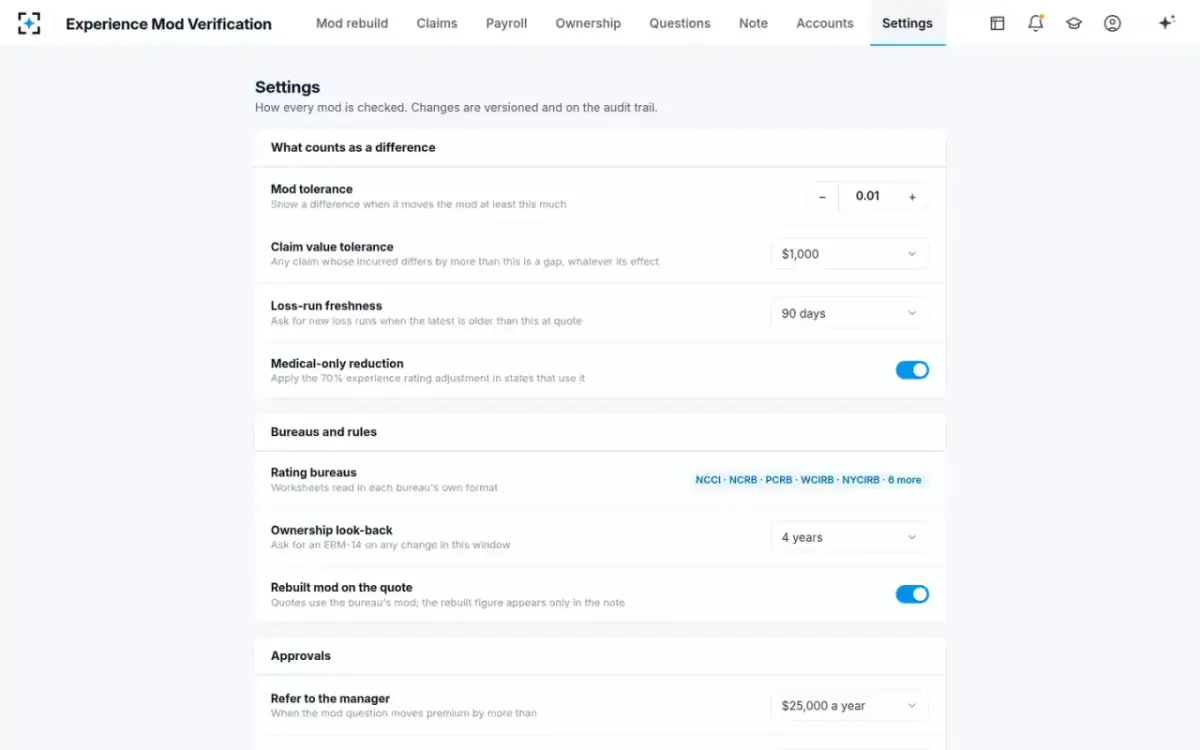
A multistate review fails quietly when one plan's rules are applied to another's worksheet: a 70% medical-only reduction in Washington, a fixed split point carried across states or years, an NCCI ownership test applied to a California acquisition. Botminds' Experience Mod Verification avoids the first two by reading the parameters printed on each worksheet rather than assuming them, and the third by applying each plan's own tests. Its settings list the bureaus whose worksheets it reads, NCCI, NCRB, PCRB, WCIRB, NYCIRB and six more, and whether the 70% medical-only reduction applies in a state.
It does not decide what a bureau will decide. Ownership estimates stay out of the rebuilt figure until the bureau rules, appeals are filed by people, and the rebuilt mod is labelled as rebuilt. How the six agents divide the review, and the questions they draft, is covered in the experience mod review guide; the formula itself, with Washington's published numbers worked through, in the experience mod calculation guide.
The rules as settings: tolerances, bureaus, the medical-only reduction and who signs
Questions people ask
What is the WCIRB?
The Workers' Compensation Insurance Rating Bureau of California, the rating organization the Insurance Commissioner has designated as his statistical agent. It collects insurers' unit statistical data, calculates experience modifications under the California plan and recommends revisions to the plan, which the Commissioner approves or rejects after public notice.
Which states have their own rating bureau?
NCCI's plan lists California, Delaware, Michigan, New Jersey, New York and Pennsylvania as having their own plans; Minnesota and Wisconsin as having their own plans that permit interstate combination; and Indiana, Massachusetts and North Carolina as having bureaus that issue intrastate mods within NCCI's interstate plan. North Dakota, Ohio, Washington and Wyoming have monopolistic state funds.
How long do I have to appeal a mod in California?
Thirty days from the date the insurer or the rating bureau serves its written decision or rejection on your Complaint and Request for Action. If no decision is served, 120 days from the date you served the complaint, or 60 business days from a request for reconsideration. The appeal goes to the Department of Insurance's Administrative Hearing Bureau on form CDI-002.
Does a California mod apply in other states?
No. California rates experience under its own plan and is not among the jurisdictions that permit combination into NCCI's interstate mod, so an employer with operations in both carries separate mods. Within NCCI's combinable states, one interstate mod applies to all of a risk's operations.
Is there a premium threshold for experience rating in Washington?
No. Washington's Department of Labor & Industries rates every employer that reported worker hours in the three-year experience period. California and NCCI states rate only employers above a premium threshold; in Texas that is $10,000 of total manual premium over the most recent 24 months, or $5,000 a year on average.