For contractors, the EMR is the workers' compensation experience modification rate that owners and general contractors ask for when they prequalify bidders: 1.00 means the contractor's losses over three years were as expected for its payroll and trades, below 1.00 better, above 1.00 worse. Many prequalification forms ask for it, and some owners have made a cut-off a condition of bidding. Virginia stopped that for construction in 2016: under its Code, any contract or offer to contract "that requires the contractor or bidder responding to the offer to contract to have a specified experience modification factor is prohibited". The reason is that the mod was built to price insurance, not to grade safety, and it measures the past imperfectly for small firms. It still sets the contractor's premium, which is why it has to be right; Botminds' Experience Mod Verification rebuilds it from the loss runs and audits so the number a contractor carries into a bid has been checked.
What a contractor's EMR measures, and what a bid screen reads into it
What an EMR measures: Three policy years ending about 21 months before the rating date
What a bid screen often assumes: How the contractor works today
What an EMR measures: A small firm’s mod is pulled towards 1.00 and moves mostly with how many claims it has
What a bid screen often assumes: One scale for every bidder, large or small
What an EMR measures: Only firms above a premium threshold; others carry a unity 1.00
What a bid screen often assumes: Every bidder has a meaningful number
What an EMR measures: All entities under common majority ownership, and businesses acquired
What a bid screen often assumes: The legal entity on the bid
What an EMR measures: Reported claims, as coded by insurers, in the classes the audits used
What a bid screen often assumes: Injuries and safety practice
What an EMR measures: “to modify the risk’s premium based on the risk’s past experience”
What a bid screen often assumes: A safety rating
What is a good EMR for contractors?
Below 1.00 is better than average and 1.00 is average, but only against the contractor's own trades and payroll. Expected losses are built class by class from payroll, so a roofer and an electrician with the same mod have each done about as well as an average firm in their own classes, not as well as each other. NCCI's filing gives the meaning of any figure: a 1.20 predicts losses 20% worse than the average employer in the same classes (NCCI Item E-1409; see EMR above 1).
Average is also not exactly 1.00 in practice. In NCCI's impact analysis for Texas, the expected loss rates were adjusted "to achieve an average intrastate mod of 0.96". In that analysis, a contractor at 1.00 was slightly worse than the average rated employer, not exactly at it. A screen that treats 1.00 as a bright line is precise about a number that is not.
What makes a mod "good" for bidding is that it is right. A contractor whose worksheet carries a miscoded claim has a worse number than its losses earned, and the first place that shows is a prequalification form.
Why do contractors need an EMR?
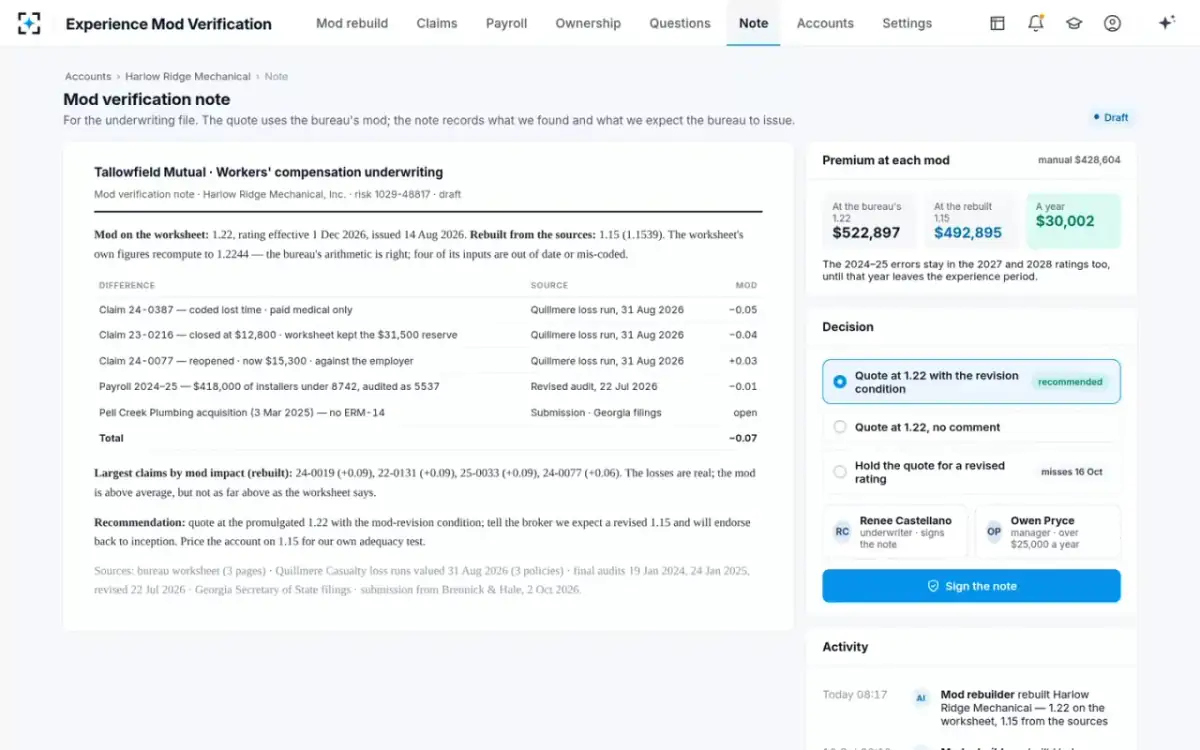
For premium first, and bids second. NCCI's plan states the purpose plainly: "The purpose of an experience rating modification is to modify the risk's premium based on the risk's past experience", and the insurer applies it by multiplying "the subject premium by the experience rating modification" (NCCI Experience Rating Plan Manual, Texas edition). On a fictional sample account, a Georgia HVAC and plumbing contractor with $428,604 of manual premium, the difference between the bureau's 1.22 and the rebuilt 1.15 is $30,002 a year.
The bid use came later and borrowed the number. When NCCI's split-point change was before the Texas regulator, Texas Mutual Insurance Company told it that "some small employers are incentivized to self-pay claims to avoid having a debit e-mod", "because the debit e-mod often denies them the opportunity to bid for or secure contracts with large clients" (Texas Commissioner's Order 2023-7897). That is the cost of a bright-line screen: it rewards keeping claims off the record, which the rating plan was redesigned to prevent.
Can an owner require a certain EMR? What Virginia's law says
In Virginia, not on a construction contract. Section 11-9.8 of the Code of Virginia, enacted in 2016, prohibits two things: a term in an offer to contract that requires the successful bidder to have a specified experience modification factor, and any contract or offer to contract that requires the contractor or bidder to have one (Code of Virginia § 11-9.8).
A term of an offer to contract issued that requires that the successful bidder have a specified experience modification factor is prohibited.
Code of Virginia § 11-9.8(B), 2016, c. 754
The definitions decide the reach. A "contract" is an agreement for construction services under which the contractor must carry insurance; an "offer to contract" is "a solicitation of bids, Request for Proposals, or similar invitation to enter into a contract that is extended to potential contractors for construction services"; and "person" includes private businesses as well as any "public body". The experience modification factor is defined as "a value assigned to an employer as determined by a rate service organization in accordance with its uniform experience rating plan". Asking for the mod, reading it, and weighing it with other evidence are not prohibited; making a specified figure a condition is.
Virginia is the state this guide found with such a rule; owners and contractors elsewhere should check their own state's procurement and contracting law. The reasoning travels further than the statute, though, and it follows from what the number measures.
Is EMR a good measure of safety?
It is a fair predictor of insurance losses on average and a weak, slow measure of any one contractor's safety. Both halves have evidence behind them. NCCI tests its plan by sorting employers by mod and comparing their later losses: in its 2022 filing, the fifth of employers with the lowest mods had a loss ratio of 63% before the mod was applied and the fifth with the highest, 149% (NCCI Item E-1409). As a group, high-mod employers did go on to lose more.
High mods do predict higher losses, on average: NCCI's quintile test
For an individual contractor the picture is less clean. A systematic review of prevention incentives found "moderate evidence that the degree of experience rating reduces injuries", while noting that most studies "have used crude proxy measures or exploited natural experiments" (Tompa and colleagues, 2007). A study of 21,558 Ontario firms found the association of experience rating with some claim outcomes and not others "suggests that firms may focus on claims and cost management practices" (Tompa and colleagues, 2013). A low mod can mean a safe workplace, or good claims management, or simply a small firm with a lucky three years.
The plan itself acknowledges the reporting problem. Medical-only claims count at 30% so that employers are not tempted to leave small medical claims unreported, as a Casualty Actuarial Society paper by an NCCI actuary (Evans, 2014). A bid screen that punishes any debit pushes in the other direction.
Does a small contractor have an EMR?
Often not, and when it does, one claim can move it a long way. Rating starts only above a premium threshold in most plans. Under the plan as approved in Texas, a risk qualifies with total manual premium of at least $10,000 over the most recent 24 months, or $5,000 a year on average; below that it carries a unity factor of 1.00, the same figure a new business gets. A Casualty Actuarial Society paper records that the thresholds were set in the early 1980s "to correspond to roughly 10 employees" (Evans, 2014). California's threshold was $10,800, with $11,700 proposed for September 2026 (CDI notice); Washington's state fund rates every employer that reported worker hours, with no premium threshold at all (Washington L&I).
So a 1.00 on a small contractor's letter may not be a rating at all, and a prequalification form that cannot tell the two apart will treat a new firm as average. When small firms are rated, the plan limits how far their own losses count: the ballast damps the effect of actual losses on the mod, and it matters most for small firms, whose mods would otherwise swing hardest (experience mod worksheet). The maximum debit, 1.10 + 0.0004 × E ÷ G, also caps a small firm's mod lower than a large one's. Even so, a single lost-time claim can carry a small contractor above 1.00 for three ratings.
Why one claim moves a small contractor's mod so far
Because a rating plan gives a firm's own losses weight in proportion to how much data it has, and one claim is a lot of data for a small firm. Washington, which publishes its full tables in regulation, makes this easy to see. Its 2026 table gives an employer with expected losses up to $6,150 a primary credibility of 12% and an excess credibility of 7%; between $35,982 and $54,456, 56% and 8%; and between $494,447 and $519,671, 70% and 25% (WAC 296-17-880).
One $35,000 lost-time claim, three contractors of different size (Washington, 2026)
| Contractor’s expected losses | Credibility, primary and excess | Primary and excess of the claim | Added to the mod |
|---|---|---|---|
| $5,000 | 12% and 7% | $31,911 and $3,089 | +0.81 |
| $50,000 | 56% and 8% | $31,911 and $3,089 | +0.36 |
| $500,000 | 70% and 25% | $31,911 and $3,089 | +0.05 |
Credibility is the reason the smallest contractor's mod would leap furthest, and the reason plans dampen it. Washington's answer is a cap: "No employer's experience modification factor shall increase or decrease by more than twenty-five percent during any one year". NCCI's answer is the ballast and the maximum debit. Either way, a small contractor with one serious claim can carry a debit through three ratings that a large firm would barely register, and a bid screen that compares the two on one scale is comparing a coin toss with a large sample.
When the number on the bid is wrong
Then the contractor loses work for losses it did not have, and the fix runs through people the owner never meets. The mod comes from unit reports the contractor's past insurers filed; an injury type left as lost time on a claim that paid no wage benefits, a reserve left high after a claim closed, or payroll filed in a class with a lower expected loss rate all raise it. Only the reporting insurer can file a correction, and only the bureau revises the mod, the current one and the two before it. The questions that start that process are covered in the experience mod review guide.
Ownership is the other trap. Under NCCI's plan, companies under common majority ownership are combined into one mod, and a business acquired brings its experience along unless narrow exclusion conditions are met. A contractor bidding under a new company name may be carrying its parent's mod, or a purchased firm's, and the reverse can flatter a bidder. A letter that states the mod without naming the rated entities hides that; what a complete letter should state is set out in the EMR verification letter guide.
A verified mod, written up: the differences, their sources and premium at each mod
A prequalification checklist that uses the mod fairly
Owners and general contractors can keep the mod in a prequalification without letting it decide alone, and in Virginia's construction market they must. The checklist below reads the number for what it is.
Using a contractor's EMR in prequalification without a bright-line cut-off
- Ask for three ratings, each with its rating effective date and status
A trend says more than one year, and a preliminary or contingent mod may change.
- Ask whether the figure is a rating or a unity factor
Small and new firms often carry 1.00 because they are not rated.
- Ask which entities the mod covers
Combined and acquired companies change what the number describes.
- Read the mod with the claims behind it
Lost-time claims and their causes, from loss runs, say more than the ratio.
- Weigh size
A small contractor’s mod can move on one claim; a large one’s reflects many.
- Use other evidence of safety practice
OSHA’s inspection data can be searched by establishment, and site safety plans and training records speak to today, not three years ago.
- Never reward claims kept off the books
A screen that punishes any debit invites self-paid claims, which keeps them out of the data the mod is built from.
For the contractor, the practical step is to check the number before it goes on a form. Botminds' Experience Mod Verification is built for the insurer's underwriter quoting the account, but the same rebuild answers the contractor's question: whether the mod on the worksheet matches the losses in the loss runs and the payroll in the audits. On the sample account it found four differences worth 0.07, and drafted the correction requests; the underwriter sent them.
Questions people ask
What EMR disqualifies a contractor?
None by law, except where a state bars mod requirements altogether. Cut-offs are each owner's choice, and some prequalification forms draw the line at 1.00. In Virginia, a construction bid or contract may not require a specified experience modification factor at all.
How can a contractor improve its EMR?
By making sure the inputs are right, then by having fewer and smaller claims. Check every claim's coding and value against the loss runs and payroll against the audits, report ownership changes on time, pursue subrogation, and bring injured workers back to suitable work. Each policy year stays in the mod for three ratings, so improvements show slowly. EMR above 1 works through the levers in detail.
Is an EMR the same as an OSHA incident rate?
No. The EMR is an insurance rating from the claims and payroll insurers report to a rating bureau, compared with expected losses for the contractor's classes. An OSHA rate is calculated from the employer's own injury and illness records and hours worked. A firm can have a low incident rate and a debit mod, or the reverse.
Do subcontractors on a wrap-up project have their own EMR?
Yes. Under NCCI's plan, a wrap-up policy for a participating contractor carries that contractor's own mod, and its payroll and losses flow into the participant's future mods: "There is no experience rating modification for the wrap-up construction project as a unit."
Does a new company inherit an old company's EMR?
Usually, if it took over the business. NCCI's plan transfers experience to the acquiring, surviving or new entity unless all three exclusion conditions are met, and treats any action that results in a mod being misapplied as evasion, "regardless of the intent". The change must be reported within 90 days of the change.