An EMR verification letter is a short letter from a contractor's insurance carrier or broker confirming a contractor's current workers' compensation experience modification rate (EMR, or experience mod), the date it took effect and, often, the ratings before it. General contractors and project owners ask for one when they prequalify subcontractors. The letter does not create the number: the mod is issued by a rating organization on an experience rating worksheet, computed from the payroll and claims that past insurers reported, so the letter can only be as right as everything upstream of it. Botminds' Experience Mod Verification rebuilds that worksheet from the loss runs, audits and ownership record, so the number on the letter has been checked, not just copied.
That matters because a mod is easy to take on trust, and a letter adds one more party who trusts it. Take a fictional sample account used throughout this guide, Harlow Ridge Mechanical, an HVAC and plumbing contractor in Georgia. Its worksheet says 1.22. Rebuilt from its prior carrier's loss runs and audits, the mod comes to 1.15. A letter stating 1.22 would be a faithful restatement, and still wrong about the contractor.
Six hand-offs stand between an injury and an EMR letter, and each has its own clock
- 1
Claims adjusterInsurer’s claim file
The claim is opened, coded medical only or lost time, and reserved.
From the first report of injury
- 2
InsurerRating organization
The unit statistical report: payroll by class and every claim on the policy, at its valued amount.
Valued 18 months after the policy starts, due by month 20 (Texas)
- 3
Premium auditorInsurer, then rating organization
Audited payroll by class code, and any revision after a dispute.
Payroll corrections within three years of policy expiry
- 4
EmployerRating organization
Ownership changes, on the ERM-14 form or a signed letter.
Within 90 days of the change
- 5
Rating organizationInsurer and producer of record
The experience rating worksheet: the mod, its rating effective date and its status.
Before the rating date where data allows; preliminary or contingent if not
- 6
Insurer or brokerGeneral contractor or owner
The EMR letter, restating the worksheet.
Days, once the worksheet exists
What is an EMR verification letter?
It is a restatement, not a rating. No experience rating plan defines a document called an EMR letter; the official document is the rating organization's experience rating worksheet, and the letter repeats what the worksheet says for a reader who cannot see it. NCCI's plan describes the purpose of the number plainly: experience rating compares an employer's own losses with those of the average employer in the same classes, to reflect differences in safety and loss prevention (NCCI Experience Rating Plan Manual, Texas edition; the experience mod calculation guide works the formula).
So the word "verification" promises less than it sounds. The writer verifies that the number in the letter matches the number the bureau issued. Nobody in that exchange verifies that the bureau was given the right claims, the right payroll classes and the right owners. A mod of 1.00 means losses as expected for the employer's payroll; above 1.00 is a debit, below is a credit, and a few hundredths either side can decide whether a subcontractor clears a prequalification form.
The letter usually carries the mod for the current rating and the two before it. That habit has a rule behind it: the rating organization issues and revises only the current mod and the two before it (experience mod review lists the exceptions), so those three are the only ratings that can still change.
Who provides an EMR letter, and who may see the worksheet?
Whoever can see the worksheet can write the letter, and in NCCI states that is a short list. The plan as approved in Texas has the rating organization tell each rated employer how to get its worksheet, and gives access to the carrier of record, the producer of record, and anyone else the employer authorises in writing (experience mod lookup sets out the routes). A general contractor is none of these unless the subcontractor signs it in.
That is why the request lands on the subcontractor's broker or insurer. The producer of record, the agent or broker on the policy, can read the worksheet and put the figures on its own letterhead; so can the carrier. A broker who is not on the current policy, or a carrier the employer left last year, sees the worksheet only through the employer.
Outside NCCI's plan the route differs. California rates experience under its own plan, the California Workers' Compensation Experience Rating Plan—1995 in Title 10 of the California Code of Regulations, with the rating bureau that the Insurance Commissioner has designated as his statistical agent collecting the data and recommending revisions (California Department of Insurance notice, March 2026). In Washington, where the state fund is the only workers' compensation insurer, the Department of Labor & Industries answers the question directly: the employer's account manager there can provide the calculation (Washington L&I).
Four people handle the number behind an EMR letter, and none of them issues it
Today
Asks the broker for a letter whenever a prequalification form arrives, and has rarely seen the worksheet behind it.
With agents
Gets the letter with a note on whether the mod was rebuilt from the loss runs, and what differs.
Still theirs: Authorizing who else may see the worksheet
Today
Copies the mod from the bureau’s worksheet onto letterhead.
With agents
Sends questions that name the claim, the loss-run page or the missing form when the rebuilt mod differs.
Still theirs: What the letter says and when it goes
Today
Quotes on the worksheet mod, rarely with the hours to rebuild it.
With agents
Sees the bureau’s mod and the rebuilt one side by side before quoting, each difference with its source.
Still theirs: The quote, and signing the file note
Today
Files unit reports and corrections; learns of a miscoded claim only if someone asks.
With agents
Receives a specific correction request citing the claim and the loss run.
Still theirs: Filing the correction report
What an EMR letter shows, and four details it should never leave out
A useful letter states the number and the four details that tell a reader what kind of number it is. Without them, two honest letters about the same contractor can disagree and both be right.
The rating effective date. The first date on which an insurer applies that particular mod to a policy, as the plan defines it. A letter that gives a mod without its rating date leaves the reader guessing whether 1.08 is this year's mod or last year's.
The status. The plan knows three kinds of mod: preliminary, final and contingent (each is annotated in the experience mod worksheet guide). A preliminary mod uses rating values that are expected to change pending a rate filing; a contingent mod is missing some data the insurer is expected to submit. Either can move before the year is out. A unity factor of 1.00 is a fourth possibility, applied for reasons that include a risk that does not qualify for rating, a new business with no data, or an insurer unable to provide data after an ownership change.
The rated entity. Companies under common majority ownership are combined and given one mod. A letter in the name of one company may be stating a mod that belongs to a group of companies, or one that should include a business the group bought.
Who issued it, and when. A letter dated before the worksheet was revised is stale, and the revision rules decide whether the change runs back to the start of the policy.
What a complete EMR verification letter states
- The insured’s name exactly as the worksheet shows it, and the bureau’s risk identifier
Combined entities share one mod; a reader needs to know which group the number belongs to.
- The mod and its rating effective date
The date the mod first applies, not the date of the letter.
- The status: preliminary, final or contingent, or a unity factor
Preliminary and contingent mods can change; a unity factor of 1.00 may mean no rating at all.
- The two preceding ratings, with their dates
These are the ratings the bureau can still revise.
- The state or states covered
An interstate mod applies to all of a risk’s operations; a separate state mod does not travel.
- Who wrote it, in what capacity, and the worksheet date relied on
Carrier of record, producer of record or an authorized party, and the worksheet’s issue date.
- Any open question the writer knows of
A pending ownership ruling or a correction request already sent changes what the number means.
Who waits on whom between a claim and the letter
The letter is the fast step. Everything before it runs on reporting clocks that were set for accuracy, not speed, and three of the six hand-offs in the figure above belong to people who will never see the letter.
The longest is the unit statistical report. In Texas a policy's first report is valued 18 months after the policy starts and is due by month 20, and later reports follow every 12 months until the tenth or until every claim has closed (Texas Department of Insurance; the unit statistical report guide sets out the schedule). A claim from the first month of a policy is therefore reported to the bureau about a year and a half later, at whatever value its reserve had on the valuation date.
Then each policy year stays in the mod for three ratings. NCCI's plan counts a policy in a rating if it started between 21 and 57 months before the rating effective date, with no more than 45 months of data in all, and Washington's state fund tells employers that a claim affects three years of premium (Washington L&I; EMR above 1 follows one claim through all three).
One policy year in an NCCI state: two years before it touches a mod, then three ratings
- Policy year12 mo
- To valuation6 mo
- Filed, rated6 mo
- Rating 1 uses the 1st reportDec 2026
- Rating 2 uses the 2nd reportDec 2027
- Rating 3 uses the 3rd reportDec 2028
How long does it take to get an EMR letter? The clocks upstream of the request
From a broker or carrier with the worksheet, a letter is a matter of days. The real question is whether the number is ready to state. Three conditions slow it down, and each is written into the plan.
The first is a mod that has not been issued. Rating values are updated with each state's rate filing, and until the regulator acts, the bureau issues a preliminary modification, which "uses existing rating values that are expected to change pending regulatory action on a rate filing". A letter written in that window should say preliminary.
The second is missing data. A contingent modification "is missing some data that is expected to be submitted by the insurance provider, but meets the minimum data requirement". If even the minimum is missing, the plan says the rating organization "does not issue an experience rating modification" and the insurer applies a unity factor of 1.00. A contractor whose former insurer is slow to report can therefore show 1.00 on a letter for reasons that have nothing to do with its claims.
The third is a mod in revision. Once corrected data arrives, the bureau recalculates automatically, and the letter has to wait for the new worksheet. Washington's answer to why this cannot be faster is candid: "It takes time for claims to be reported and further time before we can estimate the ultimate severity of the injury."
When the letter is wrong: who can change the number behind it
Nobody who writes the letter can. The plan reserves the mod to the bureau, which calculates it, issues it and revises it when it must. The insurer that reported the data can file correction reports, and the bureau then recalculates the current mod and up to two before it on its own (unit statistical report). A broker or underwriter who believes the mod is wrong can only ask the party that reported the input, and then reissue the letter when the worksheet changes. The questions that make that request specific are the subject of the experience mod review guide.
When the change comes, the direction decides when it applies. A decrease for any reason other than a classification correction runs back to the policy's start (or to the rating date, if later). An increase from revised payroll or losses follows the 60-day rule: within 60 days of the policy's start it runs back to inception, and after that only pro rata from the date the insurer endorses the policy (experience mod review). A contractor whose mod falls after a correction can recover premium for the whole policy year; a letter sent in the meantime should not be treated as permanent.
Some errors never reach a letter-writer's desk at all. On the sample account, one claim was a cut palm that paid $17,640 of medical bills and no wage benefits, yet the unit report kept it as lost time. Under the plan, a medical-only claim counts at 30% of its value, because its primary and excess losses are both cut by 70%. That single code was worth 0.05 on the mod. Why the code matters, and when a claim properly crosses the line, is set out in the lost time claim definition guide.
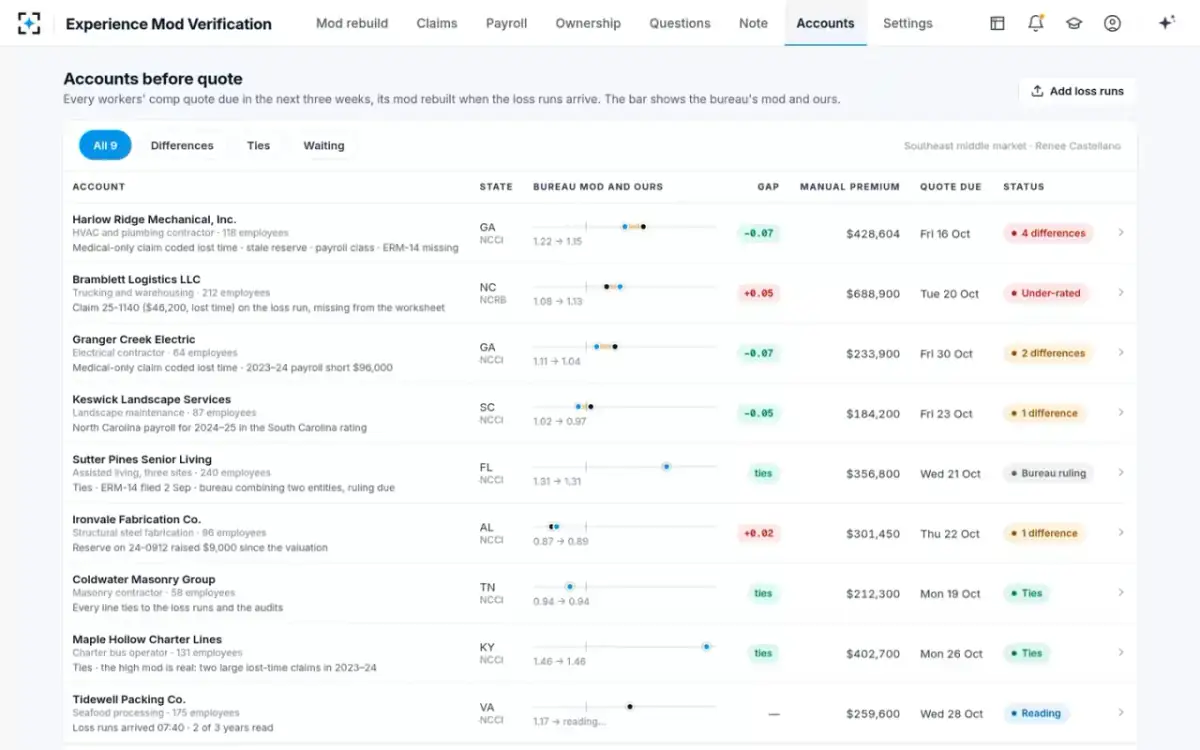
Experience Mod Verification: every quote due, the bureau's mod and the rebuilt one on one scale
Ownership changes: the longest wait in the chain
Ownership is where a letter is most likely to state a number that is about to change. The plan makes the employer report a change of ownership or combinability within 90 days, using an online tool, the ERM-14 form or a signed narrative on letterhead. The Texas Department of Insurance describes the ERM-14 as "an NCCI form that insurers use to report changes in ownership information".
The failure to report changes in ownership according to the 90-Day Reporting Requirement—Notification of Change in Ownership Endorsement may be considered experience rating modification evasion.
NCCI Experience Rating Plan Manual, Texas edition (2025)
When the bureau does act, it can reach back. If a change requires recalculation, the bureau revises the current and up to two preceding mods, and the insurer applies the revised mods back to the date of the change. An acquisition that nobody reported can therefore change three letters' worth of mods at once.
The waits are not only the bureau's. In a precedential California decision, a property manager bought a business whose 118% mod then followed it onto the buyer's policy. To test the buyer's claim that the workforce had largely changed, the rating bureau wrote to the buyer's insurer for payroll records on 1 May, 19 June, 18 July, 14 August and 19 September 2000, and received nothing. The bureau decided in October, and the decision on appeal, which the Department lists as precedential, affirmed it, holding that the burden of proving a change in employees lay with the employer (DeMiranda Management Co., California Department of Insurance). Five months of letters went unanswered, and the mod stayed.
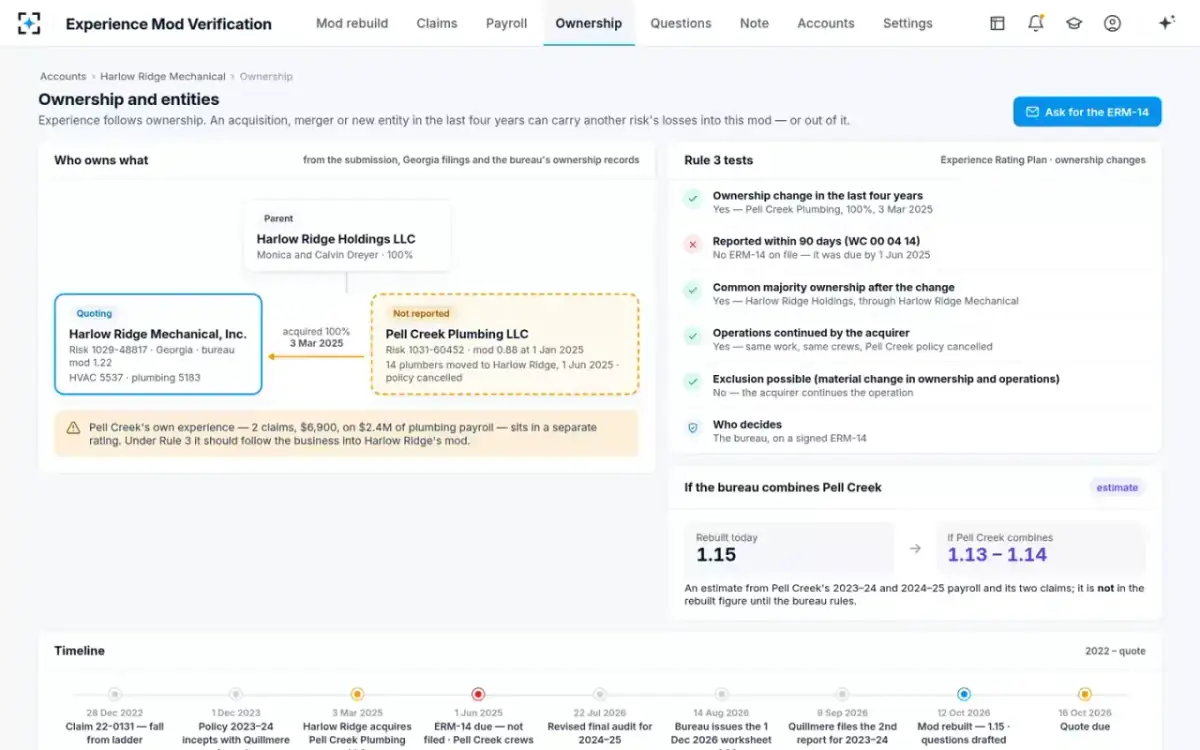
On the sample account the open question is of this kind. Harlow Ridge's parent bought a plumbing company outright in March 2025 and moved its crews over in June, and no ERM-14 is on file. The solution's ownership checker applies the plan's tests and drafts the request for the form, but it never decides whether the experience combines: the bureau does, on a signed ERM-14.
Why general contractors ask for the EMR, and where one state drew a line
Owners and general contractors read the mod as a safety signal, and some write a cut-off into the bid. Virginia stopped that for construction contracts in 2016: § 11-9.8 of its Code prohibits any contract or offer to contract that requires the contractor or bidder to have a specified experience modification factor (Code of Virginia § 11-9.8). Asking for the mod is still allowed; making a specified figure a condition is not.
Even where cut-offs are lawful, the letter's reader should know what a mod can and cannot say about safety, how small contractors are rated, and why one claim moves a small employer's mod so far. Those questions are worked through in EMR for contractors and Virginia's ban on mod cut-offs.
Checking the number before it goes on letterhead
The cheapest moment to catch a wrong mod is before anyone repeats it. Botminds' Experience Mod Verification is built for the carrier's side of a workers' compensation quote: six agents read the bureau's worksheet, the prior carriers' loss runs, the final and revised audits and the ownership filings, rebuild the mod line by line beside the bureau's, and draft the questions that would correct the inputs. On the sample account they did that in 41 seconds, a figure from the solution running on fictional data, and flagged four differences: the miscoded claim, a reserve the worksheet still carried at its first-report value after the claim had closed far lower, a reopened claim that worked against the employer, and installer payroll left in a sales class.
The solution does not write EMR letters, and it never presents the rebuilt mod as official; it labels it "rebuilt — not the promulgated mod". What it gives a broker or carrier asked for a letter is a reason to send it with confidence, or a specific question to send first. Where the rebuilt and the bureau's mods tie, the letter can go. Where they differ, the honest letter states the bureau's mod, its status and the correction already requested.
The ownership checker's view: who owns what, the plan's tests, and an estimate kept out of the figure
Questions people ask
Can my broker issue an EMR letter?
Yes, if the broker is the producer of record on your current policy. In NCCI states the rating organization gives the worksheet to the carrier of record and the producer of record, and to anyone else you authorize in writing, so your broker can read the mod and state it. A broker who is not on the policy needs your written authorization or a copy from you.
How long does it take to get an EMR letter?
A few days from a broker or carrier with the worksheet in hand. It takes longer when the mod is preliminary, pending a rate filing, or contingent, missing data the prior insurer has not yet reported. In Texas a policy's first report is valued 18 months after it started, so a mod can be issued only a few months before its rating date: on the sample account the worksheet came out on 14 August for a 1 December rating.
Is an EMR letter the same as an experience mod worksheet?
No. The worksheet is the rating organization's calculation: payroll by class, expected losses, every claim and the formula's totals. The letter is a restatement of the result by someone allowed to see the worksheet. For a line-by-line reading of the worksheet itself, see the experience mod worksheet, annotated.
What if my EMR letter is wrong?
If the letter misstates the worksheet, ask the writer to reissue it. If the worksheet itself is wrong, the fix runs through the insurer that reported the data, which files a correction report, and the bureau, which recalculates the current and up to two preceding mods. Decreases apply back to the start of the policy, so premium paid at the higher mod can be returned.
Do new businesses have an EMR?
Usually not at first. NCCI's plan applies a unity factor of 1.00 to a new business with no data and to a risk that does not meet its state's premium eligibility, which in Texas is $10,000 of total manual premium over the most recent 24 months, or $5,000 a year on average. Washington is the exception among the states covered here: its state fund uses no premium threshold.
Why do general contractors ask for an EMR letter at all?
Because the mod compares an employer's losses with those expected for its payroll and classes, many owners treat it as a quick safety screen. It was built to price insurance, and it weighs a small contractor's losses less heavily than a large one's. Virginia prohibits construction contracts and bids that require a specified mod.