An experience mod calculation divides an employer's rated actual losses by its rated expected losses over a three-year experience period. Expected losses come from audited payroll by class code times each class's expected loss rate; actual losses are the claims the prior insurers reported, with each claim split into a primary part counted in full and an excess part given only partial weight, plus a ballast that keeps small employers' mods from swinging. The arithmetic is short and published. What goes wrong in practice is the inputs, which is why Botminds' Experience Mod Verification rebuilds the calculation from the loss runs and audits rather than from the worksheet alone, and why the right way to trust any mod checker is to replay it on mods you already know.
NCCI's plan, as approved for Texas from 1 July 2025, puts the purpose in one sentence: experience rating works "by comparing the experience of individual risks with that of the average employer in the same classification" (NCCI Experience Rating Plan Manual, Texas edition). An earlier NCCI filing gave the reading of the result: a mod of 1.20 forecasts losses 20% worse than the average employer in the same classes (NCCI Item E-1409, filed with the Texas Department of Insurance).
The experience mod formula, term by term, and where each input comes from
| Term | What it is | How the plan computes it | Comes from |
|---|---|---|---|
| E · expected losses | Losses expected for this payroll in an average firm | (Payroll ÷ 100) × expected loss rate, by class and year | Audited payroll on the unit reports; rates in the bureau’s rating values |
| Ep · expected primary | The part of E expected below the split point | D-ratio × expected losses | D-ratios in the rating values |
| Ee · expected excess | The rest of E | E − Ep | Arithmetic |
| Ap · actual primary | Each claim’s value up to the split point, summed | Medical-only claims reduced by 70% first | The prior insurers’ unit reports |
| Ae · actual excess | Each claim’s value above the split point, summed | Capped by the state’s per-claim limit | The prior insurers’ unit reports |
| W · weighting value | The share of excess losses that counts | Rises with the employer’s expected losses | Rating values, by size |
| B · ballast | A stabilizing amount added to both sides | Rises with expected losses | Rating values, by size |
| Mod | Rated actual over rated expected | (Ap + W×Ae + (1−W)×Ee + B) ÷ (E + B), to two decimals | The formula |
How is an experience mod calculated? The formula in the plan's own words
Start with expected losses. For each class code and policy year the plan multiplies payroll by the class's expected loss rate: "(Payroll / 100) × ELR = Expected Losses". A discount ratio, the D-ratio, then says how much of that is expected below the split point: "Discount Ratio × Expected Losses = Expected Primary Losses". The rest is expected excess.
Actual losses come from the claims. The plan splits each claim at the split point; the primary part counts in full, the excess part only in proportion to the weighting value: "Weighting Value × Actual Excess Losses = Actual Ratable Excess Losses". A stabilizing value is added to both actual and expected: "Expected Excess Losses × (1 – Weighting Value) + Ballast Value = Stabilizing Value". Then "Total A ÷ Total B = Experience Rating Modification", rounded to two decimals.
Two caps sit around the result. Large claims are limited per claim and per accident, and the mod itself is capped for smaller employers by a maximum debit: "1.10 + (0.0004 x E÷G) = Maximum Debit Modification", where G is the state's average claim cost in thousands. The plan explains what the ballast is for: it steadies the mod by limiting how far actual losses can move it (experience mod worksheet).
What are primary and excess losses, and where is the split point?
Primary losses are the first dollars of every claim, up to the split point; excess losses are the rest. The plan defines the split point as "the dollar level at which the rating organization divides each actual incurred loss into two portions". Washington's rule gives the reason: the first-dollar part of each claim has "been shown in actuarial studies, to have the greater credibility in predicting future experience" (WAC 296-17-855). NCCI's filing draws the consequence, "primary losses receive a greater weight than excess losses", and gives an example: with a $15,000 split point, "a claim totaling $50,000 would contribute $15,000 to the primary layer and $35,000 to the excess layer."
The split point itself has moved. A fixed split point eroded as claims got costlier; a Casualty Actuarial Society paper by an NCCI actuary records that "NCCI has implemented an increase in the split point from $5,000 to $15,000+ inflation (over three years)" (Evans, CAS E-Forum, 2014). In 2022 it was one countrywide figure, $18,500; NCCI's Item E-1409 replaced that with state-specific split points indexed each year. Texas adopted the change in 2023, setting $16,500 for ratings from 1 July 2024, a value its order notes "will change annually" (Texas Commissioner's Order 2023-7897). The split point on any worksheet is that state's for that rating date, and it is printed on the worksheet; a calculation that assumes one is already wrong.
The weighting value decides how much of the excess counts, and it rises with size. NCCI's filing puts the principle simply: "as the size of the employer increases, credibility also increases." A small contractor's mod therefore moves mainly with how often it has claims; a large one's also with how big they are.
What is the experience period for a mod?
Usually the three most recent complete policy years, ending a year before the rating date. NCCI's plan includes a policy if it started "not less than 21 months before the RED" and "not more than 57 months before the RED", and caps the period at 45 months of data. Its earlier filing gave the plain version: "a mod effective January 1, 2018 will generally be based on experience from 2014–2016".
Each year enters at a different maturity. In Texas, a policy's first unit report is valued 18 months after the policy starts, with later reports valued every 12 months (Texas Department of Insurance), and NCCI's plan uses the most current of each year's first three unit reports, with any corrections (unit statistical report). So in one rating, the oldest year's claims are 42 months old and the newest only 18; the newest year's reserves are the least settled numbers on the worksheet.
Three policy years, three maturities, one rating: a 1 December 2026 mod
- Policy year12 mo
- To 3rd valuation, 1 Jun 202630 mo
- Policy year12 mo
- To 2nd valuation18 mo
- Policy year12 mo
- To 1st valuation6 mo
How are medical-only claims treated in the mod?
In NCCI states they count at 30% of their value. The plan says: "For each medical-only claim, the rating organization reduces the actual primary losses and actual excess losses by 70%." This is the experience rating adjustment, introduced in 1998, and its purpose, in the NCCI actuary's words, is "to remove the potential incentive for employers to not report small medical only claims" (Evans, 2014).
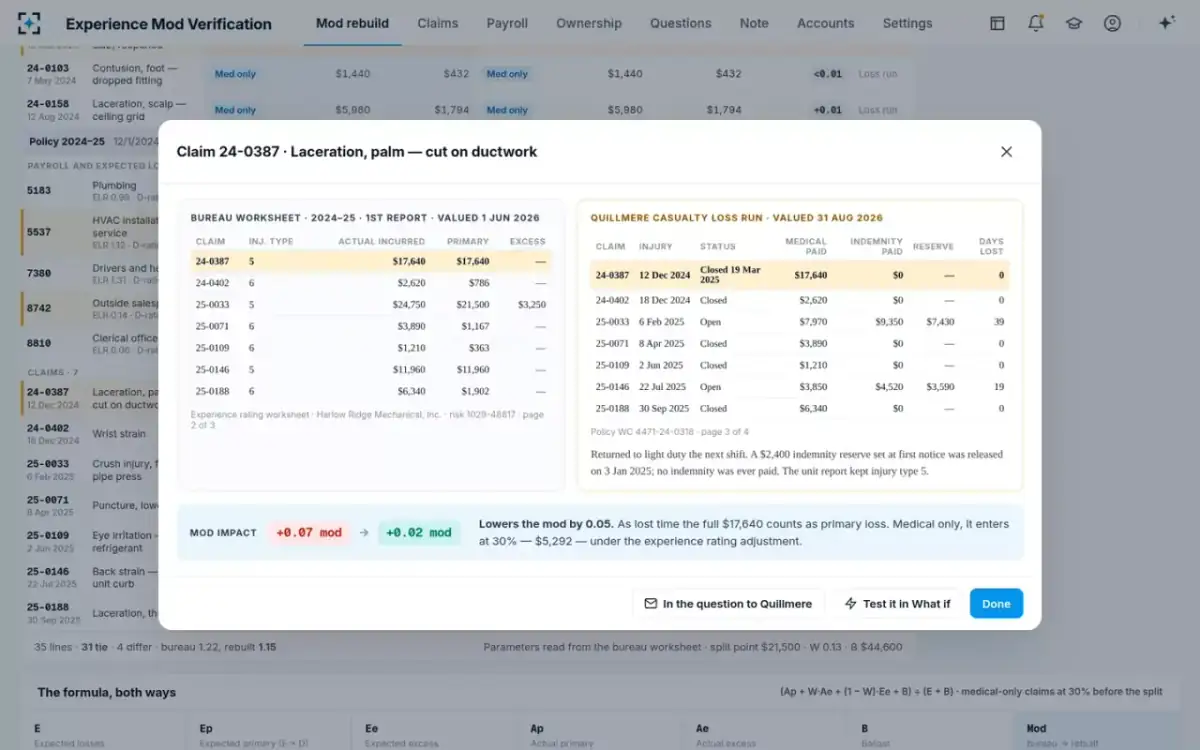
That makes one field on the unit report worth more than most dollar amounts. A claim that paid no wage benefits but stayed coded as lost time counts in full. On the fictional sample account, a $17,640 cut-hand claim coded that way counted as $17,640 of primary loss; as medical only it would count as $5,292. Washington, which writes its own plan, does it differently: claims without disability benefits are first reduced by "the lesser of $4,100 or the total cost of the claim", which "on average" cuts their actual loss "about 70 percent" (WAC 296-17-855). The two aim at a similar average and differ claim by claim: a $5,000 medical-only claim counts as $900 in Washington and $1,500 under NCCI's 30%, while a $35,000 one counts as $30,900 in Washington and $10,500 under NCCI's rule.
One mod worked from its totals: 1.22 on the worksheet, 1.15 from the sources
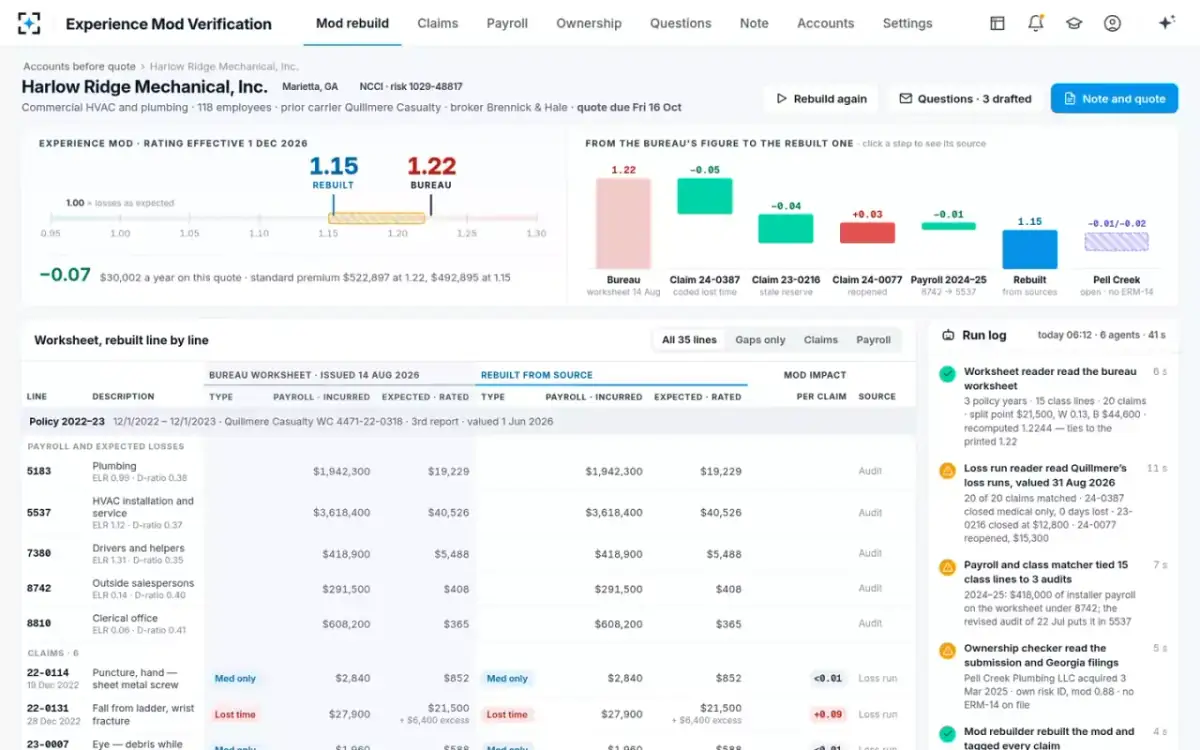
Take a fictional sample account as it runs through the solution: Harlow Ridge Mechanical, a Georgia HVAC and plumbing contractor with 20 claims and 15 class lines over three policy years. The bureau's worksheet prints 1.22. Recomputed from the worksheet's own lines, it comes to 1.2244: the arithmetic ties. Rebuilt from the prior carrier's loss runs and audits, the same formula gives 1.15.
The formula can be rewritten to show what a mod really measures. Because E + B is the same on both sides, the mod is one plus the difference between rated actual and rated expected losses, divided by expected losses plus ballast. On the rebuilt sample, rated actual losses are $134,865 and rated expected $95,568; the difference, $39,297, divided by $255,398 of expected losses plus ballast, is 0.1539. The mod is 1.15: above average, and by less than the worksheet says.
The same view prices a single claim. On the bureau's worksheet, expected losses plus ballast were $4,096 lower, because $418,000 of installer payroll sat in a sales class with a far lower expected loss rate. Over that $251,301, the miscoded $17,640 claim is worth 0.07 of the mod as lost time and 0.02 as medical only. The rebuild finds five such movements and keeps one of them, an ownership question, out of the figure.
What moved the sample mod from 1.22 to 1.15, and what kind of difference each was
The mod rebuild: the bureau's mod and the rebuilt one on one ruler, and the bridge between them
Washington publishes every number: a claim-by-claim calculation
Washington's state fund is the one plan in this guide whose full formula, split, and credibility tables sit in current regulation, refiled each January. Its rule reads: "(Credible Actual Primary Loss + Credible Actual Excess Loss)/Expected Loss", where each credible loss mixes the employer's actual with its expected by a credibility percentage. For 2026, claims up to $28,180 are primary in full, and above that the primary part is 70,460 × total ÷ (total + 42,280) (WAC 296-17-855).
Washington, 2026: how four claims split into primary and excess
| Claim | Type | After the medical-only deduction | Primary | Excess |
|---|---|---|---|---|
| $5,000 | Medical only | $900 | $900 | $0 |
| $35,000 | Medical only | $30,900 | $29,751 | $1,149 |
| $35,000 | Time loss | $35,000 | $31,911 | $3,089 |
| $90,000 | Permanent partial disability | $90,000 | $47,939 | $42,061 |
Now an illustrative employer. Suppose expected losses of $50,000, half expected primary and half excess, an assumption for the arithmetic. Washington's 2026 table gives an employer with expected losses between $35,982 and $54,456 a primary credibility of 56% and an excess credibility of 8% (WAC 296-17-880). Give it two claims, the $35,000 time-loss claim and the $5,000 medical-only one.
Actual primary is $31,911 + $900 = $32,811, actual excess $3,089. Credible primary is $32,811 × 56% + $25,000 × 44% = $29,374; credible excess is $3,089 × 8% + $25,000 × 92% = $23,247. The mod is $52,621 ÷ $50,000 = 1.05. Recode the large claim as medical only and it becomes 1.03; with no claims at all the formula alone would give 0.68. Two points follow. A large medical-only claim is reduced far less in Washington than in NCCI states, because the deduction is a fixed $4,100. And the employer's own excess losses barely matter at this size, because only 8% of them count.
Washington also shows why a calculation must use the right valuation. Its rule fixes one date: "The valuation date shall be June 1, seven months immediately preceding the effective date of premium rates", and claim values are not revised between valuation dates except for listed reasons such as "mistake other than error of judgment" (WAC 296-17-870).
Replay before you trust a mod checker
A mod checker earns trust the way the experience rating plans themselves do: by being tested on outcomes already known. Pick accounts whose final mods you have, gather the documents as they stood on each worksheet's date, rebuild blind, and compare line by line. The test is not whether the checker reproduces the bureau's mod; on accounts with input errors it should not. The test is whether every difference it reports is real and classified.
A replay test for any mod checker, in seven steps
- Choose 20 to 30 accounts across your states, with final mods issued
Include ties you trust, mods you know were later revised, and at least one ownership change.
- Freeze the documents at each worksheet’s issue date
Loss runs valued later bring in development the bureau could not have used, and every one shows as a false difference.
- Run the checker without telling it the answer
It reads the worksheet, the loss runs and the audits as it would on a live quote.
- Require the printed mod to recompute from the worksheet’s own lines
On the sample account, 1.2244 against a printed 1.22. A checker that cannot do this has a parsing problem.
- Compare line by line, not mod by mod
Two offsetting errors produce a matching mod and a failed test.
- Classify every difference as source error, timing or the tool’s own
Confirm source errors against later correction reports or revised worksheets where they exist.
- Count what matters
Lines tied, real differences found, false differences raised, and differences the checker missed that a person found.
Three kinds of difference: source error, timing, and the tool's own
Source errors are inputs the bureau was given wrongly: a claim coded lost time that paid only medical bills, payroll filed under the wrong class, a claim reported on the wrong policy. They are the ones worth a correction request, because the reporting insurer can file a correction report and the bureau will recalculate. On the sample, two of the four differences were of this kind.
Timing differences are values that were right when reported and have since moved: a reserve that closed lower, a claim that reopened. They are real, but they are not errors, and whether they reach this rating depends on the report schedule. A precedential California decision shows the hard line: a claim reported open at $43,031 that closed at $27,508 before the mod's effective date still counted at $43,031, because neither plan allows a corrected unit filing for a claim that closes between the valuation date and the mod's effective date (B.D.D. Pest Control, California Department of Insurance, 2000; quoted in the California plan guide). A checker that calls timing an error sends correction requests that will be refused.
The tool's own differences are the ones a replay exists to find: a misread line, a wrong rating value, a rule applied from the wrong state or year. NCCI changed its split points, accident limits, D-ratios and credibility parameters for ratings from 2023 and 2024, and Washington refiles its values every January, so a checker that carries last year's parameters fails quietly. Experience Mod Verification avoids that by using the parameters printed on the worksheet itself, never assumed ones, and the replay is how to confirm it does.
One difference opened: the worksheet line beside the prior carrier's loss run
What replaying old mods cannot prove
A replay tests agreement and classification; it cannot prove that the sources are true. If a loss run is itself wrong, the checker will tie to the wrong number with confidence. It cannot decide what the bureau will rule on an ownership change, and a good checker does not try. It also cannot stand in for a test of the rating plan, which is a different question: NCCI tests that by sorting employers by mod and comparing their later loss ratios. In its 2022 filing, the fifth of employers with the lowest mods had a loss ratio of 63% before the mod was applied and the fifth with the highest had 149%; after the mod, all five groups fell between 94% and 103% (NCCI Item E-1409). The plan predicts well on average. Whether one employer's inputs are right is the narrower question a mod checker answers, and the one a replay tests. How one wrong input carries through later ratings is the subject of EMR above 1, and the worksheet's lines are read one by one in the experience mod worksheet, annotated.
Questions people ask
What is the experience mod formula?
In NCCI states, (Ap + W×Ae + (1−W)×Ee + B) ÷ (E + B): actual primary losses plus the weighted share of actual excess, plus the unweighted share of expected excess and a ballast, over expected losses plus the same ballast. The result is rounded to two decimals and capped for smaller employers by a maximum debit of 1.10 + 0.0004 × E ÷ G.
What is an expected loss rate?
The losses expected per $100 of payroll for a class code, published by the rating organization with each state's rate filing. Multiplying a class's payroll by its rate, year by year, gives the expected losses the employer's actual losses are compared with. In Texas the regulator notes that unit statistical data, collected for every policy, is used in developing expected loss rates.
Can you recalculate your own experience mod?
Yes, if you have the worksheet: every payroll line, expected loss rate, D-ratio, claim value, weighting value and ballast is printed on it, so the arithmetic can be redone line by line. Recalculating from the worksheet only confirms the bureau's arithmetic; to find errors you have to rebuild from the loss runs and audits. A recalculated or rebuilt mod is never official.
Why is my mod above 1.00 when I had few claims?
Because the mod weighs how many claims you had more than how large they were, against what your payroll predicts. A small employer with one lost-time claim can carry a debit for three ratings, and a medical-only claim coded as lost time counts at more than three times its proper weight in NCCI states.
Does the split point change every year?
In NCCI states, yes: since NCCI's Item E-1409 each state has its own split point, indexed with its annual rate filing, and Washington refiles its own each January. Read the split point from the worksheet for the rating date in question rather than carrying one forward.