An experience modification rate calculator takes the inputs of a workers' compensation experience rating, payroll by class code, expected loss rates, D-ratios, each claim's value and type, the split point, the weighting and ballast values, and returns a mod. Typed with the bureau's own numbers, a good one reproduces the bureau's mod to two decimals. That is its strength and its limit: it repeats the arithmetic on whatever it is given, and experience mods go wrong in the inputs, not the arithmetic. A rebuilt, cited mod takes the inputs from the source documents instead, the prior carriers' loss runs, the payroll audits and the ownership record, and shows which line differs and why. Botminds' Experience Mod Verification does the second; this guide shows where each approach earns its place.
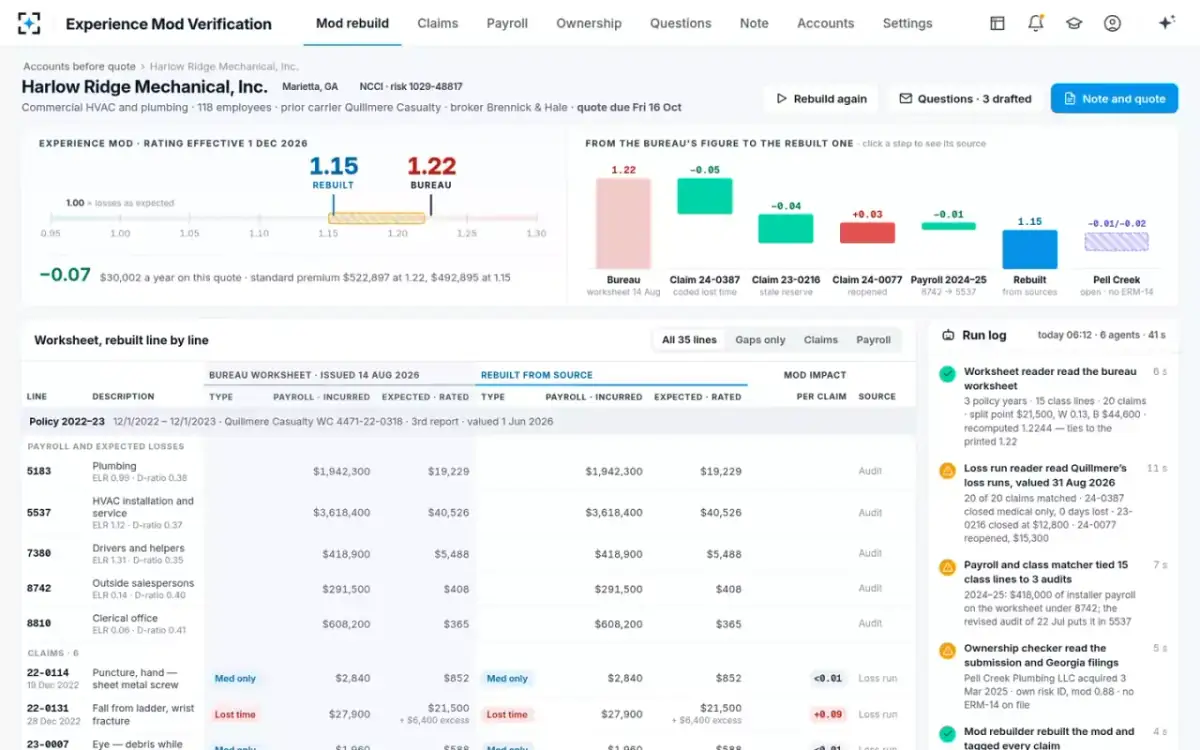
Take a fictional sample account as it runs through the solution: Harlow Ridge Mechanical, a Georgia HVAC and plumbing contractor quoted on a bureau worksheet of 1.22. Type every line of that worksheet into a calculator and it returns 1.2244, which rounds to the bureau's 1.22. Rebuild the same formula from the sources and it comes to 1.15.
Same account, two answers: the calculator stops at 1.22, the rebuild walks to 1.15
What an experience modification rate calculator does
It performs the plan's arithmetic. NCCI's plan, as approved in Texas for policies from 1 July 2025, spells out every step a calculator copies: payroll ÷ 100 × expected loss rate for expected losses, a D-ratio for the primary share, a weighting value on actual excess losses, and finally Total A ÷ Total B, rounded to two decimals (NCCI Experience Rating Plan Manual, Texas edition; the formulas are quoted in experience mod calculation). Washington publishes its own version in regulation, with the split, the primary-loss formula and the credibility table (WAC 296-17-855).
Because the formula is public, calculators are easy to build and useful for three jobs: checking the bureau's arithmetic, showing an employer what one claim does to its mod, and projecting a future mod from assumptions. None of the three tells you whether the worksheet's inputs are right. A calculator fed a claim coded lost time will price it as lost time.
The order matters too. A calculator asks what the mod is, given these numbers; a verification asks whether these are the right numbers. On a quote, a dispute or an EMR letter, the second question is the one with money attached; how the formula itself works is set out in the experience mod calculation guide.
What inputs does an EMR calculator need?
More than most calculators ask for, and each one has an owner. The table lists what the plan's formula uses, where it is printed, and whether a calculator can check it or only accept it.
Every input to an experience mod calculation, where it comes from, and whether a calculator can check it
| Input | Where it is printed | Who produced it | Can a calculator check it? |
|---|---|---|---|
| Payroll by class code and policy year | The worksheet | The insurer, from the final audit, on its unit report | No: only the audit can |
| Expected loss rate and D-ratio by class | The worksheet and the bureau’s rating values | The rating organization, with each rate filing | Only that they match the rating date’s tables |
| Each claim’s value | The worksheet | The insurer, at the report’s valuation date | No: only the loss run can |
| Each claim’s type: medical only or lost time | The worksheet | The insurer, on its unit report | No: only what was paid can |
| Split point and per-claim limits | The worksheet and rating values | The rating organization, by state and year | Only that they match the state and rating date |
| Weighting and ballast values | The worksheet | The rating organization, by employer size | Only that they match the size band |
| Which policies are in the experience period | The worksheet | The rating organization, from the rating date | Only against the plan’s 21-to-57-month window |
| Which entities are combined | The worksheet header | The rating organization, from ownership filings | No: only the ownership record can |
Four of the eight rows are answered "no". Those are the inputs a rebuild takes from documents instead of from the worksheet, and they are where the sample account's 0.07 came from.
How accurate are experience mod calculators?
As accurate as their inputs and parameters, and no more. Given the worksheet's own lines and the right rounding, a calculator should land on the bureau's figure: the plan rounds expected losses and most intermediate values "to the nearest whole number" and the mod "to two decimal places". When a calculator disagrees with a worksheet it was fed from, the cause is usually a parameter, not an error by the bureau.
Parameters are where home-made calculators drift. NCCI's 2022 filing records that the split point was "a countrywide value ($18,500)" updated with each state's rate filing, and its Item E-1409 replaced that with state-specific split points indexed annually; Texas set $16,500 for ratings from 1 July 2024, a value that "will change annually" (Texas Commissioner's Order 2023-7897). The same filing notes that "Tables of W and B values corresponding to employer size ranges are updated with each state's annual loss cost/rate filing" (NCCI Item E-1409). A calculator built on last year's values, or on another state's, returns a plausible wrong number.
Even then, the calculator is answering a narrower question than people ask it. Fed the worksheet, it can be exact and still say nothing about the four inputs only documents can check.
Three things a calculator never sees: ownership, timing and state lines
Some of what decides a mod is not a number at all, so no calculator field can hold it. The first is ownership. Under NCCI's plan, "When entities share common majority ownership, the rating organization combines them to calculate a single experience rating modification", where common majority means "the same person, group of persons, or corporation owns more than 50% of each entity". A calculator given one company's payroll and claims cannot know that the parent bought another company in March 2025; on the sample account, that acquisition is the open question worth an estimated 0.01 to 0.02.
The second is timing. Each policy year enters the rating at a different report level, and a claim's value on the worksheet is its value on the report's valuation date. A calculator fed today's loss run will value a claim that closed last month at its closed amount; the bureau, correctly, may not. Telling those apart needs the dates of both documents, which is why a rebuild records the valuation date of every source it reads.
The third is the state line. An interstate mod "applies to all the risk's operations, even if the insurance provider or insurance providers write the coverage under separate policies", and the plan averages weighting and ballast across states by expected losses. But NCCI's plan does not apply in states whose bureaus run their own plans, California among them, and four states with monopolistic funds rate their own employers. A calculator that blends a California payroll into an NCCI-state mod has produced a number no bureau would issue. How the plans differ is set out in the California experience rating plan compared with other states.
Can you estimate next year's mod?
Yes, as a projection with stated assumptions, and it is worth doing before a renewal. The method follows the experience period. Next year's rating drops the oldest policy year and adds the newest, valued at its first report; the two middle years move up a report level. Washington's state fund publishes the mapping for employers: each claim affects three calendar years of premium (Washington L&I).
Three things a projection cannot know. The rating values: new expected loss rates, D-ratios, weighting and ballast arrive with the next rate filing, which is why the plan issues a preliminary mod on today's rating values while the filing awaits the regulator. The development of open claims: in Texas the first report is valued 18 months after the policy starts, and later ones every 12 months (Texas Department of Insurance). And any timing rule that keeps a known change out: in a precedential California decision, a claim that had closed at $27,508 still counted at its $43,031 reported value in the next mod, because it closed after the valuation date (B.D.D. Pest Control, California Department of Insurance).
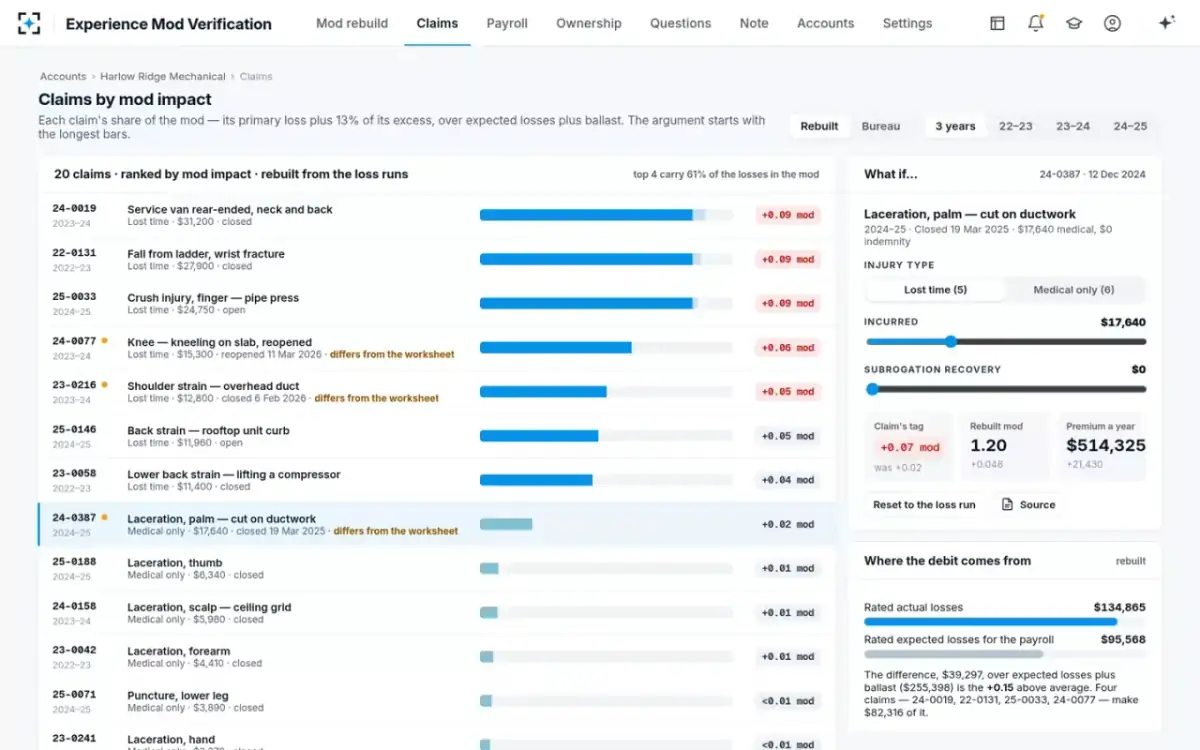
So a good projection is a range with its assumptions written down. The solution's what-if does the same thing on the current rating: change a claim's injury type, incurred value or subrogation recovery, and see the claim's share of the mod, the rebuilt mod and the premium move.
The what-if: change one claim and watch the mod and the premium move
Four ways to check a mod, compared
The choice is not calculator against software. There are four common approaches, and they answer different questions at different costs.
Four ways to check an experience mod, and what each one can and cannot tell you
| Approach | Inputs come from | Catches wrong inputs? | Shows its sources? | Typical use |
|---|---|---|---|---|
| Read the bureau’s worksheet | The bureau | No | The worksheet itself | The mod of record for every quote |
| Calculator or spreadsheet | Whoever types them | No; it repeats them | No | Arithmetic checks, what-ifs, budgets |
| Review by hand against loss runs and audits | Source documents | Yes, when time allows | In the reviewer’s notes | Disputes and large accounts |
| Rebuild by agents, with a person deciding | Source documents | Yes, on every account | Every line cites its page | Every quote, before pricing |
The middle rows are where most practices sit today: a calculator for what-ifs, a review by hand when a broker pushes back. The gap is coverage. A review by hand finds the sample account's four differences, but only on the accounts someone has time to review, so the mods taken on trust are exactly the ones nobody checked.
What you get from a calculator, and what you get from a rebuild
Calculator: Numbers typed from the worksheet or estimated
Rebuilt, cited mod: The worksheet, the loss runs, the audits and the ownership filings
Calculator: 1.22, the bureau’s figure
Rebuilt, cited mod: 1.15, with four differences and one open question
Calculator: Priced as lost time
Rebuilt, cited mod: Found from $0 indemnity and 0 days lost on the loss run
Calculator: Priced as typed
Rebuilt, cited mod: Found against the revised audit, class by class
Calculator: Not visible
Rebuilt, cited mod: Found in the filings; estimate shown and kept out of the figure
Calculator: A number
Rebuilt, cited mod: Questions citing the claim, the page and the party that can correct it
Calculator: No
Rebuilt, cited mod: No; labelled rebuilt, and quotes use the bureau’s mod
What software verifies experience mods? Questions to ask before you buy
Software that verifies, rather than calculates, has to read documents it did not create. The questions below test that, and they are different from the questions you would ask of a calculator.
Questions to ask experience mod verification software before you buy
- Does it read the bureau’s worksheet itself, in each bureau’s format?
Typing a worksheet in is where the first errors enter. Ask which bureaus’ layouts it reads.
- Does it read loss runs in any carrier’s layout, by valuation date?
Prior carriers’ loss runs are the source for claim values and types; there is no standard layout.
- Where do its rating values come from?
From the worksheet for the rating in question, or from a table someone maintains? Split points and size tables change with each filing.
- Does it handle interstate risks?
The plan averages weighting and ballast across states by expected losses, and payroll filed in the wrong state moves the mod.
- Can it show a claim’s share of the mod?
A ranked list of claims by mod impact tells you where an argument is worth having.
- Does it separate errors from timing?
A claim that developed after its valuation date is not a correction request.
- Are projections and estimates labelled and kept apart?
A what-if or an ownership estimate must never become the rebuilt figure.
- What does it hand a person at the end?
A file note with the differences and their sources, and drafted questions, not a changed number.
Where Experience Mod Verification fits, and where a calculator is enough
A calculator is enough when the question is arithmetic or assumption. Budgeting next year's premium, showing a client what a safety programme might save, checking that a worksheet adds up: none of those needs source documents, and a spreadsheet with current rating values does them well.
Verification is for the moments when the number will be relied on: a quote, a renewal with a jump, a contractor's EMR letter, a dispute, an acquisition. Botminds' Experience Mod Verification reads the worksheet with its own parameters, never assumed ones, rebuilds every line from the loss runs and audits, ranks each claim by its share of the mod, and drafts the questions for the broker, the prior carrier and the bureau. On the sample account six agents did that in 41 seconds, and the underwriter quoted on the bureau's 1.22 with a revision condition, telling the broker to expect 1.15.
It is not a calculator for the public, and it does not publish or project official mods. It never prices the account, never sends a question on its own, and never presents its figure as the bureau's. The questions it drafts, and to whom each goes, are covered in the experience mod review guide; where the official number is kept and who may see it, in the experience mod lookup guide.
The rebuild beside the bureau's figure, line by line, with the parameters read from the worksheet
Questions people ask
Why is my calculated mod different from the bureau's?
Usually a parameter or a rounding step: a split point, weighting or ballast value from the wrong state or year, expected losses not rounded to whole dollars, or a policy that is or is not inside the experience period. If your inputs came from loss runs rather than the worksheet, the difference may be real: a claim valued later than the bureau's report, or coded differently.
What is the difference between a mod estimate and the official mod?
Only the rating organization issues the official mod, on its worksheet, and it can be preliminary, contingent or final. An estimate is anyone else's calculation, from a broker, a consultant or software, and it carries no weight with an insurer applying the plan, however carefully it was made.
Is there a free experience mod calculator?
A spreadsheet is enough to calculate a mod, because the formula is published: NCCI's plan prints each step and Washington's regulation prints its formula and tables. What costs effort is current rating values for your state and size band, and inputs you can trust.
Can a calculator handle a multistate employer?
Only if it follows the interstate rules. NCCI's plan averages the weighting and ballast values across states, weighting each state's values by its expected losses, and applies one interstate mod to all of a risk's operations. States with their own plans, such as California, rate separately.
How long does a verification take compared with a calculation?
A calculation takes minutes once the inputs are typed. A rebuild by hand, matching every claim to loss runs and every class to the audits, takes about two hours per mod by Botminds' estimate. With Experience Mod Verification the agents took 41 seconds on the sample account, and the underwriter's review of the differences takes the rest.