An EMR above 1 means an employer's workers' compensation experience modification rate is a debit: its past losses were worse than the losses expected for its payroll and class codes, so the bureau predicts worse-than-average losses ahead, and the premium the mod applies to rises in proportion. At 1.20 the prediction is 20% worse than average and the premium 20% higher. For contractors a debit can also cost bids. The expensive case is a mod that is above 1, or further above it, because of an error rather than real losses: a miscoded or stale claim stays in up to three ratings, so the employer pays for it three times unless someone catches it. Botminds' Experience Mod Verification rebuilds the mod from the loss runs and audits before quote, so the error is found while it is still cheap.
The figures below come from a fictional sample account as it runs through the solution: Harlow Ridge Mechanical, a Georgia HVAC and plumbing contractor with $428,604 of manual premium, a bureau mod of 1.22 and a rebuilt mod of 1.15.
One miscoded claim, three ratings: an estimated $64,000 that real losses did not earn
- Rating 1 Dec 2026$21,430
- Rating 1 Dec 2027≈ $21,430
- Rating 1 Dec 2028≈ $21,430
- Each rating counts the claim at 30%, as the plan intendsnothing extra
What does an EMR above 1 mean?
It means a debit: the mod increases premium. A mod of 1.00 is unity, the average for the employer's classes and payroll; below it is a credit. NCCI's own filing with the Texas Department of Insurance puts the reading in one sentence: "an experience rating modification of 1.20 is a prediction that the employer's future loss experience will be 20% worse than the average employer in the same classification" (NCCI Item E-1409).
The premium effect is direct. The plan's rule is short: "Multiply the subject premium by the experience rating modification" (NCCI Experience Rating Plan Manual, Texas edition). On the sample account, manual premium of $428,604 becomes $522,897 at 1.22 and $492,895 at 1.15. Every hundredth of a point is worth about $4,286 a year to that employer.
A debit has a ceiling for smaller employers. The plan caps the mod at "1.10 + (0.0004 x E÷G)", where E is the employer's expected losses and G the state's average claim cost in thousands, so a small firm's single bad year cannot produce an unlimited debit. The cap rises with the employer's size, because a larger employer's own losses are judged more credible.
Is an EMR of 1.2 bad?
It is a prediction of losses 20% above average, and it costs 20% more premium than a 1.00. Whether it is "bad" depends on what produced it. For a large employer, whose losses carry high credibility, 1.20 usually reflects a real pattern of claims. For a small one it may be one lost-time claim: NCCI's filing notes that credibility rises with the employer's size (experience mod calculation), so a small firm's mod is built mostly from how often it has claims and is pulled back towards 1.00 by a ballast.
It also depends on whether the number is right. The sample account's 1.22 was arithmetically correct and still overstated: rebuilt from the sources, the mod was 1.15, still a debit, because four large lost-time claims were real. "The losses are real; the mod is above average, but not as far above as the worksheet says," the drafted note reads. That is the distinction this guide is about: a debit earned by losses, and a debit added by an error.
The sample account's premium at four mods: what each hundredth of a point costs
How long does a claim stay on your EMR?
Three ratings, in most plans. NCCI's plan counts a policy in a rating if it started between 21 and 57 months before the rating effective date (the experience period, worked through), so a policy year enters its first rating about two years after it begins and leaves after its third. Washington's state fund tells employers the same thing in plain terms: "A claim will affect your premiums for 3 calendar years", and its table maps injuries between July 2019 and June 2020 to premiums for 2022, 2023 and 2024 (Washington L&I).
That is why an error is expensive. A claim from the sample account's 2024–25 policy year sits in the ratings of 1 December 2026, 2027 and 2028, each time at a later value: first from the first unit report, then the second, then the third. If its injury type is wrong on the unit report, it stays wrong in all three unless the reporting insurer files a correction. Washington's own explanation of the long window is that "the accuracy of the estimated claim costs increases over time"; the cost of that accuracy is that a wrong figure has three chances to be charged.
How much does a high EMR cost? Premium, and the bids it closes
In premium, the debit times the premium it applies to, every year it lasts. The sample account would pay $428,604 at 1.00; at the bureau's 1.22 it pays $94,293 more, and that debit can be split by what produced it: the part its real losses earned, and the part the input errors added.
Of the $94,293 debit at the bureau's 1.22, nearly a third came from input errors
Debit above 1.00 at the bureau’s mod
- Earned by real losses, 1.00 to 1.15 · 68.2%
- Added by input errors, 1.15 to 1.22 · 31.8%
The second cost does not appear on any invoice. Contractors are prequalified on their mods, and a debit can rule them out. When NCCI's split-point change was before the Texas regulator, Texas Mutual Insurance Company told it that some small employers pay claims themselves to avoid a debit mod, because a debit can cost them bids and contracts with large clients (Texas Commissioner's Order 2023-7897). Virginia has gone further and prohibits construction bids and contracts that require a specified mod; EMR for contractors sets out the law and what a bid screen should and should not read into the number.
For the market as a whole, workers' compensation is a profitable line. The NAIC's 2025 report puts its pure net loss ratio at 48%, slightly worse than the year before but still among the most profitable commercial lines (the hard and soft market guide sets it beside the others; NAIC, 2025 property and casualty report). Individual mods move against that backdrop for individual reasons, which is why a jump deserves a line-by-line look rather than an explanation from the market.
Earned or added? Telling a real debit from an error
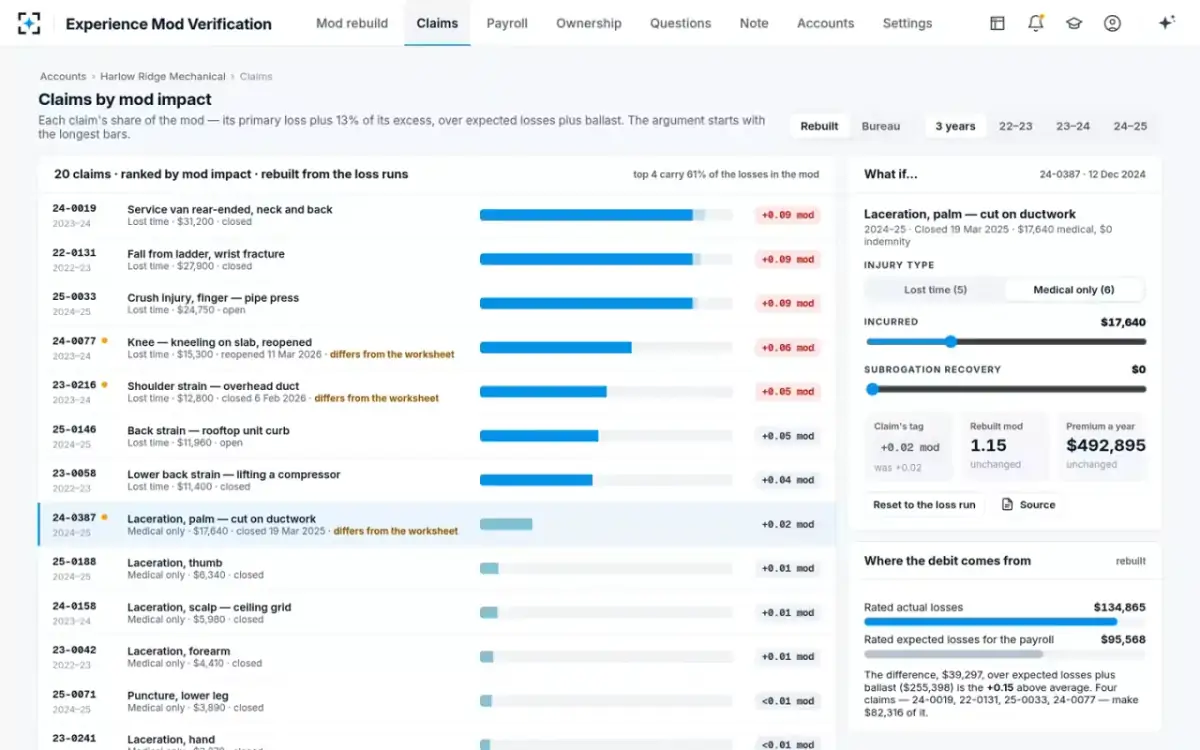
Most debits are earned, and a review should say so as plainly as it reports an error. The worksheet itself carries the clues to which kind a debit is, before any loss run is opened. On the sample account, four lost-time claims, a van crash, a fall from a ladder, a crush injury and a knee, carry 61% of the losses in the mod and tie to the loss runs: that part of the debit is real. The other 0.07 came from inputs.
Six signs on a worksheet, what each usually means, and what to check
| What the worksheet shows | Likely cause | What settles it |
|---|---|---|
| One or two large lost-time claims drive the debit | Real losses; a small employer’s mod moves most on claim count | Days lost and indemnity paid on the loss run |
| Small claims coded lost time | Coding: medical-only claims losing their 70% reduction | Indemnity paid and days lost for each |
| A closed claim still at a round reserve figure | Timing: the worksheet used an earlier report | The loss run’s closed value and both valuation dates |
| The mod jumped after an acquisition or a new entity | Ownership: experience combined or carried over | The ownership filings and any ERM-14 on record with the bureau |
| Expected losses fell though the workforce did not | Payroll in a lower-rated class | The final and any revised audit, class by class |
| The mod rose with no new claims | A good year left the period, or old claims developed | Which policy year dropped out, and each claim’s value year on year |
The last row catches more renewals than any other. Because each rating drops the oldest policy year and adds the newest, a mod can rise in a year with no new claims at all: a clean year leaves, or a claim from the middle year develops at its second report. Before anyone suspects an error, compare the three years on this worksheet with the three on last year's.
Can an error raise your experience mod, and can you get the money back?
Yes to both, within limits the plan sets. Errors that raise a mod are usually in the inputs: a medical-only claim coded as lost time, a reserve carried at its first-report value after the claim closed lower, a claim that belongs to another employer, payroll in a class with a lower expected loss rate than the work done, or an ownership change that pulled in someone else's losses. The plan's rule for medical-only claims shows why coding matters so much: it cuts both the primary and the excess part of each such claim by 70% (experience mod calculation).
The money comes back when the mod is revised, and the direction of the change decides from when. A decrease for any reason other than a classification correction runs back to the start of the policy, or to the rating date if that is later. But only three ratings can move: the plan limits revisions to the current mod and the two before it (the experience mod review guide sets out the four revision rules), with exceptions only for special fund reimbursements and subrogation recoveries. An error found in the fourth year is a refund nobody can issue.
Late revisions cut both ways. Increases follow a 60-day rule: an increase within 60 days of the policy's start applies from inception, and a later one only pro rata from the date the insurer endorses the policy. In a 1996 precedential California decision, retroactive mods led to this: "Appellant's insurer sued it for more than $54,000 in back premiums as the result of the retroactive experience modifications" (Kevin D. Woody Landscape Maintenance, California Department of Insurance). In California, an employer that disputes a mod files a Complaint and Request for Action, and has 30 days from a written decision to appeal to the Department (form CDI-002).
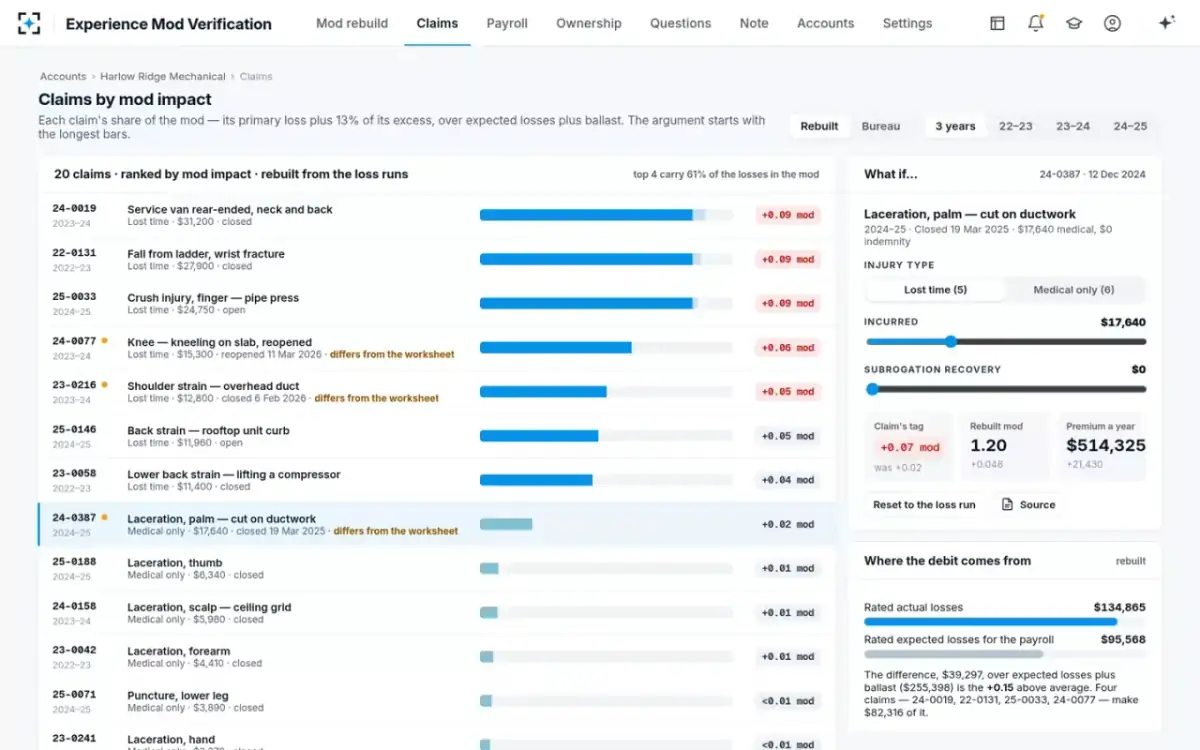
Testing the claim before arguing about it: the what-if on one sample claim
How to lower an EMR without hiding claims
Lower it by making the inputs right and the losses smaller, never by keeping claims off the books. The plan was redesigned in 1998 against exactly that temptation: medical-only claims count at 30% so that employers have no reason to leave small medical claims unreported, as a Casualty Actuarial Society paper by an NCCI actuary (Evans, 2014). Paying claims privately to protect a mod keeps them out of the data the plan is built on, the opposite of what the 1998 change was for.
Seven legitimate ways to bring an EMR down
- Check the coding of every claim against what was paid
A claim with no wage benefits and no days lost should be medical only, counted at 30% in NCCI states.
- Check each claim’s value against the latest loss run
A closed claim still carried at its reserve will fall at the next report; know which rating it reaches.
- Check payroll by class against the final and revised audits
Payroll in a lower-rated class understates expected losses and raises the mod.
- Report ownership changes within 90 days
Experience follows ownership. An acquisition can bring losses in, a sale can take them out, and late reporting may be treated as evasion.
- Pursue subrogation where a third party caused the injury
A recovery reduces the loss value once the insurer files a correction report.
- Bring injured workers back to suitable work
Fewer days lost means lower indemnity; where no wage benefit is owed, the claim stays medical only.
- Prevent the next claim
Each policy year counts for three ratings, so a better year shows for three years too.
Return to work is the lever with the most practical detail behind it, from the job offer to the doctor's restrictions; the sample claim returned to light duty the next shift. A modified duty job description template covers how that offer is written. On prevention, the research is encouraging but measured: a systematic review found moderate evidence that stronger experience rating reduces injuries (Tompa and colleagues, Scandinavian Journal of Work, Environment and Health, 2007).
Catching the error before the quote
The cheapest correction is the one made before a quote is priced on the wrong mod. Botminds' Experience Mod Verification reads the bureau's worksheet, the prior carriers' loss runs, the audits and the ownership filings, rebuilds the mod beside the bureau's, and prices each difference: on the sample account it found the miscoded claim (−0.05), the stale reserve (−0.04), a reopened claim that ran against the employer (+0.03), and installer payroll in a sales class (−0.01), and drafted the correction requests. The underwriter quotes on the bureau's 1.22 with a condition that the policy will be endorsed if the bureau revises it, and tells the broker to expect 1.15.
It does not file corrections or change the bureau's mod; only the reporting insurer and the bureau can. What it changes is that the question is asked in the first year of the error, inside the revision window, not in the fourth. How those questions are drafted and to whom they go is set out in the experience mod review guide.
Claims ranked by how far each moves the mod, with the ones that differ from the worksheet marked
Questions people ask
What is a good EMR?
Below 1.00 is a credit and 1.00 is average for the employer's classes and payroll. There is no universal threshold beyond that; owners who screen contractors often treat 1.00 as the line, which Virginia prohibits as a bid requirement on construction contracts. A good EMR is also an accurate one: a 0.95 built on a missing claim is a problem waiting for the next revision.
Does a medical-only claim affect my EMR?
Yes, but lightly in NCCI states: the plan reduces a medical-only claim's primary and excess losses by 70%, so it counts at 30% of its value. Washington instead deducts the lesser of $4,100 or the claim's cost. A medical-only claim miscoded as lost time loses that reduction and counts in full.
Can a claim be removed from my experience mod?
Only in narrow cases. NCCI's plan excludes claims reported as noncompensable or fraudulent, coal mine disease claims, and COVID-19 claims reported under Catastrophe Number 12 for accidents from 1 December 2019 to 30 June 2023. Otherwise "the rating organization does not exclude a loss from the experience of a risk regardless of whether the risk was responsible for the accident".
How fast does an EMR come down after a bad year?
One policy year leaves the experience period at each annual rating, so a bad year drops out after its third rating. A large employer's mod responds faster to good years than a small one's, because its own losses carry more weight. Correcting an error is faster: the bureau recalculates when the reporting insurer files the correction.
Can I get a refund if my mod was wrong?
Yes, if the mod is revised within the window: the bureau can revise the current and two preceding mods, and a decrease applies back to the start of each affected policy. The refund comes from the insurer that wrote that policy. After that window, an error generally stays.