A modified duty job description template is the document an employer uses to offer an injured worker temporary work within the doctor's restrictions: a job title, the essential tasks, hours, pay, location, start date and time, and a space for the treating doctor's approval. The template is the easy part. Offers fail when a single task contradicts the current restriction, because the doctor will not approve a job that asks a worker with "no kneeling" to kneel, and until the doctor approves, temporary total disability keeps running. Botminds' Workers' Compensation Claims Management is software for lost-time claims whose return-to-work agent tests every task of an employer's offer against every current restriction and drafts the revision; the adjuster or return-to-work coordinator decides what is sent.
The template below follows Georgia's rule, which names every attachment an offer needs, and is tested on one fictional sample claim: a warehouse maintenance technician recovering from knee surgery, offered an office job that turned out to need a ladder. The people and companies are invented; the rules are quoted from the State Board, the Florida and South Carolina codes and the EEOC.
One modified-duty offer, tested before it reached the doctor
6tasks
in the employer’s offer, each tested against four restrictions
2of 6
broke a restriction: kneeling at bottom racks and a fixed ladder
0of 6
conflicts after the revision, using the employer’s own equipment
$653.33
a week less indemnity once the worker starts the job
sample-claim estimate
What should a modified duty job offer include?
At minimum, what your state's suitable-employment rule requires, and in Georgia that is precise. Board Rule 240 requires the written offer, on Form WC-240, to attach "a description of the essential job duties to be performed, including the hours to be worked, the rate of payment, and a description of the essential tasks to be performed", "the written approval of the authorized treating physician(s) of the essential job duties", and "the location of the job, with the date and time that the employee is to report to work" (Rule 240(b)(3)). The form itself has boxes for the title, essential duties, rate of pay, location, hours and days, and the date and time to report (Form WC-240).
What a doctor needs on top is the physical demand of each task, and Georgia's Board publishes an optional form for exactly that. Form WC-240a, the Job Analysis, which "may" be used with a WC-240 "to provide a detailed job description" (Rule 61(b)(37)), grades lifting, carrying and pushing by weight and by frequency, from "Occasional (up to 1/3 of the time)" to "Constant (over 2/3 of the time)", and lists postures from sitting and standing to kneeling, squatting, crawling and climbing. It ends with a section for the treating physician: release to the job, no release, or release "with the following restrictions/limitations/modifications" (Form WC-240a).
That structure is the point. "Inventory control clerk, cold-dock office" tells a surgeon nothing. "Kneel to scan bottom-rack labels, about 10 times a shift" tells her everything. A template that asks for tasks one per line, each with its frequency and its posture, lift and duration, is the difference between an approval at the next visit and a rejection that costs another week of benefits.
A modified duty job description template, field by field
The template is short. Each field earns its place by answering a question the doctor, the adjuster or the Board will ask. The right-hand column shows the revised job from the sample claim, the version the doctor approved.
A modified duty job description template, with the reason for each field
| Field | What to write | Why it is there | Sample claim (revised job) |
|---|---|---|---|
| Job title and place | Title, department, site and the person the worker reports to | Georgia’s WC-240 asks for the title and the location of the job | Inventory control clerk, cold-dock office, Garden City |
| Essential tasks | One task per line, with how often it is done in a shift | The rule requires “a description of the essential tasks to be performed” | Six tasks, from reconciling pallet counts to scanning bottom racks |
| Physical demand of each task | Posture, lift in pounds, standing or walking time, climbing | Lets the doctor match each task to each restriction | Scan bottom racks standing, with a pole-mounted scanner; no ladder |
| Equipment and help provided | The employer’s own tools, stools, carts and co-workers that make a task fit | Turns a conflict into a fit without changing the job | Pole scanner (asset T-2214); stool at the label station; dock lead brings stock down |
| Hours, days and pay | Hours a week, shift, hourly rate | Required on the WC-240; sets any partial disability benefit | 40 hours a week at $24.50 an hour, $980 a week |
| Report date and time | The first shift, with a time | Georgia counts its ten days back from this date | Monday 26 October, 07:00 |
| Restrictions tested against | The work-status note’s date and its review date | An approval is only as current as the note it rests on | Note of 5 October; review 19 October |
| Doctor’s answer | Approved as written, approved with changes, or not approved, signed and dated | Rule 240 requires the treating doctor’s written approval | “Approved. Employee may perform this job within the restrictions of 5 Oct.” |
Modified duty vs light duty: one job or two?
For the doctor and the Board the label matters less than the tasks. The EEOC notes that "light duty" has "a number of different meanings in the employment setting": excusing an employee from the functions an impairment prevents, positions "created specifically for the purpose of providing alternative work", or any position that is "sedentary or is less physically or mentally demanding" (EEOC). "Modified duty" has no separate definition in that guidance, and employers use both terms for the same range of arrangements.
The sample claim shows why the distinction is thin. The employer offered a different job, an inventory clerk's, rather than the worker's maintenance role. The fix was not a new job but two modified tasks inside it: a pole-mounted scanner instead of kneeling, and stock brought down by the dock lead instead of a ladder. Same title, hours, pay and start date. Whatever a template calls itself, it should be written at the level of tasks, because that is the level at which doctors approve and refuse.
Can an employer offer light duty only to workers hurt on the job?
Yes, in most cases, and the EEOC says so directly. An employer "may recognize a special obligation arising out of the employment relationship to create a light duty position for an employee when s/he has been injured while performing work for the employer", and the policy does not on its face discriminate. The limit is that "an employer may not use disability as a reason to refuse to create a light duty position when an employee is occupationally injured" (EEOC guidance, question 27).
Two further points from the same guidance shape a light-duty programme. If an employer reserves vacant light-duty positions for occupational injuries, it must still consider reassigning an employee with a disability who was not hurt at work to a vacant one, as a reasonable accommodation, unless that would impose an undue hardship (question 28). And an employer that offers only temporary light duty need only provide a temporary position for a worker with a disability-related occupational injury (question 29). A template that states the expected duration of the modified job answers that question before it is asked.
One task can sink the offer
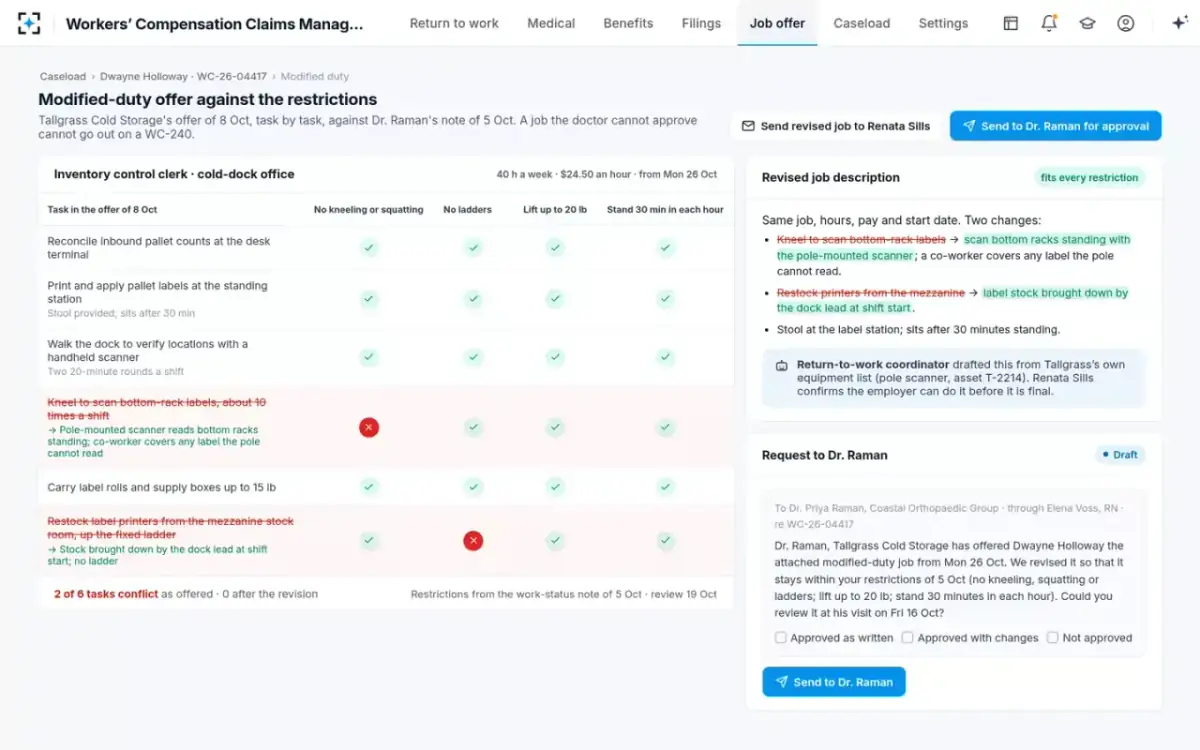
In the sample claim, the employer's offer of 8 October was reasonable on its face: an office job at the same warehouse, 40 hours, $24.50 an hour. Tested task by task against Dr. Raman's note of 5 October ("No kneeling, squatting or climbing ladders. Lift up to 20 lb. Stand no more than 30 minutes in each hour."), four tasks fitted and two did not. Sent unchanged, the offer would have reached a doctor who could not approve it, and the start date would have moved with every round trip.
The offer of 8 October against the note of 5 October, task by task
Task as offered: Reconcile inbound pallet counts at the desk terminal.
Tested against the four restrictions: Fits all four restrictions.
Task as offered: Print and apply pallet labels at the standing station; stool provided.
Tested against the four restrictions: Fits: the stool keeps standing under 30 minutes in each hour.
Task as offered: Walk the dock to verify locations with a handheld scanner, two 20-minute rounds a shift.
Tested against the four restrictions: Fits all four restrictions.
Task as offered: Kneel to scan bottom-rack labels, about 10 times a shift.
Tested against the four restrictions: Breaks “no kneeling”. Revised: scan standing with the pole-mounted scanner; a co-worker covers any label the pole cannot read.
Task as offered: Carry label rolls and supply boxes up to 15 lb.
Tested against the four restrictions: Fits the 20 lb limit.
Task as offered: Restock label printers from the mezzanine stock room, up the fixed ladder.
Tested against the four restrictions: Breaks “no ladders”. Revised: label stock brought down by the dock lead at shift start.
The offer as a grid: six tasks, four restrictions, two red marks
The revision did not invent anything. The pole-mounted scanner was already on the employer's equipment list, and the dock lead was already on the floor at shift start. That is the second rule of a good template: ask for the equipment and help the employer can provide, because the cheapest fix for a conflicting task is usually something the employer already owns.
Who approves a modified duty job?
The treating doctor approves it medically; in a dispute, the state decides whether it was suitable. In Georgia the job must be "approved by his/her authorized treating physician(s) after an examination within the last 60 days", and the employer must give the worker and counsel "a copy of any job description/analysis at the time of submission to the authorized treating physician(s)" (Claims Adjuster Reference). The Form WC-240 certificate repeats both conditions and adds that the offer is made "in good faith no later than ten days prior to the date the employee is expected to report for work" (Form WC-240).
Other states put the final word elsewhere. South Carolina's statute speaks of employment "suitable to his capacity and approved by the commission" (S.C. Code § 42-9-190). In Florida, a refusal bars compensation "unless at any time in the opinion of the judge of compensation claims such refusal is justifiable" (Fla. Stat. § 440.15(6)). A template that records who approved the job, on what date and against which note travels well across all three. Georgia's full sequence, from the doctor's approval to the first day back, is set out in the Georgia workers compensation 240 process.
What happens if a worker refuses light duty?
Benefits can stop, but only if the offer followed the rules, and the rules protect a worker who tries the job and cannot do it. In Georgia, if the worker "unjustifiably" refuses a suitable job offered on a proper WC-240, or attempts it "for less than eight cumulative hours or one scheduled work day, whichever is greater", the employer or insurer may suspend income benefits from the scheduled start date. If the worker attempts the job but cannot continue for fifteen scheduled work days, benefits "shall immediately be reinstated" (Form WC-240).
South Carolina's statute says a worker who refuses suitable employment "shall not be entitled to any compensation at any time during the continuance of such refusal" (§ 42-9-190), and during its 150-day payment window an employer may suspend payments when the doctor has released the worker to limited duty and the employer "provides limited duty work consistent with the terms upon which the employee has been released" (§ 42-9-260(B)(5)). Florida's rule is in the same terms, subject to the judge's view of whether the refusal was justified. In each state the dispute turns on the same words: whether the job was suitable to the worker's capacity. A worker who has questions about an offer can contact the state agency named on the form; the Georgia form gives the State Board's numbers.
The agent that checks offers, step by step
In Botminds' solution, checking an offer is one agent's job, set between people who make every decision. The return-to-work coordinator agent splits the offer into tasks, tests each against every current restriction, and drafts a revised job and a request to the treating doctor. It never contacts the worker, sends nothing itself, and deals with a represented worker only through the attorney.
From an employer's offer to a job the doctor can sign
Agent
Intake readerFiles the employer’s modified-duty offer to the claim the day it arrives.
Never: decides compensability
Agent
Return-to-work coordinatorSplits the offer into tasks and tests each against the current restrictions, quoting the doctor’s note.
Never: contacts the worker
Agent
Return-to-work coordinatorDrafts a revised job from the employer’s own equipment and staffing, and the request to the doctor.
Never: sends anything itself
A person decides
Employer contactConfirms the revised tasks can be done before the draft is final.
A person decides
Adjuster or return-to-work coordinatorDecides what goes to the doctor, and sends it through the nurse case manager.
A person decides
Treating doctor and nurse case managerThe doctor answers; the nurse records the answer word for word.
Agent
State filing drafterDrafts the state’s suitable-employment form and holds it until the approval is on file.
Never: files without the adjuster’s signature
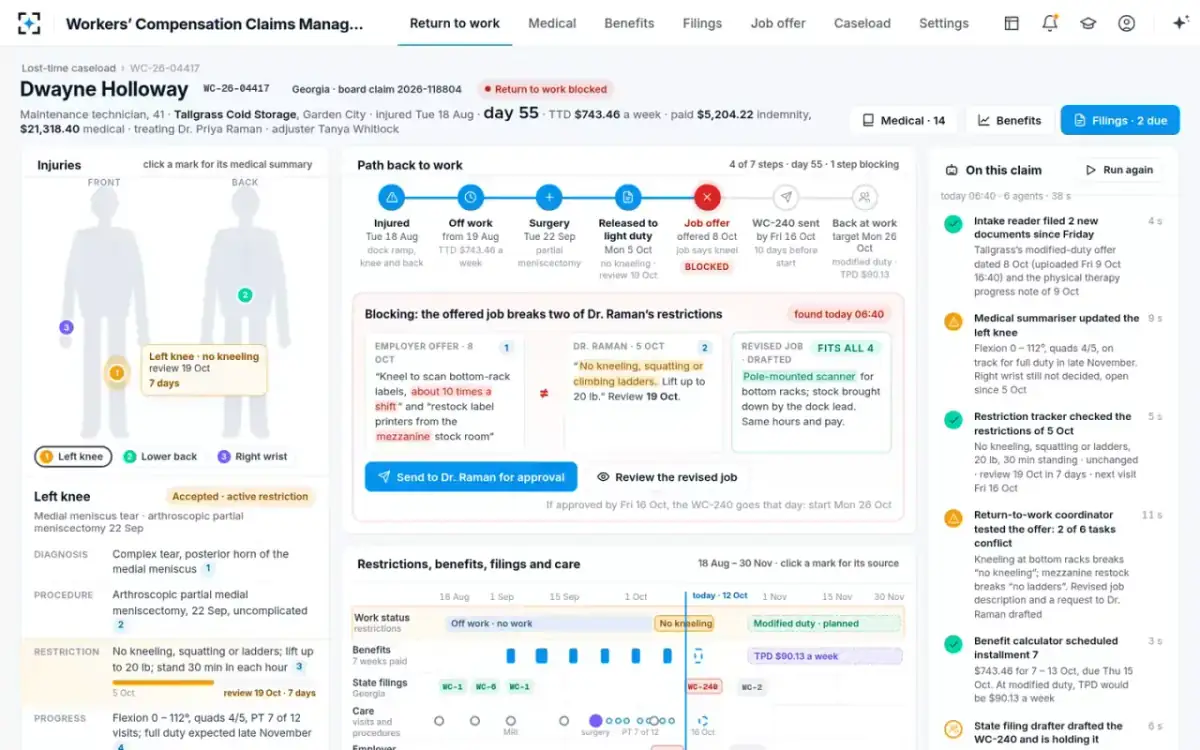
The blocking step, named on the claim's first screen
Buying software that checks modified-duty offers: what to look for
The test of any tool is whether it catches the task that breaks the restriction before the doctor does. Several kinds of product claim to help with return to work: job-description libraries, physical-demand databases, case-management systems and claims platforms. They answer different questions. Ask each to run on one of your own rejected offers and see whether it finds what the doctor found.
Questions to put to any tool that checks modified-duty offers
- Does it test every task against every current restriction?
Not the job title against a diagnosis. The sample offer passed at the job level and failed on two tasks.
- Does it read the restriction from the doctor’s note itself?
With the note date and the review date, quoted rather than retyped, so an expired restriction is never applied.
- Does it propose fixes from the employer’s own equipment?
A revision the employer cannot staff or equip will not survive the first shift.
- Who sends, and who is contacted?
The tool should draft; a named person should send. Nothing should reach a represented worker except through the attorney.
- Does it keep the dates your state counts?
In Georgia: the doctor’s examination within 60 days, the copy of the job description at submission, and ten days before the start.
- Does it hold the state form until the approval is on file?
Georgia’s WC-240 certifies that the doctor has approved the duties; a form sent before the approval cannot make that certificate true.
- Can you see its working?
Each conflict should cite the task line and the restriction sentence, so an adjuster or a judge can check it.
Where the solution fits, and where it stops
The return-to-work agent does one narrow thing well: it reads the offer and the restrictions side by side and drafts. It does not decide that a job is suitable; the doctor approves the job and, in a dispute, the state decides. It depends on the employer describing the tasks honestly and listing its equipment, and it cannot see a task the offer leaves out. In the sample setup, checking every offer before it reaches the doctor is a setting, and revised job descriptions can be sent only by the adjuster or the return-to-work coordinator.
The setting matters because the saving is time, and time on a lost-time claim is money. On the sample claim, a job the doctor approved on 12 October allowed a start on 26 October and cut weekly indemnity from $743.46 to $90.13, about $3,267 over five weeks on the sample claim's own estimate. How the partial benefit is calculated from the average weekly wage is covered in how to calculate average weekly wage in workers compensation. The person who usually carries the job to the doctor is the subject of the nurse case manager's seat. To see the offer screen on the full sample claim, start from Workers' Compensation Claims Management.
Questions people ask
Do I have to accept light duty at a lower wage?
In Georgia a suitable job can pay less than the pre-injury wage, and temporary partial disability then makes up two thirds of the difference, up to a weekly maximum of $533 for accidents on or after 1 July 2023, according to the State Board's Form WC-2. On the sample claim, a $980 job against a $1,115.19 average weekly wage gives $90.13 a week of partial benefits.
How long can modified duty last?
As long as the employer offers it and the restrictions require it, within the state's limits on partial benefits. The EEOC says an employer may decide its light-duty positions are temporary, and Georgia's Form WC-2 caps temporary partial disability at 350 weeks from the date of accident.
Does a modified duty offer have to be in writing?
In Georgia, yes, if the employer wants to suspend benefits on a refusal: Rule 240 covers employment "offered to the employee in writing", on a Form WC-240 with the job description and the doctor's approval attached. A verbal offer may still get a worker back, but it does not support a suspension.
Can the employer change the job after the doctor approves it?
The doctor's approval covers the essential duties described on the page. A job whose tasks change is no longer the job the doctor approved, so a changed job needs a fresh approval before it can support a Georgia WC-240.
Who writes the modified duty job description?
The employer, because it owns the job, the equipment and the schedule. A nurse case manager may help in Georgia only "as consistent with" the suitable-employment statute and Rule 240, and a return-to-work coordinator, or software, can test and redraft it, but the employer has to confirm it can provide every task as written.