A workers comp late payment penalty is an amount the state adds to an income benefit that is not paid when due, paid to the injured worker on top of the benefit itself. In Georgia it is 15% of the benefits paid late, with no grace period, and 20% when an award goes unpaid for 20 days; in Florida it is 20% of an installment more than seven days late, plus 12% a year in interest; in South Carolina 10% after fourteen days; in Alabama 15% after thirty. Lost-time claims run on many such clocks at once, and an adjuster who keeps them by diary is relying on the diary being opened on the right day. Botminds' Workers' Compensation Claims Management is software in which agents schedule every installment against its state's clock and draft it for approval days before it is due, while the adjuster approves each payment.
The penalty is only the visible cost of lateness. Research on more than 950,000 lost-time claims uses a delay in the first indemnity payment to study what drives attorney involvement, and finds that involvement substantially increases indemnity. This guide prices both, on the rules of four Southeastern states and on one fictional sample claim with a weekly benefit of $743.46.
What one late week of $743.46 adds, by state
$111.52
Georgia: 15% when not paid when due
$148.69
Florida: 20% once more than 7 days late, plus interest
$74.35
South Carolina: 10% once more than 14 days late
$111.52
Alabama: 15% once more than 30 days late without good cause
What is the penalty for late workers comp payments?
A fixed percentage of the late benefit, set by each state's statute, paid to the worker in addition to the benefit. Georgia's Board puts it in one line: "If income benefits due without an award are not paid when due, a 15% penalty must be paid at the same time. The penalty is in addition to the accrued benefits" (Claims Adjuster Reference). The Board's form for injured workers says the same in plain words: "If income benefits are paid late, the employer/insurer will pay you a 15% penalty on all accrued benefits. If benefits are paid late after an award has been issued, the employer/insurer will pay you a 20% penalty" (Form WC-2). The 20% applies when an award is not paid "within 20 days of the date of an award", unless a timely appeal is filed (Supervisor's Manual).
Florida's penalty is larger and comes with interest. An installment payable without an award that "is not paid within 7 days after it becomes due" carries "a penalty of an amount equal to 20 percent of the unpaid installment", and every late installment also carries "interest thereon at the rate of 12 percent per year", with a $5 minimum (Fla. Stat. § 440.20(6) and (8)). South Carolina adds "an amount equal to ten per cent" to an installment "not paid within fourteen days after it becomes due" (§ 42-9-90). Alabama's Workers' Compensation Division states that an installment "not paid without good cause within 30 days after it becomes due" carries 15% (Alabama claim handling manual).
Four states' rules for a late income benefit
| State | First payment due | Then | Penalty on a late installment | Paid to |
|---|---|---|---|---|
| Georgia | 21st day after the employer knew of the injury | Weekly | 15% when not paid when due; 20% if an award is unpaid after 20 days | The worker |
| Florida | 14th day after the employer was notified, when disability lasts 8 days or more | Every two weeks | 20% after 7 days late, plus 12% a year interest; fines to a state fund below a 95% on-time rate | The worker (fines to the state) |
| South Carolina | 14th day after the employer knew, under an approved agreement | Weekly | 10% after 14 days late; 25% for breaking the rules on starting and stopping payments | The worker |
| Alabama | Not stated in the manual; paid at the intervals wages were paid | As wages were paid | 15% after 30 days late without good cause | The worker |
How many days does an insurer have to pay workers comp?
Two to three weeks for the first payment in these states, then a weekly or biweekly rhythm. Georgia counts from the employer's knowledge: "The first payment of income benefits is due on the 21st day after the employer has knowledge of the injury or death, on which day all income benefits then due shall be paid. Thereafter, income benefits shall be due and payable in weekly installments" (Claims Adjuster Reference). Notice to the employer is notice to the insurer, so a first report that sits on a supervisor's desk for a week has already spent a third of the clock.
Florida's first installment is due "no later than the 14th calendar day after the employer receives notification of the injury or death, when disability is immediate and continuous for 8 calendar days or more", and later installments every two weeks (§ 440.20(2)(a)). South Carolina's first installment under an agreement "is due on the fourteenth day after the employer has knowledge of the injury or death", then weekly, on the same day of each week (§ 42-9-230). The grace before each state's penalty then runs from those due dates.
How long an installment can be late before each state adds its penalty
- Penalty applies from the day after the due date15%
- Interest only7 d
- Penalty and interest20% + 12% a year
- No penalty yet14 d
- Penalty10%
- No penalty yet30 d
- Penalty15%
One late installment, priced in four states
On the sample claim the weekly benefit is $743.46, and installment 7, for 7 to 13 October, is due on Thursday 15 October. Paid on Friday 16 October in Georgia, it costs an extra $111.52 the same day. Paid a week late in Florida, it costs the 12% interest for those days, about $1.71, but the $5 minimum applies; paid eight days late it adds $148.69 of penalty as well. The same lateness in South Carolina or Alabama costs nothing until the fourteenth or thirtieth day.
The penalty on one $743.46 installment, once each state's grace has passed
The per-installment figures look small, and per installment they are. The cost is in the count. A desk with 71 lost-time claims, the sample caseload's size, has dozens of installments due every week. If one a week slips by a single day in Georgia, the 15% at the sample claim's rate adds $111.52 a week, about $5,800 a year, before any attorney is involved. That is our arithmetic on the sample figures, not a measured result, and the right number for any desk is its own late-installment count multiplied by its own average benefit.
What if my workers comp check is late?
The law expects the penalty to be paid with the late benefit, without the worker having to ask. Georgia's form tells workers that the employer or insurer "will pay you a 15% penalty on all accrued benefits" when income benefits are paid late, and the Board's rules require the penalty to be shown "as a separate item" on the payment form (Rule 221(e)). A worker who believes a payment is late or wrong can contact the State Board; its numbers are printed on every Board form.
Payment counts from when it is sent, not when it arrives, in some states. In Georgia a cheque mailed from inside the state is on time if mailed by the due date; one mailed from outside Georgia must go "no later than three (3) days prior to the due date", and an electronic payment counts when "the payer initiates an ACH electronic funds transfer" (Claims Adjuster Reference). In Florida, money sent by direct deposit or prepaid card "is considered paid on the date the funds become available for withdrawal by the employee" (§ 440.20(1)(a)).
Who pays the late payment penalty?
The party responsible for paying the benefit, which on an insured claim is the insurer, though some states let the regulator assess it against the employer when the employer caused the delay. Florida's statute says the department "may assess without a hearing the penalty against either the employer or the carrier, depending upon who was at fault in causing the delay", and that the insurance policy cannot shift to the carrier a penalty the state has placed on the employer. It also bars recovery through pricing: "No penalty assessed under this section may be recouped by any carrier or self-insurer in the rate base, the premium, or any rate filing" (§ 440.20(6)(a) and (16)).
Florida also fines carriers for their on-time rate as a whole. Below a 95% timely-payment standard, the carrier pays the state's Workers' Compensation Administration Trust Fund $50 for each installment below the standard, and $100 for each installment below 90% (§ 440.20(8)(b)). That turns timeliness from a claim-by-claim question into a measured performance figure, and it is the figure a Florida claims leader should be watching.
Does a late payment make workers hire lawyers?
The research suggests that delay and representation travel together, and that representation is expensive. In a 2024 NBER working paper, since published in the Journal of Risk and Insurance, using more than 950,000 claims "with more than seven days of lost time", Bogdan Savych and David Neumark estimate the causal effect of attorney involvement on indemnity. One of their two instruments for involvement is "a delay in the first indemnity payment", and they conclude that "attorney involvement substantially increases total indemnity benefits paid to workers" (NBER w33210).
The same authors wrote the companion study for the Workers Compensation Research Institute, a non-profit whose funders include insurers and employers, drawing on its database of workers injured from October 2012 to September 2019 in 31 states, which "represent over 80 percent of the benefits paid in 2017" (WCRI). Neither source says a late cheque causes a worker to hire a lawyer. What the design does tell a claims leader is that a delayed first payment and a represented claim are linked closely enough to serve as a statistical lever, and that the represented claim costs more. In Georgia, a claim not controverted within 21 days "may result in a 15% penalty on benefits accrued and payment of attorney’s fees" as well (Supervisor's Manual).
Medical bills run on a separate penalty clock
Income benefits are not the only payments with a penalty. Georgia gives an insurer 30 days from receiving a medical bill and its reports, then adds penalties automatically: "A 10% penalty on reasonable medical charges paid after 30 days but before 60 days; a 20% penalty on reasonable medical charges paid after 60 days but before 90 days; and, in addition to the 20% penalty, a 12% per annum interest rate is charged on reasonable medical charges paid after 90 days", payable to the provider. Mileage claims are due within 15 days (Claims Adjuster Reference).
Florida requires bills to be paid within 45 calendar days and fines carriers below a 95% timely standard for medical bills too, $25 a bill and $50 below 90% (§ 440.20(6)(b)). South Carolina gives 30 days from the provider's request for payment (§ 42-9-360(D)). A desk that watches only the indemnity clock will still pay penalties, to providers instead of workers.
Why diaries miss installments, and what replaces them
A diary entry is a date with no document behind it. It cannot see that the claim's first report reached the insurer eight days after the employer knew, that the worker's return to work changed the benefit type, or that a new wage statement changed the rate. Each of those moves a due date or an amount, and each arrives as a document. The fix is to set every clock from the documents themselves and to have the payment drafted before it is due, not remembered on the day.
A caseload sorted by the next state deadline, not by claim number
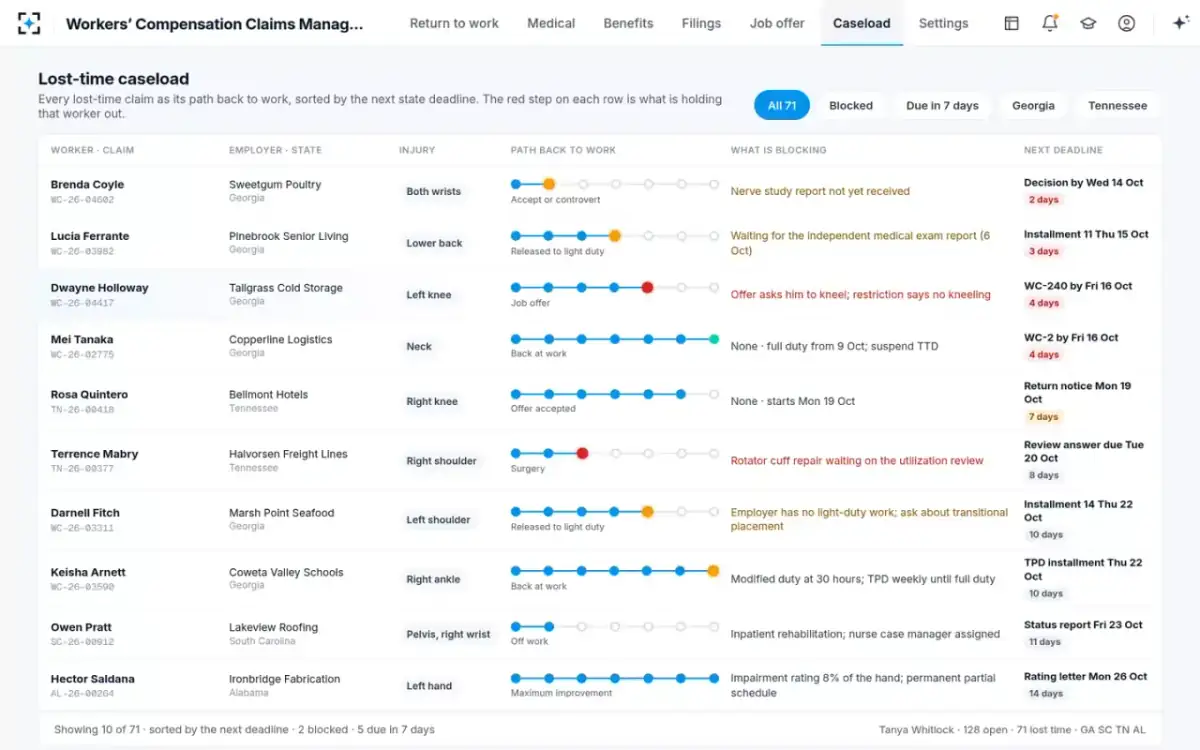
In Botminds' solution the benefit calculator schedules each installment against the state clock, and the drafts are ready a set number of business days before they are due. A setting called the penalty guard refuses to let an installment be held within three days of its late date without a named reason. The adjuster still approves every payment; the agents never issue one.
The clocks are settings: alert lead time and the penalty guard
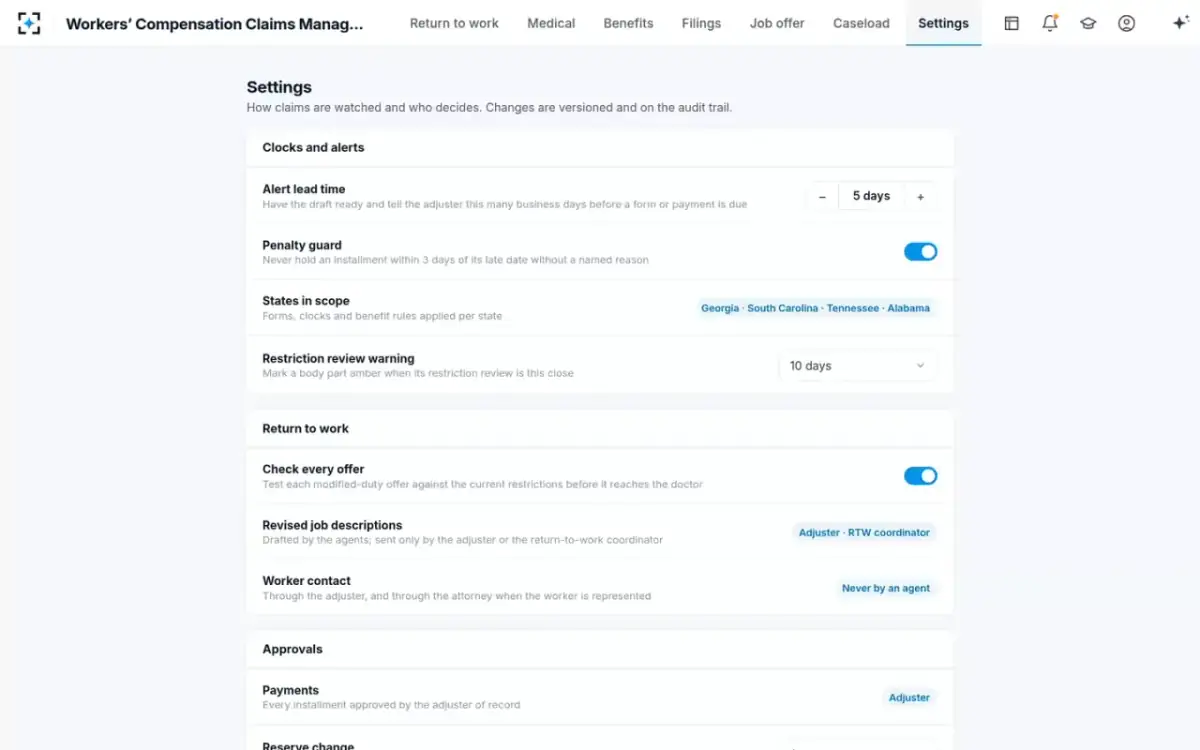
The design target is that every form and installment has a draft ready before its alert date. That is a target for the live system, not a measured result. Whether a claim is late at all depends on when its clocks started, which is where the lost time claim definition comes in; how the weekly amount itself is worked out is in how to calculate average weekly wage in workers compensation.
Pricing a late week for your own book
The cost of a late week is the statutory penalty plus whatever the delay does to the claim. The first part is arithmetic any desk can do from its own payment history; the second needs the desk's own data on what happens to claims after a late first payment. Neither should be estimated from someone else's book.
Six numbers to pull before you price late payments
- Installments paid late last year, by state
Count against each state’s own grace period: same day in Georgia, 7 days in Florida, 14 in South Carolina, 30 in Alabama.
- Penalties paid, as recorded
Georgia requires late-payment penalties to be shown as a separate item on the form and in the case progress report.
- Days from employer knowledge to first report
Every day here comes off the first-payment clock before the claim is opened.
- First payments made after their due date
The delay the research uses as a lever on attorney involvement.
- Represented claims among those late first payments
Compared with claims paid on time, on your own book.
- Medical bills paid after 30 or 45 days
Georgia’s 10%, 20% and interest; Florida’s 95% standard.
To see the sample claim's installments, the caseload and the settings together, start from Workers' Compensation Claims Management.
Questions people ask
Is there a grace period for workers comp payments in Georgia?
Not for the penalty. The State Board's manual says income benefits "not paid when due" carry a 15% penalty paid at the same time, and the first payment is due on the 21st day after the employer knew of the injury. A cheque mailed from outside Georgia must be mailed three days before the due date to count as on time.
Can the late payment penalty be excused?
In some cases. Georgia's statute, O.C.G.A. § 34-9-221(e), lets the Board excuse the 15% where the employer shows that conditions beyond its control stopped the payment, and the penalty does not run on benefits the employer has disputed in time with a notice to controvert. Florida's 20% "shall not apply for late payments resulting from conditions over which the employer or carrier had no control", South Carolina's 10% applies unless the commission excuses it on a similar showing, and Alabama's 15% applies only without good cause. The excuse has to be shown; it is not assumed.
Does interest apply on top of the penalty?
In Florida, yes: 12% a year from the due date on every late installment, whether or not an order exists, with a $5 minimum, in addition to any penalty. Georgia adds 12% a year on medical bills paid more than 90 days late, alongside the 20% penalty.
What happens if the insurer stops payments without notice?
The rules on stopping are as strict as the rules on starting. Georgia requires 10 days' advance notice to suspend for a change in condition unless the worker has actually returned to work, and South Carolina adds a 25% penalty on benefits withheld in breach of its rules on starting and stopping payments within the first 150 days.
Are penalties paid to the worker or to the state?
The percentage penalties on late benefits are paid to the worker in all four states covered here; Georgia's medical-bill penalties go to the provider. Florida also fines carriers whose on-time rate falls below 95%, and those fines go to the state's Workers' Compensation Administration Trust Fund.