A nurse case manager in workers comp is a registered nurse, or another credentialed professional, retained by the employer or insurer to coordinate an injured worker's medical care and carry information between the treating doctor, the adjuster and the employer. Her most valuable output is small: the restriction sentence in the doctor's note, read correctly, dated and put in front of the people who must act on it. The work is hard because the rules governing her contacts are strict and the clocks around her are short. Georgia, for example, requires consent before she works with the worker, ten days' notice before a private meeting with the doctor, and copies of what the doctor sends to every party. Botminds' Workers' Compensation Claims Management is software for lost-time claims in which agents read every medical record and draft the next step, while the nurse, the adjuster and the return-to-work coordinator decide and send.
This guide follows the seat through Georgia's rules, which spell it out in detail, and through one fictional sample claim: Dwayne Holloway, a maintenance technician who twisted his left knee at a cold-storage warehouse. The people, employer and claim are invented; the rules quoted are the State Board's own.
The numbers that fence a nurse case manager's seat in Georgia
8
credentials that qualify a medical case manager under Rule 200.2, from CRRN to CCM
10days
notice before a private meeting with the treating doctor
60days
the doctor must have examined the worker within, to approve a job
48hours
to appoint a supplier once a catastrophic injury is accepted
What does a nurse case manager do in workers comp?
She coordinates care and turns medical language into decisions other people can make. Georgia's Rule 200.2 describes the job as contacting the treating physician "for purposes of assessing, planning, implementing, and evaluating the options and services required to effect a cure or provide relief" (Rule 200.2(B)(2)). In practice that means four recurring tasks: reading each new work-status note, scheduling and following appointments, carrying questions to the doctor, and helping the employer's job description reach the doctor in a form the doctor can approve.
The rule is just as clear about what she does not do. "Nothing in this rule shall be construed to allow or promote utilization review on the part of the qualified medical case manager," it says, so she does not decide whether treatment is medically necessary. She does not accept or deny a body part either: compensability belongs to the adjuster. And she may help with job descriptions "only as consistent with O.C.G.A. § 34-9-240 and Board Rule 240", the suitable-employment route covered in our guide to the Georgia workers compensation 240 process.
The nurse case manager's seat: what comes in, what she does, what leaves
What reaches her
- Work-status notes and office notes from the authorized treating physician
- Therapy progress notes, imaging and operative reports
- The employer's modified-duty job description
- The adjuster's questions: is the worker improving, when is the next review?
What she does
- Obtains and records consent before working with the worker
- Gives notice before any private meeting with the doctor
- Carries the job description and the question to the doctor
- Records the doctor's answer, word for word, with its date
What leaves her desk
- The restriction, in the doctor's words, to the adjuster
- Work status and restrictions, not diagnoses, to the employer
- Copies of everything the doctor sent, to every party
- Appointment dates that drive the claim's next review
What is not hers
- Utilization review: barred by Rule 200.2(B)(4)
- Accepting or denying a body part: the adjuster's call
- Suspending benefits: the adjuster files, under Rule 240
Who does the nurse case manager work for, and who sees her letters?
She is retained and paid by the employer or its insurer, and her work is shared with everyone. Rule 200.2 lets employers and insurers "voluntarily utilize qualified medical case managers to provide telephonic or field medical case management services", at their expense. A case manager who works without the worker's consent must first give "all parties and attorneys of record written notification of being retained by the employer/insurer" before she contacts the treating physician.
The rule then makes her a conduit, not a private channel. She "shall provide copies of all medical records, medical reports, office notes, test results, and all other written documents received from the employee’s treating physician to all parties and their attorneys" (Rule 200.2(C)(2)). The Board's guidance adds that the injured worker or attorney receives "the substance of all oral communications with authorized physician(s)", though not her billing, and that a case manager employed directly by the employer, insurer or third-party administrator does not have to hand over her notes (Board best practices). That last point matters: the rule's notice and copy duties do not apply to a direct employee of the insurer or employer at all, "provided that their specific role is identified".
The employer's view is narrower again. Federal guidance on the Americans with Disabilities Act lets employers tell supervisors and managers "about necessary restrictions on the work or duties of the employee and about necessary accommodations" (EEOC). Diagnoses stay with the claim team. A nurse who tells the employer that the worker may not kneel until the 19 October review is giving it what it needs to build a job; a nurse who forwards the operative report is not.
Is a nurse case manager required in workers comp?
Usually not. In Georgia a medical case manager is optional in non-catastrophic claims: the rule says employers and insurers "may voluntarily" use one. Catastrophic claims are different. Once a catastrophic injury is accepted, the employer or insurer "shall appoint a registered catastrophic rehabilitation supplier within 48 hours of accepting the injury as compensable", by filing Form WC-R1 (Rule 200.1(II)(A)(1)). Either way the professional must hold one of eight credentials, including Certified Rehabilitation Registered Nurse, Certified Case Manager and Certified Occupational Health Nurse, and must be registered with the Board.
Other states set their own rules. The point for an adjuster is practical rather than legal: on a lost-time claim with surgery, therapy and a modified-duty offer, somebody has to read every note the day it arrives. If it is not the nurse, it is the adjuster, reading it between every other file on the desk.
Can a nurse case manager attend doctor appointments?
Yes, with the worker's written consent, and the worker keeps the right to see the doctor alone. Georgia's rule requires consent "in writing when attending any medical appointment", and the Board's guidance spells out the rest: "A patient is always entitled to a private medical exam with their physician without the presence of the medical case manager in the exam room." Consent can be withdrawn, and the worker must be told in writing that it may be refused (Rule 200.2(B)(1) and (3)).
A private meeting with the doctor, without the worker, is allowed without consent but not without notice. The Board's answer is unambiguous: "10 days notice is required for such a private medical meeting to include the day, time and location", sent to the worker, the attorney and the provider, and the worker or attorney cannot be excluded (SBWC FAQ). Exceptions exist for medical necessity or with the worker's consent. The table below sets out the combinations a Georgia case manager meets every week.
Consent, notice and copies: what each contact needs in Georgia
| Contact | Consent | Notice | Copies |
|---|---|---|---|
| Phone the injured worker | Verbal, from the worker or attorney, with a written follow-up that it can be withdrawn | Best practice: tell the worker or attorney as soon as she is involved | Substance of oral communications with the doctor, on request |
| Attend a medical appointment | Written | Not applicable | The worker keeps the right to a private examination |
| Write to or call the treating doctor | Not required | Written notice of being retained, before first contact, if working without consent | Every written document received from the doctor, to all parties |
| Private meeting with the doctor | Not required | Ten days, with day, time and place, to worker, attorney and provider | Worker and attorney may attend; they cannot be excluded |
| Present a job description | Not required | In person: ten days, with a copy of the job description | In writing: copies to all parties at the same time |
| Consult for the adjuster only | Not required | Not required | None, but no contact with the worker or the doctors |
Telephonic or field: two ways to run the seat
Rule 200.2 names both, and they differ mainly in what consent they need. Telephonic case management works by phone and paper: the nurse reads the notes, calls the worker with verbal consent, and writes to the doctor. Field case management puts her in the room, at appointments and on site, and needs written consent for every appointment she attends. The trade is detail against reach: in the room she hears what the doctor says aloud; on the phone she can follow more claims.
What does not change between the two is the paper trail. Whichever model a carrier uses, the rules require the same thing: what the doctor wrote reaches every party, and what the doctor said is recorded. Both kinds of nurse lose time in the same place, which is finding the one sentence in a two-page note that changes the claim.
One restriction sentence, three readers
The restriction sentence is the unit of the nurse's work, and each reader needs it in a different form. In the sample claim, Dr. Priya Raman's post-operative note of 5 October reads: "Return to work with restrictions: sedentary to light duty. No kneeling, squatting or climbing ladders. Lift up to 20 lb. Stand no more than 30 minutes in each hour." The adjuster needs it to decide whether temporary total disability continues. The employer needs it to build a job. The return-to-work coordinator needs it task by task.
The restriction sentence, highlighted where the doctor wrote it
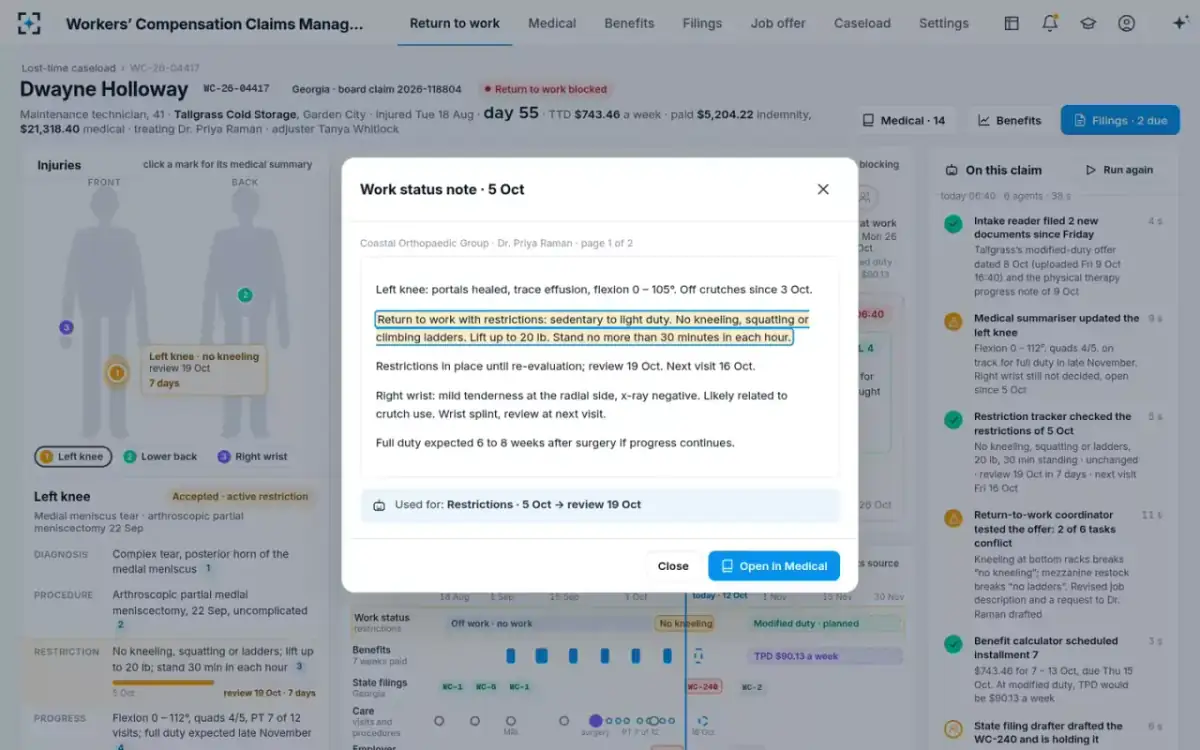
Three things go wrong with that sentence in a claim file kept by hand. It gets shortened to light duty, no kneeling and loses the ladder. It loses its review date, so a restriction that expired on 19 October is still applied in November. And it never reaches the employer's job description, which is how an offer that says "kneel to scan bottom-rack labels" goes to a doctor who has written "no kneeling". In the sample claim that is exactly what happened on 8 October.
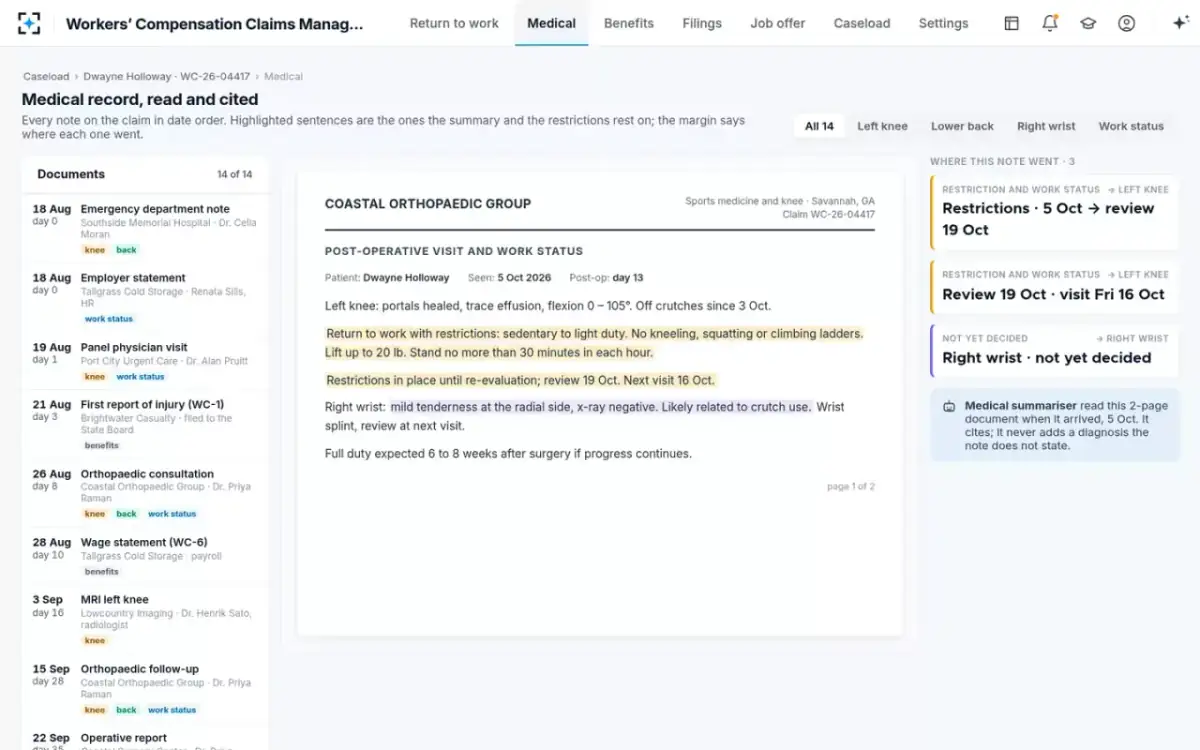
In Botminds' solution the medical summariser agent reads each note as it arrives and keeps a summary per body part, with every line citing its source. The restriction tracker records each restriction's start and review dates and quotes the doctor's words. Neither agent may change or extend a restriction, and a new body part, such as the right wrist that began to hurt from crutch use, is marked "not yet decided" for the adjuster.
All fourteen documents in date order, with the margin saying where each sentence went
How does a nurse case manager help return to work?
By getting a job the doctor can approve in front of the doctor before the review date passes. In Georgia the suitable-employment route needs the authorized treating physician's written approval of the job, given after an examination within the last 60 days, and the employer must copy any job description to the worker and counsel when it goes to the doctor. The offer itself, on Form WC-240, must reach the worker at least ten days before the return date; the full sequence is dated in the Georgia 240 process. The nurse is usually the person who carries the job to the doctor, so her calendar sets the earliest return date.
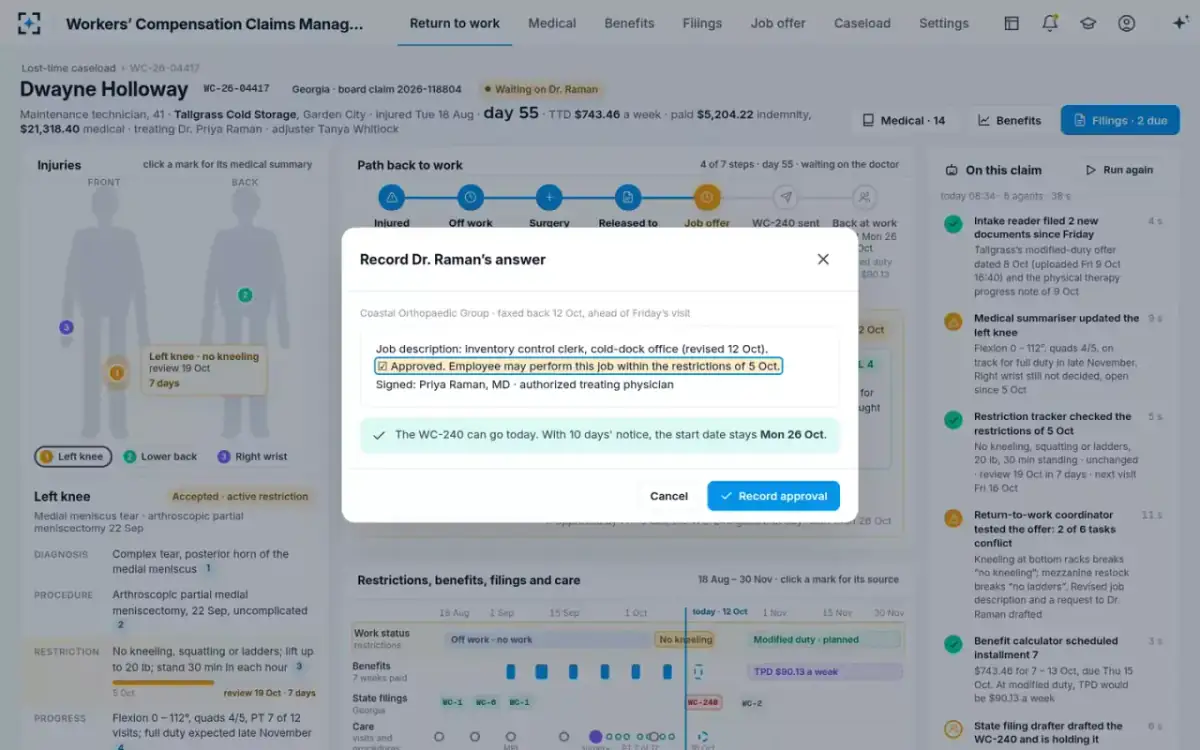
In the sample claim, the agents tested the employer's offer against the 5 October restrictions at 06:40 on Monday 12 October and found two of six tasks in conflict: kneeling at the bottom racks about ten times a shift, and restocking label printers from a mezzanine reached by a fixed ladder. The return-to-work coordinator agent drafted a revised job using the employer's own pole-mounted scanner, with the dock lead bringing stock down, and a request to Dr. Raman. The adjuster sent it to the doctor's office through Elena Voss, RN, the nurse case manager. The office faxed back an approval the same day, and Elena recorded it.
The doctor's answer, recorded by the nurse case manager
The arithmetic shows what the nurse's same-day answer was worth. The worker's average weekly wage on the sample claim is $1,115.19, so temporary total disability runs at $743.46 a week. In the modified job he earns $980, and temporary partial disability is two thirds of the $135.19 gap, $90.13 a week. If he starts on 26 October and reaches full duty around 30 November, the date the claim's what-if assumes, the indemnity paid over those five weeks falls by about $3,267. That is an estimate on the sample claim, not a measured result, but every input is a date or a dollar figure from the file.
The same 103 days off full duty, paid two ways
- Off work, temporary total68 d · $743.46 a week
- Modified duty, temporary partial35 d · $90.13 a week
- Off work, temporary total103 d · $743.46 a week
The same logic explains why the nurse's notice calendar matters. A private meeting needs ten days' notice; a written request with simultaneous copies does not. When the review date is a week away, writing to the doctor is often the only route that lands before it. For the job description itself, our guide to a modified duty job description template sets out the fields Georgia requires and how to test each task against the restrictions.
Where the nurse fits in Workers' Compensation Claims Management
In the solution the nurse case manager is a named person with her own view, and the agents work around her rather than through her. The agents read and draft; she carries requests to the treating doctor and records the doctor's answers. No agent contacts the worker: contact goes through the adjuster, and through the attorney when the worker is represented. The employer's contact sees work status and restrictions, never diagnoses, which is the line the ADA guidance draws.
Seven checks for a Georgia nurse case manager's file
- Consent recorded, with its form
Verbal consent to work with the worker, followed in writing; written consent for each appointment attended; the notice that consent may be refused.
- Retention notice sent before first doctor contact
Required when working without consent: written notice to all parties and attorneys of record.
- Ten days counted for every private meeting
Day, time and place to the worker, attorney and provider. A rescheduled appointment needs the notice to cover the new date.
- Copies sent promptly, to everyone
Every record, report, note and test result received from the treating doctor, to all parties and their attorneys.
- Restrictions quoted, not paraphrased
With the note date, the review date and the next visit, so nobody applies an expired restriction.
- Job description copied when it goes to the doctor
Rule 240 requires the copy to the worker and counsel at the time of submission, not later.
- The 60-day examination checked before a WC-240 is drafted
An approval from a doctor who last examined the worker more than 60 days earlier will not support the offer.
Where the medical work and the claim work meet is also where software categories blur. A buyer weighing nurse case management tools against claims systems will find the differences set out in our guide to workers compensation case management software. To see the sample claim screen by screen, start from Workers' Compensation Claims Management.
Questions people ask
Can I refuse a nurse case manager on my workers comp claim?
In a non-catastrophic Georgia claim, the case manager needs the worker's or attorney's consent to work with the worker, and that consent can be withdrawn. Refusing does not stop her contacting the treating doctor: Rule 200.2 says the worker's consent "shall not be required" for that, though she must first send written notice of being retained to all parties. Catastrophic claims follow Rule 200.1, where a rehabilitation supplier is appointed.
What is telephonic nurse case management?
It is case management done by phone and in writing rather than in person. Georgia's Rule 200.2 names "telephonic or field medical case management services" as the two forms. A telephonic nurse needs verbal consent to speak with the worker, followed by a written note that the consent can be withdrawn.
Does the nurse case manager have to share her notes with my attorney?
She must copy every written document she receives from the treating doctor to all parties and their attorneys, and the Board's guidance says the worker or attorney receives the substance of her oral communications with the doctor. A case manager employed directly by the employer, insurer or third-party administrator does not have to provide copies of her own notes, according to the same guidance.
What qualifications does a workers comp nurse case manager need in Georgia?
One of eight certifications or licences listed in Rule 200.2: CRC, CDMS, CRRN, WAVES, LPC, CCM, COHN or COHN-S, plus registration with the State Board. A registered nurse without one of those credentials does not qualify under the rule.
Can a nurse case manager decide whether treatment is necessary?
No. Rule 200.2(B)(4) says nothing in the rule allows "utilization review on the part of the qualified medical case manager". She can coordinate, schedule and ask questions; medical necessity disputes go through the Board's separate procedures.